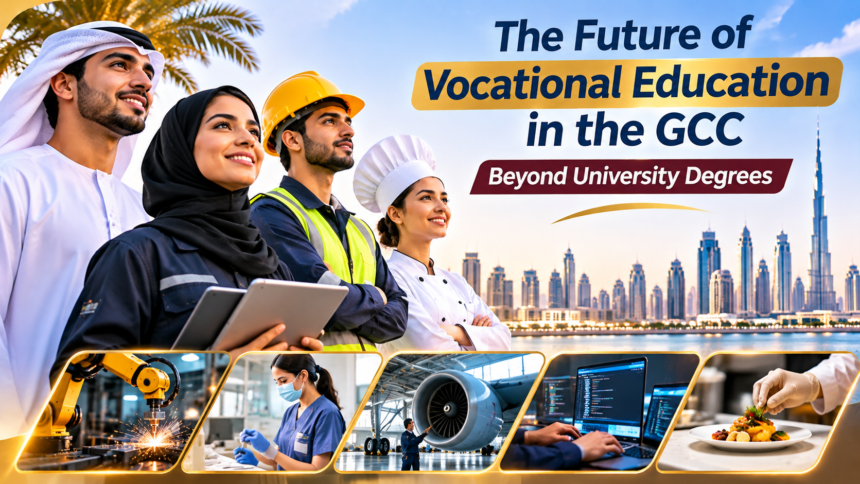
Building a Skills-First Education System for the GCC’s Future
For decades, university education has been viewed as one of the most reliable pathways to professional success across the Gulf Cooperation Council (GCC). Families have traditionally encouraged young people to pursue academic degrees, often associating university qualifications with career stability, social recognition, and long-term financial opportunities. However, changing labour market requirements, technological innovation, and economic diversification are encouraging a broader discussion about what successful education should look like.
- 1. Why Vocational Education Is Becoming Essential Across the GCC
- 2. How GCC Countries Are Expanding Technical and Vocational Training
- 3. University Degrees Versus Vocational Education: Understanding the Difference
- 4. The Future Industries Creating Demand for Skilled Technical Workers
- 5. How Apprenticeships and Industry Partnerships Can Improve Employment Outcomes
- 6. Overcoming the Challenges Facing Vocational Education in the GCC
- 7. The Future of Vocational Education in the GCC: A Skills-First Approach
Vocational education in the GCC is gaining strategic importance as governments and employers recognise the value of practical skills, technical qualifications, and industry-specific training. From advanced manufacturing and renewable energy to aviation maintenance, cybersecurity, hospitality, and healthcare support, many growing industries require workers who can combine technical understanding with hands-on experience.
This shift does not suggest that university degrees are becoming unnecessary. Instead, it highlights the need for education systems that offer multiple respected routes into employment. Technical colleges, apprenticeships, professional certifications, and workplace training can complement traditional academic pathways while responding more directly to evolving workforce demands.
As GCC countries pursue ambitious economic development strategies, the future of vocational education will depend on its ability to prepare learners for meaningful careers, support lifelong learning, and strengthen connections between education and industry.
1. Why Vocational Education Is Becoming Essential Across the GCC
The economic landscape of the Arabian Gulf has changed considerably over recent decades. While oil and gas remain economically important, GCC governments are investing in sectors such as tourism, logistics, digital technology, healthcare, manufacturing, and renewable energy.
These industries require a diverse workforce with different levels of education, practical experience, and specialised expertise.
Traditional universities play an essential role in preparing researchers, engineers, doctors, and other professionals. However, many technical positions require occupational competencies that can be developed through vocational training, apprenticeships, and applied education.
The Changing Nature of Workforce Demand
Economic diversification has increased attention on the relationship between educational qualifications and actual workplace requirements.
For example, a modern manufacturing facility may require technicians who understand automated machinery, industrial safety, equipment maintenance, and digital monitoring systems.
Similarly, renewable energy projects need workers trained in electrical installation, equipment inspection, and technical maintenance.
These responsibilities cannot always be learned effectively through theoretical instruction alone. Practical training environments allow learners to develop skills using equipment and processes similar to those found in the workplace.
Understanding Technical and Vocational Education
Technical and Vocational Education and Training, commonly known as TVET, includes educational programmes designed to develop knowledge and competencies for particular occupations.
Training may be offered through specialised colleges, technical institutes, employer programmes, apprenticeships, or recognised certification pathways.
Common vocational education fields include:
- Mechanical and electrical engineering technology.
- Automotive maintenance and repair.
- Construction and building services.
- Healthcare and laboratory support.
- Hospitality and culinary operations.
- Information technology and cybersecurity.
- Logistics and warehouse operations.
- Renewable energy systems.
- Industrial automation and equipment maintenance.
Vocational training may lead to certificates, diplomas, advanced technical qualifications, or applied degrees, depending on the institution and national education framework.
Supporting Economic Diversification
Saudi Arabia’s Vision 2030 explicitly identifies the expansion of vocational training and closer alignment between education and labour market needs as development objectives.
The UAE also places importance on technical and vocational education as part of its efforts to prepare workers for emerging technologies and a knowledge-based economy.
Similar priorities can be observed across the wider GCC, although each country’s institutions and training systems operate differently.
The long-term objective is to develop workforces capable of supporting economic growth while creating meaningful opportunities for citizens and other eligible learners.
2. How GCC Countries Are Expanding Technical and Vocational Training
Although GCC countries share certain economic priorities, vocational education has developed through different institutions, regulations, and national programmes.
Understanding these differences is important because the region does not operate under a single vocational education system.
Saudi Arabia’s Focus on Technical Skills
Saudi Arabia’s Technical and Vocational Training Corporation (TVTC) plays a central role in delivering and regulating technical and vocational training.
Its activities include technical colleges, training institutes, strategic partnerships, and programmes designed around labour market requirements.
Technical education forms part of the Kingdom’s wider human capital development efforts, particularly as new industries generate demand for specialised skills.
Training partnerships with businesses can also help connect educational programmes with employment opportunities.
The UAE’s Applied Education Approach
The United Arab Emirates has developed institutions and initiatives supporting practical education and technical qualifications.
The Abu Dhabi Centre for Technical and Vocational Education and Training (ACTVET) supports the development and regulation of vocational education within Abu Dhabi.
Other institutions, including the Higher Colleges of Technology and specialised training providers, contribute to applied learning and professional development.
The UAE’s National Qualifications Center also supports qualification standards and quality assurance within the country’s education and training landscape.
Vocational Education in Qatar, Oman, Bahrain, and Kuwait
Qatar has developed technical education initiatives connected to industry requirements, including specialised training opportunities in the energy sector.
Oman has historically offered vocational and applied training across fields such as engineering, marine industries, agriculture, and technical services. A 2024 royal decree transferred responsibilities for the vocational training sector to the Ministry of Labour, reinforcing the connection between training and employment needs.
Bahrain supports professional skills development through institutions and workforce initiatives such as Tamkeen, which provides support for eligible vocational and technical training.
Kuwait’s Public Authority for Applied Education and Training (PAAET) provides an institutional foundation for applied education and occupational training.
Overview of Vocational Education Across the GCC
| GCC Country | Key Institution or Initiative | Areas of Emphasis |
|---|---|---|
| Saudi Arabia | Technical and Vocational Training Corporation | Technical colleges, occupational skills, industry partnerships |
| UAE | ACTVET, National Qualifications Center, applied education institutions | Vocational qualifications, technical training, emerging skills |
| Qatar | Vocational education institutions and QatarEnergy training programmes | Industry training, engineering technology, energy operations |
| Oman | Vocational training under the Ministry of Labour | Practical training, occupational standards, workforce preparation |
| Bahrain | Tamkeen and vocational education providers | Skills development, professional qualifications, workforce readiness |
| Kuwait | Public Authority for Applied Education and Training | Applied education, technical qualifications, occupational training |
These initiatives demonstrate that practical education is already part of the GCC’s development agenda.
However, the effectiveness of individual programmes depends on accreditation, teaching quality, employer involvement, and employment outcomes.
The next stage of development will require institutions to respond continuously to technological changes rather than relying on qualifications designed for yesterday’s industries.
3. University Degrees Versus Vocational Education: Understanding the Difference
The growing importance of vocational training has encouraged discussion about whether academic degrees remain the best educational choice for every student.
The answer depends on individual career goals, professional requirements, financial circumstances, and preferred learning styles.
Universities and vocational institutions serve different purposes, although their educational offerings increasingly overlap.
Academic Education and Professional Preparation
University programmes generally provide broader theoretical foundations and opportunities for research, critical thinking, and specialised academic study.
Certain careers, including medicine and many regulated professional roles, require specific university qualifications and professional licensing.
Academic pathways are also important for students interested in advanced research or disciplines where theoretical knowledge forms the foundation of professional practice.
The Practical Focus of Vocational Training
Vocational education typically places greater emphasis on occupational competence, practical demonstrations, and workplace readiness.
Students may learn through workshops, laboratories, simulations, supervised projects, and industry placements.
In some fields, vocational programmes allow learners to enter employment sooner than longer degree programmes. However, programme duration and career progression vary widely.
Comparing the Two Educational Pathways
| Factor | University Education | Vocational Education |
|---|---|---|
| Primary Focus | Academic knowledge and professional specialisation | Occupational skills and practical competence |
| Learning Methods | Lectures, research, laboratories, projects | Workshops, simulations, applied tasks, workplace training |
| Programme Duration | Often several years | Ranges from short courses to multi-year qualifications |
| Qualifications | Bachelor’s, master’s, doctoral and professional degrees | Certificates, diplomas, advanced qualifications and applied degrees |
| Career Preparation | Broad or profession-specific | Usually linked to particular occupations |
| Employment Entry | Depends on profession and experience | May support direct entry into technical roles |
| Further Education | Postgraduate and professional study | Advanced training, applied degrees, or recognised progression routes |
Neither pathway guarantees employment, high earnings, or career advancement.
Graduates from both systems must demonstrate relevant competencies and adapt to changing professional requirements.
Why the GCC Needs Multiple Educational Pathways
A diverse economy cannot depend exclusively on university graduates.
Hospitals need qualified healthcare professionals alongside skilled technical support workers. Airports require engineers, pilots, ground operations specialists, and aircraft maintenance technicians.
Similarly, construction projects depend on architects and engineers as well as electricians, equipment operators, and specialised technicians.
Creating respected educational pathways for these occupations can improve workforce planning and offer students more appropriate choices.
The objective should be to reduce unnecessary barriers between academic and vocational learning, allowing individuals to progress according to their interests and abilities.
4. The Future Industries Creating Demand for Skilled Technical Workers
Emerging industries are likely to influence the direction of vocational education across the GCC.
Digitalisation, sustainability objectives, infrastructure development, and industrial diversification are changing the technical competencies required in many workplaces.
These developments create opportunities for training institutions to introduce new specialisations and modernise existing programmes.
Renewable Energy and Sustainable Technology
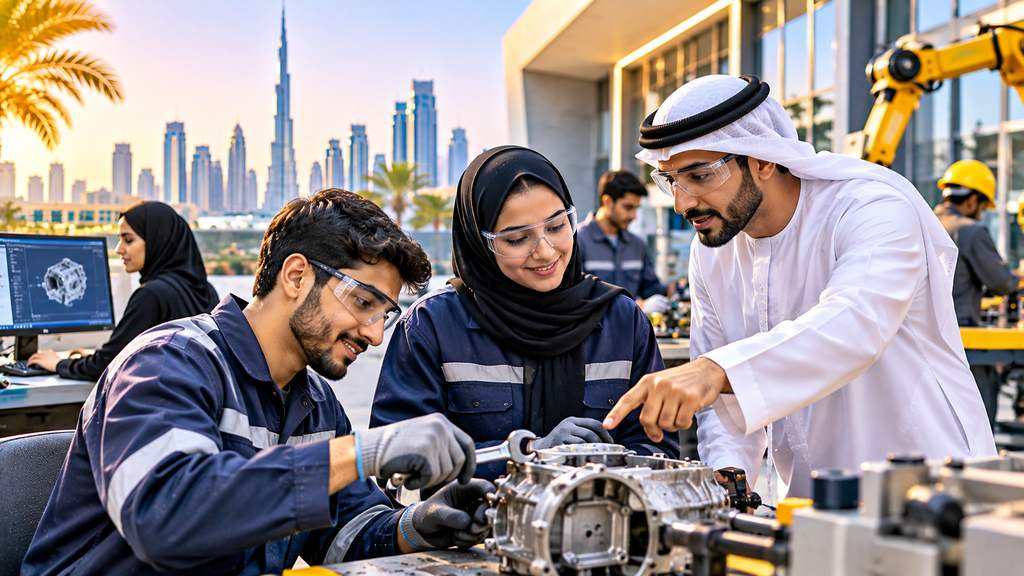
Solar energy facilities, energy-efficient buildings, and expanding electrical infrastructure require specialised technical capabilities.
Vocational programmes can prepare learners for equipment installation, maintenance, inspection, safety procedures, and operational support.
Training institutions may also need to address battery systems, electrical controls, and energy monitoring technologies.
As sustainable infrastructure develops, employers will require workers who understand both established electrical principles and modern equipment.
Artificial Intelligence and Industrial Automation
Automation is changing the way factories, logistics centres, and technical services operate.
Modern facilities increasingly use sensors, software-controlled equipment, robotics, and digital monitoring systems.
This creates opportunities for technicians trained in mechatronics, industrial electronics, troubleshooting, and automated systems.
However, automation can also reduce demand for certain repetitive tasks.
Vocational institutions must therefore prepare learners to work with changing technology rather than training them exclusively for fixed processes.
Aviation, Logistics, and Transportation
The GCC’s geographical position supports its role in international aviation, shipping, and logistics.
These industries require a wide range of technical specialists, including equipment maintenance workers, warehouse systems technicians, and logistics coordinators.
Training may involve operational safety, digital inventory systems, machinery maintenance, and specialised transportation procedures.
Certain occupations also require regulatory approvals or professional licences beyond completion of a training course.
Hospitality and Tourism
Tourism development creates opportunities in hotel operations, culinary arts, event production, technical maintenance, and customer services.
Vocational education can help learners develop practical hospitality competencies while introducing professional standards for service delivery.
Training should also include communication, digital systems, and workplace problem-solving skills.
Technical Skills for Emerging Industries
| Industry | Relevant Vocational Skills | Potential Career Pathways |
|---|---|---|
| Renewable Energy | Electrical systems, solar installation, maintenance | Solar technician, electrical maintenance specialist |
| Advanced Manufacturing | Automation, mechatronics, industrial safety | Manufacturing technician, automation support specialist |
| Aviation | Aircraft systems, maintenance procedures, safety | Licensed or trainee aviation maintenance roles |
| Logistics | Warehouse technology, inventory systems, equipment operations | Logistics technician, warehouse operations specialist |
| Healthcare | Laboratory procedures, medical equipment support | Laboratory or equipment technician, subject to licensing |
| Hospitality | Culinary skills, service operations, event support | Culinary professional, hospitality operations specialist |
| Digital Technology | Networking, technical support, cybersecurity fundamentals | IT support technician, network support specialist |
These occupations illustrate why practical training remains important even as economies become increasingly digital.
Employers will continue to need workers who can operate, maintain, repair, and improve the systems supporting modern industries.
5. How Apprenticeships and Industry Partnerships Can Improve Employment Outcomes
One of the biggest challenges facing education systems is ensuring that graduates possess competencies relevant to actual workplace conditions.
Vocational institutions can address this challenge through closer cooperation with employers.
Industry partnerships allow training providers to understand changing occupational requirements while offering students practical exposure to professional environments.
The Value of Work-Based Learning
Apprenticeships combine structured education with supervised workplace experience.
Depending on the programme, participants may receive classroom instruction, practical assessments, mentoring, and on-the-job training.
This model can help learners understand how technical knowledge is applied in real working conditions.
For example, an electrical engineering trainee may study safety principles in a classroom before practising installation and inspection under qualified supervision.
Such experiences allow students to build confidence while learning professional standards.
How Employers Benefit
Businesses can benefit from vocational partnerships because they provide opportunities to shape training around specific operational needs.
Employers may contribute equipment, technical expertise, curriculum advice, or supervised placements.
Potential advantages include:
- Better alignment between training and occupational requirements.
- Opportunities to identify suitable future employees.
- Reduced gaps between theoretical learning and workplace expectations.
- Access to structured employee development pathways.
- Improved communication between educational institutions and industries.
However, apprenticeships require adequate supervision and quality controls.
Poorly designed programmes may offer limited learning opportunities or place excessive emphasis on routine work without developing transferable skills.
Developing Effective Employer Partnerships
A strong partnership should establish clear responsibilities for training institutions, employers, and students.
Important elements include defined learning objectives, qualified supervisors, safety protections, transparent assessment methods, and opportunities to provide feedback.
Institutions should also evaluate whether placements lead to meaningful competency development rather than treating participation numbers as the primary measure of success.
Measuring Employment Outcomes
Employment rates can provide useful information about programme effectiveness, but they should not be the only indicator.
Training providers should also examine:
- Whether graduates find work related to their qualifications.
- How quickly graduates transition into suitable employment.
- Whether employers are satisfied with graduates’ practical skills.
- Whether training supports career progression.
- Whether graduates have opportunities for further learning.
- Whether employment conditions and wages reflect occupational responsibilities.
These indicators can help institutions identify programmes that require improvement.
The broader goal is to ensure that vocational education offers credible career opportunities rather than becoming a short-term response to labour shortages.
6. Overcoming the Challenges Facing Vocational Education in the GCC
Despite growing institutional support, vocational education faces several challenges that could influence its long-term development.
These include public perceptions, training quality, access to modern equipment, industry coordination, and uncertainty about career progression.
Addressing these issues will be essential if technical education is to become a widely respected choice.
Changing Public Perceptions of Technical Careers
In some communities, university degrees continue to carry greater social prestige than vocational qualifications.
Technical training may be viewed as an alternative for students who do not enter university rather than a valuable educational choice in its own right.
Such perceptions can discourage capable students from considering technical occupations.
Career counselling, public awareness initiatives, and visible examples of successful technical professionals may help challenge these assumptions.
However, improving public perception also requires attractive working conditions and credible opportunities for advancement.
Improving Training Quality and Accreditation
Not all vocational qualifications provide the same level of preparation.
Students need reliable information about institutional accreditation, curriculum standards, assessment methods, and whether qualifications are recognised by employers.
Training providers must also maintain equipment, update teaching materials, and ensure instructors understand contemporary industry practices.
Outdated facilities can limit the value of vocational education, especially in technology-intensive sectors.
Access and Inclusion
Educational opportunities differ across GCC countries and between individual programmes.
Eligibility may depend on nationality, residency, age, academic qualifications, funding arrangements, and institutional requirements.
Some government-supported initiatives are intended primarily for citizens, while other training providers may admit wider groups of eligible residents.
Prospective learners should verify these requirements before applying.
Geographical access also matters, particularly when specialised training facilities are concentrated in major cities.
Key Challenges and Possible Responses
| Challenge | Why It Matters | Possible Solution |
|---|---|---|
| Social perceptions | Students may overlook technical careers | Career awareness and successful graduate examples |
| Outdated equipment | Training may not reflect industry standards | Regular technology investment |
| Limited employer involvement | Skills may not match workplace needs | Stronger industry partnerships |
| Qualification recognition | Graduates may face mobility barriers | Transparent accreditation and progression systems |
| Unequal access | Some learners may have fewer opportunities | Clear eligibility information and accessible programmes |
| Rapid technological change | Occupational skills may become outdated | Continuous curriculum updates |
| Limited career progression | Graduates may struggle to advance | Higher qualifications and lifelong learning pathways |
Creating Clear Career Progression Routes
Vocational qualifications should not necessarily represent the end of formal education.
Students may begin with a technical certificate before progressing to an advanced diploma, an applied degree, or specialised professional training.
Recognising prior learning and workplace experience can also help experienced workers gain formal qualifications.
These pathways are important because technical occupations evolve over time.
A technician may eventually become a supervisor, trainer, technical manager, or entrepreneur through additional education and experience.
By supporting progression, GCC education systems can make vocational training a foundation for long-term professional development.
7. The Future of Vocational Education in the GCC: A Skills-First Approach
The future of vocational education in the GCC is likely to be shaped by the idea that professional competence should be demonstrated through relevant knowledge, practical ability, and continued learning.
Academic qualifications will remain important, particularly in regulated professions and research-intensive fields.
However, employers may increasingly combine educational credentials with practical assessments, professional certifications, portfolios, and demonstrated workplace skills.
This approach could create more flexible opportunities for learners from different educational backgrounds.
Micro-Credentials and Flexible Learning
Micro-credentials are short, focused qualifications designed to demonstrate competence in specific subjects or skills.
They may cover areas such as digital systems, equipment safety, project operations, or specialised technical processes.
When properly assessed and recognised, these qualifications can support professional development without requiring learners to complete an entirely new academic programme.
However, not all short courses carry equal value.
Students should confirm whether credentials are recognised by relevant employers, regulators, or educational institutions.
Technology-Enhanced Practical Training
Simulation systems, virtual reality, and digital learning platforms may become increasingly important in technical education.
For example, aviation students can practise certain maintenance procedures through simulations before working with real equipment.
Industrial trainees may use virtual environments to understand machinery and safety requirements.
Digital tools can reduce some training limitations, but they cannot fully replace supervised experience with physical equipment where practical competence is essential.
The most effective approach will depend on the occupation and the skills being assessed.
Lifelong Learning and Workforce Reskilling
Technical skills do not remain permanently relevant without further development.
As industries introduce new technology, experienced workers may need additional training to remain effective.
Vocational institutions can support this process through flexible schedules, modular courses, employer-sponsored training, and recognised professional development programmes.
Lifelong learning is particularly important in sectors affected by automation, digitalisation, and changing environmental standards.
A Practical Checklist for Students Considering Vocational Education
Before choosing a programme, students should evaluate both educational quality and career opportunities.
- Identify the technical occupation or industry of interest.
- Research current employment requirements in the intended country.
- Confirm the training provider’s accreditation.
- Review the programme’s practical training components.
- Check whether apprenticeships or industry placements are available.
- Understand tuition fees, funding options, and eligibility conditions.
- Ask about recognised qualifications and licensing requirements.
- Investigate graduate employment and career progression.
- Consider whether the qualification allows further education.
- Compare vocational training with relevant university programmes.
A well-informed choice should reflect personal interests and realistic professional requirements rather than social expectations alone.
What GCC Policymakers and Institutions Should Prioritise
Building a stronger vocational education system requires coordination between government agencies, educational institutions, and employers.
Priority areas include developing credible qualifications, expanding practical training opportunities, improving career guidance, and supporting access to modern teaching facilities.
Governments and institutions may also benefit from regularly collecting information about emerging occupations and skills shortages.
This can help training programmes respond to economic developments before shortages become more difficult to address.
Conclusion
The future of vocational education in the GCC extends beyond the traditional debate between university degrees and technical qualifications.
As Gulf economies diversify and adopt increasingly sophisticated technologies, the demand for practical competence and specialised occupational knowledge will remain important.
Vocational education can help meet this demand by connecting learners with relevant skills, industry experience, and recognised professional pathways.
However, its success will depend on more than expanding the number of training programmes. Institutions must provide quality instruction, maintain industry relevance, support career progression, and demonstrate positive employment outcomes.
University education and vocational training should therefore be viewed as complementary components of a broader education system.
A graduate with advanced theoretical knowledge and a technician with specialised practical expertise can both make valuable contributions to economic development.
For the GCC, developing respected vocational pathways offers an opportunity to prepare a more adaptable workforce while giving learners greater freedom to choose careers aligned with their abilities and ambitions.
Ultimately, the future of education in the Gulf will be determined not only by the qualifications people earn, but also by how effectively they can apply their knowledge, develop new skills, and contribute to changing industries.
Do follow us on Instagram
Read More – Why Traditional Storytelling Still Matters in the Digital Age