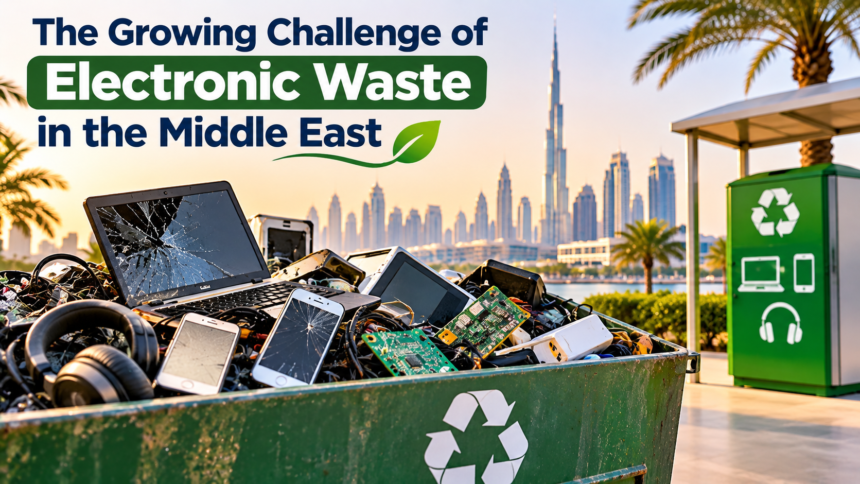
How Electronic Waste Recycling Recovers Valuable Materials
An outdated smartphone sits forgotten in a drawer in Dubai. A business in Riyadh replaces hundreds of computers during an office upgrade, while a family in Doha purchases a new television and discards the old one. These situations appear ordinary, yet together they illustrate an environmental challenge accompanying the region’s rapid adoption of technology.
- Why Electronic Waste in the Middle East Is Becoming a Major Concern
- 7 Critical Challenges Behind the Region’s E-Waste Problem
- Dubai, Abu Dhabi and Saudi Arabia: E-Waste Recycling in Practice
- How Electronic Waste Recycling Recovers Valuable Materials
- The Economics of Electronic Waste and the Circular Economy
- Environmental and Health Risks of Improper E-Waste Disposal
- How Households, Businesses and Governments Can Reduce E-Waste
- The Future of Electronic Waste in the Middle East and FAQs
Electronic Waste in the Middle East is becoming an increasingly important issue as households, businesses and public institutions replace electrical and digital equipment.
Electronic waste, commonly called e-waste, includes discarded smartphones, laptops, televisions, printers, refrigerators, communication equipment and other products that operate using electricity or electromagnetic fields.
These products contain valuable materials such as copper, aluminium, steel and, in some cases, gold and silver.
They can also contain hazardous substances or components requiring specialised handling.
When electronic equipment is discarded without appropriate collection and processing, recoverable materials may be lost while environmental and health risks increase.
The scale of the challenge is considerable.
According to the Global E-waste Monitor 2024, the world generated approximately 62 million tonnes of electronic waste in 2022.
Only 22.3% was documented as formally collected and recycled in an environmentally sound manner.
For Western Asia, the report estimated approximately 2.96 million tonnes of electronic waste in 2022, equivalent to 10.3 kilograms per person.
However, Western Asia is a statistical region that includes countries outside the Arabian Gulf. Its figures should not be interpreted as totals for the six GCC countries alone.
The regional collection figures also demonstrate a significant gap. Approximately 270,000 tonnes of Western Asia’s electronic waste were documented as formally collected and recycled in 2022, equivalent to about 9.1% of the amount generated.
These are the latest comparable regional figures identified in the published global monitoring framework, not measurements of electronic waste generated during 2026.
Meanwhile, governments and businesses are expanding efforts to address the issue.
Dubai Municipality announced an electronic waste recycling partnership with Enviroserve in June 2026, while Saudi Arabia’s Communications, Space and Technology Commission has reported substantial results from its device recycling and donation initiative.
These programmes illustrate how electronic waste management is becoming part of broader sustainability and circular economy strategies.
However, collecting devices is only the beginning.
The challenge is to establish systems that encourage responsible purchasing, extend product lifetimes, protect personal data and recover valuable materials without exposing workers or communities to unsafe recycling practices.
Why Electronic Waste in the Middle East Is Becoming a Major Concern
The growth of electronic waste is closely connected to the increasing number of electrical and digital products used in everyday life.
Modern households may own several smartphones, laptops, televisions, tablets, routers and appliances.
Businesses also depend on computing equipment, data storage systems, telecommunications networks and specialised electronic machinery.
As these devices become outdated, damaged or commercially unsuitable, they eventually enter the waste stream.
The Impact of Digital Transformation
The Middle East has invested heavily in digital infrastructure, telecommunications and technology-enabled services.
These developments can improve productivity and access to essential services.
However, expanding equipment ownership also increases the number of devices that will eventually require repair, reuse or disposal.
Digital progress therefore creates a corresponding responsibility for managing the physical products supporting it.
Shorter Replacement Cycles
Consumers may replace devices because newer models offer better performance, cameras, batteries or software features.
Businesses may also upgrade equipment to maintain security, compatibility and operational efficiency.
Not every replacement involves a device that has completely stopped working.
Some discarded products remain suitable for refurbishment or reuse.
The Challenge of Mixed Waste
Electronic devices should not automatically be placed in ordinary household rubbish.
They contain components with different recycling requirements, including metals, plastics, batteries and electronic circuits.
Mixing them with general waste can make recovery more difficult and may create safety risks.
What Counts as Electronic Waste?
| Equipment Category | Examples | End-of-Life Concern |
|---|---|---|
| Small Electronics | Smartphones and tablets | Batteries and data |
| Computers | Laptops and desktops | Valuable metals and storage devices |
| Displays | Televisions and monitors | Glass and specialised components |
| Large Appliances | Refrigerators and washing machines | Metals and possible hazardous substances |
| Communication Devices | Routers and networking equipment | Circuit boards |
| Office Equipment | Printers and scanners | Mixed materials and consumables |
| Batteries | Rechargeable battery packs | Fire and chemical hazards |
The challenge is not simply the number of devices discarded, but whether appropriate systems exist to recover and manage them.
7 Critical Challenges Behind the Region’s E-Waste Problem
Electronic waste management involves technical, economic and behavioural difficulties.
These factors affect countries differently, but several common challenges help explain why collection and recycling can remain limited.
1. Rapid Technology Replacement
New devices enter the market every year.
Consumers may replace equipment before its technical lifespan ends, while businesses frequently upgrade systems for operational reasons.
This can increase the quantity of devices requiring end-of-life management.
2. Limited Consumer Awareness
Some households are uncertain about where to dispose of old electronics.
Small devices may remain stored for years or eventually enter ordinary waste bins.
Convenient collection services and clear information can help address this problem.
3. Difficult Material Separation
Modern electronics contain complex combinations of metals, plastics, glass and chemicals.
Recovering valuable materials requires appropriate dismantling and processing technologies.
Some materials are difficult or uneconomical to separate at high purity.
4. Hazardous Components
Certain batteries, circuit boards and older devices may contain hazardous materials.
Unsafe breaking, burning or chemical processing can expose workers and surrounding communities to contaminants.
Appropriate handling and treatment are essential.
5. Data Security Concerns
Consumers and businesses may hesitate to recycle devices containing photographs, personal information or confidential records.
Without reliable data destruction procedures, valuable equipment may remain unused in storage.
Secure erasure and documented destruction can encourage responsible disposal.
6. Recycling Economics
Recovering metals can create commercial value, but collection, sorting, labour and specialised treatment are expensive.
A recycling facility may struggle financially when recovered-material revenue is lower than processing costs.
7. Inconsistent Collection and Reporting
Reliable waste statistics require accurate measurement across households, businesses and recycling operators.
Differences in reporting practices can make national and regional comparisons difficult.
The Global E-waste Monitor identifies major gaps between electronic waste generation and documented formal collection.
Seven Challenges Compared
| Challenge | Main Consequence | Possible Response |
|---|---|---|
| Frequent Replacement | More discarded devices | Repair and reuse |
| Low Awareness | Improper disposal | Collection education |
| Complex Materials | Recovery difficulties | Specialised recycling |
| Hazardous Components | Health and environmental risks | Controlled treatment |
| Data Security | Devices kept in storage | Certified data destruction |
| Processing Costs | Limited commercial viability | Efficient recovery systems |
| Reporting Gaps | Uncertain outcomes | Reliable tracking |
Addressing these challenges requires cooperation between consumers, manufacturers, recyclers, businesses and public authorities.
Dubai, Abu Dhabi and Saudi Arabia: E-Waste Recycling in Practice
Different Middle Eastern authorities are developing systems to manage discarded electrical equipment.
These include collection points, recycling partnerships, producer responsibilities and digital waste tracking.
However, regulations and services vary between jurisdictions.
Dubai’s Recycling Infrastructure
Dubai Municipality provides collection services for selected bulky household waste, including electrical appliances and electronic equipment, subject to service-area conditions.
The municipality has also developed recyclable-material collection facilities designed to accept items such as discarded electronics, mobile phones and certain batteries.
These arrangements can make responsible disposal more accessible.
However, residents should check which items a particular facility accepts before visiting.
In June 2026, Dubai Municipality announced a partnership with electronics recycling specialist Enviroserve to strengthen electronic waste recycling.
The partnership reflects the city’s broader interest in recovering useful materials from discarded equipment.
Dubai’s Circle Dubai initiative, launched in October 2025, also supports waste reduction, segregation and recycling as part of the emirate’s long-term waste management strategy.
Its target of diverting all waste from landfill by 2041 is a future policy objective rather than an outcome already achieved.
Abu Dhabi’s Requirements
Abu Dhabi has established rules governing the management of waste electrical and electronic equipment.
A 2022 circular issued by Tadweer requires relevant waste producers to use permitted environmental service providers for collection.
It also specifies that covered electronic waste should be received and treated at authorised facilities within the emirate.
The circular includes requirements for electronic waste transport documentation.
These provisions demonstrate that e-waste management is not simply a voluntary recycling activity for every business.
Organisations must determine which legal obligations apply to their equipment and operations.
Saudi Arabia’s Device Recycling Programme
Saudi Arabia’s Communications, Space and Technology Commission operates a programme focused on repairing, donating and recycling electronic devices.
According to its Digital & Space Sustainability in Saudi Arabia 2026 report, the initiative’s two editions, covering activity from 2022 through 2025, delivered substantial results.
The commission reported more than 400,000 devices donated, over 960 tonnes recycled or repaired, participation from more than 40,000 individuals and public entities, and support for more than 120 charities and schools.
The initiative also provides for data destruction before equipment is processed.
These figures describe the commission’s specific programme and should not be interpreted as Saudi Arabia’s total national electronic waste recycling volume.
Saudi Arabia’s Waste Management Framework
The Saudi National Center for Waste Management, known as MWAN, operates within a regulatory framework covering different waste streams, including waste electrical and electronic equipment.
Its implementing regulations define extended producer responsibility as a mechanism through which relevant producers or importers may carry legal and financial obligations for end-of-life products.
The scope of individual responsibilities depends on applicable rules and product categories.
In April 2026, MWAN and the National Center for Privatization announced an expression-of-interest stage for a proposed national digital waste management platform.
The platform is intended to improve tracking, regulation and coordination across waste-management activities.
It should be described as a proposed development project, not a completed national system.
Qatar’s Circular Economy Direction
Qatar’s environmental sustainability strategy emphasises waste management, resource efficiency and circular economy development.
Its policy framework includes improving waste data, developing markets for recycled materials and considering mechanisms such as extended producer responsibility.
However, this broader strategy should not be confused with a specific nationwide electronic-waste collection achievement.
Regional Approaches Compared
| Location | Documented Initiative | Main Focus |
|---|---|---|
| Dubai | Electronics collection and Enviroserve partnership | Collection and recycling |
| Dubai | Circle Dubai | Waste segregation and circular economy |
| Abu Dhabi | Electronic waste handling circular | Authorised collection and treatment |
| Saudi Arabia | Recycle Your Device programme | Repair, donation and recycling |
| Saudi Arabia | MWAN regulatory framework | Waste governance and tracking |
| Qatar | Environmental sustainability strategy | Resource efficiency and circular economy |
These initiatives provide a foundation for better e-waste management, but their effectiveness requires continued measurement and responsible implementation.
How Electronic Waste Recycling Recovers Valuable Materials
Electronic waste contains a mixture of components with different physical and chemical properties.
Recycling therefore involves more than crushing devices and collecting metals.
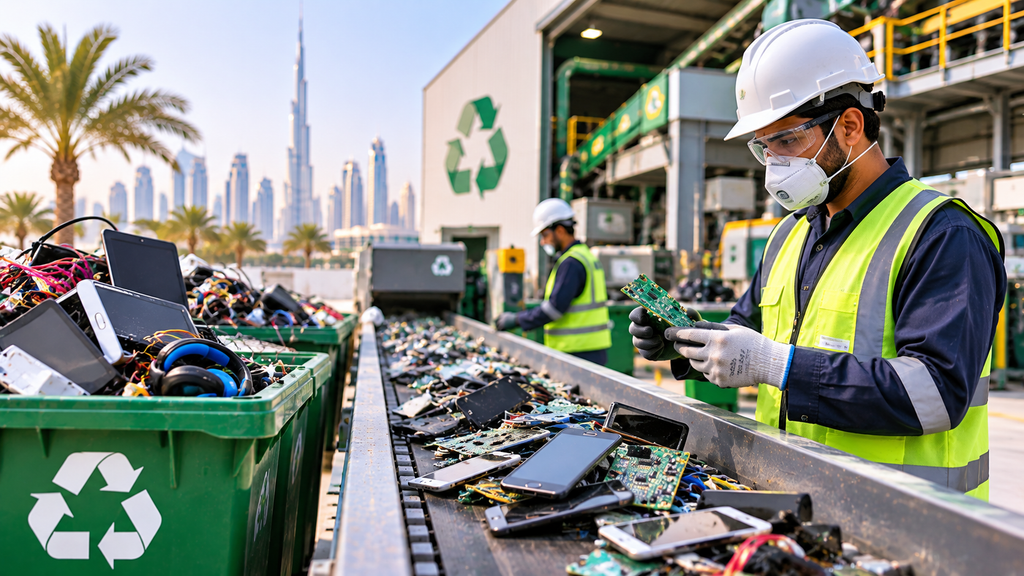
The process begins with safe collection and identification, followed by testing, dismantling, separation and appropriate treatment.
Collection and Classification
Discarded equipment is collected through approved facilities, collection programmes or authorised service providers.
Operators may classify products according to equipment type and the substances they contain.
For example, refrigerators require different treatment from mobile phones because refrigeration appliances may contain refrigerants that require controlled recovery.
Data Destruction
Before computers, smartphones and storage equipment are reused or recycled, personal and business data must be addressed.
Some functioning devices can be securely erased and refurbished.
Others may require physical destruction of storage components through appropriate procedures.
Simply deleting files or performing a basic reset may not satisfy every organisation’s security requirements.
Inspection and Repair
Functional devices may be assessed for repair or refurbishment.
Extending the useful life of a suitable laptop can delay the need for manufacturing a replacement.
However, equipment should not be redistributed without checking safety, performance and data security.
Dismantling and Separation
Recyclers can remove batteries, circuit boards, cables, frames and other components.
Mechanical processes may separate metals and plastics into different streams.
More specialised technologies can recover valuable metals from complex components.
However, recovering every material at commercial purity may be impractical.
Hazardous Material Management
Certain components require controlled handling.
Batteries can present fire risks if crushed or damaged, while older equipment may contain substances requiring specialised treatment.
Workers need appropriate facilities, training and protective measures.
How the Recycling Process Works
| Stage | Main Activity | Purpose |
|---|---|---|
| 1. Collection | Receive discarded equipment | Controlled waste handling |
| 2. Classification | Identify device types | Select suitable treatment |
| 3. Data Sanitisation | Erase or destroy information | Protect privacy |
| 4. Repair Assessment | Test functional equipment | Extend product life |
| 5. Dismantling | Separate components | Improve recovery |
| 6. Material Processing | Recover metals and other materials | Produce secondary resources |
| 7. Residue Treatment | Manage hazardous and unusable parts | Reduce environmental risks |
Recycling should be evaluated through the quality of recovered materials and the safety of processing, not simply the weight of devices collected.
The Economics of Electronic Waste and the Circular Economy
Discarded electronics represent an opportunity to recover materials that would otherwise require new mining and processing.
However, electronic waste recycling is not automatically profitable.
Collection, transport, skilled labour and treatment costs can consume much of the value recovered from discarded devices.
The Hidden Value Inside Electronics
The Global E-waste Monitor estimated that electronic waste generated worldwide in 2022 contained approximately US$91 billion worth of metals.
This included an estimated US$19 billion in copper, US$15 billion in gold and US$16 billion in iron.
However, these figures represent estimated material value embedded in global e-waste, not revenue that recyclers actually collected.
The report estimated that secondary materials worth approximately US$28 billion were recovered through documented electronic waste recycling.
Why Recycling Costs Matter
A recycling company may receive large quantities of obsolete devices but still face financial difficulties.
Some equipment contains relatively little valuable material, while specialised processing can be expensive.
Safe management of hazardous components adds further cost.
Businesses must therefore consider both the recoverable materials and the complete treatment process.
Illustrative Electronics Recycling Model
Consider a fictional regional recycler processing 100 tonnes of discarded electronic equipment.
| Financial Measure | Hypothetical Amount |
|---|---|
| Incoming Electronic Waste | 100 tonnes |
| Recoverable Material Yield | 70% |
| Recovered Materials | 70 tonnes |
| Average Recovered Material Revenue | AED 4,000 per tonne |
| Material Sales Revenue | AED 280,000 |
| Collection and Transport | AED 65,000 |
| Processing and Labour | AED 135,000 |
| Data Destruction and Hazardous Treatment | AED 55,000 |
| Illustrative Operating Surplus | AED 25,000 |
The figures are hypothetical and are not actual Gulf recycling prices or profit margins.
They exclude facility investment, financing, regulatory fees and other business costs.
A different composition of incoming waste could produce substantially different financial results.
Why Refurbishment Matters
Repairing and reselling suitable equipment can sometimes create greater value than dismantling it for materials.
A working laptop may have useful market value as a complete product.
By comparison, its individual components may generate less revenue after processing costs.
However, refurbishment must be supported by safety checks, adequate performance and secure data handling.
Employment and Industrial Opportunities
Electronic waste management may support jobs in collection, repair, logistics, dismantling, material recovery and technical testing.
It can also create demand for businesses specialising in secure information destruction.
These opportunities require investment in worker training and appropriate environmental safeguards.
Environmental and Health Risks of Improper E-Waste Disposal
Electronic waste can contain hazardous substances that require careful management.
When recycling is conducted without suitable controls, workers and surrounding communities may be exposed to dangerous pollutants.
The World Health Organization identifies informal and unsafe electronic waste processing as an important environmental health concern.
Risks From Unsafe Processing
Burning cables or plastics to recover metals can release harmful pollutants.
Uncontrolled breaking, heating or chemical treatment may also expose people to contaminants.
The actual hazards depend on the components, processing method and exposure conditions.
Why Children Need Protection
The WHO explains that children can be particularly vulnerable to toxic substances released during unsafe e-waste recycling.
Their developing bodies and greater exposure relative to body size can increase certain health risks.
However, these findings concern exposure to hazardous e-waste processing conditions, not ordinary use of properly functioning consumer electronics.
Battery Safety
Rechargeable batteries require particular attention.
Damaged lithium-ion batteries can overheat or ignite, especially when crushed or handled incorrectly.
Consumers should avoid puncturing batteries or placing damaged battery packs into ordinary mixed-waste streams.
Swollen, leaking or overheating devices require advice from an appropriate professional or authorised collection service.
Environmental Contamination
Improper disposal can allow hazardous substances to enter soil or water under certain conditions.
Unsafe recycling may also create air pollution.
Formal collection and controlled treatment help reduce these risks, although facilities must maintain suitable operating standards.
Risk and Prevention Comparison
| Risk | Possible Consequence | Preventive Measure |
|---|---|---|
| Open Burning | Harmful air emissions | Prohibit uncontrolled burning |
| Improper Battery Handling | Fire or chemical exposure | Separate battery collection |
| Uncontrolled Chemical Treatment | Worker exposure | Approved facilities |
| Discarded Components | Soil or water contamination | Responsible treatment |
| Poor Data Handling | Information theft | Secure data destruction |
| Untrained Workers | Occupational injuries | Training and safeguards |
The environmental benefits of recycling depend on whether valuable materials are recovered without creating unacceptable harm during processing.
How Households, Businesses and Governments Can Reduce E-Waste
Improving electronic waste management requires action before a device becomes waste.
Repairability, purchasing decisions and product lifetimes can influence how frequently equipment needs replacing.
Collection and recycling then become necessary when continued use is no longer practical.
Choose Durable and Repairable Devices
Consumers can compare product durability, warranty coverage, software support and repair options before purchasing.
A device that remains useful for longer may reduce the frequency of replacement.
However, repairing severely damaged or unsafe equipment is not always appropriate.
Use Trade-In and Collection Programmes
Retailers, manufacturers and authorised recyclers may offer programmes for collecting old equipment.
Consumers should verify the provider’s acceptance conditions and whether batteries or accessories need separate handling.
Availability can differ by city and provider.
Businesses Need Asset Management Plans
Companies often replace large numbers of computers, printers and networking devices.
Maintaining an equipment inventory can help identify devices suitable for reassignment, refurbishment or recycling.
A formal disposal procedure should also define data security responsibilities.
Government Collection Infrastructure
Authorities can improve access through convenient collection points, public information and reliable waste tracking.
Programmes should distinguish between amounts collected, repaired, recycled and finally disposed of.
These measures produce different environmental outcomes.
Practical Household Checklist
- Check whether a device can be repaired.
- Consider donating suitable working equipment.
- Back up important information.
- Follow appropriate data-erasure procedures.
- Remove batteries only when designed for safe user removal.
- Avoid opening or dismantling hazardous components.
- Find an authorised collection provider.
- Follow special instructions for damaged batteries.
- Request disposal documentation when appropriate.
- Avoid placing electronics in ordinary rubbish.
Practical Business Priorities
Businesses can establish equipment replacement schedules that balance security with useful service life.
They should use suitable contracts for collection, data destruction and recycling.
Where practical, organisations can also track the final destination of discarded equipment rather than relying solely on a collection receipt.
The Future of Electronic Waste in the Middle East and FAQs
The Middle East’s electronic waste challenge will continue to evolve as technology becomes more widespread.
Smart infrastructure, digital services, renewable energy equipment and connected household products will eventually create additional waste-management requirements.
However, the quantity and composition of future e-waste will depend on product lifetimes, consumption patterns and the effectiveness of reuse and repair systems.
Extended Producer Responsibility
Extended producer responsibility, often abbreviated EPR, is a policy approach that assigns certain end-of-life responsibilities to producers or importers.
Depending on the jurisdiction, these responsibilities may concern collection, financing, treatment or reporting.
Saudi Arabia’s waste management framework includes the concept, while Qatar has identified producer responsibility as a measure for consideration within its broader circular economy approach.
Implementation requirements vary, and no single rule should be assumed to cover the entire Middle East.
Digital Tracking and Transparent Reporting
Waste-management platforms may help regulators follow materials through collection, transportation and processing.
Saudi Arabia’s proposed national digital platform reflects interest in improving coordination and traceability.
However, digital records are useful only when the underlying information is accurate and the operators comply with relevant requirements.
A Greater Role for Repair and Reuse
Future e-waste strategies may place greater emphasis on extending product lifetimes before recycling.
Saudi Arabia’s device donation initiative offers an example of combining reuse with material recovery.
Developing repair services and refurbishment networks could help retain more economic value within the region.
Frequently Asked Questions
What is electronic waste?
Electronic waste includes discarded electrical and electronic products such as mobile phones, computers, televisions, refrigerators and related equipment.
How much electronic waste does the Middle East generate?
The Global E-waste Monitor estimated approximately 2.96 million tonnes generated in Western Asia during 2022. This regional definition is broader than the Gulf and does not represent all possible definitions of the Middle East.
What percentage is recycled?
Around 9.1% of electronic waste generated in Western Asia in 2022 was documented as formally collected and recycled. Actual treatment pathways for the remaining waste are not fully captured by that figure.
Can old smartphones be recycled?
Yes. Suitable recycling processes can recover selected metals and other materials, provided batteries and components are handled appropriately.
Is electronic waste dangerous?
Certain components contain hazardous substances or present risks if damaged, burned or processed without appropriate controls.
Does Dubai offer electronic waste collection?
Dubai Municipality has documented collection services for selected appliances and electronic equipment, alongside specialised recycling initiatives.
What is Saudi Arabia doing about e-waste?
Saudi Arabia’s Communications, Space and Technology Commission operates a device repair, donation and recycling initiative, while MWAN regulates relevant waste-management activities.
Can electronics be donated instead of recycled?
Yes, suitable functioning equipment may be refurbished and donated after appropriate testing and secure data removal.
Should electronic devices be thrown in ordinary bins?
They should be handled through appropriate waste collection arrangements rather than mixed indiscriminately with household rubbish.
Is gold recovered from electronic waste?
Yes. Certain circuit boards contain precious metals, but recovery requires specialised processes and may not be economical for every device.
How can businesses dispose of old computers safely?
Businesses should use appropriate authorised providers, establish secure data destruction procedures and retain relevant documentation.
Will electronic waste increase in the future?
Global forecasts indicate continued pressure from rising electronic equipment use. Regional outcomes will depend on future consumption, repair, collection and recycling practices.
Final Thoughts
Electronic waste is becoming an important environmental and economic challenge for Middle Eastern countries.
The expansion of digital services and consumer technology creates benefits for households and businesses, but it also produces equipment that eventually needs responsible management.
The Global E-waste Monitor shows a significant gap between electronic waste generation and documented formal recycling in Western Asia.
At the same time, initiatives in Dubai, Abu Dhabi and Saudi Arabia demonstrate efforts to improve collection, regulation, refurbishment and material recovery.
The opportunity extends beyond preventing pollution.
Discarded electronics contain valuable materials that may be recovered and used again, while suitable functioning equipment can sometimes receive a second life through repair or donation.
However, recycling must be supported by worker safety, environmental controls and secure handling of personal information.
For households, responsible disposal begins with better purchasing decisions and proper collection.
For businesses, it requires clear asset management and data-security procedures. For governments, it involves accessible infrastructure, effective regulation and reliable measurement.
Ultimately, tackling Electronic Waste in the Middle East will require treating digital equipment as a resource throughout its lifecycle.
A more circular technology economy can reduce unnecessary waste, recover valuable materials and support the region’s sustainability objectives without slowing the benefits of digital development.
Do follow us on Instagram
Read More – Sustainable Aviation Fuel in the Gulf: 7 Powerful Changes for Airlines