Why Digital Technology Is Essential for Protecting Gulf Arabic Heritage
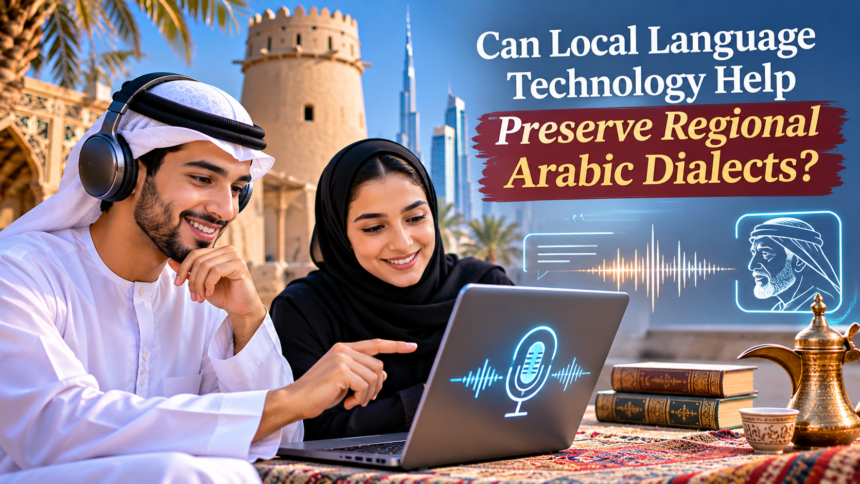
The Arabic language connects hundreds of millions of people through a shared linguistic and cultural heritage, yet the way Arabic is spoken varies considerably across countries, cities, and communities. From the Gulf to the Levant and North Africa, regional dialects carry distinctive pronunciations, vocabulary, expressions, and storytelling traditions that reflect generations of social and cultural development. As artificial intelligence, digital communication, and language-processing technologies become more influential, an important question is emerging: can modern technology help preserve these linguistic differences rather than gradually overlooking them?
- 1. Why Regional Arabic Dialects Are Important to Cultural Identity
- 2. How Artificial Intelligence and Speech Recognition Can Document Arabic Dialects
- 3. The Powerful Role of Digital Archives in Preserving Gulf Linguistic Heritage
- 4. How Language Technology Can Connect Younger Generations With Arabic Dialects
- 5. Real-World Research Advancing Arabic Dialect Technology
- 6. Challenges of Using AI to Preserve Regional Arabic Dialects
- 7. The Future of Arabic Dialect Preservation Technology in the Gulf
Arabic dialect preservation technology offers new possibilities for documenting spoken language, developing digital archives, and making regional expressions more accessible to younger generations. Speech recognition systems, artificial intelligence models, online dictionaries, and community-based recording projects can help capture linguistic knowledge that may otherwise remain undocumented.
However, preserving dialects involves more than collecting words or creating digital recordings. Language reflects identity, historical experiences, family relationships, and cultural values. Regional expressions often contain meanings that cannot be reproduced through direct translation alone.
Across the Arabian Gulf, where traditional linguistic practices interact with global media and rapidly developing technology, digital preservation could help maintain cultural diversity while supporting innovation. The challenge is ensuring that these tools represent regional communities accurately and remain connected to the people who speak the dialects.
1. Why Regional Arabic Dialects Are Important to Cultural Identity
Arabic is often discussed as a single language, but everyday communication across the Arab world involves considerable linguistic diversity.
Modern Standard Arabic is widely used in formal writing, education, journalism, and official communication. Regional dialects, meanwhile, are commonly used in everyday conversation, family interactions, entertainment, and informal social settings.
These forms of Arabic are closely related, but they differ in pronunciation, grammar, vocabulary, and common expressions.
Understanding the Diversity of Spoken Arabic
A person speaking Arabic in Morocco may use expressions unfamiliar to someone from Kuwait. Similarly, dialects within Saudi Arabia can differ across geographical regions.
Even neighbouring communities may develop distinctive linguistic practices shaped by history, trade, migration, and social interaction.
These variations are not simply informal or incorrect versions of Standard Arabic. They are established spoken varieties with their own linguistic patterns.
Regional dialects demonstrate how language adapts to changing social environments while maintaining connections to shared cultural foundations.
The Linguistic Diversity of the Arabian Gulf
The GCC includes several important spoken Arabic varieties, with differences appearing both between and within national borders.
| Country or Region | Examples of Dialectal Diversity | Cultural Influences |
|---|---|---|
| Saudi Arabia | Najdi, Hijazi, Eastern, Southern, and Northern varieties | Regional history, trade, settlement, and community traditions |
| United Arab Emirates | Emirati Arabic with local and generational variation | Maritime trade, heritage, and regional interaction |
| Kuwait | Kuwaiti Arabic and its social variations | Trade, migration, and urban history |
| Qatar | Qatari varieties of Gulf Arabic | Local heritage, maritime connections, and community traditions |
| Bahrain | Bahraini Arabic varieties, including historically distinct urban and rural speech | Maritime exchange, settlement, and social history |
| Oman | Diverse Omani Arabic varieties across regions and communities | Geography, maritime trade, and historical settlement |
These descriptions are broad classifications rather than complete inventories of regional speech.
The Gulf’s linguistic landscape also includes non-Arabic languages and long-established multilingual communities.
Why Dialects Carry Cultural Memory
Regional dialects preserve expressions connected to local environments, occupations, social relationships, and historical experiences.
Traditional vocabulary associated with fishing, agriculture, desert travel, and pearl diving may reveal aspects of life that have changed significantly over time.
Proverbs and idiomatic expressions can also communicate cultural values that are difficult to explain through literal translation.
When younger generations encounter these expressions, they gain access to historical perspectives embedded within everyday language.
Preserving dialects therefore contributes to a broader understanding of cultural heritage.
2. How Artificial Intelligence and Speech Recognition Can Document Arabic Dialects
Artificial intelligence is changing the way researchers collect, organise, and analyse spoken language.
Speech recognition systems can convert audio recordings into written text, making it easier to search and study spoken material.
Natural language processing allows computers to identify patterns in language, including vocabulary, sentence structures, and differences between dialects.
These technologies create new opportunities for documenting Arabic varieties that have traditionally received less attention in mainstream digital systems.
The Role of Speech Recognition
Automatic speech recognition, commonly known as ASR, converts spoken language into text using computational models.
For dialect preservation, ASR could help researchers transcribe interviews, oral histories, community discussions, and traditional storytelling recordings.
A recording of an older speaker describing local customs, for example, could be preserved alongside a searchable transcript.
Researchers could then analyse regional vocabulary, pronunciation, and linguistic changes.
However, automatic transcription is not always accurate, especially when dealing with unfamiliar accents, background noise, or expressions absent from training data.
Human review remains essential.
Training AI to Understand Dialectal Differences
AI models learn linguistic patterns from datasets containing spoken or written examples.
A system trained mainly on Modern Standard Arabic may struggle to interpret informal Gulf conversations accurately.
Dialect-specific datasets can help improve performance by introducing local vocabulary, pronunciation, and grammatical patterns.
Research has already demonstrated the importance of specialised Arabic language resources.
In 2024, researchers published work describing large textual datasets covering Gulf countries and regional Saudi dialects.
Such resources provide material for developing and evaluating Arabic language-processing systems.
Building Useful Language Datasets
A language preservation dataset may include:
- Audio recordings from speakers of different generations.
- Transcriptions preserving regional vocabulary.
- Information about pronunciation and linguistic variation.
- Explanations of cultural expressions.
- Regional and community context.
- Translations where appropriate.
- Consent and access information for recorded material.
These components help researchers study dialects without reducing them to isolated words.
Understanding the Limitations of AI
AI can identify recurring patterns, but it does not automatically understand the social meaning behind every expression.
Humour, sarcasm, politeness, and cultural references may depend on relationships between speakers.
A machine-generated transcription may preserve the words while failing to explain why they matter.
For this reason, language preservation projects should combine computational methods with the expertise of linguists, historians, and community speakers.
3. The Powerful Role of Digital Archives in Preserving Gulf Linguistic Heritage
Digital archives offer another important approach to protecting regional Arabic dialects.
Traditionally, linguistic knowledge has often been passed between generations through everyday conversation, family storytelling, poetry, and community activities.
While these practices remain valuable, recordings can provide additional documentation for future research and education.
Preserving Oral Histories and Community Voices

Oral-history projects can record individuals discussing personal experiences, family traditions, occupations, and community changes.
For example, an interview with a former pearl-diving worker might preserve both historical information and vocabulary associated with maritime life.
Similarly, recordings of traditional poetry or storytelling could document pronunciation, rhythm, and local expressions.
These recordings become more useful when accompanied by accurate contextual information.
A complete archive might explain where a speaker grew up, when the recording was created, and which linguistic features are significant.
Personal details should be collected only with appropriate consent and privacy protections.
The Value of Community-Based Documentation
Community participation is essential because speakers understand how their dialects are used in daily life.
Researchers may identify grammatical patterns, but local participants can explain humour, social meaning, and differences between formal and informal expressions.
A community-led project might invite residents to contribute traditional sayings, recordings, or explanations of regional vocabulary.
Such efforts can help create richer linguistic records while encouraging public participation.
Digital Preservation Tools Compared
| Technology | Possible Preservation Role | Main Limitation |
|---|---|---|
| Audio Archives | Store pronunciation and spoken narratives | Require consent and long-term maintenance |
| Speech Recognition | Convert recordings into searchable text | May misinterpret regional accents |
| Digital Dictionaries | Document vocabulary and local expressions | May overlook cultural context |
| AI Translation | Improve communication across dialects | Can lose nuance and idiomatic meaning |
| Mobile Applications | Support accessible language learning | Need accurate content and ongoing updates |
| Online Storytelling Platforms | Share traditional narratives | Depend on responsible representation |
Long-Term Digital Preservation
Creating an archive is only the beginning.
Digital files can become inaccessible when software becomes outdated, funding disappears, or storage systems fail.
Institutions need reliable preservation strategies involving appropriate file formats, secure backups, metadata, and clear access policies.
Partnerships between universities, cultural organisations, and community groups can help maintain these resources over time.
The objective should be to create linguistic records that remain useful for future generations rather than temporary collections that disappear when individual projects end.
4. How Language Technology Can Connect Younger Generations With Arabic Dialects
Language preservation becomes especially meaningful when younger generations have opportunities to encounter and use regional expressions.
Digital tools can help introduce dialectal vocabulary and cultural traditions through formats that fit contemporary learning environments.
Mobile applications, educational games, online storytelling, and interactive dictionaries could make regional linguistic knowledge more accessible.
Digital Learning and Regional Vocabulary
An educational application could introduce learners to words commonly used in a particular Gulf community.
Instead of presenting vocabulary without context, the application might include audio pronunciation, example conversations, and explanations of cultural meanings.
Students could compare local expressions with Modern Standard Arabic while learning when each variety is commonly used.
This approach would help learners understand linguistic diversity without suggesting that one form of Arabic is inherently superior.
Interactive Storytelling and Oral Traditions
Traditional stories provide a valuable way to introduce regional dialects.
Digital platforms could present authorised recordings of folktales, poetry, or personal memories alongside subtitles and cultural explanations.
Young listeners could hear how expressions are pronounced while learning about the historical settings in which they developed.
Storytelling also allows language to be encountered naturally rather than through isolated vocabulary lists.
The Role of Families and Schools
Technology should complement everyday communication rather than replace it.
Families can encourage children to listen to older relatives, ask about unfamiliar expressions, and explore stories associated with their communities.
Schools may introduce local linguistic heritage through cultural activities, supervised recording projects, and discussions about regional history.
Possible activities include:
- Comparing regional expressions with Modern Standard Arabic.
- Recording family stories with permission.
- Exploring local poetry and traditional narratives.
- Creating student-led dialect dictionaries.
- Discussing how language changes between generations.
- Investigating connections between vocabulary and historical occupations.
These activities can help students develop appreciation for both formal Arabic literacy and regional speech.
Avoiding the Stigmatisation of Dialects
Educational programmes should not present dialects as signs of limited education or linguistic ability.
A person may use Modern Standard Arabic in formal settings while speaking a regional variety at home.
Both forms have important social and communicative functions.
Recognising this distinction can encourage younger speakers to appreciate their linguistic heritage without feeling that dialectal communication conflicts with academic achievement.
5. Real-World Research Advancing Arabic Dialect Technology
Arabic language technology is already an active research field across the Middle East and internationally.
Universities, research institutes, and collaborative projects are developing datasets, speech recognition systems, and computational methods designed to improve support for dialectal Arabic.
Although these projects do not automatically guarantee cultural preservation, they demonstrate technical progress relevant to future documentation efforts.
Qatar Computing Research Institute
The Qatar Computing Research Institute (QCRI), part of Hamad Bin Khalifa University, conducts research into Arabic language technologies.
Its work includes speech recognition, machine translation, dialect identification, and automated language analysis.
These areas are particularly important because Arabic language technologies must account for differences between formal written Arabic and spoken regional varieties.
Research resources can support applications involving transcription, accessibility, education, and linguistic analysis.
The Casablanca Multidialectal Speech Project
Published in 2024, the Casablanca project introduced a large-scale community-driven dataset for multidialectal Arabic speech recognition.
The project covers eight dialects, including Emirati Arabic, and incorporates information about transcription and code-switching.
Code-switching occurs when speakers alternate between languages or linguistic varieties during communication.
This phenomenon is especially relevant to multilingual communities where Arabic may be used alongside English or other languages.
The Casablanca project demonstrates how community-contributed recordings can help address gaps in existing speech datasets.
Research on Saudi and Gulf Dialects
A 2024 study developed two extensive textual resources for Arabic dialect research.
The Gulf Arabic Corpus includes approximately 1.7 million social media posts from six Gulf countries.
The Saudi Dialect Corpus contains approximately 790,000 posts covering five broad regional Saudi dialect groupings.
These datasets can support dialect identification and other language-processing tasks.
However, social media writing does not capture every characteristic of spoken language.
Researchers therefore need complementary audio resources and more diverse samples.
Oman’s Dialect Documentation Research
In 2026, researchers introduced OMAN-SPEECH, a corpus containing approximately 40 hours of spontaneous and semi-spontaneous Omani Arabic speech.
The dataset includes 32 speakers from 11 Omani wilayats and provides multiple layers of linguistic annotation.
Its design aims to reflect regional and sociolinguistic differences that broader Gulf Arabic datasets may overlook.
This research illustrates the importance of documenting variation within individual countries rather than treating an entire national population as linguistically uniform.
Why These Initiatives Matter
These projects demonstrate that Arabic dialect technology is progressing beyond general language models.
Research increasingly recognises the importance of specialised datasets, representative speakers, and regional linguistic differences.
However, technical success should not be confused with complete cultural preservation.
A system that identifies a dialect accurately may still fail to document its oral traditions, historical vocabulary, or community significance.
6. Challenges of Using AI to Preserve Regional Arabic Dialects
Despite its potential, language technology presents important limitations.
Digital tools depend on the quality and diversity of available data. If certain communities are poorly represented, their speech may be interpreted less accurately.
Preservation initiatives must also consider privacy, cultural authority, and the consequences of storing or distributing recorded material.
Unequal Representation in Language Datasets
Not all Arabic dialects have equally extensive digital resources.
Urban speech, media content, and widely used dialects may be easier to collect than speech from smaller communities or remote areas.
This can create systems that perform well for some speakers while producing more errors for others.
Differences related to age, accent, gender, social environment, and conversational context may also affect recognition performance.
Researchers should therefore evaluate systems using diverse, representative samples.
The Problem of Non-Standardised Spelling
Many spoken Arabic dialects do not have a single universally accepted spelling system.
A word may be written differently by speakers using Arabic script, informal online conventions, or transliteration.
This makes automated text processing more difficult.
For example, an AI system might incorrectly treat several spellings of the same expression as unrelated words.
Linguistic annotation and community review can help address this issue, but imposing a rigid spelling standard may also erase authentic variation.
Privacy, Consent, and Ownership
Voice recordings may contain personally identifying information, including biometric characteristics and private conversations.
Collecting them requires clear communication about how the material will be stored, accessed, and reused.
Speakers should understand whether recordings may be included in publicly accessible archives or used to train commercial AI systems.
Major Risks and Possible Safeguards
| Challenge | Potential Risk | Suggested Safeguard |
|---|---|---|
| Limited Dialect Data | Inaccurate recognition | Expand representative datasets |
| Cultural Misinterpretation | Loss of meaning | Include community experts |
| Privacy Concerns | Unauthorised use of recordings | Obtain informed consent |
| AI Voice Cloning | Misuse of personal vocal identity | Restrict reproduction and require permission |
| Commercial Exploitation | Communities lose control of material | Establish transparent licences |
| Technical Obsolescence | Digital archives become inaccessible | Maintain backups and open preservation formats |
| Unequal Representation | Some dialects receive little support | Prioritise underrepresented communities |
The Risk of Artificial Standardisation
Language technology may unintentionally encourage speakers to modify their language to match what automated systems understand.
If a voice assistant recognises one regional pronunciation but not another, users may begin avoiding less widely supported expressions.
Over time, poorly designed systems could reinforce dominant varieties rather than protect linguistic diversity.
Developers should therefore support variation instead of treating differences as errors.
Technology Cannot Replace Living Communities
A dialect remains culturally meaningful because people continue to speak it.
Digital documentation can preserve examples of pronunciation and vocabulary, but recordings alone cannot maintain everyday language use.
Community participation, intergenerational communication, and cultural education remain essential.
Technology should strengthen these practices rather than become a substitute for them.
7. The Future of Arabic Dialect Preservation Technology in the Gulf
The future of Arabic dialect preservation technology will depend on cooperation between researchers, cultural institutions, technology developers, educators, and local communities.
Advances in artificial intelligence may make it easier to transcribe speech, identify dialectal differences, and organise large linguistic collections.
However, long-term success requires more than improved technical performance.
Preservation projects must remain culturally relevant, ethically responsible, and accessible to the communities whose languages they document.
Building Community-Centred Language Projects
Future initiatives could begin by identifying linguistic knowledge that communities consider important.
This might include regional vocabulary, traditional poetry, oral histories, occupational terminology, or expressions associated with local customs.
Project organisers could then work with community representatives to determine appropriate recording methods and access restrictions.
Such an approach recognises speakers as active participants rather than simply sources of data.
The Potential of Multimodal AI
Multimodal artificial intelligence can work with combinations of text, audio, images, and video.
For language preservation, this could allow researchers to connect spoken expressions with historical objects, cultural performances, and contextual explanations.
For example, a digital museum exhibition might combine a recording of traditional maritime terminology with images of vessels and explanations from heritage specialists.
This would provide visitors with a richer understanding than a basic dictionary entry.
However, AI-generated interpretations should be reviewed by knowledgeable human contributors.
A Practical Preservation Framework
Organisations planning dialect documentation projects can follow a structured process.
- Identify the dialects and communities to be represented.
- Consult speakers, linguists, and cultural experts.
- Establish informed consent and data ownership policies.
- Collect high-quality audio from diverse participants.
- Record contextual information and regional vocabulary.
- Produce human-reviewed transcriptions and annotations.
- Evaluate speech recognition systems for accuracy and bias.
- Develop accessible educational or research resources.
- Maintain long-term digital storage and security.
- Review the project regularly with participating communities.
Checklist for Responsible Arabic Dialect Preservation
- Represent speakers from different regions and generations.
- Preserve original pronunciation and linguistic variation.
- Include cultural explanations alongside translations.
- Obtain clear permission before recording or publication.
- Avoid unauthorised voice reproduction.
- Use human experts to verify AI-generated material.
- Provide accessible resources for younger audiences.
- Protect sensitive personal and cultural information.
- Establish sustainable archive maintenance.
- Ensure communities retain meaningful involvement.
Opportunities for Gulf Universities and Cultural Institutions
Universities can contribute linguistic research, technology development, and professional training.
Museums and heritage organisations can provide historical context and opportunities for public education.
Schools may introduce students to local linguistic traditions, while technology companies can develop accessible applications.
Partnerships between these groups could support preservation projects that are both technically effective and culturally meaningful.
Regional cooperation may also help researchers study linguistic connections across Gulf borders while recognising local differences.
Conclusion
Local language technology has significant potential to help preserve regional Arabic dialects, but its success will depend on how thoughtfully it is developed and used.
Speech recognition, artificial intelligence, digital archives, and interactive educational applications can make linguistic knowledge easier to document, study, and share.
Research across the Gulf already demonstrates progress in creating Arabic dialect datasets and developing systems capable of processing regional speech.
However, preserving a dialect requires more than teaching a computer to recognise its vocabulary.
Language carries memories, relationships, cultural practices, and ways of understanding the world that cannot be fully captured through automated analysis.
For Gulf societies, the most promising approach combines technological innovation with community participation, responsible documentation, and intergenerational learning.
By placing speakers and cultural knowledge at the centre of preservation efforts, language technology can become a valuable tool for protecting regional linguistic diversity.
The future of Arabic dialects should not be determined solely by whether artificial intelligence can understand them. It should also depend on whether communities continue to value, speak, teach, and celebrate the distinctive expressions that connect them to their heritage.
Do follow us on Instagram
Read More – How Community Volunteering Is Changing Across Gulf Societies