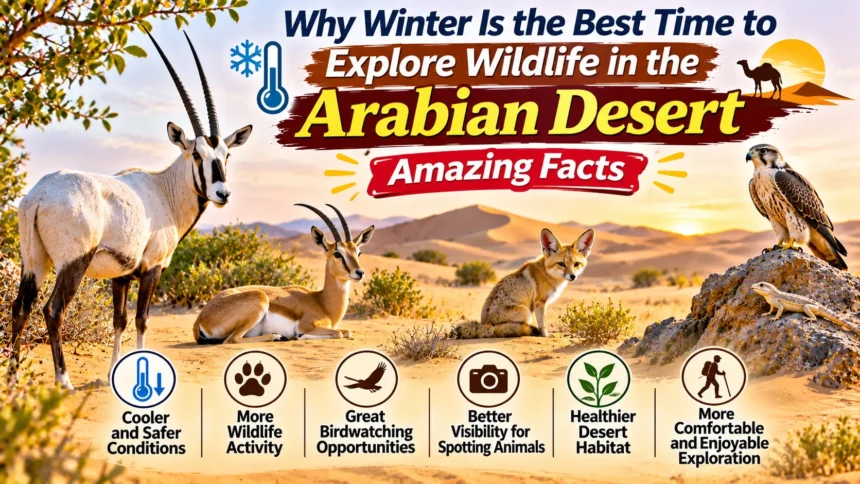
Why Winter Is the Best Time to Explore Wildlife in the Arabian Desert
1. Pleasant Weather Makes Wildlife Exploration Easier
One of the biggest reasons winter is the best time to explore wildlife in the Arabian Desert is the comfortable weather. During summer, temperatures across much of the Arabian Peninsula can become extremely high. The heat makes outdoor activities difficult and can limit the time visitors spend exploring natural habitats.
- 1. Pleasant Weather Makes Wildlife Exploration Easier
- 2. Winter Brings More Opportunities to Observe Desert Animals
- 3. Migratory Birds Make Winter Special for Birdwatchers
- 4. Seasonal Rainfall Supports Desert Vegetation
- 5. Arabian Oryx and Gazelles Are Fascinating Winter Wildlife
- 6. Desert Predators Become an Interesting Part of Wildlife Exploration
- 7. Winter Is a Great Time to Explore Different Desert Habitats
- 8. Best Places to Explore Arabian Desert Wildlife in Winter
- 9. Best Time of Day to Observe Desert Wildlife
- 10. Winter Desert Wildlife Photography and Birdwatching
- 11. How to Explore Desert Wildlife Responsibly
- 12. Conservation Challenges Facing Arabian Desert Wildlife
- Conclusion
- Frequently Asked Questions (FAQs)
Winter brings cooler temperatures, making it easier to walk through desert landscapes, visit nature reserves and observe animals in their natural surroundings.
Across the Arabian Peninsula, winter generally falls between November to March, although seasonal conditions differ between northern, southern and coastal areas. A climate study using temperature data from 1985 to 2022 found that the average winter period begins in late November and continues until late February. It also found regional differences in the timing and length of the season.
The cooler weather offers several advantages for wildlife enthusiasts:
- Outdoor activities become more comfortable.
- Visitors can spend longer exploring desert habitats.
- Morning and evening wildlife observation becomes easier.
- Guided nature walks and desert photography become more enjoyable.
- Birdwatchers can explore wetlands and open landscapes without dealing with intense summer heat.
Animals also respond to changing temperatures. Many desert mammals are most active during the cooler parts of the day, particularly early morning and late evening. Winter can make these periods more comfortable for observation.
However, not every animal becomes more active during winter. Some reptiles prefer warmer conditions and may be less visible on particularly cold days. The exact wildlife activity depends on the species and local weather.
2. Winter Brings More Opportunities to Observe Desert Animals
The Arabian Desert supports different wildlife species, including mammals, reptiles and birds. Many of these animals are naturally difficult to spot because they have developed excellent ways to avoid heat and predators.
During summer, several desert mammals reduce their daytime activity and spend more time resting in shaded or sheltered areas. They may search for food during the cooler hours of the night.
Winter temperatures can create more comfortable conditions for animals to move around their habitats. This can provide visitors with better opportunities to observe wildlife during early morning and late afternoon outings.
Some of the animals that wildlife enthusiasts may encounter include:
- Arabian Oryx: A distinctive desert antelope recognised by its white coat and long, straight horns.
- Arabian Sand Gazelle: A graceful animal adapted to dry landscapes and limited water availability.
- Arabian Red Fox: A clever predator that searches for small mammals, insects and other available food.
- Rüppell’s Sand Fox: A small desert fox with large ears that help it release body heat.
- Sand Cat: A rare wild cat specially adapted to life in sandy desert environments.
- Desert Hedgehog: A small mammal that usually searches for food during the night.
- Spiny-tailed Lizard: A desert reptile commonly known as the dhub.
These animals are not guaranteed to appear during every desert visit. Their visibility depends on the location, weather, time of day and level of human disturbance.
3. Migratory Birds Make Winter Special for Birdwatchers
Winter is one of the most exciting seasons for birdwatching across the Arabian Peninsula. Many birds travel from colder regions of Europe and Asia to warmer parts of the Middle East and Africa.
During winter, many birds travel through the region as part of their seasonal migration. This gives birdwatchers a better chance to spot different birds, along with local birds of prey and desert species.
During these journeys, they use the region’s wetlands, coastal areas, lakes and open desert habitats as important resting and feeding locations.
Oman lies along the Afro-Eurasian bird migration route and provides several habitats for migratory species. Its mountains, deserts, wetlands and coastlines support birds at different stages of their seasonal journeys.
Some migratory birds that can be seen in different parts of Arabia during winter include:
Flamingos: These beautiful pink birds gather around shallow coastal waters and wetlands. Qatar, Kuwait and the UAE provide important winter habitats for Greater Flamingos.
Houbara Bustards: These ground-dwelling birds are closely associated with the dry landscapes of Arabia. Some populations migrate into the Arabian Peninsula during winter.
Steppe Eagles: These large birds of prey travel from northern breeding areas towards warmer wintering regions, including parts of the Middle East.
Sandgrouse: These birds are well adapted to arid environments and can be found in open desert habitats.
Herons and waders: These birds often gather around shallow wetlands, mudflats and coastal lagoons to search for food.
Kuwait’s coastal wetlands are particularly important during winter because many migratory birds arrive from colder areas farther north.
For birdwatchers, winter provides an opportunity to observe both local species and seasonal visitors in the same region.
4. Seasonal Rainfall Supports Desert Vegetation
Winter is also an important period for the natural vegetation of the Arabian Desert. Although the region receives relatively little rainfall, seasonal showers can change the appearance of some desert landscapes.
When rain reaches dry soil, seeds that have remained dormant may begin to grow. Small grasses, flowering plants and fresh shrubs can appear in suitable areas.
This growth provides food for herbivores and helps support other parts of the desert food chain.
The Arabian Peninsula’s rainfall patterns vary by location. The wetter season generally extends from November to April in parts of the region, while rainfall is concentrated in particular areas, especially the southwest.
Fresh vegetation can attract several plant-eating animals, including:
- Arabian oryx.
- Arabian sand gazelles.
- Mountain gazelles.
- Hares.
- Other small herbivores.
These animals feed on grasses, leaves, shoots and other available plant material.
The growth of vegetation also benefits insects and smaller wildlife, which become food sources for birds, foxes and other predators.
However, desert rainfall is unpredictable. Not every winter brings enough rain to produce widespread greenery. The amount of plant growth depends on local rainfall, soil conditions and temperature.
This is part of what makes desert ecosystems interesting: even small changes in water availability can influence wildlife activity.
5. Arabian Oryx and Gazelles Are Fascinating Winter Wildlife
The Arabian oryx and gazelles are two of the best-known animals living in the Arabian Desert. Their appearance and ability to survive in dry environments make them popular subjects for wildlife photography.
Arabian Oryx
The Arabian oryx has a white coat, long straight horns and dark markings on its face. It is well adapted to desert conditions and can survive for long periods without drinking water.
It gets much of its required moisture from vegetation and can travel across large areas in search of food.
One of the most important places for observing and protecting Arabian oryx is the ‘Uruq Bani Ma’arid protected area in Saudi Arabia. Located on the western edge of the Empty Quarter, the reserve supports free-ranging Arabian oryx and Arabian sand gazelles. It became Saudi Arabia’s first natural UNESCO World Heritage Site in 2023.
During cooler weather, animals do not need to hide from the extreme heat as they do in summer. This makes it easier to spot animals like the Arabian oryx and sand gazelles searching for food or moving across open areas.
Arabian Sand Gazelle
The Arabian sand gazelle, also known as Reem, is another remarkable desert animal. It has a light-coloured coat that helps reflect sunlight and blend into sandy surroundings.
These gazelles usually feed on grasses, leaves and desert shrubs. They can survive in environments where fresh water is limited and often move between different feeding areas.
Winter offers favourable conditions for visitors hoping to observe these animals in protected desert landscapes. Early morning and late afternoon are particularly useful times to look for them.
6. Desert Predators Become an Interesting Part of Wildlife Exploration
The Arabian Desert is not only home to herbivores. It also supports several predators that help maintain the natural balance of the ecosystem.
Predators play an important role because they feed on rodents, insects, birds and other small animals.
Some fascinating desert predators include:
Arabian Red Fox
The Arabian red fox is an adaptable animal that lives in different environments, including deserts, mountains and areas near human settlements. It has excellent hearing and smell, which help it locate prey.
Rüppell’s Sand Fox
The sand fox is specially adapted to dry environments. Its large ears help release body heat, while its light-coloured coat helps it blend into sandy landscapes.
Sand Cat
The sand cat is one of the most interesting animals of the Arabian desert. It has thick fur on its paws, which provides protection from hot sand and helps it move across loose desert surfaces.
Arabian Wolf
The Arabian wolf is a rare predator found in parts of the Arabian Peninsula. It mainly feeds on small mammals, birds and other available prey.
These animals are often difficult to see in the wild because many are nocturnal or naturally avoid people. Wildlife observation should therefore focus on patience, guided tracking and respecting their natural behaviour.
7. Winter Is a Great Time to Explore Different Desert Habitats
The Arabian Desert is not made up of endless sand dunes. It includes several different natural environments, each supporting its own wildlife.
Exploring different habitats during winter can help visitors understand the region’s biodiversity.
Sand Dunes
Sand dunes provide habitats for animals such as sand foxes, gerbils and desert reptiles. Their vegetation also offers food and shelter for smaller animals.
Rocky Landscapes
Rocky hills and mountain slopes support different species of gazelles, reptiles and birds of prey. These places also provide natural shelter and nesting sites.
Wadis
Wadis are dry river valleys that may carry water after rainfall. They can support plants, insects and small animals, making them important habitats in otherwise dry areas.
Desert Grasslands and Open Plains
These areas may develop fresh vegetation after seasonal rainfall. They provide feeding opportunities for gazelles, oryx and other grazing animals.
Coastal Wetlands and Oases
Wetlands and water-rich areas within or alongside desert environments attract migratory birds, waterbirds and other wildlife.
For example, Ras Al Khor Wildlife Sanctuary in Dubai supports thousands of wintering birds, including flamingos, ducks, waders and other migratory species.
Exploring these different habitats shows that the Arabian Desert is a diverse ecosystem rather than a landscape made up only of sand.
8. Best Places to Explore Arabian Desert Wildlife in Winter
Several protected areas across the Arabian Peninsula provide opportunities to learn about native wildlife and conservation.
Dubai Desert Conservation Reserve, UAE
The Dubai Desert Conservation Reserve is one of the region’s important protected desert areas. It supports Arabian oryx, gazelles, foxes, reptiles and several bird species.
It also provides habitat for the MacQueen’s Bustard, Pharaoh Eagle Owl and other birds of conservation interest.
Al Marmoom Desert Conservation Reserve, UAE
Al Marmoom is a large protected desert landscape in Dubai. It supports Arabian oryx, mountain gazelles, sand gazelles and a wide variety of birds and reptiles.
Its natural ecosystems and lakes provide opportunities for wildlife observation and birdwatching.
Qasr Al Sarab Protected Area, Abu Dhabi
Located in the Al Dhafra region, this protected area covers natural sand dunes and coastal salt flats.
According to Abu Dhabi’s Environment Agency, it supports more than 30 bird species, 13 reptile species and 10 mammal species, including Arabian oryx.
‘Uruq Bani Ma’arid, Saudi Arabia
This protected landscape is located on the western edge of the Empty Quarter. It is especially important for Arabian oryx and Arabian sand gazelles.
Its dunes, wadis and rocky landscapes support a rich variety of desert wildlife. UNESCO recognised it as a World Heritage Site in 2023.
Oman’s Desert and Coastal Habitats
Oman offers different wildlife experiences through its mountain ranges, central desert, wadis and coastal wetlands.
Its location along the Afro-Eurasian Flyway makes it particularly valuable for observing migratory birds during the winter season.
These locations have different access rules. Visitors should check protected-area regulations before planning a trip, as some conservation zones require permission or guided access.
9. Best Time of Day to Observe Desert Wildlife
Winter provides good opportunities for wildlife observation, but choosing the right time of day is equally important.
Many desert animals avoid direct sunlight and become more active when temperatures are comfortable. Therefore, early morning and late afternoon are often the best times to explore the desert.
Early Morning
The hours after sunrise are suitable for observing gazelles, oryx and some desert birds. Animals may leave their resting areas to search for food and water.
Morning light is also useful for nature photography because it creates soft shadows and brings out the colours of desert landscapes.
Late Afternoon
As the temperature begins to fall, some animals become active again. Gazelles may move towards feeding areas, while birds can often be seen flying between resting and feeding locations.
Night-time Wildlife Exploration
Some desert animals are mainly active after sunset. Desert foxes, sand cats, hedgehogs and other nocturnal species may become more active during the night.
However, night-time wildlife observation should always be conducted responsibly, preferably with experienced guides who understand local wildlife and protected-area rules.
10. Winter Desert Wildlife Photography and Birdwatching
Winter offers excellent conditions for wildlife photography because the weather is generally more comfortable and visitors can spend longer outdoors.
The softer sunlight during early morning and evening also helps photographers capture natural colours and animal behaviour.
Here are some useful tips for photographing desert wildlife:
- Use a zoom lens: A telephoto lens helps capture animals from a safe distance without disturbing them.
- Choose suitable lighting: Morning and evening light can produce clearer and more attractive wildlife photographs.
- Be patient: Animals may take time to appear, so avoid moving around too frequently.
- Avoid sudden movements: Loud noises and quick movements can frighten wildlife.
- Use binoculars: These are useful for observing distant birds and mammals.
- Respect wildlife: Never approach animals or try to attract them with food for a photograph.
Birdwatching is another enjoyable winter activity. Migratory birds can be observed around wetlands, coastal lagoons, desert lakes and open landscapes.
Keeping a simple wildlife checklist can also help visitors identify different species and learn more about the biodiversity of the Arabian Peninsula.
11. How to Explore Desert Wildlife Responsibly
Winter tourism brings more visitors to Arabian deserts, which creates opportunities to promote nature education and conservation. However, increased human activity can also disturb sensitive habitats.
Responsible wildlife exploration helps protect animals while allowing visitors to enjoy their natural surroundings.
Some important practices include:
- Stay on approved roads and designated walking routes.
- Never chase animals or approach their young.
- Avoid loud music and unnecessary vehicle noise.
- Do not feed wild animals.
- Keep plastic, food waste and other rubbish away from natural habitats.
- Avoid shining bright lights directly at nocturnal animals.
- Never damage plants or disturb nesting areas.
- Follow the instructions of wildlife guides and reserve authorities.
Driving off established tracks can damage desert vegetation and disturb animals living beneath the sand. It can also destroy small habitats that take a long time to recover.
Visitors should remember that wildlife observation is about understanding animals in their natural environment, not forcing them to appear.
12. Conservation Challenges Facing Arabian Desert Wildlife
Although winter provides better opportunities to explore wildlife, animals across the Arabian Peninsula continue to face serious environmental challenges.
Habitat destruction: Roads, urban development and other construction activities can reduce natural habitats and separate wildlife populations.
Water scarcity: Many desert animals depend on limited natural water sources. Long periods without rain can affect plants, prey populations and the availability of drinking water.
Climate change: Rising temperatures and changing rainfall patterns can affect vegetation, migration and breeding conditions. These changes may put additional pressure on species already adapted to harsh environments.
Illegal hunting: Uncontrolled hunting can reduce populations of gazelles, bustards and other wildlife.
Human disturbance: Off-road driving, littering, excessive noise and poorly managed tourism can affect feeding and resting behaviour.
Several conservation projects across Arabia are working to address these problems.
For example, Saudi Arabia’s ‘Uruq Bani Ma’arid protected area supports the reintroduction of Arabian oryx and gazelles. Dubai’s desert conservation reserves also protect important habitats for native mammals, reptiles and birds.
Protecting wildlife requires regular monitoring, habitat restoration, responsible tourism and cooperation between governments, scientists and local communities.
Conclusion
Winter is one of the most rewarding times to explore wildlife in the Arabian Desert. Cooler temperatures make outdoor exploration more comfortable, seasonal rainfall can support fresh vegetation, and migratory birds bring additional life to the region’s wetlands and open landscapes.
From the graceful Arabian oryx and sand gazelle to desert foxes, rare sand cats and colourful migratory birds, the Arabian Peninsula offers many opportunities to understand wildlife and its ability to survive in challenging environments.
Protected areas such as Dubai Desert Conservation Reserve, Al Marmoom, Qasr Al Sarab and Saudi Arabia’s ‘Uruq Bani Ma’arid demonstrate the importance of maintaining natural habitats for future generations.
However, winter wildlife exploration is about more than spotting animals. It is also an opportunity to understand the relationship between wildlife, climate and the environment.
By choosing responsible nature activities, respecting protected areas and supporting conservation projects, visitors can help preserve the Arabian Desert’s natural beauty and biodiversity.
The next time you explore the Arabian Desert during winter, look beyond the sand dunes. You may discover a world of wildlife that is active, fascinating and essential to the region’s natural heritage.
Frequently Asked Questions (FAQs)
1. Why is winter the best time to explore wildlife in the Arabian Desert?
Winter brings cooler temperatures and more comfortable outdoor conditions. It also coincides with the arrival of many migratory birds, making it a suitable season for wildlife observation and nature photography.
2. Which animals can be seen in the Arabian Desert during winter?
Visitors may encounter Arabian oryx, sand gazelles, Arabian foxes, sand cats, desert hedgehogs, reptiles and different species of birds. Sightings depend on the location and weather.
3. When does winter wildlife season begin in Arabia?
Winter generally begins around November and continues through February, although the exact timing varies across the Arabian Peninsula.
4. What is the best time of day to see desert animals?
Early morning and late afternoon are generally good times to observe mammals and birds. Some nocturnal animals are more active after sunset.
5. Can visitors see migratory birds in the Arabian Desert during winter?
Yes. The Arabian Peninsula receives many migratory birds during winter. Wetlands, desert lakes and coastal habitats provide important feeding and resting areas.
6. Where can visitors explore wildlife in the Arabian Desert?
Popular protected areas include Dubai Desert Conservation Reserve, Al Marmoom Desert Conservation Reserve, Qasr Al Sarab Protected Area and ‘Uruq Bani Ma’arid in Saudi Arabia.
7. Why do some desert animals become more active during winter?
Cooler temperatures can make it easier for some animals to search for food, move between habitats and spend time outside. However, activity patterns differ between species.
8. Does winter rainfall help desert wildlife?
Yes. Rainfall can encourage plant growth and increase food availability for herbivores. This can also benefit insects and predators that depend on other animals.
9. Is winter a good time for desert wildlife photography?
Yes. Comfortable temperatures and softer morning and evening light make winter a good season for wildlife photography and birdwatching.
10. How can visitors protect wildlife during desert exploration?
Visitors should stay on approved routes, avoid feeding or chasing animals, reduce noise, dispose of waste properly and follow the rules of protected areas.
Do follow us on Instagram
Read More – The Science Behind Animal Migration