How AI Inspection Drones Could Improve Middle East Maintenance
Across the Gulf Cooperation Council, infrastructure development continues to play an important role in economic growth. Roads, bridges, railway networks, electricity systems, telecommunications towers, industrial facilities, and ports support the daily movement of people, goods, energy, and information.
- 1. Why Autonomous Inspection Drones in the Gulf Are Becoming Important
- 2. How Dubai’s Infrastructure Projects Demonstrate Drone Inspection Benefits
- 3. What Saudi Arabia’s Energy Sector Reveals About Industrial Drone Applications
- 4. How AI, Thermal Imaging, and Digital Twins Could Improve Maintenance Decisions
- 5. Could Autonomous Drones Make Infrastructure Maintenance Safer and More Efficient?
- 6. The Regulatory, Technical, and Safety Challenges of Autonomous Drone Inspection
- 7. The Future of Autonomous Infrastructure Inspection Across the GCC
- Conclusion
However, building infrastructure is only one part of the challenge. Maintaining these assets safely and efficiently over many years requires continuous inspection, reliable data, skilled engineers, and appropriate repair planning.
Traditional inspection methods often involve workers accessing difficult locations, operating elevated platforms, entering confined spaces, or temporarily restricting access to important infrastructure.
These activities can be expensive, time-consuming, and potentially hazardous.
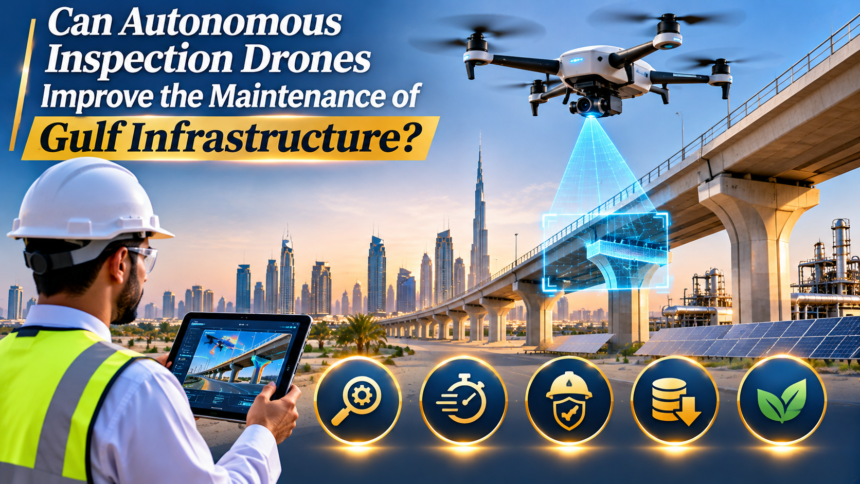
As a result, autonomous inspection drones in the Gulf are attracting attention as a technology that could make infrastructure monitoring more efficient and support better maintenance decisions.
Equipped with cameras, thermal sensors, navigation systems, and artificial intelligence software, inspection drones can collect information from locations that may be difficult to examine through conventional methods.
Some systems can follow predefined inspection routes, identify potential surface defects, and organise the captured information into digital reports.
Others use remote pilots or human supervisors to control flights and review results.
This distinction matters because not every drone-based inspection is autonomous. A drone operating through a remotely controlled flight is different from one navigating largely through onboard automated systems.
Across the GCC, existing projects demonstrate the potential of these technologies.
Dubai’s Roads and Transport Authority has used drones to inspect Metro tunnels, while e& UAE announced autonomous drone-based inspections of telecommunications towers in April 2025. Saudi Aramco has also documented drone applications involving pipelines, industrial facilities, and energy infrastructure.
However, drones cannot replace every conventional inspection method.
Detailed material testing, underground defect detection, structural assessment, and maintenance repairs may still require engineers, specialist equipment, and direct physical examination.
The future of drone-based inspection will therefore depend on how successfully this technology complements existing infrastructure management.
1. Why Autonomous Inspection Drones in the Gulf Are Becoming Important
Infrastructure maintenance involves examining assets regularly to identify damage, deterioration, operational problems, or potential safety concerns.
These inspections help asset owners determine whether repairs, further testing, or replacement may be necessary.
As cities and industrial networks grow, maintaining infrastructure becomes more complicated.
The Challenge of Large Infrastructure Networks
A transport authority may be responsible for roads, bridges, tunnels, stations, and associated equipment spread across a large geographical area.
Electricity utilities must monitor transmission lines, substations, and generation facilities.
Telecommunications providers maintain towers and antennas in urban, industrial, and remote environments.
Inspecting all these assets requires substantial coordination.
Some sites can be examined from the ground, while others require access equipment or specially trained teams.
What Makes a Drone Autonomous?
An inspection drone may operate at different levels of automation.
A manually piloted drone is controlled directly by an operator.
An automated drone may follow a programmed route while allowing human intervention.
A more autonomous system may use onboard sensors and software to navigate obstacles or adjust its flight.
Even where a company describes its system as autonomous, human supervision, regulatory restrictions, and operational safeguards may still apply.
Why Gulf Conditions Create Additional Challenges
The region’s climate can expose infrastructure to heat, airborne dust, humidity, and, in some coastal areas, salt-related corrosion.
These conditions can affect assets as well as inspection equipment.
Drone operations must therefore account for temperature limits, visibility, wind conditions, battery performance, and sensor reliability.
The suitability of a drone depends on the specific environment.
Infrastructure Inspection Approaches Compared
| Inspection Method | Main Advantage | Important Limitation |
|---|---|---|
| Manual Visual Inspection | Direct professional examination | Access and safety challenges |
| Rope Access | Close inspection of elevated areas | Specialist workers required |
| Elevated Platforms | Stable access to certain structures | Equipment and traffic constraints |
| Remotely Piloted Drones | Aerial images without direct access | Requires trained operators |
| Automated Inspection Drones | Repeatable flight routes | Requires approved operating conditions |
| Autonomous Inspection Systems | Potential adaptive navigation | Complex validation and oversight |
| Ground Robots | Inspection in selected confined areas | Limited mobility across some environments |
Why Drone Technology Deserves Attention
The strongest opportunity is not necessarily replacing conventional inspections.
It is improving how asset owners identify which locations require closer professional examination.
2. How Dubai’s Infrastructure Projects Demonstrate Drone Inspection Benefits
Dubai provides several examples of organisations using drone technology to support infrastructure management.
These projects cover rail transport, electricity networks, telecommunications, and municipal operations.
Dubai Metro Tunnel Inspections
On December 22, 2025, Dubai’s Roads and Transport Authority announced that it had deployed drone technology to inspect Dubai Metro tunnels in collaboration with rail operator Keolis MHI.
The authority reported a 60% reduction in inspection duration.
It also highlighted improved access to difficult tunnel areas and the ability to capture high-resolution images.
The drone-based process supports automated data collection and digital inspection reports.
However, the announcement did not establish that every tunnel inspection was completed without human supervision.
Why Tunnel Inspection Is Difficult
Railway tunnels contain structural surfaces, cables, equipment, ventilation systems, and other assets requiring regular examination.
Inspection activities may need to be scheduled around railway operations and safety procedures.
Drone imagery can provide a broader view of selected areas and reduce the need for personnel to access certain locations directly.
However, important defects may still require physical measurements or specialist testing.
DEWA’s Use of Drone Technology
Dubai Electricity and Water Authority has used drones and robotic systems as part of its infrastructure monitoring activities.
DEWA reported in August 2025 that it uses nanosatellites, drones, and smart robots to inspect overhead and underground infrastructure and identify potential problems.
Its Smart Grid Report 2025 also documented a completed drone pilot for overhead line inspection and maintenance applications.
These activities demonstrate how utility inspection can become part of a wider digital asset-management strategy.
However, a completed pilot is not the same as confirming autonomous inspection across every electricity asset.
e& UAE’s Autonomous Telecom Tower Inspections
In April 2025, e& UAE announced an autonomous drone-based inspection initiative for telecommunications towers.
According to the company, its drones use AI analytics and automated flight capabilities while being monitored by expert teams through a Drone Operations Centre.
The system can collect visual information and identify potential structural anomalies for further action.
This provides a clear example of autonomy combined with human operational oversight.
Dubai’s Smart Municipality Initiatives
In November 2025, Dubai Municipality announced cooperation with Eanan Al Samma to develop AI-enabled drone applications for municipal inspection and field services.
The initiative forms part of a wider effort to support digital urban management.
However, the announcement should be distinguished from independently verified citywide deployment.
Selected UAE Examples
| Organisation | Application | Reported Status |
|---|---|---|
| Dubai RTA | Metro tunnel inspection | Deployment announced in December 2025 |
| DEWA | Electricity infrastructure monitoring | Existing drone uses and documented pilot |
| e& UAE | Autonomous telecom tower inspection | Launch announced in April 2025 |
| Dubai Municipality | Drone and AI-supported municipal operations | Development collaboration |
These examples illustrate different operating models, technical capabilities, and stages of implementation.
3. What Saudi Arabia’s Energy Sector Reveals About Industrial Drone Applications
Saudi Arabia’s energy industry provides further evidence of the practical role inspection drones can play in large industrial facilities.
Oil and gas infrastructure contains equipment that may be difficult, hazardous, or costly to inspect through conventional access methods.
Aramco’s Experience With Inspection Drones
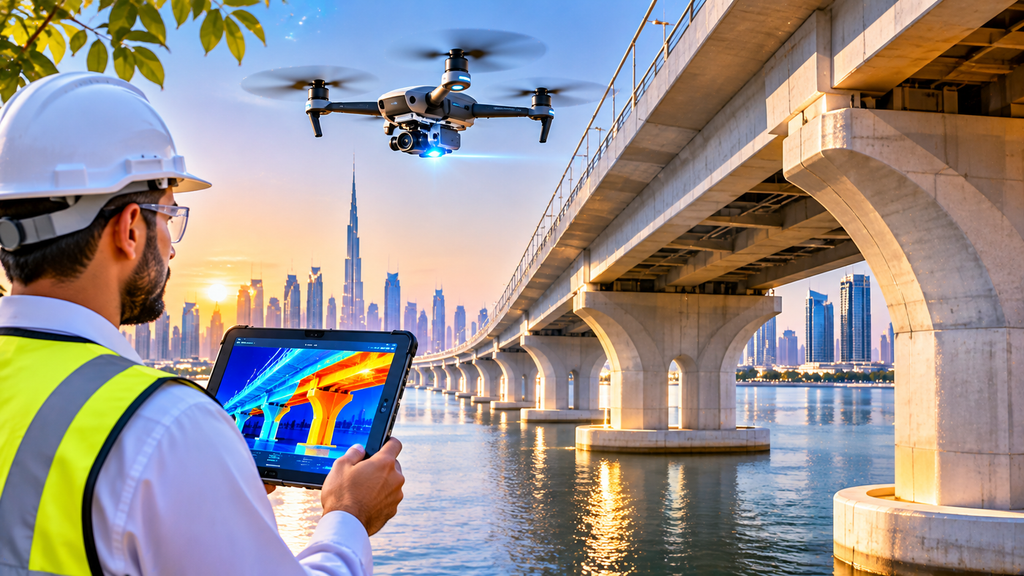
Saudi Aramco has documented the use of drones for inspecting pipelines, storage tanks, energy facilities, and power infrastructure.
In its 2024 report on drone applications, the company explained that drone technology had supported inspection activities across onshore and offshore operations.
The technology also contributes to aerial mapping, emergency response, and environmental monitoring.
These applications demonstrate the breadth of potential uses within a large industrial organisation.
Inspection Time Improvements
Aramco’s digitalisation materials state that drones and wearable technology helped reduce pipeline and machinery inspection times by approximately 90% in the relevant operations.
This is a company-reported figure associated with specific applications.
It should not be applied to every Aramco facility or treated as a general GCC-wide improvement rate.
The Role of Specialised Technology Providers
In April 2025, Reuters reported that Japanese drone company Terra Drone planned to expand cooperation with Aramco on energy infrastructure inspection.
The company had established a Saudi subsidiary in 2023.
This illustrates how demand for industrial inspection may create opportunities for specialist service providers.
However, expanded cooperation does not automatically establish the scale of operational deployment or financial returns.
Beyond Aerial Drones
Some industrial environments require other robotic approaches.
Aramco has also explored underwater inspection robots, while researchers at King Fahd University of Petroleum and Minerals have worked on autonomous systems for cleaning and inspecting large industrial vessels.
These technologies demonstrate the importance of choosing the appropriate type of robot for each environment.
An aerial drone is not suitable for every pipeline, tank, or underwater structure.
Industrial Applications Compared
| Asset | Possible Drone Application | Further Inspection Requirement |
|---|---|---|
| Aboveground Pipelines | Visual or thermal surveys | Leak testing and engineering checks |
| Storage Tanks | Exterior or selected interior imaging | Material thickness measurements |
| Power Equipment | Thermal anomaly detection | Electrical safety assessment |
| Industrial Structures | Surface damage photography | Structural evaluation |
| Offshore Facilities | Inspection of difficult access areas | Specialist marine and engineering work |
| Large Vessels | Robotic internal inspection | Approved nondestructive testing |
Why Industrial Safety Matters
Reducing the need for people to enter hazardous locations can be valuable.
However, drones introduce their own risks involving collisions, equipment failures, ignition sources, and emergency procedures.
Industrial facilities must assess whether particular aircraft and equipment are suitable for their operating environment.
4. How AI, Thermal Imaging, and Digital Twins Could Improve Maintenance Decisions
Drone technology becomes more useful when its collected information can support accurate maintenance decisions.
High-resolution photographs are valuable, but asset managers also need a way to organise, compare, and interpret them.
Artificial intelligence and digital asset models may support this process.
Computer Vision and Defect Detection
Computer vision systems can analyse images to identify features such as visible cracks, corrosion, missing components, or unusual surface conditions.
A trained model may flag areas requiring further examination.
However, detection accuracy depends on image quality, training data, lighting, surface conditions, and the types of defects being assessed.
An AI-generated alert should not automatically be treated as confirmation of structural damage.
Thermal Inspection
Thermal cameras can detect differences in surface temperature.
In selected applications, abnormal temperature patterns may indicate electrical problems, insulation deficiencies, or equipment operating conditions requiring investigation.
However, a thermal image does not directly reveal the cause of a problem.
Temperature patterns can be influenced by weather, sunlight, material properties, and operating loads.
Professional interpretation remains necessary.
Photogrammetry and Three-Dimensional Models
Overlapping drone photographs can be processed into three-dimensional representations of structures.
This technique, called photogrammetry, may support measurement, visual documentation, and comparison over time.
However, the accuracy of the resulting model depends on camera calibration, image coverage, control points, and processing methods.
A visually detailed model is not necessarily suitable for precise engineering measurements.
Digital Twins
A digital twin represents aspects of a physical asset using connected information and models.
Drone imagery may contribute to maintaining a digital representation of a bridge, industrial plant, or building.
However, an ordinary 3D model does not automatically qualify as a functioning digital twin.
A meaningful digital twin generally requires appropriately managed information about the asset and its condition.
AI and Drone Technologies Compared
| Technology | Main Function | Key Limitation |
|---|---|---|
| High-Resolution Cameras | Visual documentation | Cannot reveal every hidden defect |
| Thermal Cameras | Surface temperature analysis | Requires environmental interpretation |
| Computer Vision | Flag visible anomalies | False positives and missed defects |
| Photogrammetry | Build 3D models from images | Accuracy depends on survey design |
| LiDAR | Capture spatial measurements | Cost and sensor limitations |
| Digital Twins | Combine models and asset information | Requires reliable data management |
| Predictive Analytics | Estimate maintenance risks | Depends on validated historical data |
Why Repeated Inspections Could Matter
When drone surveys are performed using consistent methods, asset managers may compare images across different periods.
This can help identify visible changes that deserve attention.
However, differences in lighting, camera position, and resolution can create misleading comparisons.
Standardised inspection procedures are therefore important.
5. Could Autonomous Drones Make Infrastructure Maintenance Safer and More Efficient?
One of the strongest arguments for drone inspection is reducing the need for workers to access difficult locations.
However, economic and safety benefits should be measured through actual operating conditions.
Reducing Work at Height
Inspecting telecommunications towers, bridge structures, and industrial equipment can require workers to operate at considerable heights.
Drones may allow selected visual examinations without placing inspectors directly beside the structure.
This can reduce some exposure to fall hazards.
However, the remaining inspection and repair tasks may still require qualified personnel.
Potentially Reducing Service Disruptions
Some inspections require temporary closures, access restrictions, or carefully scheduled maintenance windows.
Drone-based imaging may reduce the duration of selected activities.
Dubai RTA’s reported reduction in Metro tunnel inspection time provides one practical example.
However, this improvement should not be assumed for every bridge, road, railway, or industrial installation.
Improving Maintenance Prioritisation
Large infrastructure owners may face more potential repair needs than can be addressed immediately.
Consistent inspection data may help engineers prioritise further investigation.
For example, a system that identifies visible deterioration could help direct a maintenance team toward a specific component.
However, actual repair priorities should be based on engineering risk assessment.
Understanding the Financial Case
Drone operations involve purchase or service fees, trained personnel, insurance, maintenance, software, and data management.
Autonomous systems may also require docking infrastructure, communications links, and additional security controls.
The financial benefit should be evaluated against these costs.
Illustrative Inspection Cost Comparison
The following figures are hypothetical and are not market quotations.
| Cost Item | Conventional Inspection | Drone-Assisted Inspection |
|---|---|---|
| Access equipment and mobilisation | AED 12,000 | AED 3,000 |
| Inspection personnel and operations | AED 10,000 | AED 7,000 |
| Data processing and reporting | AED 3,000 | AED 6,000 |
| Total illustrative cost | AED 25,000 | AED 16,000 |
The illustration excludes several possible expenses, including permits, specialised testing, emergency arrangements, and follow-up engineering work.
It demonstrates how a drone-assisted method could cost less for an appropriate task, not that such savings are guaranteed.
Why Total Inspection Quality Is More Important Than Cost Alone
A cheaper aerial survey provides little value if it fails to detect important problems.
Infrastructure owners should assess inspection completeness, accuracy, safety, and the quality of maintenance decisions alongside operational cost.
6. The Regulatory, Technical, and Safety Challenges of Autonomous Drone Inspection
Drones operating near critical infrastructure require careful management.
Airspace restrictions, operational safety, cybersecurity, privacy, and technical reliability can determine whether a proposed inspection is permissible or practical.
UAE Aviation Rules and Temporary Restrictions
The UAE regulates civil drone activity through federal aviation legislation and relevant local requirements.
Dubai also has its own rules governing drone operations.
In addition, the UAE General Civil Aviation Authority issued Safety Decision 2026-03, Issue 03, dated April 27, 2026.
The decision imposed a temporary suspension on specified commercial and recreational drone operations, while excluding operations authorised under Part SPO from the scope of that particular suspension and allowing specifically authorised exemptions.
Because aviation restrictions can change, infrastructure operators must verify the latest official notices before planning or conducting flights.
Historical drone deployments do not establish that equivalent operations are currently permitted.
Autonomous Flight and Beyond-Visual-Line-of-Sight Operations
Automated flight does not necessarily mean a drone is operating beyond the visual line of sight of a pilot.
Beyond-visual-line-of-sight operations, commonly called BVLOS, introduce additional safety considerations.
Depending on national rules, these may require particular approvals, risk assessments, communications systems, and procedures.
Operators should not assume that automated route-following provides permission for unrestricted flights.
Cybersecurity and Critical Infrastructure
Inspection drones may capture sensitive images of energy facilities, telecommunications systems, ports, and transport networks.
Their communications and stored data need appropriate protection.
A compromised drone system could create information security or operational risks.
Strong authentication, encryption, secure updates, and access controls are therefore important.
Technical Limitations
Drones can experience battery limitations, sensor failures, navigation difficulties, and disruptions caused by weather.
Dust may reduce visibility, while strong winds can affect flight stability.
Indoor tunnels and industrial structures may also limit satellite navigation signals.
Safe systems require appropriate alternatives, monitoring, and emergency procedures.
Why Drones Cannot Replace All Structural Inspections
A 2026 review of drone applications in bridge inspection found that conventional UAVs are particularly effective for visual documentation and photogrammetry.
However, activities requiring material sampling, tactile testing, hammer sounding, or internal defect measurements may still need specialised equipment.
Some advanced robotic systems are being developed to address these limitations, but they are not equivalent to ordinary camera drones.
Risks and Appropriate Responses
| Risk | Possible Consequence | Management Response |
|---|---|---|
| Unauthorised Flight | Regulatory violation | Verify current permissions |
| Collision | Damage or injury | Flight planning and obstacle avoidance |
| Data Breach | Exposure of sensitive information | Cybersecurity controls |
| Sensor Errors | Incorrect inspection findings | Calibration and validation |
| Weather Conditions | Unsafe or unreliable operation | Operating limits |
| AI Misclassification | Missed defects or false alarms | Engineer review |
| Battery Failure | Loss of aircraft | Contingency procedures |
| Incomplete Inspection | Undetected deterioration | Complementary testing |
Why Human Accountability Remains Essential
Even highly automated systems require clear responsibility.
Infrastructure owners, operators, inspectors, and engineers should understand who approves flights, reviews findings, and authorises repairs.
Autonomy should improve decision support rather than remove professional accountability.
7. The Future of Autonomous Infrastructure Inspection Across the GCC
Autonomous inspection technology could become more useful as infrastructure owners adopt digital asset management, advanced sensors, and AI-supported maintenance planning.
However, its adoption will depend on regulatory approval, cost, technical suitability, and demonstrated operational value.
Drone-in-a-Box Systems
A drone-in-a-box arrangement typically uses a docking station that can support automated launch, landing, battery charging, and data transfer.
Under suitable conditions, these systems may enable more frequent inspections of selected assets.
However, unattended operations still require appropriate aviation permissions, communications reliability, safety controls, and maintenance.
Saudi Aramco’s published robotics opportunity materials identify autonomous drone-in-a-box systems among areas of interest.
That does not establish that every such concept has entered routine operation.
Combining Drone Data With Maintenance Systems
Drone observations may become more valuable when integrated with maintenance databases.
For example, a potential defect identified in an image could be linked to an asset record and assigned for engineering review.
The result might generate a maintenance work order after validation.
However, this requires reliable data standards and clearly defined responsibility for approving actions.
A Practical Drone Inspection Adoption Checklist
- Identify infrastructure assets suitable for drone inspection.
- Define the engineering purpose and required accuracy.
- Verify current aviation restrictions and permissions.
- Determine the appropriate level of automation.
- Assess site safety and environmental conditions.
- Select suitable cameras and sensing equipment.
- Establish secure communications and data handling.
- Train or engage qualified operating personnel.
- Develop emergency and equipment recovery procedures.
- Validate AI-generated findings against engineering assessments.
- Combine aerial surveys with required physical testing.
- Evaluate costs and inspection quality through pilot projects.
- Establish procedures for maintenance decisions.
- Review system performance regularly.
How Infrastructure Owners Should Measure Success
The number of flights completed does not establish whether an inspection programme is effective.
Asset owners should evaluate the quality of information collected, operational safety, financial performance, and actual maintenance outcomes.
Suggested Performance Indicators
| Indicator | What It Measures |
|---|---|
| Inspection Coverage | Proportion of target assets examined |
| Inspection Duration | Time required per survey |
| Defect Detection Accuracy | Reliability of identified anomalies |
| False Alarm Rate | Unnecessary maintenance alerts |
| Worker Exposure | Reduction in hazardous access tasks |
| Total Inspection Cost | Full cost of completed inspections |
| Data Quality | Image and measurement reliability |
| Regulatory Compliance | Adherence to flight permissions |
| Maintenance Response Time | Time from finding to action |
| Asset Reliability | Performance of infrastructure over time |
Opportunities for GCC Technology Companies
Drone inspection could create opportunities for robotics developers, surveying companies, AI specialists, engineering consultancies, sensor suppliers, and data-management providers.
Universities may contribute research into autonomous navigation, corrosion detection, structural analysis, and robotic inspection systems.
However, technical innovation must be supported by appropriate validation and regulatory compliance.
The Role of Hybrid Inspection Models
For many assets, the most practical future approach may involve combining drones with conventional methods.
An aerial survey might identify a suspicious surface condition.
A qualified engineer could then determine whether close inspection, material testing, or repair is required.
This allows technology to improve information collection without weakening professional engineering standards.
Conclusion
Autonomous inspection drones could improve Gulf infrastructure maintenance by making selected inspections faster, safer, and more informative.
Their potential is particularly relevant to large infrastructure networks involving electricity, transportation, telecommunications, industrial facilities, and other critical assets.
Existing projects provide evidence of practical use.
Dubai RTA has reported shorter Metro tunnel inspection times, e& UAE has introduced autonomous telecom tower inspection technology, and Saudi Aramco has documented drone applications across energy infrastructure.
However, not every drone programme is fully autonomous, and the benefits achieved in one environment cannot automatically be applied across all infrastructure sectors.
Autonomous inspection also faces important restrictions involving aviation safety, cybersecurity, sensor reliability, and the limitations of visual assessment.
For infrastructure owners, the priority should be identifying inspection tasks where drones offer clear operational advantages.
For engineers, drone imagery should provide additional evidence rather than replace professional assessment.
For regulators and technology developers, safe integration will require reliable standards, appropriate permissions, and accountability.
Ultimately, the strongest contribution of autonomous inspection drones may be their ability to make infrastructure maintenance more informed and proactive.
By combining aerial data collection, intelligent analysis, and qualified engineering judgement, Gulf infrastructure operators could build inspection systems that support safer operations and more effective long-term asset management.
Do follow us on Instagram
Read More – Why Quantum-Safe Encryption Matters for the Future of Middle Eastern Banking