Why Protecting Arabian Desert Flora Matters for Biodiversity
The Arabian Desert is often imagined as a vast landscape of golden sand dunes, intense sunshine and almost endless stretches of dry land. From Saudi Arabia’s Empty Quarter to the rocky deserts of Oman and the United Arab Emirates, the region is known for its extreme temperatures and limited rainfall.
- 1. The Arabian Desert’s Extreme Climate Has Created Remarkable Plant Adaptations
- 2. The Ghaf Tree Is One of Arabia’s Most Extraordinary Desert Survivors
- 3. Arta, Arfaj and Saltbush Reveal the Diversity of Desert Plant Life
- 4. The Empty Quarter Supports Plants That Survive in One of the World’s Harshest Landscapes
- 5. Southern Arabia Is Home to Rare Plants Found in Very Few Other Places
- 6. Seasonal Rainfall Can Transform Desert Ground Into Wildflower Habitats
- 7. Arabian Desert Plants Support Wildlife, Soil Stability and Traditional Knowledge
- 8. Why Conservation Is Essential for the Future of Arabian Desert Plants
- Conclusion: Arabia’s Plants Are Extraordinary Examples of Natural Adaptation
At first glance, these conditions may seem unsuitable for plant life. Yet the Arabian Peninsula supports a remarkable variety of trees, shrubs, grasses and seasonal wildflowers that have developed extraordinary ways to survive.
Some plants grow deep roots to reach underground moisture. Others produce tiny leaves, tolerate salty soils or remain dormant until rain provides the conditions needed for growth. Certain species can survive for years in environments where water is scarce and temperatures change dramatically between day and night.
These adaptations make Arabian desert plants an important part of the region’s natural heritage.
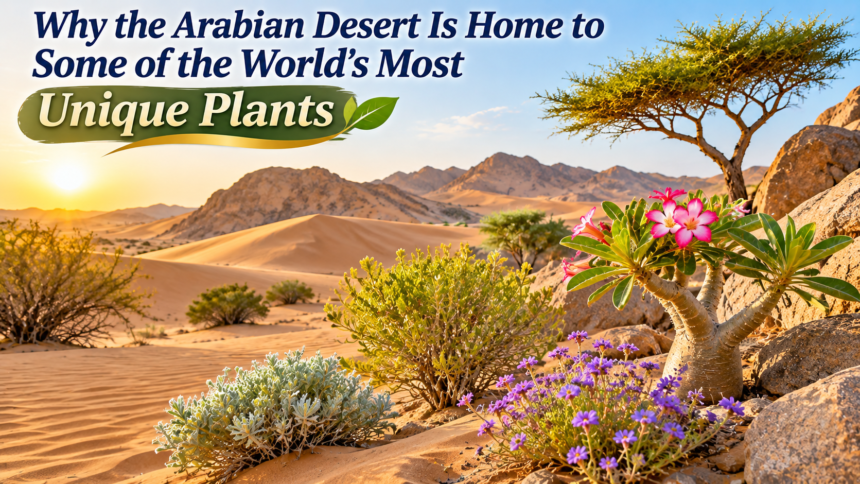
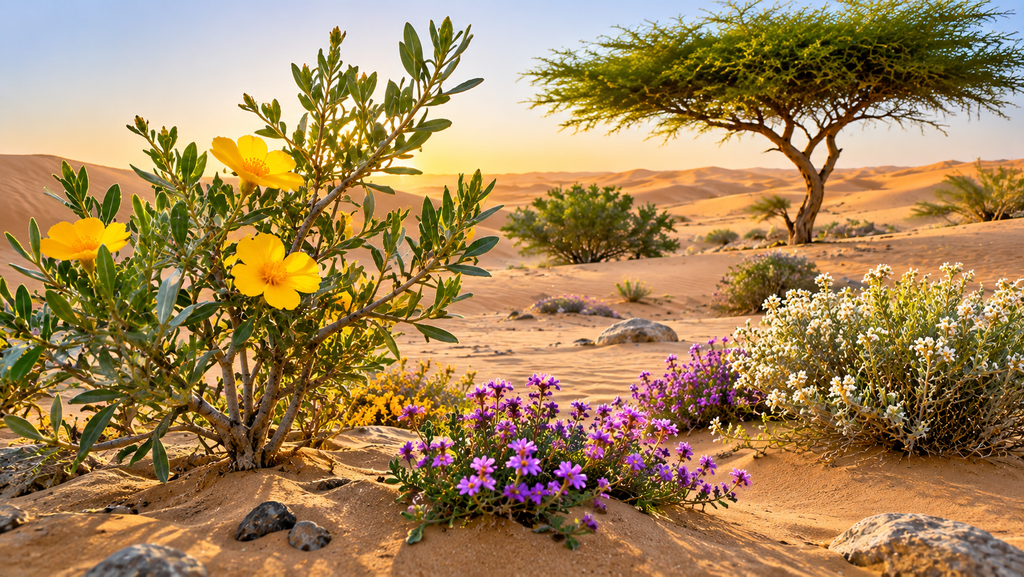
Among the best-known species is the ghaf tree, a symbol of resilience in the UAE. Other examples include the drought-tolerant arta shrub, the yellow-flowering arfaj, the desert-growing saltbush and the remarkable desert rose found in parts of southern Arabia.
What makes the region particularly interesting is that its plant life is not limited to one type of desert. Sandy dunes, gravel plains, rocky mountains, coastal salt flats and fog-influenced environments support different botanical communities.
A scientific review published in the journal Plants in 2024 describes the Arabian Peninsula as a meeting point for plant species with African, Mediterranean and Asian biogeographic connections. Its varied geography and environmental history have helped create distinctive plant communities, including species found nowhere else. PubMed Central (PMC)
However, Arabian desert vegetation faces increasing pressure from overgrazing, habitat disturbance, urban expansion and climate change.
Understanding how these plants survive, and why they matter, can help strengthen conservation efforts across Saudi Arabia, the UAE, Oman and neighbouring countries.
1. The Arabian Desert’s Extreme Climate Has Created Remarkable Plant Adaptations
The Arabian Desert is among the world’s most challenging environments for vegetation.
Rainfall can be limited and unpredictable, summer temperatures are often extremely high, and strong winds can move large quantities of sand.
In many places, the soil contains little organic matter and offers limited moisture near the surface.
Yet desert plants have evolved different strategies to cope with these difficulties.
Surviving with limited water
One important adaptation is the ability to obtain or conserve water efficiently.
Some species develop extensive root systems that explore large areas of soil.
Others reduce the amount of water lost through their leaves.
Plants may also slow their growth during dry periods and respond quickly when rainfall becomes available.
A 2025 study of native UAE desert plants investigated drought-tolerance responses in Lycium shawii, Salvadora persica, Calligonum comosum and Haloxylon salicornicum.
The research examined physiological and biochemical responses under different water availability conditions, illustrating that desert species use different strategies to tolerate drought. PubMed Central (PMC)
Reducing evaporation
Leaves are essential for photosynthesis, but they are also important sites of water loss.
Some Arabian desert plants have very small leaves or modified green stems.
Reducing exposed leaf surface can help limit transpiration, particularly during periods of heat and water scarcity.
Certain species also possess protective surfaces or other structures that influence water loss.
Surviving through dormancy
Not every desert plant remains visibly active throughout the year.
Some annual plants complete much of their life cycle following suitable rainfall.
Their seeds can remain in the soil during dry periods and germinate when moisture becomes available.
This allows vegetation to appear rapidly after rain, even where the ground looked almost barren beforehand.
Major survival adaptations
| Adaptation | How it works | Potential advantage |
|---|---|---|
| Deep or extensive roots | Accesses moisture over a larger soil volume | Improves water availability |
| Small leaves | Reduces exposed leaf surface | Limits water loss |
| Green photosynthetic stems | Allows reduced dependence on large leaves | Supports photosynthesis in dry conditions |
| Drought dormancy | Reduces activity during unsuitable conditions | Helps survive prolonged dryness |
| Salt tolerance | Maintains function in saline environments | Supports survival on salt-affected soils |
| Rapid seasonal growth | Uses brief favourable periods | Supports reproduction after rainfall |
These strategies demonstrate that desert plants are not all adapted in the same way.
Each species responds to the particular conditions of its habitat.
2. The Ghaf Tree Is One of Arabia’s Most Extraordinary Desert Survivors
Scientific name: Prosopis cineraria
The ghaf tree is one of the most recognisable plants of the Arabian Peninsula.
It is particularly important in the United Arab Emirates, where it has been designated the national tree.
The ghaf can grow in arid environments and provides shade in landscapes where large trees are often uncommon.
Its ecological and cultural importance has made it a symbol of endurance and the relationship between desert communities and their environment.
How the ghaf survives
The ghaf has an extensive root system that helps it access moisture in dry environments.
Established trees may obtain water from deeper soil layers when suitable conditions allow.
Their ability to persist under harsh conditions makes them valuable components of desert woodland habitats.
However, young seedlings still require suitable conditions to establish, and the species is not immune to drought or environmental disturbance.
A natural shelter for wildlife
Ghaf trees create small habitat areas in otherwise exposed landscapes.
Their branches provide nesting and resting opportunities for birds, while their shade can benefit other organisms.
Flowers and pods also contribute to desert food webs.
Dubai Municipality’s Ghaf Nazwa Conservation Reserve was established to protect an important grove of ghaf trees and the wildlife associated with them. Dubai Municipality
The ghaf’s cultural importance
Historically, ghaf trees provided shade and other useful resources to communities living in arid environments.
Their significance extends beyond their biological characteristics.
The Environment Agency – Abu Dhabi describes the ghaf as a cultural symbol of stability and peace within the UAE’s desert environment. ead.gov.ae
Modern scientific interest
Researchers are also studying the genetic diversity of ghaf populations.
In 2025, the Environment Agency – Abu Dhabi and the International Center for Biosaline Agriculture reported findings from a UAE ghaf population genomics study.
The research was intended to improve understanding of genetic diversity and inform future conservation and restoration planning. mediaoffice.abudhabi
The ghaf is not exclusive to Arabia; it also occurs elsewhere in western and southern Asia. Its importance lies in how successfully it has adapted to particular Arabian desert environments.
3. Arta, Arfaj and Saltbush Reveal the Diversity of Desert Plant Life
Although the ghaf is widely recognised, many smaller Arabian desert plants have equally interesting adaptations.
Shrubs and grasses often form the main vegetation of environments where tree cover is sparse.
Several species demonstrate different approaches to surviving in sand, gravel and saline soils.
Arta: A shrub adapted to shifting sand
Scientific name: Calligonum comosum
Arta is a desert shrub found in parts of the Arabian Peninsula.
Its distinctive branching structure and extensive root system make it well adapted to sandy environments.
The shrub can grow where surface moisture is limited, and its roots help it use water beneath the rapidly drying upper layer of sand.
Scientific research on Arabian vegetation describes how the extensive horizontal roots of Calligonum comosum allow it to exploit moisture in sandy soils. DOI
This species can also contribute to local sand stabilisation, although its effectiveness depends on vegetation density and site conditions.
Arfaj: A flowering desert shrub
Scientific name: Rhanterium epapposum
Arfaj is a small shrub recognised for its yellow flowers.
It occurs in several Gulf countries, including Kuwait and Saudi Arabia.
The plant can tolerate dry environments and forms part of native desert shrub communities.
Kew Science records its native range across parts of the Arabian Peninsula, while Saudi Arabia’s Ministry of Environment, Water and Agriculture identifies it among plants suitable for certain arid landscaping conditions. Kew Science+1
Arfaj is also culturally significant and is recognised as Kuwait’s national flower.
Saltbush and other saline-tolerant shrubs
Certain Arabian desert plants survive where soils contain substantial amounts of salt.
Species such as Haloxylon salicornicum are found in desert environments across parts of the peninsula.
These plants possess physiological adaptations that help them tolerate conditions unsuitable for many other species.
Their presence demonstrates why desert vegetation cannot be understood solely in terms of rainfall.
Soil chemistry also plays an important role.
Distinctive Arabian desert plants
| Plant | Scientific name | Notable characteristic |
|---|---|---|
| Ghaf | Prosopis cineraria | Drought-tolerant desert tree |
| Arta | Calligonum comosum | Extensive roots suited to sandy soils |
| Arfaj | Rhanterium epapposum | Yellow-flowering desert shrub |
| Desert saltbush | Haloxylon salicornicum | Tolerance of dry and saline environments |
| Desert wolfberry | Lycium shawii | Hardy shrub found in arid habitats |
| Toothbrush tree | Salvadora persica | Tolerates heat, drought and some saline conditions |
These examples show that even apparently simple desert landscapes contain plants with varied structures and survival strategies.
4. The Empty Quarter Supports Plants That Survive in One of the World’s Harshest Landscapes
The Rub’ al Khali, commonly called the Empty Quarter, stretches across parts of Saudi Arabia, Oman, the UAE and Yemen.
It is famous for enormous sand dunes and extremely dry conditions.
Although much of the landscape has sparse vegetation, it is not entirely lifeless.
A limited range of highly adapted plants survives in suitable locations, including interdune areas and parts of the sandy plains.
Plants of the great sand dunes
The distribution of vegetation in the Empty Quarter is strongly influenced by sand movement, soil conditions and the availability of moisture.
Some shrubs grow in widely separated patches rather than forming continuous vegetation.
A botanical study published by Cambridge University Press describes distinctive Empty Quarter plant communities involving Calligonum crinitum subsp. arabicum, Cornulaca arabica and Haloxylon persicum. Cambridge University Press
The study also highlights the exceptional scarcity of annual plants in the most hyper-arid environments.
Why widely spaced vegetation matters
Plants growing far apart may face less direct competition for scarce water and nutrients.
However, sparse vegetation also means that damage to individual plants can affect a substantial area of local habitat.
Desert shrubs may take years to establish and grow.
Repeated disturbance can therefore have lasting consequences.
Stabilising moving sand
Certain shrubs and grasses influence how wind moves sand across the landscape.
Their stems and root systems can trap particles and help create small areas of more stable sediment.
These vegetation-supported sand accumulations can provide different microhabitats for other organisms.
However, plants cannot prevent all dune movement, and mobile dunes remain an important natural feature of desert ecosystems.
The importance of desert grasses
Perennial grasses such as Panicum turgidum and species of Stipagrostis occur in suitable Arabian desert habitats.
These grasses contribute to ground cover and can provide forage for herbivores.
Their growth patterns differ according to rainfall, soil conditions and grazing pressure.
Life in the Empty Quarter
| Environmental challenge | Plant response |
|---|---|
| Very limited rainfall | Drought-tolerant growth and survival strategies |
| Moving dunes | Root systems adapted to sandy substrates |
| High evaporation | Reduced water loss |
| Nutrient-poor soils | Slow growth and specialised resource use |
| Irregular moisture | Growth concentrated in suitable periods |
| Sparse vegetation | Widely distributed shrubs and grasses |
The plants of the Empty Quarter demonstrate that extreme aridity can produce specialised ecosystems rather than complete biological emptiness.
5. Southern Arabia Is Home to Rare Plants Found in Very Few Other Places
Not every part of the Arabian Peninsula experiences the same desert climate.
Southern Oman and Yemen contain mountains, coastal plains and areas influenced by seasonal moisture and fog.
These environmental differences have helped create distinctive botanical habitats.
Some plants found in southern Arabia have very restricted natural ranges.
The remarkable desert rose
Scientific name: Adenium obesum, including Arabian forms historically treated under different names
The desert rose is known for its swollen stem base and striking flowers.
It is found in parts of Arabia and northeastern Africa.
Its thickened tissues help store water, allowing it to survive extended dry periods.
Despite its common name, it is not a true rose.
Kew Science records Adenium obesum in Oman, Saudi Arabia and Yemen, as well as parts of Africa and Socotra. Kew Science
The plant is sometimes marketed under the name Adenium arabicum, but botanical treatments of these forms can differ.
Its appearance reflects a striking survival strategy: storing resources within a compact, drought-tolerant structure.
Frankincense trees and dry landscapes
The frankincense tree, Boswellia sacra, is another distinctive plant associated with southern Arabia.
It grows in dry, rocky environments and produces an aromatic resin historically valued in trade.
Frankincense is closely linked with the cultural and commercial history of Oman.
However, these trees are associated with particular rocky and mountainous habitats rather than the entire Arabian sand desert.
Ancient environmental history
The distribution of southern Arabian plants cannot be explained by modern rainfall alone.
Scientific research suggests that parts of southern Arabia acted as environmental refuges during earlier climatic periods.
A 2019 study in Annals of Botany found that restricted-range endemic plants in southern Oman were associated with environments that may have remained relatively stable during past climatic changes. PubMed Central (PMC)
These conditions helped preserve unusual plant communities.
Why endemic plants matter
An endemic plant naturally occurs only within a particular geographic region.
Such plants can provide important information about local evolution, environmental history and ecological adaptation.
However, a restricted distribution can also increase vulnerability.
If a plant occurs in only a few locations, habitat destruction or prolonged environmental change may threaten much of its population.
The unique flora of southern Arabia therefore deserves conservation attention alongside the more familiar vegetation of the Arabian sand deserts.
6. Seasonal Rainfall Can Transform Desert Ground Into Wildflower Habitats
One of the most surprising features of Arabian desert vegetation is how quickly some landscapes can change after rainfall.
Areas that appear almost bare during dry periods may develop temporary green cover and flowers when conditions become favourable.
This transformation occurs because many desert plants follow seasonal life cycles.
Seeds waiting for favourable conditions
Some annual plants survive dry periods as seeds.
These seeds may remain dormant until sufficient moisture becomes available.
When suitable rainfall arrives, they germinate and begin growing.
Under favourable conditions, some plants can complete flowering and seed production before the soil dries again.
This strategy allows them to avoid remaining active through the harshest periods.
The importance of seasonal wildflowers
Temporary flowering plants contribute to desert biodiversity.
Their flowers can provide resources for insects, while their seeds and vegetation form part of wider food webs.
However, flowering patterns vary significantly between years.
A single heavy rainfall event does not guarantee widespread flowering throughout the region.
Examples of seasonal desert vegetation
Botanical research identifies annual species such as Aizoon canariense, Asphodelus fistulosus and certain species of Plantago among plants that may respond to suitable rainfall in Arabian habitats. DOI
These species occupy different local environments and should not be assumed to occur uniformly across all deserts.
Why rainfall timing matters
The amount of rainfall is not the only important factor.
Temperature, rainfall timing, soil conditions and the presence of viable seeds can influence plant growth.
For example, rainfall followed by favourable temperatures may support germination, while prolonged heat or rapid drying may limit establishment.
Seasonal versus perennial plants
| Feature | Seasonal annual plants | Perennial desert plants |
|---|---|---|
| Lifespan | Often complete their life cycle within one season | Persist across multiple years |
| Dry-period strategy | Survive mainly as seeds | Maintain living roots and stems |
| Growth pattern | Respond rapidly to suitable rainfall | Often grow more slowly |
| Examples | Selected desert herbs and wildflowers | Ghaf, arta and arfaj |
| Ecological contribution | Temporary flowers, seeds and vegetation | Longer-lasting habitat and ground cover |
Both groups are important components of Arabian desert ecosystems.
Their different survival strategies allow plant life to persist despite unpredictable environmental conditions.
7. Arabian Desert Plants Support Wildlife, Soil Stability and Traditional Knowledge
Desert plants provide benefits far beyond their ability to survive extreme temperatures.
They help create habitats, contribute to food webs and influence the physical condition of desert soils.
Their cultural significance is also considerable.
Providing shelter for animals
Desert vegetation offers shelter from direct sunlight and exposure.
Birds may use trees and shrubs for nesting or resting.
Small animals can seek cover among roots, branches and patches of grass.
The ghaf is especially valuable in areas where tall vegetation is limited.
Supporting desert food webs
Leaves, seeds, flowers and other plant materials provide resources for insects and herbivores.
These animals, in turn, support predators and other species.
Removing native vegetation can therefore affect organisms that depend on it.
Influencing soil and sand movement
Roots can help stabilise soil in suitable environments.
Shrubs and grasses may also slow wind close to the ground, allowing some particles to accumulate.
These processes can contribute to local habitat development.
However, vegetation effects depend on plant density, soil type and environmental conditions.
Traditional uses of desert plants
Arabian communities have long recognised the practical value of native vegetation.
Certain species have been used for shade, animal forage, materials and traditional remedies.
For example, Salvadora persica is associated with the use of natural chewing sticks for oral hygiene.
However, traditional medicinal use should not be confused with scientifically established clinical effectiveness.
Some desert plants contain biologically active or toxic substances, and they should not be consumed or used medicinally without reliable safety information.
Ecological and cultural contributions
| Contribution | Example |
|---|---|
| Wildlife habitat | Ghaf trees supporting birds |
| Forage | Selected desert grasses and shrubs |
| Soil stability | Roots influencing sediment movement |
| Biodiversity | Seasonal flowers supporting insects |
| Cultural heritage | Ghaf and frankincense traditions |
| Scientific research | Studies of drought and salt tolerance |
Native desert vegetation is therefore important for both environmental conservation and the region’s cultural history.
8. Why Conservation Is Essential for the Future of Arabian Desert Plants
Although Arabian desert plants are adapted to difficult natural conditions, they are not immune to human pressures.
Some species face habitat damage, overgrazing, off-road vehicle disturbance and changes in land use.
Climate change may create additional challenges in certain habitats.
Overgrazing and vegetation recovery
Excessive grazing can reduce plant cover and damage seedlings.
When vegetation is repeatedly removed, plants may struggle to regenerate.
This can affect soil stability and the availability of forage for other animals.
However, carefully managed grazing can be compatible with the conservation of some ecosystems.
The impact depends on grazing intensity, season and habitat conditions.
Urban development and habitat fragmentation
Expanding roads, industrial areas and residential developments can remove native vegetation.
They may also divide previously connected habitats.
This can be particularly concerning for plants with restricted natural ranges.
Environmental assessments can help identify sensitive habitats before construction begins.
Off-road vehicle disturbance
Driving across fragile desert environments can damage vegetation and disturb surface soils.
Tracks may remain visible for extended periods in areas where natural recovery is slow.
Designated routes and protected areas can help reduce unnecessary disturbance.
Native plants in restoration projects
Saudi Arabia’s Ministry of Environment, Water and Agriculture has identified suitable native species for landscaping and vegetation development.
Its recommendations include plants such as arfaj and Salvadora persica, reflecting interest in species adapted to local environmental conditions. MEWA
However, restoration requires more than selecting a drought-tolerant species.
Projects should consider local genetic diversity, soil conditions, natural habitat composition and long-term maintenance.
The importance of botanical research
Scientific studies can help identify threatened plants and understand their responses to environmental change.
Research may also reveal useful traits for ecological restoration and future agricultural innovation.
However, using wild plant genetics in research or breeding should follow appropriate conservation and access requirements.
A practical conservation roadmap
- Document native plants: Map important species and their habitats.
- Protect sensitive environments: Reduce unnecessary disturbance in areas of high conservation value.
- Manage grazing responsibly: Support natural vegetation regeneration.
- Limit destructive off-road activity: Protect fragile soils and plants.
- Use locally appropriate species: Avoid unsuitable or potentially invasive restoration choices.
- Conserve seeds and genetic diversity: Support long-term botanical conservation.
- Encourage scientific research: Improve understanding of drought tolerance and habitat requirements.
- Monitor restoration results: Measure survival, regeneration and ecosystem recovery.
Conclusion: Arabia’s Plants Are Extraordinary Examples of Natural Adaptation
The Arabian Desert may appear harsh and almost lifeless from a distance, but its vegetation reveals a remarkable story of survival.
Ghaf trees access scarce moisture and provide shade in exposed environments. Arta shrubs tolerate sandy soils, while arfaj and salt-tolerant plants survive conditions unsuitable for many other species.
In the Empty Quarter, widely spaced shrubs and grasses demonstrate how life can persist under extreme aridity.
Southern Arabia adds another dimension through its desert roses, frankincense trees and restricted-range plants shaped by unusual environmental histories.
Seasonal wildflowers show that even apparently barren landscapes can respond dramatically when rainfall becomes available.
Together, these plants support wildlife, influence soil conditions and preserve important elements of Arabian cultural heritage.
However, their future depends on protecting habitats, managing land use and supporting scientific conservation.
Ultimately, Arabian desert plants are among the region’s most fascinating natural treasures, demonstrating how life can adapt, diversify and persist in one of the world’s most demanding environments.
Do follow us on Instagram
Read More – 8 Fascinating Facts About the Arabian Humpback Whale