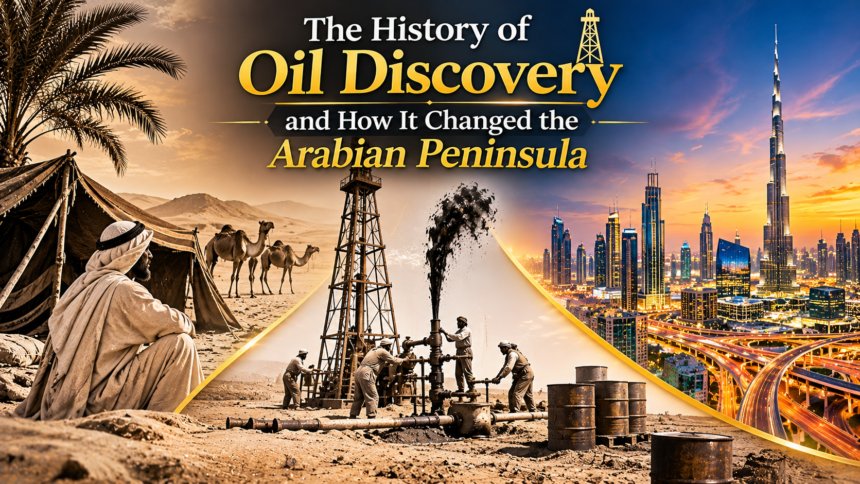
Why Petroleum Revenue Transformed Gulf Cities and Economies
Before the discovery of oil transformed the Arabian Peninsula, much of the region’s economy depended on fishing, pearl diving, agriculture, livestock, trade and traditional craftsmanship. Coastal towns were connected through maritime commerce, while desert communities relied on caravan routes, oases and locally available resources.
- 1. What Was Life Like in Arabia Before the Discovery of Oil?
- 2. Bahrain’s 1932 Oil Discovery Marked the Beginning of a New Era
- 3. Saudi Arabia’s Dammam Well No. 7 Changed the Region’s Economic Future
- 4. How Kuwait, Qatar, the UAE and Oman Entered the Oil Economy
- 5. How Oil Revenues Transformed Arabian Cities, Infrastructure and Public Services
- 6. How Oil Changed the Arabian Peninsula’s Position in the Global Economy
- 7. The Social and Environmental Challenges That Followed Oil Development
- 8. Why the Arabian Peninsula Is Now Preparing for a Future Beyond Oil
Today, the Arabian Peninsula is associated with some of the world’s most important energy-producing countries. Saudi Arabia, Kuwait, the United Arab Emirates, Qatar, Bahrain and Oman have developed modern cities, international airports, advanced infrastructure and major industries.
This transformation did not happen overnight.
The history of oil discovery in the Arabian Peninsula is a remarkable story of geological exploration, international business relationships, economic development and changing societies.
The discovery of commercial petroleum reserves during the twentieth century created new opportunities for governments to invest in roads, hospitals, schools, electricity networks and public services.
Bahrain became the first country on the Arabian side of the Gulf to discover commercially significant oil in 1932. Saudi Arabia followed with its famous Dammam Well No. 7 in 1938, the same year Kuwait discovered oil at Burgan.
Other major discoveries followed in Qatar, Abu Dhabi and Oman, although exploration and production developed at different speeds.
According to Saudi Aramco, commercial production from Dammam Well No. 7 began in 1938, establishing the foundations of Saudi Arabia’s modern petroleum industry. Aramco
The discovery of these resources had consequences far beyond the energy industry.
New employment opportunities attracted workers, settlements expanded into cities and governments developed new institutions to manage public revenue.
At the same time, petroleum production created economic dependencies, environmental challenges and new questions about long-term development.
Understanding this history helps explain how the Arabian Peninsula became an important part of the global energy economy and why its countries are now investing in industries beyond oil.
1. What Was Life Like in Arabia Before the Discovery of Oil?
Before large-scale petroleum production, the Arabian Peninsula contained communities with different economic traditions.
The region was not uniformly poor, isolated or economically inactive. Trading cities, agricultural oases and commercial ports had connected Arabia with other parts of the world for centuries.
However, access to modern infrastructure and government revenue was generally far more limited than it would become during the petroleum era.
Coastal settlements depended heavily on the sea.
Fishing provided food and income, while maritime trade brought textiles, spices, timber and other products from foreign ports.
Pearl diving was especially important in several Gulf communities.
Bahrain, Kuwait, Qatar and coastal settlements in what would later become the UAE participated in the pearl economy.
Divers travelled to oyster beds during seasonal expeditions, while merchants purchased and distributed valuable natural pearls.
This industry supported sailors, boatbuilders, traders and many other workers.
Yet pearl diving was demanding and dangerous. Earnings could vary considerably, and workers often depended on complex financial relationships with merchants and vessel owners.
The decline of natural pearling during the twentieth century placed additional pressure on some coastal economies.
Inland communities followed different economic patterns.
Date cultivation, livestock keeping and trade supported settlements around oases.
Camels played an important role in transportation, particularly across long desert routes.
Markets connected agricultural producers, artisans and travelling merchants.
In parts of Oman and Yemen, agriculture and historical trading networks also supported significant settlements.
The economic circumstances of different communities therefore varied greatly.
Nevertheless, many areas faced challenges involving limited water resources, difficult transportation conditions and restricted access to modern healthcare and education.
Large infrastructure projects required financial resources that local governments did not always possess.
The eventual development of petroleum industries would dramatically change this situation.
| Economic activity | Importance before large-scale oil production |
|---|---|
| Pearl diving | Employment and export income in Gulf coastal communities |
| Fishing | Food supplies and local commerce |
| Maritime trade | Connections with India, East Africa and other regions |
| Agriculture | Dates, grains and other products in suitable areas |
| Livestock keeping | Food, transport and trade |
| Traditional crafts | Clothing, tools, boats and household goods |
| Caravan commerce | Movement of goods between inland settlements |
Understanding these earlier activities is important because the petroleum industry developed within societies that already possessed established commercial and cultural traditions.
2. Bahrain’s 1932 Oil Discovery Marked the Beginning of a New Era
Bahrain holds an important place in the history of Arabian petroleum exploration.
On June 2, 1932, oil was discovered at Well Number One near Jebel Al Dukhan.
This was the first commercially significant petroleum discovery on the Arabian side of the Gulf.
The discovery followed exploration efforts involving foreign companies and local authorities.
Bahrain Petroleum Company, commonly known as Bapco, became central to the development of the country’s oil industry.
Its official historical records identify the 1932 discovery as a defining moment in Bahrain’s economic development. About Us
The success of exploration demonstrated that valuable underground petroleum reserves could be developed in the Arabian Gulf.
This encouraged further interest in the region’s geology and economic potential.
Bahrain began exporting crude petroleum in 1934.
The development of production facilities created demand for workers, technical equipment, transportation and supporting infrastructure.
It also encouraged investment in industries connected to refining and petroleum processing.
The refinery industry became particularly important in Bahrain’s later economic development.
Unlike some neighbouring countries, Bahrain did not possess the same scale of petroleum reserves.
This difference influenced its development strategy and contributed to the importance of refining, services and other economic activities.
The discovery also changed employment patterns.
Workers acquired new industrial skills, while the petroleum sector created opportunities beyond traditional occupations.
However, the transition did not happen immediately or equally for everyone.
The growth of the industry required training and created new relationships between local workers, foreign specialists and commercial organisations.
Bahrain’s experience demonstrated that petroleum could provide a new foundation for government revenue and industrial development.
Its success also strengthened international interest in exploring other parts of the Arabian Peninsula.
3. Saudi Arabia’s Dammam Well No. 7 Changed the Region’s Economic Future
Saudi Arabia’s petroleum history is closely associated with Dammam Well No. 7, also known as the Prosperity Well.
Its discovery represented one of the most important turning points in the economic history of the Arabian Peninsula.
The process began with an exploration agreement signed in 1933 between Saudi Arabia and the Standard Oil Company of California.
The agreement provided the foundation for further geological investigation and drilling.
Exploration teams examined rock formations and searched for underground structures that might contain petroleum.
However, the early drilling programme produced disappointing results.
Several wells failed to establish the commercial production levels needed to justify major development.
Despite these setbacks, exploration continued.
On March 4, 1938, Dammam Well No. 7 demonstrated that it could produce oil in commercial quantities.
The discovery confirmed that Saudi Arabia possessed significant petroleum resources.
Saudi Aramco’s historical records describe this achievement as the beginning of a new era for the Kingdom. Saudipedia+1
The successful well became the foundation for further discoveries.
Saudi Arabia later developed several major petroleum fields, including Ghawar, which became internationally important because of its enormous production capacity.
The growth of the industry required extensive infrastructure.
Roads, pipelines, storage facilities, terminals and industrial settlements were developed to support extraction and exports.
Dhahran and other Eastern Province communities became closely connected with the country’s emerging energy sector.
The transformation also created significant demand for workers.
Engineers, geologists, technicians and other specialists became important to the expanding industry.
Over time, Saudi nationals increasingly entered technical and managerial positions.
The company that became Saudi Aramco also evolved from its early foreign corporate origins into a major Saudi-controlled energy enterprise.
Oil revenues created opportunities for government investment on a scale that had previously been difficult to achieve.
However, the Kingdom’s development was shaped by policy choices, institutions and long-term investment as well as the existence of natural resources.
The discovery was therefore a starting point, not a complete explanation of everything that followed.
4. How Kuwait, Qatar, the UAE and Oman Entered the Oil Economy
Following the early discoveries in Bahrain and Saudi Arabia, petroleum exploration expanded across other parts of the Arabian Peninsula.
The timing of discoveries and exports differed because of geological conditions, investment requirements, infrastructure and international events.
Kuwait became an important producer after commercial petroleum was discovered in the Burgan field in 1938.
Kuwait Oil Company had been established in 1934 and began exploring the country’s potential reserves.
The Second World War delayed development, and Kuwait did not export its first shipment of crude oil until June 1946.
Kuwait Petroleum Corporation identifies Burgan’s discovery and the first export shipment as major milestones in the country’s economic history. kpc.com.kw
Qatar followed a different timeline.
Exploration at Dukhan led to the discovery of petroleum in 1939, but wartime disruption delayed development.
The country’s first crude export took place on December 31, 1949, through Mesaieed.
QatarEnergy’s official history confirms these milestones. qatarenergy.qa
In the present-day UAE, Abu Dhabi’s petroleum history became especially important.
The first discovery occurred offshore in 1958, while commercial development expanded through additional discoveries and infrastructure investment.
Abu Dhabi exported its first shipment of crude oil in 1962.
The emirate subsequently used petroleum revenue to support major public development.
Dubai’s own commercial petroleum discovery came in 1966 at the offshore Fateh field, with exports beginning in 1969.
The different scale of reserves in Abu Dhabi and Dubai contributed to distinct economic development paths.
Dubai increasingly developed trade, transportation, finance and tourism alongside its petroleum industry.
Oman’s exploration history involved considerable uncertainty.
Early drilling produced unsuccessful results before commercially important discoveries were established in the 1960s.
Oil production and exports began in 1967, providing a new source of national revenue.
Petroleum Development Oman’s historical timeline records the country’s first exports as a major economic milestone. pdo.co.om
Major oil discoveries in the Arabian Peninsula
| Country or emirate | Major discovery milestone | First crude oil exports |
|---|---|---|
| Bahrain | 1932, Jebel Al Dukhan | 1934 |
| Saudi Arabia | 1938, Dammam Well No. 7 | 1939 |
| Kuwait | 1938, Burgan | 1946 |
| Qatar | 1939, Dukhan | 1949 |
| Abu Dhabi, UAE | 1958, offshore discovery | 1962 |
| Dubai, UAE | 1966, Fateh field | 1969 |
| Oman | Commercial discoveries in the 1960s | 1967 |
These dates illustrate the broad development of the petroleum industry across the Gulf. They also show why discovery, commercial production and the first export shipment should be treated as separate milestones.
5. How Oil Revenues Transformed Arabian Cities, Infrastructure and Public Services
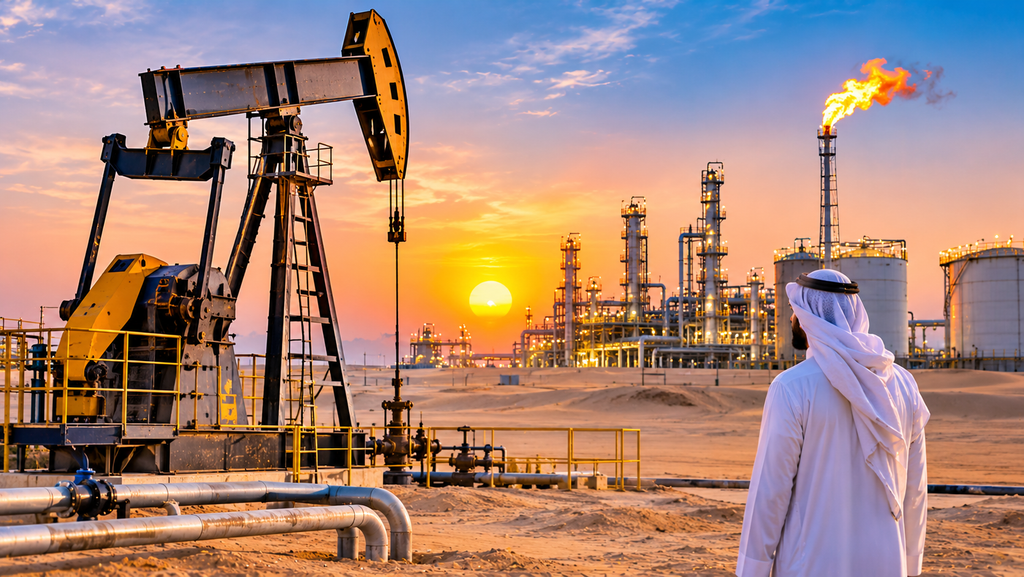
The development of the petroleum industry brought major changes to the Arabian Peninsula.
As production and exports expanded, governments gained access to substantially larger financial resources.
These revenues created opportunities to invest in infrastructure, public institutions and services that had previously been limited in many areas.
One of the most visible changes was urban development.
Settlements expanded, new residential districts were created and modern road systems connected communities that had once depended heavily on sea routes or desert travel.
Cities such as Riyadh, Abu Dhabi, Doha, Kuwait City and Manama experienced extensive physical and economic transformation.
Electricity networks, water systems, ports and airports became increasingly important parts of national development.
In arid environments, investment in desalination and water distribution also helped support larger urban populations.
Healthcare changed substantially.
Governments expanded hospitals, clinics and public health programmes, increasing access to services in many communities.
Education received significant investment as well.
New schools, universities, scholarships and technical training programmes helped develop the workforce required by modern economies.
The International Monetary Fund has documented how petroleum revenues helped GCC countries improve infrastructure, healthcare, education and other development indicators. IMF eLibrary
These improvements were not identical across countries or population groups.
The quality and accessibility of services depended on public policy, institutional capacity and the distribution of resources.
The development of the oil industry also changed employment.
New opportunities emerged in engineering, construction, transportation, administration, finance and public services.
Rapid infrastructure development attracted workers from other countries, contributing to the growth of diverse resident populations.
This movement of people influenced the languages, cultures and economic activities found in Gulf cities.
The transformation of public institutions was another important effect.
Governments expanded their administrative capabilities to manage budgets, infrastructure projects and large public programmes.
Petroleum revenues also supported investment in industries beyond crude extraction.
Refining, petrochemicals, manufacturing and logistics became increasingly important economic activities.
Major changes associated with petroleum development
| Area | Transformation |
|---|---|
| Transportation | Expansion of roads, airports and ports |
| Housing | Growth of urban neighbourhoods and modern buildings |
| Healthcare | Development of hospitals and medical services |
| Education | Expansion of schools, universities and training |
| Water infrastructure | Investment in desalination and distribution |
| Employment | Growth of industrial, technical and service occupations |
| Government administration | Greater capacity to fund and manage public programmes |
| International trade | Increased energy exports and economic connections |
The discovery of petroleum did not erase traditional Arabian culture.
However, it changed the environments in which families lived and worked.
Many communities maintained cultural practices while adapting to new opportunities, technologies and urban lifestyles.
6. How Oil Changed the Arabian Peninsula’s Position in the Global Economy
As petroleum production expanded, the Arabian Peninsula became increasingly important to international energy markets.
Industrial economies required large quantities of fuel for transportation, manufacturing and electricity production.
Saudi Arabia, Kuwait and other regional producers became significant suppliers of this demand.
Energy exports created new commercial relationships with countries across Asia, Europe and other parts of the world.
This influence extended beyond direct oil sales.
The growth of the industry encouraged investment in shipping, refining, petrochemicals and other related sectors.
It also increased the importance of international energy prices to government budgets.
A significant development occurred in September 1960, when representatives of Iran, Iraq, Kuwait, Saudi Arabia and Venezuela established the Organization of the Petroleum Exporting Countries, or OPEC, in Baghdad.
The organisation was formed to coordinate petroleum policies among its members and address shared interests in international oil markets. opec.org
Not every Arabian Peninsula country joined the organisation at the same time, and membership has changed over the decades.
OPEC became an important part of the wider history of energy production and international economic relations.
The 1970s represented another major turning point.
Changes in petroleum prices and international energy markets increased revenues for several exporting countries.
Governments used parts of these earnings to fund development and build financial assets.
However, the region also experienced the challenges associated with fluctuating prices.
When international energy prices declined, countries relying heavily on petroleum income faced pressure on public spending.
The IMF has noted that oil revenue allowed substantial improvements in living standards while also creating economic dependence and exposure to global market fluctuations. IMF eLibrary
The development of sovereign wealth funds became one response to managing energy-generated wealth.
These investment institutions allow governments to allocate financial resources across different assets and economic activities.
Their structures, responsibilities and investment strategies differ between countries.
International petroleum trade also influenced the development of major ports and industrial zones.
Export terminals, pipelines and storage facilities became essential to connecting production sites with global customers.
The Gulf’s role in the energy economy helped attract foreign businesses, technical expertise and infrastructure investment.
Economic effects of petroleum expansion
| Development | Wider significance |
|---|---|
| Increased energy exports | Connected producers with global markets |
| Higher government revenues | Supported public investment |
| Industrial development | Expanded refining and petrochemical activities |
| International partnerships | Increased commercial and technical cooperation |
| Sovereign investment | Created opportunities to manage accumulated wealth |
| Price fluctuations | Introduced budget and economic risks |
| Energy diplomacy | Increased the importance of international cooperation |
The petroleum industry therefore reshaped not only domestic economies but also the Arabian Peninsula’s relationships with the wider world.
7. The Social and Environmental Challenges That Followed Oil Development
The transformation created by petroleum was significant, but it also introduced new challenges.
Rapid economic development changed employment, settlement patterns, resource consumption and the relationship between people and the natural environment.
The consequences varied across countries and communities.
One major social change was the movement from some traditional occupations toward wage employment in government, industry and services.
Fishing, pearl diving and caravan commerce no longer occupied the same central economic position they had held in many earlier communities.
However, these activities did not disappear entirely.
Fishing, traditional crafts and maritime heritage continue to form part of the region’s cultural and economic life.
Urbanisation was another important development.
Expanding cities offered improved access to employment, education and public services, but also created demand for housing, transportation, water and energy.
The growth of construction and industrial activity placed additional pressure on some natural habitats.
Petroleum production also introduced environmental risks.
Exploration, drilling, pipelines, refining and transportation require infrastructure that can affect surrounding land and marine environments.
Oil spills may damage coastal habitats and marine organisms, while industrial activities can create air pollution and waste-management challenges.
The burning of oil and other fossil fuels releases carbon dioxide, a major greenhouse gas contributing to global climate change.
This creates an important distinction between the historical economic benefits of petroleum and the environmental costs associated with its production and use.
Energy policy must therefore address both economic requirements and environmental responsibilities.
Another challenge is economic dependence.
When government revenue relies heavily on commodity exports, changes in global prices can affect public finances.
Countries may respond through savings, taxation, borrowing, investment adjustments or economic diversification.
The effectiveness of these approaches depends on national circumstances.
The petroleum era also shaped labour markets.
The expansion of construction, healthcare, industry and other sectors attracted large numbers of foreign workers to Gulf countries.
These workers contributed to economic development, while differences in employment rules and living conditions created policy challenges.
The experiences of workers and residents were not uniform, and assessments of social change should recognise both new opportunities and inequalities.
| Challenge | Why it matters |
|---|---|
| Dependence on energy revenue | Creates exposure to international price changes |
| Urban expansion | Increases demand for infrastructure and resources |
| Industrial pollution | Can affect health and environmental quality |
| Coastal development | May disturb marine ecosystems |
| Greenhouse gas emissions | Contribute to climate change |
| Labour market changes | Require appropriate employment policies |
| Loss of some traditional occupations | Creates challenges for cultural preservation |
These issues demonstrate why long-term development requires more than expanding petroleum production.
Countries must also consider environmental protection, economic resilience and the wellbeing of their populations.
8. Why the Arabian Peninsula Is Now Preparing for a Future Beyond Oil
The discovery of petroleum changed the Arabian Peninsula during the twentieth century.
Today, its countries face another important economic challenge: developing sustainable and competitive economies that are not excessively dependent on hydrocarbon revenue.
Petroleum continues to play a significant role in several national economies.
However, governments are investing in additional industries to create employment opportunities, strengthen innovation and prepare for changing global energy demand.
Saudi Arabia’s Vision 2030 is one example.
The national development programme includes objectives involving tourism, investment, logistics, manufacturing, technology and other non-oil activities.
Its official framework identifies economic diversification as a central priority. Overview
The UAE has developed major activities in aviation, trade, logistics, finance, tourism and technology.
Dubai’s economic experience is particularly notable because the emirate developed substantial commercial sectors beyond its comparatively limited petroleum production.
Abu Dhabi is also expanding investment in industries and technologies outside crude oil production.
Qatar’s development is closely connected with natural gas as well as petroleum.
Its large-scale natural gas industry has supported energy exports and industrial investment, but gas remains a hydrocarbon resource.
Diversification therefore requires distinguishing between expanding energy-related activities and developing genuinely non-hydrocarbon sectors.
Oman has identified opportunities in tourism, logistics, manufacturing, fisheries and renewable energy.
Kuwait and Bahrain are also exploring ways to broaden economic activity while maintaining important existing industries.
Education and workforce development are central to these efforts.
Universities, research centres and professional training institutions can help prepare workers for sectors requiring specialised technical knowledge.
Innovation is equally important.
Investment in renewable energy, digital infrastructure, advanced manufacturing and scientific research may help create new economic opportunities.
However, diversification is a gradual process.
Building competitive industries requires private investment, appropriate regulations, skilled workers and access to international markets.
Tourism and technology projects cannot automatically replace petroleum revenue at the same scale.
Governments must evaluate whether new sectors are creating sustainable employment and economic value.
Major areas of future economic development
| Sector | Potential contribution |
|---|---|
| Tourism | Hospitality, cultural industries and visitor services |
| Logistics | Ports, transportation and international trade |
| Technology | Digital services and innovation |
| Renewable energy | Additional energy sources and industrial opportunities |
| Advanced manufacturing | Greater industrial diversification |
| Education and research | Development of skilled professionals |
| Healthcare | Specialised services and medical innovation |
| Finance and investment | Business development and capital allocation |
The future of the Arabian Peninsula will likely remain influenced by its petroleum history, even as countries pursue broader economic development.
Oil helped provide the financial resources for modernisation.
The long-term challenge is using accumulated knowledge, infrastructure and investment capacity to create economies capable of adapting to future conditions.
Conclusion
The history of oil discovery in the Arabian Peninsula is one of the most important stories in the region’s modern development.
Before large-scale petroleum production, communities relied on trading networks, fishing, pearl diving, agriculture and traditional occupations.
These activities supported established cultures and economies, but many areas had limited access to modern infrastructure and public services.
The discovery of commercial petroleum in Bahrain in 1932 marked the beginning of a major transformation.
Saudi Arabia’s Dammam Well No. 7 in 1938 demonstrated the Kingdom’s enormous energy potential, while discoveries in Kuwait, Qatar, Abu Dhabi and Oman helped expand the region’s petroleum industry.
The revenues generated by oil production supported the development of cities, hospitals, schools, roads, airports and industries.
They also strengthened the Arabian Peninsula’s position in international commerce.
However, petroleum development introduced challenges involving environmental protection, economic dependence and rapid social change.
These issues remain relevant as countries plan for the future.
Today, the region is investing in tourism, technology, manufacturing, renewable energy and other industries to create new opportunities beyond petroleum.
Ultimately, the discovery of oil did more than change the Arabian Peninsula’s economy. It reshaped its cities, institutions, international relationships and everyday life, creating a lasting legacy that continues to influence the region’s future.
Do follow us on Instagram
Read More – How Traditional Arabian Ships Shaped Maritime Trade in the Gulf