


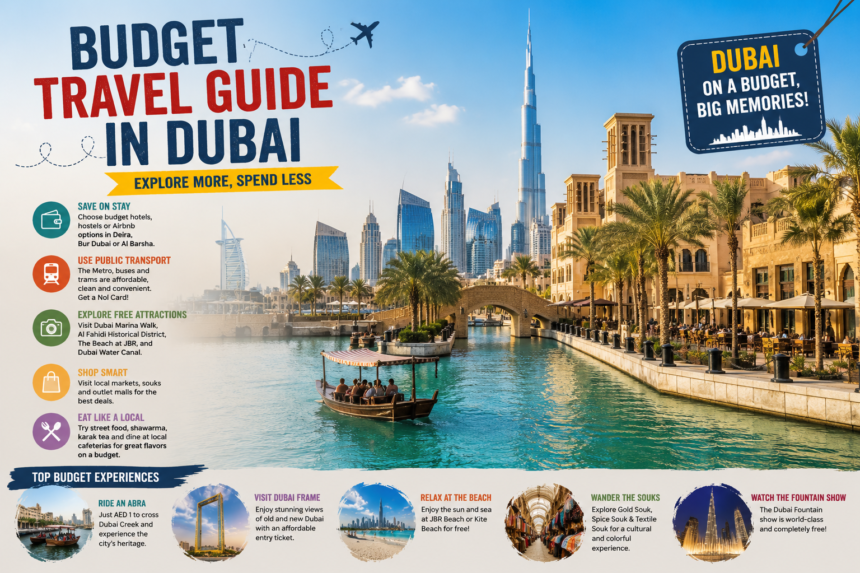
Dubai on a Budget: How to Explore the City Without Overspending
Dubai has a reputation for luxury. Five-star hotels, supercars, designer shopping, private beaches and record-breaking attractions can make the city appear expensive before you even arrive. But Dubai does not have to be a luxury-only destination.
- Can You Really Visit Dubai on a Budget?
- 1. Use Dubai’s Metro Instead of Taxis
- 2. Buy the Right nol Card
- 3. Stay Near Public Transport, Not Necessarily Downtown
- 4. Explore Old Dubai for a Low-Cost Day
- 5. Take an Abra Across Dubai Creek
- 6. Enjoy Dubai’s Public Beaches
- 7. Use Free Views Instead of Paying for Every Observation Deck
- 8. Eat Where Residents Eat
- 9. Be Careful With Hotel Breakfast Charges
- 10. Use Supermarkets for Water and Snacks
- 11. Do Not Try to Visit Every Paid Attraction
- 12. Book Major Attractions Carefully
- 13. Walk More, but Understand Dubai’s Geography
- 14. Visit Dubai in a Better-Value Season
- 15. Avoid Unnecessary Airport Transport Costs
- A Sample Budget Day in Dubai
- Example Daily Budget Categories
- A Possible 3-Day Budget Dubai Itinerary
- Best Areas for Budget Travellers
- Free and Low-Cost Experiences Worth Prioritising
- Common Budget Travel Mistakes in Dubai
- Where You Should Spend More
- How Much Can Public Transport Save?
- Budget Dubai Does Not Mean Missing the Real City
- FAQs About Budget Travel in Dubai
- Conclusion
This Budget Travel Guide in Dubai shows how visitors can experience the city without spending heavily every day. Affordable public transport, inexpensive restaurants, public beaches, historic neighbourhoods, souks and low-cost cultural experiences make it possible to build a surprisingly reasonable Dubai itinerary.
One of the biggest savings comes from transportation. Dubai’s Roads and Transport Authority currently charges AED 3 for a regular Silver nol card journey within one zone, AED 5 across two adjacent zones and AED 7.50 for journeys crossing more than two zones.
The key is knowing where Dubai offers genuine value and where convenience or prestige adds significantly to the price.
Can You Really Visit Dubai on a Budget?
Yes, but you need to travel differently from someone planning a luxury holiday.
Dubai gives visitors plenty of opportunities to spend money. Premium observation decks, beach clubs, fine dining, taxis and luxury hotels can quickly increase the cost of a trip.
None of them is compulsory.
A budget-conscious traveller can instead build a trip around:
- Metro and buses
- Affordable hotels outside premium tourist districts
- Local cafeterias and restaurants
- Public beaches
- Old Dubai
- Traditional souks
- Creek crossings
- Free waterfront areas
- Parks and walking districts
- Carefully selected paid attractions
The smartest approach is not trying to make every experience cheap.
Instead, save on ordinary expenses so you can spend money on the experiences that genuinely matter to you.
If seeing the Burj Khalifa observation deck is important, pay for it and save elsewhere.
If you care more about culture, Old Dubai can fill much of a day at a fraction of the cost.
1. Use Dubai’s Metro Instead of Taxis
Transport is one of the easiest areas in which visitors overspend.
Dubai taxis are convenient, but repeatedly using them throughout a multi-day holiday can add a substantial amount to your total travel cost.
The Dubai Metro is usually the better choice for budget travellers when your destinations are close to stations.
Dubai’s public transport fare system divides the city into seven zones. With a Silver nol card, current regular fares are:
| Journey | Silver nol Fare |
|---|---|
| Within one zone | AED 3 |
| Two adjacent zones | AED 5 |
| More than two zones | AED 7.50 |
RTA allows transfers between the Metro and buses within defined conditions, including making the transfer within 30 minutes, so connected journeys can be charged based on the overall zones travelled rather than as completely separate trips.
For tourists making several journeys, those savings add up quickly.
Budget tip: Check whether your hotel is within comfortable walking distance of a Metro station before booking it.
A slightly cheaper hotel far from public transport can sometimes cost more overall because of repeated taxi rides.
2. Buy the Right nol Card
Dubai’s nol system is used across much of the city’s public transport network.
RTA says cash is not accepted for its regular public transport services, making a nol card important for most visitors planning to use Metro, buses and trams.
The Silver nol card currently costs AED 25 and includes AED 19 in travel balance. It is valid for five years.
Short-stay visitors also have access to Red Tickets, but travellers taking multiple journeys may find the Silver card more convenient.
RTA also offers seven-day travel passes. Current Silver card prices are:
- AED 50 for one zone
- AED 80 for two zones
- AED 110 for all zones
Whether a pass saves money depends on how frequently and how far you travel.
Do the calculation rather than automatically buying an unlimited-style product.
For a traveller making only two or three journeys per day, paying individual fares can sometimes be cheaper.
3. Stay Near Public Transport, Not Necessarily Downtown
Accommodation can consume the largest part of a Dubai travel budget.
Visitors often begin searching around Downtown Dubai, Dubai Marina or Palm Jumeirah because those areas dominate tourism photographs.
They are convenient and attractive, but they are not the only practical places to stay.
Budget travellers can also look at areas such as:
- Deira
- Bur Dubai
- Al Barsha
- Al Rigga
- Karama
- areas around Union or BurJuman
- locations near Metro stations farther from premium beachfront districts
The most important factor is transport connectivity.
Imagine two hotel options.
Hotel A costs AED 230 per night but is five minutes from a Metro station.
Hotel B costs AED 190 but requires two taxi rides every day.
The cheaper room may not produce the cheaper trip.
Always estimate the total cost of location, not just the room price.
4. Explore Old Dubai for a Low-Cost Day
Old Dubai is one of the strongest areas for visitors trying to experience the city without expensive attraction tickets.
Neighbourhoods around Dubai Creek provide a contrast to the skyscrapers seen elsewhere.
A budget-friendly Old Dubai day can include:
- Al Fahidi Historical Neighbourhood
- Dubai Creek
- Bur Dubai
- traditional souks
- Deira
- Al Seef
- Gold Souk
- Spice Souk
Much of the experience comes from simply walking.
You can wander through narrow streets, see traditional architecture, watch boats move along the Creek and explore markets without paying the price of a major theme park.
It is also one of the best places to understand how Dubai developed as a trading city before the modern skyline appeared.
Suggested image placement: Travellers exploring Dubai Creek and the traditional souks.
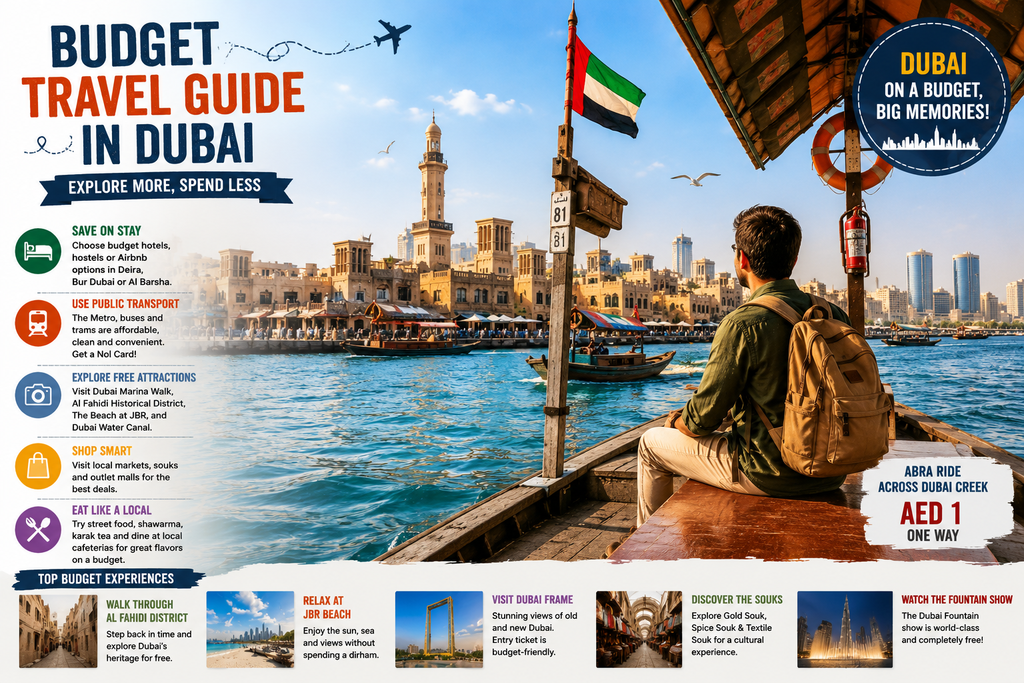
5. Take an Abra Across Dubai Creek
Few experiences demonstrate budget travel in Dubai better than the traditional abra.
These small wooden boats cross Dubai Creek between historic parts of Bur Dubai and Deira.
Some traditional crossings have historically cost as little as AED 1, although travellers should always check the current route and fare before boarding because different marine routes and vessels have different pricing. Recent 2026 travel information continues to list the classic shared crossing at AED 1.
The experience is memorable because it does not feel created purely for tourists.
You are travelling on a working form of transport while seeing the Creek from water level.
Pair the ride with the nearby souks and heritage areas and you can build several hours of sightseeing at very low cost.
Budget tip: Carry small cash when planning to use traditional abra routes because payment methods can differ by service.
6. Enjoy Dubai’s Public Beaches
A beach day does not automatically require paying for a private beach club.
Dubai has public coastal areas where visitors can enjoy the sea without purchasing expensive day passes.
Popular options include areas around:
- Kite Beach
- JBR
- Umm Suqeim
- Dubai’s public waterfronts
A simple beach visit can become one of the cheapest full experiences on your itinerary.
Bring:
- sunscreen
- drinking water
- hat
- towel
- sunglasses
and avoid renting extras unless you really need them.
Beach clubs can be enjoyable, but the premium is often for facilities, dining, pools and atmosphere rather than access to the sea itself.
For budget travellers, public coastline offers the essential experience without the luxury price.
7. Use Free Views Instead of Paying for Every Observation Deck
Dubai’s skyline is one of its biggest attractions.
That does not mean every good view requires an observation-deck ticket.
You can enjoy impressive city views from:
- Dubai Marina promenades
- Dubai Creek
- public beaches
- Downtown walking areas
- waterfront districts
- bridges and pedestrian routes
- Dubai Mall surroundings
- Al Seef
Paid observation decks can certainly provide spectacular views.
But if you are travelling on a tight budget, choose one premium viewpoint instead of paying for several.
The same principle applies throughout Dubai.
You do not need every version of the same experience.
One excellent skyscraper view can be enough.
8. Eat Where Residents Eat
Food costs can vary dramatically in Dubai.
One meal at a luxury restaurant can cost more than an entire day of eating at local cafeterias.
Dubai’s diverse population is a major advantage for budget travellers.
Neighbourhoods such as Deira, Bur Dubai and Karama have large selections of restaurants serving cuisines from across:
- India
- Pakistan
- Bangladesh
- the Philippines
- Lebanon
- Iran
- Afghanistan
- and other parts of Asia and the Middle East.
Affordable dishes may include:
- shawarma
- falafel
- biryani
- dosa
- kebabs
- manakish
- rice meals
- sandwiches
- curries
One practical technique is to eat your main meal at lunch rather than at a premium tourist restaurant in the evening.
Also check menus before sitting down.
Dubai restaurants generally display menus online or outside, making it easier to avoid surprises.
9. Be Careful With Hotel Breakfast Charges
A discounted hotel room can become less impressive once extras are added.
Breakfast is one example.
If a hotel charges a significant daily amount for breakfast, compare it with nearby cafés before booking.
Budget travellers may prefer:
- room-only hotel rates
- local bakeries
- supermarkets
- nearby cafeterias
- simple breakfast restaurants
However, hotel breakfast can still offer good value if it is included for only a small additional cost and replaces both breakfast and a later snack.
The goal is not automatically to reject every hotel add-on.
It is to calculate whether you will actually use it.
10. Use Supermarkets for Water and Snacks
Small daily purchases can quietly increase travel spending.
Buying water, soft drinks and snacks repeatedly from attractions or premium hotel locations can cost significantly more than purchasing them from supermarkets.
When you arrive, consider buying basic supplies for your room:
- bottled water
- fruit
- snacks
- breakfast items
- soft drinks
This is especially useful for families.
A family buying drinks and snacks several times per day can save noticeably by planning ahead.
The strategy also prevents impulse purchases when you are tired or hungry.
11. Do Not Try to Visit Every Paid Attraction
Dubai has an unusually large number of ticketed attractions.
That makes planning difficult because almost everything can sound essential online.
It is easy to create an itinerary containing:
- Burj Khalifa
- Dubai Frame
- Museum of the Future
- aquarium
- waterpark
- theme parks
- desert safari
- yacht cruise
- observation wheels
- premium beach clubs
The total can become enormous.
Instead, divide attractions into three categories:
Must do: Experiences you would genuinely regret missing.
Nice to do: Visit only if time and budget allow.
Skip: Attractions that overlap with something else you are already doing.
For many travellers, two or three major paid attractions across a five-day holiday provide enough variety.
Fill the remaining time with beaches, neighbourhoods, souks and waterfronts.
12. Book Major Attractions Carefully
For experiences you do want to pay for, planning can reduce unnecessary costs.
Do not assume that the first ticket website shown in a search result offers the lowest price.
Compare:
- official attraction prices
- authorized ticket platforms
- combination passes
- weekday rates
- time-slot pricing
- seasonal promotions
But be cautious with extremely cheap offers from unknown sellers.
Saving a few dirhams is not worthwhile if the ticket is invalid or the terms are unclear.
Also check cancellation conditions.
A cheaper non-refundable ticket can become expensive if your plans change.
13. Walk More, but Understand Dubai’s Geography
Walking is free.
But Dubai is not always a walkable city in the way that compact European destinations are.
Two attractions that appear close on a map may be divided by a major highway, large development or inaccessible pedestrian route.
Heat also matters.
During warmer months, attempting long walks in the middle of the day can be uncomfortable or unsafe.
Walking works best when exploring compact areas such as:
- Al Fahidi
- parts of Deira
- Al Seef
- Dubai Marina
- Downtown pedestrian areas
- beachfront promenades
Use public transport between districts and walk within them.
This usually provides the best balance between cost and practicality.
14. Visit Dubai in a Better-Value Season
Timing affects travel costs.
Hotel prices can vary significantly according to season, major events, school holidays and demand.
Dubai’s cooler months are attractive because outdoor weather is generally more comfortable, but they can also coincide with stronger tourism demand.
Travelling during shoulder periods may provide better accommodation deals.
There is a trade-off.
Lower-cost periods can come with hotter weather.
Ask yourself what matters more:
Lower accommodation cost or comfortable outdoor sightseeing?
If you plan mainly indoor attractions, malls and short outdoor visits, warmer periods may be manageable.
If beaches, walking and outdoor sightseeing are central to your trip, paying slightly more for comfortable weather may improve the overall experience.
15. Avoid Unnecessary Airport Transport Costs
Airport transfers are another area where visitors can spend more than needed.
Dubai International Airport connects with the Metro, making public transport practical for many travellers depending on arrival time, luggage and hotel location.
If your accommodation is near the Red Line and you arrive while the Metro is operating, public transport may save substantial money compared with a private transfer.
However, a taxi can still make sense when:
- several people are travelling together
- you have heavy luggage
- you arrive late
- the hotel is far from a station
- you have young children
Budget travel does not mean choosing the cheapest option every time.
It means choosing the best value for your situation.
A Sample Budget Day in Dubai
Here is an example of how a low-cost sightseeing day could work.
Morning
Take the Metro toward Old Dubai.
Explore Al Fahidi Historical Neighbourhood on foot.
Walk toward Dubai Creek.
Late morning
Take a traditional abra across the Creek.
Explore Deira’s Gold and Spice Souks.
Lunch
Choose an affordable local restaurant in Deira or Bur Dubai.
Afternoon
Use the Metro toward another district or return to your hotel during the hottest part of the day.
Evening
Visit a public beach, waterfront or free walking area.
This itinerary provides:
- culture
- transport experience
- markets
- food
- waterfront scenery
- and city exploration
without purchasing multiple premium attraction tickets.
Example Daily Budget Categories
Actual prices vary greatly according to hotel choice and travel style, so it is more useful to think in categories than promise one fixed amount.
| Expense | Budget Strategy |
| Hotel | Stay near Metro outside premium districts |
| Transport | Metro, bus and occasional taxi |
| Breakfast | Bakery, cafeteria or supermarket |
| Lunch | Local restaurant |
| Dinner | Casual restaurant or food court |
| Attractions | Mix free and one paid activity |
| Beach | Public beach |
| Sightseeing | Old Dubai, souks and waterfronts |
| Airport trip | Metro when practical |
| Snacks | Buy from supermarkets |
Accommodation remains the biggest variable.
A solo traveller paying for an entire hotel room will naturally spend more per person than two people sharing.
A Possible 3-Day Budget Dubai Itinerary
Day 1: Old Dubai
Explore Al Fahidi, Dubai Creek, traditional souks and Deira. Take an abra and eat at a local restaurant.
Day 2: Modern Dubai
Use the Metro to explore Downtown and surrounding public areas. Choose one paid attraction if it matters to you, then spend the evening walking around a free waterfront or public space.
Day 3: Beach and Marina
Spend the morning at a public beach. Explore Dubai Marina or another accessible waterfront later in the day.
This approach gives first-time visitors three different versions of Dubai:
Historic Dubai
Futuristic Dubai
Coastal Dubai
without requiring a premium budget every day.
Best Areas for Budget Travellers
Deira
Good for Old Dubai, markets, local food and access to parts of the Metro network.
Bur Dubai
Useful for heritage areas, Creek access and affordable restaurants.
Karama
Known for a large variety of everyday restaurants and a more residential atmosphere.
Al Barsha
Can offer practical accommodation options with access to the Metro depending on location.
The cheapest hotel is not always in the best area, so use a map before booking.
Check the actual walking route to the nearest station rather than trusting a hotel description saying it is “near the Metro.”
Free and Low-Cost Experiences Worth Prioritising
A budget Dubai itinerary does not need to feel empty.
Consider:
- Exploring Al Fahidi
- Walking around Dubai Creek
- Visiting traditional souks
- Taking a shared abra
- Spending time at public beaches
- Exploring waterfront promenades
- Walking around Dubai Marina
- Exploring Al Seef
- Visiting public areas around major landmarks
- Watching the city skyline at sunset
The best free experiences often have another advantage: they let you explore Dubai at your own pace.
You are not rushing through a timed attraction because you paid for a ticket.
Common Budget Travel Mistakes in Dubai
Booking a Cheap Hotel Far From Everything
The savings disappear when you constantly need taxis.
Using Taxis for Every Journey
Convenient individually, expensive collectively.
Eating Every Meal in Tourist Hotspots
Move a few neighbourhoods away and prices can change considerably.
Booking Too Many Attractions
A packed schedule is not always a better holiday.
Ignoring Small Expenses
Coffee, water, snacks, taxis and convenience-store purchases add up.
Paying for Experiences You Can Enjoy Free Elsewhere
You do not need a private beach every time you want to see the sea.
Forgetting About the Heat
Saving money by walking long distances is meaningless if conditions make the journey impractical.
Where You Should Spend More
Being on a budget does not mean avoiding every expensive experience.
Spend where it creates a memory you genuinely value.
For example:
- A desert experience may be worth paying for if it is your first visit.
- A landmark observation deck may matter to someone fascinated by architecture.
- A special restaurant may be worth including for one evening.
- Families may prioritize a theme park.
- Beach lovers may choose one premium resort day.
A balanced trip is often better than an aggressively cheap one.
Think of your spending as:
Save on transport + save on ordinary meals + save on unnecessary tickets = money available for one memorable experience.
How Much Can Public Transport Save?
Consider a visitor making several journeys across a day.
Using a Silver nol card, a single regular trip currently ranges from AED 3 to AED 7.50 depending on zones crossed.
Four public-transport trips could therefore remain relatively inexpensive compared with making four separate taxi journeys.
The savings become even greater over four, five or seven days.
A seven-day all-zone Silver travel pass currently costs AED 110, although travellers should compare this with pay-as-you-go fares based on their actual itinerary.
That is why transport planning should happen before hotel booking.
Your accommodation location determines much of your daily transport spending.
Budget Dubai Does Not Mean Missing the Real City
There is another benefit to spending less.
Budget travel can sometimes bring you closer to everyday Dubai.
Premium tourism concentrates visitors inside hotels, resorts and famous attractions.
Travelling by Metro, eating in neighbourhood restaurants, walking through Deira and crossing Dubai Creek exposes you to a different side of the city.
You see commuters.
You hear several languages.
You explore trading districts.
You experience the contrast between old neighbourhoods and skyscrapers.
That can produce a richer trip than moving only between luxury properties.
FAQs About Budget Travel in Dubai
Can Dubai be visited on a budget?
Yes. Using public transport, staying outside premium tourist districts, eating at local restaurants and mixing free attractions with a small number of paid experiences can substantially reduce the cost of a Dubai holiday.
What is the cheapest way to travel around Dubai?
The Metro and public buses are usually among the most economical options. Regular Silver nol fares currently start at AED 3 for travel within one zone.
How much does a Silver nol card cost?
RTA currently lists the Silver nol card at AED 25, including AED 19 of balance.
Are there free things to do in Dubai?
Yes. Public beaches, neighbourhood exploration, traditional souks, Dubai Creek areas and several waterfront promenades can be enjoyed with little or no admission cost.
Is the Dubai Creek abra expensive?
No. The classic shared abra crossing is famous for being one of Dubai’s least expensive transport experiences, with recent 2026 guides listing the traditional crossing at AED 1. Different marine services have different fares, so check the specific route before travelling.
Which areas are good for budget accommodation in Dubai?
Deira, Bur Dubai, Karama and parts of Al Barsha can be worth comparing. Prioritize hotels with easy public transport access.
Is food expensive in Dubai?
It can be, particularly at premium hotels and tourist restaurants. However, the city also has a large selection of affordable cafeterias and restaurants serving South Asian, Middle Eastern and other cuisines.
Do I need a rental car for a budget Dubai trip?
Usually not for a typical first-time city itinerary. Dubai’s Metro, buses, trams and occasional taxis can cover many tourist areas without the expenses associated with renting and parking a vehicle.
Conclusion
A Budget Travel Guide in Dubai may sound contradictory in a city famous for luxury, but affordable travel here is entirely possible with good planning.
The biggest savings usually come from everyday decisions.
Stay somewhere connected to the Metro instead of automatically choosing the most famous neighbourhood.
Use a Silver nol card, where regular journeys currently cost AED 3, AED 5 or AED 7.50 depending on the zones travelled.
Explore Al Fahidi, Deira and Dubai Creek instead of filling every day with ticketed attractions.
Take a traditional abra.
Spend an afternoon on a public beach.
Eat at the multicultural neighbourhood restaurants that millions of Dubai residents use every day.
Buy water and basic supplies from supermarkets rather than wherever happens to be closest to a tourist attraction.
Most importantly, decide what you genuinely want from the trip.
Dubai becomes expensive very quickly when travellers feel they need to do everything.
You do not.
The city can be experienced through its skyscrapers, but also through a three-dirham Metro journey, a Creek crossing, a plate of local food, an evening walk and a sunset beside the sea.
The best budget strategy is therefore not about making Dubai feel cheap.
It is about spending intelligently enough to enjoy the parts of Dubai that matter most to you.
follow us on Instagram
Read More – Best Islands in the Gulf: 10 Stunning Escapes to Visit