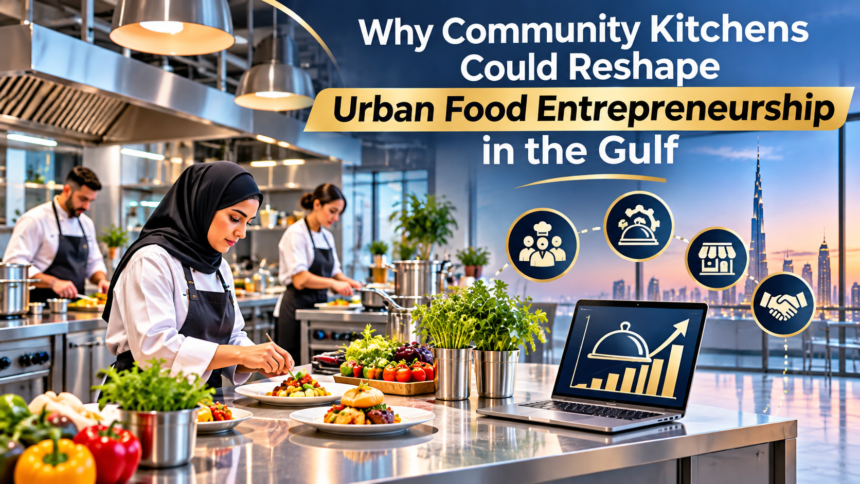
Why Community Kitchens Matter for Gulf Startup Growth
Across the Gulf Cooperation Council, food entrepreneurship is becoming an increasingly visible part of urban business activity. Independent bakers, homegrown restaurant concepts, catering businesses, speciality food producers, and delivery-focused brands are developing products for consumers who value convenience, variety, and distinctive dining experiences.
- 1. Why Community Kitchens in the Gulf Are Becoming Important for Entrepreneurs
- 2. How Shared Kitchens Could Reduce the Costs of Starting a Food Business
- 3. What UAE and Saudi Community Kitchen Initiatives Reveal
- 4. How Qatar’s Food Startup Ecosystem and Delivery Trends Could Support Shared Kitchens
- 5. How Community Kitchens Could Support Women, Small Enterprises, and Local Food Culture
- 6. The Food Safety and Operational Challenges of Shared Commercial Kitchens
- 7. The Future of Community Kitchens and Urban Food Entrepreneurship in the Gulf
- Conclusion
However, turning a food idea into a commercially sustainable business is not always straightforward.
Entrepreneurs must secure suitable premises, purchase equipment, obtain licences, meet food safety requirements, manage suppliers, and develop reliable operations before serving customers. In major cities, commercial rents and kitchen setup costs can make these requirements difficult for smaller businesses.
This is why community kitchens in the Gulf could become an important part of the region’s urban entrepreneurship ecosystem.
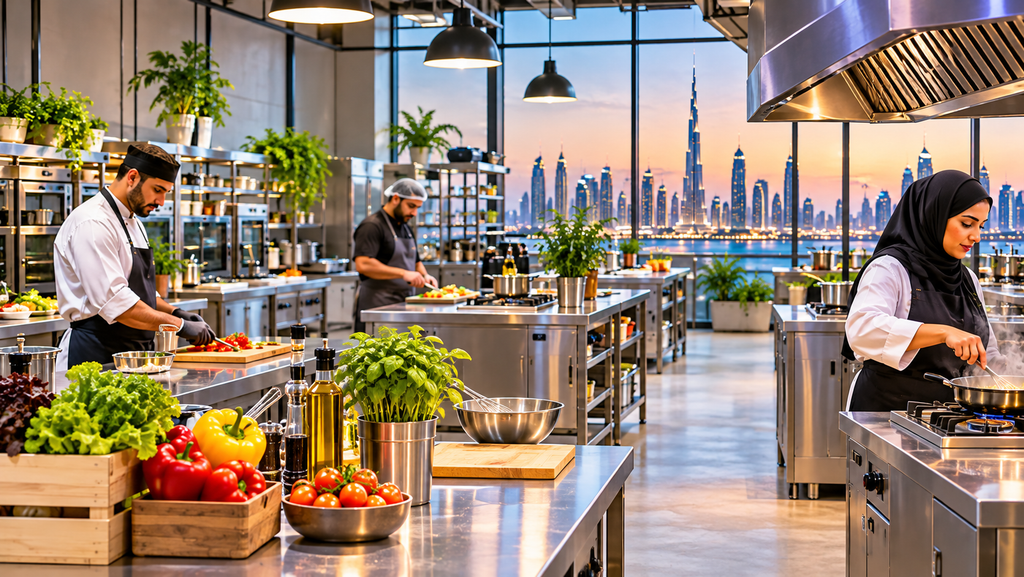
A community kitchen, sometimes called a shared commercial kitchen, provides a professionally equipped food preparation space that can be used by multiple entrepreneurs under defined operating arrangements.
Instead of immediately establishing an independent restaurant or production facility, a food entrepreneur may be able to rent an approved kitchen for particular hours, production sessions, or longer periods.
Some facilities also provide mentoring, business training, storage, marketing support, and connections with suppliers.
Others operate primarily as commercial kitchens for delivery-focused food brands.
These arrangements can help entrepreneurs test products, understand demand, and build operations before making substantial investments in permanent premises.
Across the GCC, practical examples are already emerging.
Dubai’s DMCC Agro Ecosystem identifies kitchen incubators that provide access to equipped and licensed commercial kitchens. Saudi Arabia’s Social Development Bank supports production incubators and community kitchens for productive families, while Qatar’s food entrepreneurship ecosystem includes incubation services and manufacturing facilities.
However, the concept should not be confused with unrestricted permission to prepare and sell food.
Even when a kitchen is shared, businesses must meet applicable licensing, hygiene, food handling, and operational requirements.
Community kitchens also introduce challenges involving scheduling, storage, competition, and quality control.
Understanding how these facilities operate reveals why they could become useful infrastructure for the next generation of Gulf food businesses.
1. Why Community Kitchens in the Gulf Are Becoming Important for Entrepreneurs
Food is an attractive business sector for many entrepreneurs because it allows individuals to develop products around personal skills, cultural traditions, and consumer preferences.
However, professional food production requires infrastructure that goes far beyond a domestic kitchen.
The Challenge of Starting a Food Business
An entrepreneur opening a commercial kitchen may need cooking equipment, refrigeration, ventilation, washing facilities, storage space, and appropriate safety systems.
Additional expenses can include rent deposits, utilities, staffing, insurance, and licensing.
These obligations may arise before the business develops a dependable customer base.
For someone testing a new bakery concept or speciality meal service, committing to a long-term commercial lease can create financial pressure.
Understanding the Community Kitchen Model
A community kitchen allows several businesses to use designated food production infrastructure under an agreed system.
Some facilities rent equipment and workspace by the hour or day.
Others provide dedicated production areas within a larger commercial building.
Incubator-style kitchens may offer additional services such as business mentoring, training, and market access.
However, the exact arrangement depends on the operator and the relevant licensing framework.
Community Kitchens Versus Cloud Kitchens
The terms are sometimes used interchangeably, but they describe different concepts.
A shared community kitchen is defined primarily by how production infrastructure is accessed.
A cloud kitchen is a food-service model generally focused on preparing orders for delivery rather than providing a conventional dine-in experience.
A cloud kitchen may be used by one business or several businesses.
A shared commercial kitchen may serve catering companies, bakers, food manufacturers, or delivery brands.
Food Business Models Compared
| Model | Main Characteristic | Suitable Activity |
|---|---|---|
| Community Kitchen | Shared food production facilities | Small-batch commercial production |
| Kitchen Incubator | Shared space with business support | Early-stage food entrepreneurship |
| Cloud Kitchen | Delivery-focused food operations | Online restaurant brands |
| Central Kitchen | Organised production for distribution | Catering or multi-outlet supply |
| Independent Restaurant | Dedicated premises with customer service | Dine-in and takeaway |
| Home-Based Food Business | Production under applicable home-business rules | Eligible small-scale activities |
Why This Distinction Matters
An entrepreneur should choose a facility based on the intended business activity, not simply its marketing description.
For example, a bakery supplying packaged products to retailers may have different needs from a restaurant preparing meals for immediate delivery.
2. How Shared Kitchens Could Reduce the Costs of Starting a Food Business
One of the most appealing features of shared kitchen infrastructure is the possibility of reducing upfront investment.
A new business may not need to purchase every piece of equipment before proving that customers want its products.
However, lower initial costs do not necessarily mean lower long-term operating expenses.
Avoiding a Full Kitchen Fit-Out
Commercial kitchen equipment can represent a substantial startup expense.
Ovens, refrigerators, preparation stations, ventilation systems, and washing facilities must be suitable for the intended activity.
When these resources are available within an approved shared facility, a business may be able to begin with lower equipment investment.
However, entrepreneurs may still need specialised tools, ingredient storage, packaging equipment, or additional approvals.
Matching Capacity to Actual Demand
A startup may produce only a limited number of orders during its early stages.
Renting a kitchen for scheduled production sessions can allow costs to reflect some of that limited activity.
As demand increases, the entrepreneur may book additional time or seek more dedicated space.
However, availability during peak hours may become a constraint.
An Illustrative Cost Comparison
The figures below are hypothetical assumptions, not actual market prices in the UAE or elsewhere in the GCC.
| Expense | Independent Kitchen | Shared Kitchen |
|---|---|---|
| Initial equipment and setup | AED 120,000 | AED 8,000 |
| Initial premises-related costs | AED 45,000 | AED 5,000 |
| Total illustrative startup requirement | AED 165,000 | AED 13,000 |
| Monthly facility and equipment expenses | AED 9,000 | AED 15,000 |
In this example, shared access reduces initial investment but results in higher ongoing facility charges.
The comparison excludes ingredients, staffing, permits, delivery fees, marketing, taxes, and other expenses.
It illustrates why entrepreneurs should compare total costs over a realistic operating period.
Understanding the Cost per Order
The relevant financial measure is not simply monthly rent.
Food businesses should assess the cost of preparing and delivering each acceptable order.
This includes ingredients, labour, packaging, kitchen access, delivery, wastage, and refunds.
A low-cost kitchen may still be unsuitable if it creates delays or reduces product quality.
Financial Advantages and Limitations
| Potential Benefit | Important Consideration |
|---|---|
| Lower Initial Investment | Ongoing rental fees |
| Access to Professional Equipment | Limited equipment availability |
| Flexible Production Sessions | Peak-hour scheduling |
| Reduced Fit-Out Responsibilities | Restrictions on alterations |
| Shared Infrastructure | Service and utility charges |
| Easier Initial Testing | No guarantee of customer demand |
Why Financial Planning Remains Essential
Shared facilities can reduce certain barriers, but they cannot make an unprofitable product commercially sustainable.
Entrepreneurs should test pricing, production costs, and demand before expanding.
3. What UAE and Saudi Community Kitchen Initiatives Reveal
The UAE and Saudi Arabia provide practical examples of community-oriented commercial food infrastructure.
Their initiatives demonstrate how shared kitchens can support different types of entrepreneurship.
DMCC’s Kitchen Incubators in Dubai
The DMCC Agro Ecosystem identifies kitchen incubators that provide members with access to equipped and licensed commercial kitchen facilities.
According to DMCC, these shared facilities may be rented on a short-term basis.
This offers eligible food businesses an alternative to establishing independent production premises immediately.
The model is particularly relevant to entrepreneurs who need professional facilities for product development or small-scale production.
However, the existence of a licensed kitchen does not mean every prospective tenant is automatically licensed to sell every type of food.
Saudi Arabia’s Social Development Bank
Saudi Arabia’s Social Development Bank operates a programme for Production Incubators and Community Kitchens.
The programme provides facilities equipped with tools and equipment for food production.
It is connected with support for productive families and emerging food entrepreneurs.
This represents a more explicitly community-oriented approach than conventional commercial kitchen leasing.
Support Beyond Cooking Space
The Saudi programme includes different models of food production support.
Its cloud kitchen arrangements focus on helping high-performing productive families expand their activities through dedicated spaces.
The programme also identifies operational support, supplier connections, and links with delivery applications.
These services demonstrate how community kitchens can combine production infrastructure with business development.
However, eligibility and access conditions must be checked with the programme provider.
Why Business Support Matters
An entrepreneur may be an excellent cook but have limited experience with pricing, inventory control, supplier negotiations, or online marketing.
A kitchen incubator can potentially address these gaps through relevant training and advice.
However, support programmes should be assessed on the quality of their services rather than the number of businesses they enrol.
GCC Kitchen Support Examples
| Initiative | Country | Main Offering |
|---|---|---|
| DMCC Agro Kitchen Incubators | UAE | Short-term licensed commercial kitchen access |
| Social Development Bank Community Kitchens | Saudi Arabia | Equipped food production facilities |
| Social Development Bank Cloud Kitchen Support | Saudi Arabia | Production and business development support |
| Qatar Business Incubation Center | Qatar | Startup support and relevant manufacturing facilities |
Why These Models Are Not Identical
A commercial kitchen rental business, a government-supported productive-family programme, and a general business incubator may serve different entrepreneurs.
Each should be evaluated according to its actual facilities, licensing arrangements, and support services.
4. How Qatar’s Food Startup Ecosystem and Delivery Trends Could Support Shared Kitchens
Qatar provides another example of a market where food business incubation and delivery-focused operations are receiving attention.
However, the relationship between business incubation, cloud kitchens, and shared production facilities requires careful distinction.
Qatar Business Incubation Center
The Qatar Business Incubation Center was established by Qatar Development Bank in cooperation with NAMAA.
Official business support information identifies services including training, industrial workshops for startups, and ready-to-operate manufacturing facilities.
These facilities can support a range of industries, including food and beverage.
This creates potential opportunities for entrepreneurs who require more than a standard office-based startup programme.
However, individual facility access, equipment availability, and eligibility must be verified before business planning.
Qatar’s Cloud Kitchen Guidelines
In 2025, Qatar’s Ministry of Commerce and Industry introduced guidelines governing cloud kitchen licensing.
The requirements address appropriate commercial registration, licensing, and food preparation activities.
This demonstrates regulatory recognition of delivery-focused food businesses.
However, an approved cloud kitchen is not necessarily a community kitchen shared by independent entrepreneurs.
Why Delivery Demand Matters
Food delivery platforms allow businesses to reach customers without operating a conventional dining room.
For some entrepreneurs, this can make a production-focused kitchen commercially attractive.
A food brand may test a limited menu through online orders before considering a physical retail location.
However, delivery platforms charge fees and influence how customers discover restaurants.
The Risk of Platform Dependence
A business that relies entirely on one delivery platform may be vulnerable to changes in commission arrangements, search visibility, or commercial policies.
Entrepreneurs should understand platform costs and explore appropriate ways to build direct customer relationships.
How Different Food Startup Resources Work Together
| Resource | Possible Benefit | Key Limitation |
|---|---|---|
| Shared Kitchen | Production space | Availability and licensing |
| Business Incubator | Training and mentoring | Eligibility |
| Cloud Kitchen | Delivery-focused operations | Delivery economics |
| Online Ordering Platform | Customer access | Platform dependency |
| Food Testing Services | Product evaluation | Additional costs |
| Supplier Network | Ingredient sourcing | Consistency and pricing |
Why Food Incubation Should Go Beyond Delivery
Not every new food enterprise wants to operate an online restaurant.
Some entrepreneurs develop sauces, bakery products, packaged snacks, or catering services.
Community kitchens could support these activities where the facilities and approvals are suitable.
5. How Community Kitchens Could Support Women, Small Enterprises, and Local Food Culture
Community kitchens may be particularly relevant to entrepreneurs developing businesses from culinary skills or culturally distinctive products.
However, their benefits depend on affordability, accessibility, and the types of support available.
Supporting Productive Families
Saudi Arabia’s Social Development Bank explicitly connects its community kitchen initiative with productive families.
Such programmes may help eligible participants move from informal or small-scale production into more structured commercial activity.
This can provide an opportunity to develop professional experience and more consistent production processes.
However, formal business activity still involves legal and financial responsibilities.
Opportunities for Women Entrepreneurs
Shared production facilities may be useful for women who want to develop food businesses without immediately committing to substantial fixed costs.
The same principle applies to other entrepreneurs facing capital or infrastructure barriers.
Flexible access could make it easier to test a business concept.
However, it should not be assumed that every shared facility offers suitable scheduling, transport access, or support arrangements.
Preserving and Commercialising Regional Food Traditions
The Gulf has diverse culinary traditions influenced by local heritage and long-standing connections with other regions.
Entrepreneurs may develop products involving traditional breads, sweets, spice blends, and regional dishes.
Community kitchens could help suitable businesses produce these foods in professional environments.
However, commercial preparation may require changes to processes, packaging, shelf-life testing, or ingredient sourcing.
Maintaining a traditional recipe does not remove the need for food safety controls.
Supporting Migrant and Multicultural Entrepreneurship
Gulf cities are home to consumers and entrepreneurs with diverse culinary backgrounds.
Shared kitchens may provide opportunities for businesses offering different cuisines and speciality products.
However, commercial access depends on local business ownership, employment, licensing, and residency requirements.
These differ by jurisdiction.
Potential Community Benefits
| Opportunity | Possible Contribution |
|---|---|
| Microenterprise Development | Entry into formal food business |
| Skills Training | Improved commercial capability |
| Culinary Heritage | Wider access to regional foods |
| Product Testing | Lower-risk experimentation |
| Local Supplier Relationships | Demand for ingredients and packaging |
| Entrepreneur Networks | Knowledge exchange and collaboration |
| Business Growth | Pathway toward larger operations |
Why Collaboration Must Be Organised Carefully
Entrepreneurs working in the same facility may share knowledge or develop supplier relationships.
However, they may also compete for customers and require confidentiality.
Effective facility management should establish boundaries concerning recipes, intellectual property, storage, and business information.
6. The Food Safety and Operational Challenges of Shared Commercial Kitchens
Food safety is among the most important considerations in shared kitchen development.
When multiple businesses prepare food in the same environment, responsibilities must be clearly defined.
A shared facility can offer professional infrastructure, but it can also create additional coordination requirements.
Dubai’s Food Safety Framework
Dubai’s Law No. 5 of 2025 concerning Public Health establishes responsibilities relating to food safety and the regulation of food establishments.
Relevant authorities oversee standards for premises, operations, and food handling.
Businesses using shared kitchens must verify the applicable approvals and food safety requirements.
A facility’s general licence should not be assumed to cover every tenant’s commercial activity.
Saudi Food Establishment Requirements
Saudi Arabia’s Ministry of Municipalities and Housing has established requirements for several types of food establishments, including cloud kitchens.
These requirements address building conditions, ventilation, drainage, safety, and other operational matters.
In August 2025, the ministry also announced detailed requirements for central kitchens.
These rules demonstrate why entrepreneurs must distinguish the legal classification of their production activity.
Cross-Contamination and Allergens
A kitchen may be used by businesses preparing products containing different allergens.
Inadequate cleaning or storage separation can create food safety risks.
Facilities should establish procedures for hygiene, allergen control, equipment cleaning, and ingredient handling.
Businesses should also understand who is responsible for monitoring compliance.
Temperature Control and Storage
Food products may require refrigeration, freezing, or controlled preparation temperatures.
In the Gulf’s climate, reliable cold-chain procedures are particularly important for certain ingredients and prepared foods.
However, the relevant temperature requirements depend on the product and applicable standards.
Scheduling and Production Reliability
A shared kitchen may have limited equipment and preparation space.
If several businesses need the same oven or cooking area during peak hours, delays can occur.
Entrepreneurs should understand booking priorities, cancellation terms, and contingency arrangements.
Operational Risks and Safeguards
| Challenge | Potential Consequence | Practical Response |
|---|---|---|
| Shared Equipment | Cross-contamination | Cleaning and segregation procedures |
| Allergen Exposure | Consumer health risks | Allergen management |
| Limited Storage | Inventory problems | Allocated and controlled storage |
| Booking Conflicts | Production delays | Scheduling and contingencies |
| Unclear Licensing | Regulatory difficulties | Confirm approvals |
| Equipment Breakdown | Interrupted production | Maintenance arrangements |
| Data and Recipe Exposure | Confidentiality concerns | Access controls |
| Delivery Delays | Quality deterioration | Packaging and dispatch planning |
Why Clear Contracts Matter
A facility agreement should define kitchen access, equipment use, cleaning responsibilities, storage rights, maintenance, insurance, charges, and termination conditions.
Entrepreneurs should also understand how incidents and complaints are handled.
The contract should reflect the actual business arrangement rather than rely on informal assumptions.
7. The Future of Community Kitchens and Urban Food Entrepreneurship in the Gulf
Community kitchens could become a more important part of the Gulf’s food entrepreneurship landscape as cities seek flexible business infrastructure and consumers continue exploring new food concepts.
However, sustainable growth requires more than constructing shared cooking spaces.
Facilities must provide reliable operations, suitable support, and commercially realistic terms.
Sector-Specific Food Incubation
Different food businesses require different equipment.
A pastry entrepreneur may need specialised ovens and preparation areas.
A catering company may need larger cooking capacity and transport arrangements.
A producer of packaged sauces may require processing, filling, labelling, and product testing.
Consequently, community kitchens may become more effective when facilities are designed around the needs of particular product categories.
Integrating Business Development Support
A strong food incubator could provide access to accounting guidance, menu costing, packaging advice, digital marketing, supplier introductions, and appropriate regulatory information.
However, these services should be clearly described and evaluated.
A facility that merely rents kitchen space should not be presented as providing a complete business incubation programme.
Reducing Food Waste
Shared kitchens may offer opportunities for coordinated purchasing, inventory management, and more efficient equipment use.
However, sharing equipment does not automatically reduce food waste.
Poor scheduling and inventory management could have the opposite effect.
Waste reduction should be measured through actual ingredients purchased, products sold, and material discarded.
A Practical Community Kitchen Startup Checklist
- Identify the food product and target customer.
- Test whether customers are willing to pay a sustainable price.
- Confirm the licences required for the intended activity.
- Verify the kitchen’s regulatory approvals.
- Check whether the facility permits the proposed product.
- Inspect equipment and production capacity.
- Review cleaning and allergen-control arrangements.
- Confirm storage and cold-chain availability.
- Understand booking procedures and operating hours.
- Calculate production cost per unit.
- Review delivery and packaging expenses.
- Protect confidential recipes and business information.
- Establish supplier and inventory procedures.
- Prepare contingency arrangements for equipment failures.
- Review commercial performance before expanding.
How Kitchen Operators Should Measure Success
The number of businesses renting production space is not enough to establish whether a community kitchen supports successful entrepreneurship.
Operators should also evaluate business continuity, food safety, utilisation, customer outcomes, and financial sustainability.
Suggested Performance Indicators
| Indicator | What It Measures |
|---|---|
| Kitchen Utilisation | Productive use of available space |
| Startup Survival | Continued operation of supported businesses |
| Food Safety Compliance | Adherence to hygiene and safety requirements |
| Production Cost | Commercial efficiency |
| Repeat Orders | Customer demand |
| Equipment Downtime | Facility reliability |
| Food Waste | Resource efficiency |
| Entrepreneur Satisfaction | Quality of facility support |
| Business Growth | Progress toward sustainable operations |
| Facility Profitability | Long-term financial viability |
Opportunities for Investors and Local Authorities
Community kitchen projects could create opportunities for commercial property developers, equipment suppliers, logistics providers, and business support organisations.
Local authorities may also consider how appropriately designed facilities fit into entrepreneurship development and urban planning.
However, projects must comply with land-use, building, safety, and food establishment requirements.
When Should Entrepreneurs Move to an Independent Kitchen?
A shared facility may be suitable while demand is uncertain or production volumes remain limited.
As a business grows, dedicated premises could provide more control over equipment, staffing, production schedules, and storage.
However, expansion should be based on reliable financial analysis.
Remaining in a shared facility may continue to be appropriate for businesses with seasonal or specialised production needs.
Conclusion
Community kitchens could reshape urban food entrepreneurship in the Gulf by reducing some of the infrastructure barriers faced by smaller food businesses.
Access to professional kitchens, equipment, and business support may allow entrepreneurs to test products, improve operations, and develop customer relationships before making major investments.
The UAE’s shared kitchen incubators, Saudi Arabia’s community kitchen programmes, and Qatar’s food business support infrastructure demonstrate different ways these models can operate.
However, shared production facilities are not automatically low-cost or commercially successful.
Entrepreneurs must consider licensing, food safety, equipment access, production costs, delivery arrangements, and market demand.
For governments and business support institutions, the opportunity lies in creating accessible infrastructure that encourages responsible entrepreneurship.
For private operators, long-term success depends on reliable facilities, transparent pricing, and appropriate support.
For aspiring food entrepreneurs, community kitchens may provide an intermediate stage between developing a culinary idea and establishing a fully independent business.
Ultimately, the greatest value of community kitchens will not simply come from sharing ovens, refrigerators, or preparation areas.
It will come from helping suitable food businesses develop the operational knowledge, quality standards, and commercial foundations needed to compete sustainably in the Gulf’s urban food economy.
Do follow us on Instagram
Read More – Can Synthetic Data Help Gulf Researchers Overcome Shortages of Local Training Data?