




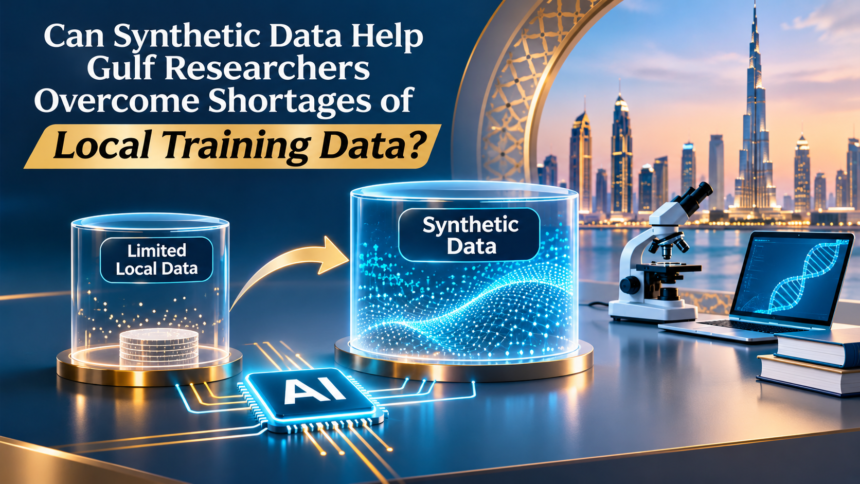
Synthetic Data Could Strengthen Gulf AI Research
Artificial intelligence is becoming an important part of economic development across the Gulf Cooperation Council. Governments, universities, technology companies, and research institutions are exploring how AI can support healthcare, financial services, transportation, education, environmental management, and advanced manufacturing.
- 1. Why Synthetic Data in the GCC Could Address Local Research Challenges
- 2. How Synthetic Data Generation Works and Where It Can Help
- 3. What Saudi Arabia’s Synthetic Data Initiatives Reveal
- 4. How UAE and Qatar Researchers Are Exploring Synthetic Data
- 5. How Synthetic Data Could Support Healthcare, Language AI, and Industrial Research
- 6. The Risks of Synthetic Data: Privacy, Bias, and False Confidence
- 7. The Future of Synthetic Data and Local AI Research in the GCC
- Conclusion
However, developing effective artificial intelligence systems requires more than computing power and sophisticated algorithms. Researchers also need reliable information that reflects the people, languages, industries, and environments where their technologies will operate.
This can be challenging in the Gulf, particularly when research requires specialised or locally representative datasets.
Many internationally available AI datasets have been developed using information from other regions. They may not fully represent Gulf Arabic dialects, local environmental conditions, regional customer behaviour, or the operational requirements of GCC institutions.
Some useful information exists within hospitals, financial institutions, government departments, and private companies, but access may be restricted because of privacy, confidentiality, or legal obligations.
These challenges are increasing interest in synthetic data in the GCC, an approach that uses computer-generated information to support research, software development, and artificial intelligence training.
Synthetic data can be designed to resemble selected characteristics of real-world information without simply reproducing every original record.
It may include artificial patient records, simulated financial transactions, generated images, speech samples, or computer-created industrial sensor readings.
Researchers can use these datasets to test systems, increase coverage of selected situations, and explore applications where collecting real examples would be difficult or expensive.
Regional institutions are already investigating these possibilities.
Digital Dubai has conducted experiments involving privacy-preserving synthetic data. Saudi Arabia’s central bank has developed a synthetic data generation platform, and Qatar-based researchers have contributed to Arabic language benchmarks that use synthetically generated material.
In November 2026, Saudi Arabia’s Data and Artificial Intelligence Authority also released a study examining synthetic data opportunities, challenges, and governance requirements.
However, synthetic data is not a universal solution to limited information.
Artificial records may reproduce biases, overlook important local characteristics, or create a misleading impression of model accuracy. Synthetic datasets generated from sensitive records may also retain privacy risks.
Understanding these limitations is essential for evaluating whether synthetic data can genuinely strengthen Gulf research.
1. Why Synthetic Data in the GCC Could Address Local Research Challenges
AI models learn patterns from information provided during development.
When that information is incomplete or unrepresentative, the resulting systems may perform poorly in situations that differ from their training environment.
For GCC researchers, data availability can be particularly challenging in areas requiring detailed local knowledge.
Understanding Synthetic Data
Synthetic data is artificially generated information designed for a specific analytical, research, or testing purpose.
It may be created using statistical models, computer simulations, generative AI, or combinations of these methods.
Some synthetic datasets are produced by analysing the characteristics of real records.
Others are generated from specified assumptions, mathematical models, or simulated environments.
The method used influences how useful the resulting data may be.
Why Local Datasets Matter
A language model developed primarily using Modern Standard Arabic may struggle with expressions commonly used in Gulf dialects.
Similarly, a computer vision system trained on road imagery from temperate climates may not perform equally well in environments affected by intense sunlight, dust, and different road markings.
These are examples of potential differences, not evidence that every imported AI model performs poorly in the Gulf.
Researchers need to evaluate performance using representative local information.
The Challenge of Rare Events
Certain events are difficult to capture in sufficient quantities.
These might include unusual equipment failures, uncommon medical conditions, or rare financial fraud patterns.
Synthetic generation can produce additional examples for experimentation.
However, artificially increasing the number of rare examples does not prove that the generated scenarios accurately represent real-world probabilities.
Types of Synthetic Data
| Type | Description | Possible Research Application |
|---|---|---|
| Synthetic Tabular Data | Artificial rows and columns | Financial or administrative modelling |
| Synthetic Images | Generated visual examples | Computer vision research |
| Synthetic Speech | Artificial audio samples | Arabic speech recognition |
| Synthetic Text | Generated written material | Language model evaluation |
| Simulated Sensor Data | Artificial equipment readings | Industrial fault detection |
| Synthetic Time Series | Generated sequences over time | Forecasting and system testing |
| Simulated Environments | Computer-generated scenarios | Robotics and autonomous systems |
Why Data Quantity Is Not Enough
A large dataset containing inaccurate assumptions may be less useful than a smaller collection of carefully verified real examples.
Researchers should therefore measure data quality and relevance alongside volume.
2. How Synthetic Data Generation Works and Where It Can Help
Synthetic data can be generated through different technical approaches.
The best method depends on the type of information, its intended use, and the level of realism required.
Statistical Data Generation
A statistical model can estimate relationships within an existing dataset and use those relationships to produce artificial records.
For example, researchers studying retail demand might generate simulated transactions based on known purchasing patterns.
The resulting records can support software testing or exploratory analysis.
However, the model may fail to reproduce important relationships that were not captured in the source data.
Generative Artificial Intelligence
Generative models can produce text, images, audio, and structured records.
Researchers may use these systems to create additional training examples or test cases.
However, generated content can contain incorrect information, unrealistic features, or patterns inherited from the model’s original training data.
Human review may be necessary, particularly for specialised applications.
Simulation-Based Generation
Engineering and robotics researchers often use computer simulations to reproduce selected physical environments.
A simulation might represent traffic movement, equipment behaviour, or robotic navigation.
Researchers can control environmental conditions and test situations that would be difficult to reproduce safely in the real world.
However, a simulated environment inevitably simplifies some aspects of physical reality.
Fully and Partially Synthetic Data
Fully synthetic datasets contain artificial records rather than direct copies of real observations.
Partially synthetic datasets retain some original information while replacing or generating selected fields.
Hybrid datasets combine real and synthetic examples.
These distinctions are important because different approaches create different privacy, accuracy, and governance considerations.
Data Generation Methods Compared
| Method | Main Advantage | Important Limitation |
|---|---|---|
| Statistical Modelling | Preserves selected data relationships | May miss complex patterns |
| Generative AI | Produces varied artificial examples | Can generate errors |
| Physical Simulation | Supports controlled experiments | Simulation-to-reality gaps |
| Data Augmentation | Expands existing examples | Limited new information |
| Differentially Private Generation | Provides formal privacy protection when correctly implemented | Privacy–utility trade-off |
| Hybrid Data Construction | Combines real and artificial examples | Requires careful provenance tracking |
The Importance of Independent Evaluation
Researchers should compare models trained with synthetic data against appropriate real-world benchmarks.
If artificial data improves performance only on other artificial examples, its practical value may be limited.
3. What Saudi Arabia’s Synthetic Data Initiatives Reveal
Saudi Arabia provides several examples of institutional interest in synthetic data.
These include regulatory experimentation, Arabic-language research, and national work on data governance.
Saudi Central Bank’s Synthetic Data Platform
The Saudi Central Bank, known as SAMA, has developed an AI-powered synthetic data generation platform.
According to SAMA, the platform is designed to produce artificial information that preserves selected statistical characteristics of original datasets.
It also supports the generation of records based on descriptions and statistical properties, without requiring users to upload real datasets for every generation task.
The platform includes capabilities involving rare patterns and extended time horizons.
SAMA identifies the project’s purpose as evaluating the feasibility of synthetic data for analysis while protecting privacy and confidentiality.
Its official listing records the stage as Completed Innovative Experimentation (2026).
This is evidence of a completed experimental initiative, not confirmation that every Saudi financial institution is using the technology in production.
Why Financial Data Is a Relevant Application
Banks and financial technology companies need to test transaction systems, fraud detection tools, and data-processing software.
Real financial records can be sensitive and difficult to share.
Synthetic datasets may support certain development and testing tasks.
However, artificial transactions must be assessed carefully before they are used to train systems affecting real customers.
SDAIA’s 2026 Study
In November 2026, the Saudi Data and Artificial Intelligence Authority released a study titled Synthetic Data: Opportunities, Challenges, and Governance Mechanisms.
The study examines potential uses in AI development, including applications involving sensitive information.
It also emphasises data quality, privacy protection, governance, and risk assessment.
The publication demonstrates official attention to synthetic data as a research and policy topic.
However, a national study does not establish that every proposed application has been implemented.
Saudi Research in Speech Technology
Researchers affiliated with SDAIA have also investigated synthetic data for speech technologies.
A 2024 research paper examined the use of synthetic data in foundational speech models and introduced evaluation resources relevant to Saudi Arabic and English code-switching.
Such work is important because real conversations may include mixtures of Arabic dialects and English terminology.
However, artificially generated speech must still be evaluated against recordings from actual speakers.
Saudi Synthetic Data Activities Compared
| Initiative | Main Focus | Development Status |
|---|---|---|
| SAMA Synthetic Data Platform | Financial and analytical experimentation | Completed innovative experimentation in 2026 |
| SDAIA Synthetic Data Study | Opportunities and governance | Study released in November 2026 |
| Saudi Speech Research | Arabic speech and code-switching | Published research |
| University Dataset Research | Data quality and Arabic AI | Academic research |
What These Developments Suggest
Saudi Arabia’s activity demonstrates interest in both technical applications and responsible governance.
The next challenge is determining which synthetic data methods produce reliable improvements under real operating conditions.
4. How UAE and Qatar Researchers Are Exploring Synthetic Data

The UAE and Qatar provide additional examples of regional research relevant to synthetic information, privacy, and Arabic-language AI.
Their activities show that synthetic data can support different objectives.
Digital Dubai’s Privacy-Focused Research
Digital Dubai has described experiments conducted with technology company Faculty AI involving privacy-preserving synthetic data.
The work explored whether artificial datasets could retain useful statistical characteristics while reducing risks associated with accessing original personal records.
Its experiments included traffic accident information from Dubai Pulse.
Digital Dubai reported that, in one experiment involving traffic accident data, its approach preserved approximately 90% of the original dataset’s utility while providing strong privacy protection under the study’s evaluation.
However, that result was specific to the experimental setting and chosen metrics.
It should not be treated as a general guarantee of 90% utility or privacy protection for all synthetic datasets.
Why Public-Sector Research Matters
Government departments may hold information relevant to urban planning, transport systems, and public services.
Researchers could potentially use appropriately generated synthetic datasets to explore selected patterns without obtaining unrestricted access to identifiable records.
However, the legal and technical conditions depend on the data and generation method.
Qatar’s AraDiCE Research
Researchers associated with Qatar Computing Research Institute and other institutions developed AraDiCE, a benchmark examining Arabic dialect and cultural capabilities in large language models.
Presented at COLING 2025, the project introduced seven synthetic dialect datasets developed using machine translation and human post-editing.
The work contributed approximately 45,000 post-edited examples and examined cultural understanding across Gulf, Egyptian, and Levantine contexts.
This provides a concrete example of synthetic generation combined with human review.
It also illustrates why local linguistic knowledge remains important.
The Importance of Human Post-Editing
Synthetic language data may be grammatically correct but culturally unnatural.
Expressions common in one Arabic-speaking region may sound unusual in another.
Human reviewers can identify errors involving vocabulary, tone, cultural references, and meaning.
However, the effectiveness of review depends on the reviewers’ expertise and the dataset’s intended application.
Regional Examples Compared
| Initiative | Location | Application |
|---|---|---|
| Digital Dubai Synthetic Data Research | UAE | Privacy-focused statistical data generation |
| AraDiCE | Qatar-associated research collaboration | Arabic dialect and cultural evaluation |
| Saudi Speech Data Research | Saudi Arabia | Speech generation and language evaluation |
| SAMA Platform | Saudi Arabia | Synthetic financial and analytical datasets |
Why These Examples Are Different
Digital Dubai’s work addresses the privacy and utility of generated records.
AraDiCE focuses on language and cultural evaluation.
SAMA’s platform explores synthetic data generation for financial applications.
All involve artificial data, but their outcomes should not be measured using identical criteria.
5. How Synthetic Data Could Support Healthcare, Language AI, and Industrial Research
The potential applications of synthetic data extend across several sectors relevant to Gulf economic development.
However, research requirements vary considerably.
A dataset suitable for software testing may be inappropriate for medical diagnosis or financial decision-making.
Healthcare Research
Medical researchers may struggle to obtain large, diverse datasets for uncommon conditions.
Synthetic records could help test healthcare software or explore selected analytical methods.
Artificial medical images may also support controlled research experiments.
However, synthetic patients are not substitutes for real clinical evidence.
Medical models must be validated using appropriately sourced patient information before clinical deployment.
Arabic Language Technology
Arabic-language AI requires knowledge of dialects, pronunciation, vocabulary, and cultural context.
Synthetic text and speech may help researchers expand selected datasets.
For example, a system could generate additional examples of customer-service conversations in different Arabic dialects.
However, researchers must verify that the generated material represents authentic local usage.
Otherwise, a model may learn artificial language patterns rather than genuine speech.
Industrial Maintenance
Manufacturing facilities collect data from sensors, machines, and control systems.
Certain equipment failures occur infrequently, leaving limited training examples.
Engineers may simulate abnormal operating conditions to test fault-detection algorithms.
However, simulated failures must reflect realistic equipment behaviour.
A model trained exclusively on artificial breakdowns may fail when exposed to actual industrial conditions.
Transportation and Autonomous Systems
Synthetic images and simulation environments can support the development of computer vision systems for vehicles and robots.
Researchers could create scenarios involving difficult lighting, road layouts, or environmental conditions.
This may be relevant to Gulf applications involving sunlight, dust, and industrial landscapes.
However, simulated performance must be checked through controlled real-world testing.
Potential GCC Applications
| Sector | Possible Synthetic Data Use | Essential Validation |
|---|---|---|
| Healthcare | Artificial patient records and images | Clinical evaluation |
| Banking | Simulated transactions and fraud patterns | Real-world detection performance |
| Arabic AI | Dialect text and speech examples | Native-speaker review |
| Manufacturing | Simulated equipment failures | Engineering verification |
| Transportation | Synthetic driving environments | Physical-world testing |
| Cybersecurity | Simulated attacks and network events | Operational testing |
| Public Administration | Artificial statistical records | Privacy and analytical evaluation |
Why Local Expertise Matters
Synthetic data is only as useful as the assumptions and information guiding its creation.
Researchers familiar with regional conditions can help identify where generated datasets fail to represent reality.
This is particularly important for linguistic, cultural, medical, and environmental applications.
6. The Risks of Synthetic Data: Privacy, Bias, and False Confidence
Synthetic data is sometimes marketed as a way to solve both data scarcity and privacy challenges.
However, neither benefit is guaranteed.
Poorly generated artificial information can produce inaccurate research results or expose details about the original dataset.
Synthetic Data Is Not Automatically Anonymous
A generative model trained on personal records may reproduce some original information.
It might memorise unusual combinations of characteristics or generate records closely resembling real individuals.
Consequently, removing names from a synthetic dataset does not necessarily establish that privacy risks have been eliminated.
The generation process and released outputs require appropriate assessment.
NIST’s Privacy Guidance
The US National Institute of Standards and Technology has published guidance explaining how differential privacy can provide formal protections when implemented correctly.
NIST also cautions that synthetic data techniques without formal privacy mechanisms may offer only informal privacy assurances.
Differential privacy involves a measurable framework for limiting the influence of an individual’s information on released results.
However, applying privacy protection can reduce the accuracy or usefulness of generated data.
The Risk of Reproducing Bias
If a source dataset underrepresents a particular community or type of event, synthetic generation may reproduce that weakness.
For example, an Arabic-language model trained using limited Gulf dialect examples may produce synthetic text that overrepresents Modern Standard Arabic or other dialects.
Generating more examples does not automatically make the dataset more representative.
Researchers must evaluate coverage and bias deliberately.
The Problem of Artificial Accuracy
A model trained and evaluated mainly on synthetic records may achieve impressive scores.
However, these results may not translate to real-world performance.
The generated data may contain repeated patterns or simplified relationships that are easier for a model to predict.
Independent validation is therefore essential.
Model Collapse and Repeated Generation
When generative models are repeatedly trained on artificial outputs from other models, some research indicates that diversity and important details may deteriorate.
This concern is often discussed as model collapse.
The risk depends on the training process, mixture of data, and safeguards.
It should not be interpreted as meaning that every use of synthetic data causes model collapse.
Major Risks and Safeguards
| Risk | Potential Consequence | Practical Response |
|---|---|---|
| Privacy Leakage | Exposure of source information | Privacy testing and suitable protections |
| Unrealistic Patterns | Poor real-world performance | Independent validation |
| Dataset Bias | Unequal model performance | Representation analysis |
| Memorisation | Reproduction of original records | Similarity and disclosure testing |
| Weak Documentation | Misuse of generated data | Provenance records |
| Incorrect Labels | Misleading model training | Expert review |
| Excessive Synthetic Data | Reduced generalisability | Careful real–synthetic balance |
| Regulatory Noncompliance | Legal and operational risks | Qualified legal assessment |
Why Data Protection Rules Still Apply
The UAE’s Federal Personal Data Protection Law and Saudi Arabia’s Personal Data Protection Law establish requirements relevant to personal information.
Other GCC jurisdictions have their own applicable frameworks.
If identifiable data is used to train a synthetic data generator, the processing of that source information may remain regulated.
An organisation should not assume that generating artificial output eliminates its existing obligations.
7. The Future of Synthetic Data and Local AI Research in the GCC
Synthetic data could become increasingly valuable as Gulf institutions develop AI applications requiring specialised regional information.
However, the strongest research strategies are likely to combine synthetic generation with carefully collected real-world data, professional review, and responsible governance.
Building Regionally Relevant AI Datasets
Research institutions may develop synthetic resources reflecting local language varieties, environmental conditions, and sector-specific requirements.
Such datasets could help smaller organisations experiment with AI without independently collecting every possible example.
However, their usefulness depends on clear documentation of where the underlying assumptions and reference data came from.
Shared Research Infrastructure
Universities, government bodies, and industry partners may collaborate on approved synthetic dataset libraries.
These could include example datasets for programming education, software testing, or non-sensitive research demonstrations.
More sensitive applications may require restricted access and formal review.
A dataset should not be made openly available solely because it is labelled synthetic.
Combining Synthetic Data With Federated Learning
Federated learning enables organisations to train models across distributed datasets without routinely centralising raw records.
Synthetic generation could potentially complement this approach by creating suitable testing examples or supporting controlled experimentation.
However, combining the two methods does not automatically guarantee privacy.
Each technology has distinct limitations requiring separate assessment.
A Practical Synthetic Data Research Checklist
- Define the research problem and intended use.
- Identify the limitations of available local datasets.
- Determine whether synthetic generation is suitable.
- Assess the quality and representativeness of source information.
- Verify lawful access to any real training data.
- Select an appropriate generation method.
- Document assumptions, parameters, and data provenance.
- Evaluate privacy leakage and memorisation risks.
- Review demographic, linguistic, and geographic coverage.
- Check generated labels and technical consistency.
- Test model performance using independent real-world data.
- Compare results with a real-data-only baseline.
- Establish expert review for high-risk applications.
- Record limitations and permitted uses.
- Monitor whether generated data remains appropriate over time.
How Researchers Should Measure Success
The number of synthetic records produced is not a meaningful measure of research value on its own.
Researchers should evaluate whether the generated data improves the intended task without creating unacceptable privacy, accuracy, or fairness risks.
Suggested Evaluation Indicators
| Indicator | What It Measures |
|---|---|
| Real-World Model Performance | Effectiveness on genuine test data |
| Statistical Fidelity | Preservation of relevant relationships |
| Dataset Diversity | Coverage of important variations |
| Privacy Leakage Risk | Potential disclosure of source information |
| Bias Assessment | Representation and fairness |
| Expert Acceptance | Technical and contextual realism |
| Research Cost | Resources required |
| Data Provenance | Traceability of source and generation methods |
| Reproducibility | Ability to repeat the research |
| Operational Value | Usefulness for the intended application |
Opportunities for Gulf Research Institutions and Startups
Synthetic data could support specialised technology businesses providing simulation environments, Arabic-language datasets, privacy engineering, healthcare testing tools, and industrial AI development services.
Research universities may contribute expertise in machine learning, statistics, cybersecurity, and domain-specific evaluation.
However, organisations should avoid marketing artificial datasets as substitutes for authentic evidence when real-world validation is essential.
Why Small, High-Quality Local Datasets Still Matter
Synthetic generation depends on credible information about the environment it is intended to represent.
A small collection of carefully verified Gulf Arabic conversations may be valuable for evaluating a much larger synthetic language dataset.
Similarly, real industrial measurements or clinically validated examples may help identify weaknesses in artificial data.
The priority should therefore be making better use of trustworthy local evidence rather than replacing it entirely.
Conclusion
Synthetic data could help Gulf researchers address selected shortages of local AI training information by generating artificial examples for experimentation, testing, and model development.
Its potential is especially relevant to areas where information is difficult to collect, expensive to label, or subject to confidentiality requirements.
Research in Qatar involving Arabic dialect datasets demonstrates how generated material can support language technology when combined with human review.
Digital Dubai’s experiments illustrate the potential role of privacy-focused synthetic records, while Saudi Arabia’s central bank and data authority have explored both practical applications and governance requirements.
However, synthetic data cannot independently establish facts about real people, industries, or environments.
Artificial datasets can reproduce bias, create unrealistic patterns, and introduce privacy risks when generated from sensitive source information.
For researchers, the most important consideration is whether synthetic data improves performance on independent, authentic evaluation material.
For governments and universities, the opportunity lies in building responsible data infrastructure, supporting technical expertise, and encouraging collaboration.
For technology companies, success will depend on transparency, reliable evaluation, and clearly defined uses.
Ultimately, synthetic data could become a valuable addition to the Gulf’s AI research ecosystem, but its strongest role is likely to be complementing rather than replacing trustworthy local information.
By combining artificial datasets with real-world evidence, privacy safeguards, and regional expertise, GCC researchers may be better positioned to develop AI systems that reflect the needs and characteristics of their own societies.
Do follow us on Instagram
Read More – How Machine-Readable Regulations Could Simplify Compliance for GCC Businesses