



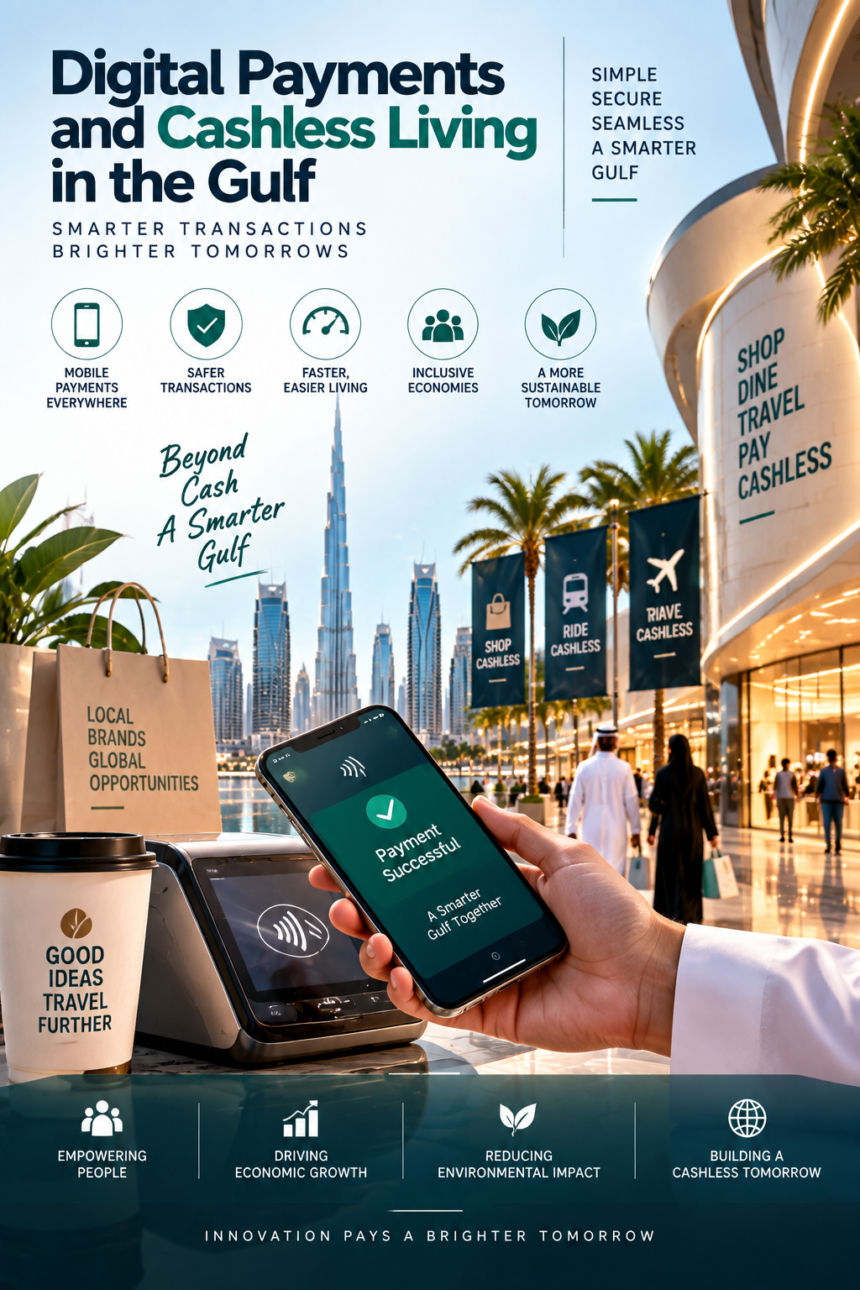
Digital Payments in the Gulf Are Becoming the New Normal
Digital payments in the Gulf are rapidly changing how people shop, transfer money, pay bills and manage everyday expenses. From tapping a phone at a supermarket in Dubai to sending money instantly in Riyadh or scanning a QR code in Muscat, payments are becoming faster and increasingly invisible.
- Why Digital Payments in the Gulf Are Growing So Quickly
- Cashless Living Is Becoming Part of Everyday Gulf Life
- Saudi Arabia Is Moving Rapidly Away From Cash
- The UAE Is Building Instant Payments Around Aani
- UAE Payment Systems Are Processing Huge Volumes
- Mobile Wallets Are Replacing the Physical Wallet
- Qatar Is Expanding Instant Mobile Payments
- QR Codes Are Turning Phones Into Payment Terminals
- Oman Is Seeing a Major Digital Payment Surge
- Bahrain Has Made BenefitPay Part of Everyday Finance
- Kuwait’s Wamdh Is Making Instant Transfers Routine
- Why Are Instant Payments Becoming So Important?
- Contactless Payments Have Changed Small Purchases
- Digital Payments and E-Commerce Are Growing Together
- Cashless Payments Are Helping Small Businesses Go Digital
- Tourists Are Benefiting From Cashless Gulf Cities
- Are Gulf Countries Becoming Completely Cashless?
- Security Becomes More Important as Payments Go Digital
- Five Simple Rules for Safer Digital Payments
- Biometrics Could Make Payments Nearly Invisible
- AI Will Play a Bigger Role in Digital Payments
- Cross-Border GCC Payments Could Become Easier
- What Would Truly Connected GCC Payments Look Like?
- Digital Currencies Could Add Another Layer
- Digital Payments Are Creating More Data
- How the Six GCC Countries Compare
- Cashless Living: Convenience vs Challenges
- What Could Slow the Cashless Transition?
- What the Next Generation of Gulf Payments Could Look Like
- Quick Takeaway: What Is Driving the Gulf Cashless Economy?
- Digital Payments in the Gulf Are Becoming the New Normal
The shift goes far beyond replacing banknotes with cards. The GCC is developing a complete digital payment ecosystem built around mobile wallets, instant bank transfers, QR codes, contactless cards, online payment gateways and national payment platforms.
Saudi Arabia provides one of the clearest examples of the transformation. payments represented 85 percent of retail payment transactions in the Kingdom during 2025, up from 79 percent a year earlier. Saudi payment systems processed around 14.6 billion electronic transactions during the year.
Similar changes are taking place in the UAE, Qatar, Oman, Bahrain and Kuwait. Together, they are moving the Gulf steadily toward a cash-light economy where carrying physical money becomes less necessary for everyday life.
Why Digital Payments in the Gulf Are Growing So Quickly
The Gulf has several characteristics that make it particularly suitable for cashless living. Smartphone use is widespread, banking infrastructure is well developed and consumers are already comfortable using apps for transport, shopping, food delivery and government services.
Businesses also have a strong reason to adopt digital payments. Electronic transactions can make checkout faster, reduce the need to handle cash and provide better records of sales.
The biggest drivers include:
- Widespread smartphone use
- Contactless card adoption
- Expansion of mobile wallets
- Instant bank-transfer platforms
- Growth of e-commerce
- Government digitalisation
- Fintech investment
- QR-code payments
- Younger digital-first consumers
- Improved payment security
The result is a payment environment where consumers can choose between several digital options instead of relying entirely on cash or traditional bank cards.
Cashless Living Is Becoming Part of Everyday Gulf Life
A cashless economy does not necessarily mean physical money disappears completely. It means people can complete most daily transactions without needing it.
Consider a normal day in a Gulf city.
| Everyday Activity | Cashless Alternative |
|---|---|
| Morning coffee | Phone or contactless card |
| Taxi journey | Transport app or digital wallet |
| Grocery shopping | Card, phone or QR payment |
| Sending money to a friend | Instant mobile transfer |
| Paying utility bills | Banking app |
| Online shopping | Payment gateway or wallet |
| Restaurant bill | Contactless or QR payment |
| Parking | Mobile application |
| Government service | Digital payment portal |
| Subscription | Automatic recurring payment |
When all these systems work together, consumers may go for days without visiting an ATM.
That behavioural change is more important than simply measuring how many cards or payment apps exist.
Saudi Arabia Is Moving Rapidly Away From Cash
Saudi Arabia has made reducing reliance on cash an important part of its financial-sector transformation.
The Saudi Central Bank reported that electronic payments accounted for 85 percent of total retail payment transactions in 2025. That represented another significant increase from the 79 percent recorded in 2024.
The number of electronic transactions also increased from approximately 12.6 billion in 2024 to 14.6 billion in 2025.
Saudi Arabia’s cashless shift in numbers:
| Indicator | 2024 | 2025 |
|---|---|---|
| Electronic share of retail payments | 79% | 85% |
| Electronic transactions | 12.6 billion | 14.6 billion |
This growth is supported by mada, Saudi Arabia’s national card-payment infrastructure, alongside online banking, mobile payments, digital wallets and e-commerce transactions.
For consumers, the important change is convenience. Small purchases that may once have been made with cash can now be completed instantly by tapping a card or phone.
The UAE Is Building Instant Payments Around Aani
The UAE is developing its own advanced payment infrastructure through Aani, the national instant payments platform operated by Al Etihad Payments.
Aani allows consumers and businesses to transfer money instantly using identifiers such as mobile numbers. It also supports QR payments, Request to Pay and other payment functions.
By April 2026, Aani had exceeded 12.5 million registered users and was connected with 74 licensed financial institutions. Transfers could be completed in around three seconds, while approximately 774,000 merchants had adopted the platform.
That scale demonstrates how instant account-to-account payments can become an alternative to both cash and traditional card transactions.
What Aani can support:
- Instant person-to-person transfers
- Payments using mobile numbers
- QR-code merchant payments
- Request to Pay
- Instant account-to-account settlement
- Transfers available around the clock
The platform is part of a much broader UAE effort to modernise national financial infrastructure.
UAE Payment Systems Are Processing Huge Volumes
Digital payments are not limited to one application.
The Central Bank of the UAE reported that the country’s national payment infrastructure processed enormous volumes during 2025. UAE debit-card point-of-sale transactions alone exceeded 522 million during the year.
Retail transfers through the UAE Funds Transfer System reached approximately 114.9 million transactions worth around AED 9.9 trillion.
The UAE is also developing Jaywan, its domestic card scheme, while continuing work on instant payments and other digital financial infrastructure.
This creates multiple layers within the payment ecosystem rather than relying on a single provider.
Mobile Wallets Are Replacing the Physical Wallet
For many people, the biggest change in cashless living is simple: the bank card itself is no longer always necessary.
Cards can be stored digitally on smartphones or smartwatches. A customer can then tap the device at a compatible terminal to complete a purchase.
This reduces the number of physical items people need to carry.
A modern digital wallet may contain:
✓ Debit cards
✓ Credit cards
✓ Loyalty cards
✓ Transport passes
✓ Event tickets
✓ Boarding passes
✓ Digital payment credentials
The next stage could make even the idea of selecting a card feel outdated. Payment systems may increasingly choose the most appropriate account or funding source automatically.
Qatar Is Expanding Instant Mobile Payments
Qatar has also built national infrastructure designed to support mobile payments.
The Qatar Mobile Payment system is the country’s national interoperable mobile-payment switch. It connects licensed banks and payment-service providers, allowing users to send money between participating digital wallets.
Customers can transfer money between wallets and bank accounts while using smartphones for transactions around the clock.
Qatar has also introduced Fawran, an instant-payment service supporting rapid transfers.
By December 2025, Fawran had around 3.6 million registered accounts, while the Qatar Mobile Payment system had approximately 1.27 million registered wallets.
These services demonstrate how national instant-payment infrastructure can gradually reduce the need for both cash and traditional money transfers.
QR Codes Are Turning Phones Into Payment Terminals
One of the simplest cashless technologies is the QR code.
A merchant displays a QR code, the customer scans it through a banking or payment application and confirms the amount.
This can be particularly useful for smaller businesses because they may not need complicated payment hardware.
Oman, for example, has developed interoperable QR payments through its Mobile Payment Clearing and Settlement System. Businesses can use the system to receive electronic payments directly into bank accounts.
QR payments are attractive because they can work in many situations:
- Small retail stores
- Cafés
- Delivery businesses
- Market stalls
- Freelancers
- Service providers
- Online invoices
For small businesses, turning a printed code into a payment acceptance point can significantly reduce the barrier to becoming cashless.
Oman Is Seeing a Major Digital Payment Surge
Oman’s transition toward electronic payments accelerated significantly during 2025.
Data from the Central Bank of Oman showed that transactions through local electronic payment gateways reached approximately OMR 3.2 billion, representing growth of 76.3 percent compared with 2024.
The number of transactions increased even faster, jumping from around 67 million to more than 168 million.
Point-of-sale transaction values exceeded OMR 7.5 billion during the year, while QR-code payments recorded particularly strong growth.
Oman Digital Payment Snapshot
| Indicator | 2025 |
|---|---|
| Electronic payment gateway value | OMR 3.2 billion |
| Gateway transaction volume | 168+ million |
| Annual gateway value growth | 76.3% |
| POS transaction value | OMR 7.5+ billion |
| QR payment growth | 133.5% |
The Central Bank of Oman itself describes the continued rise in electronic transaction volumes as evidence of progress toward a less-cash society.
Bahrain Has Made BenefitPay Part of Everyday Finance
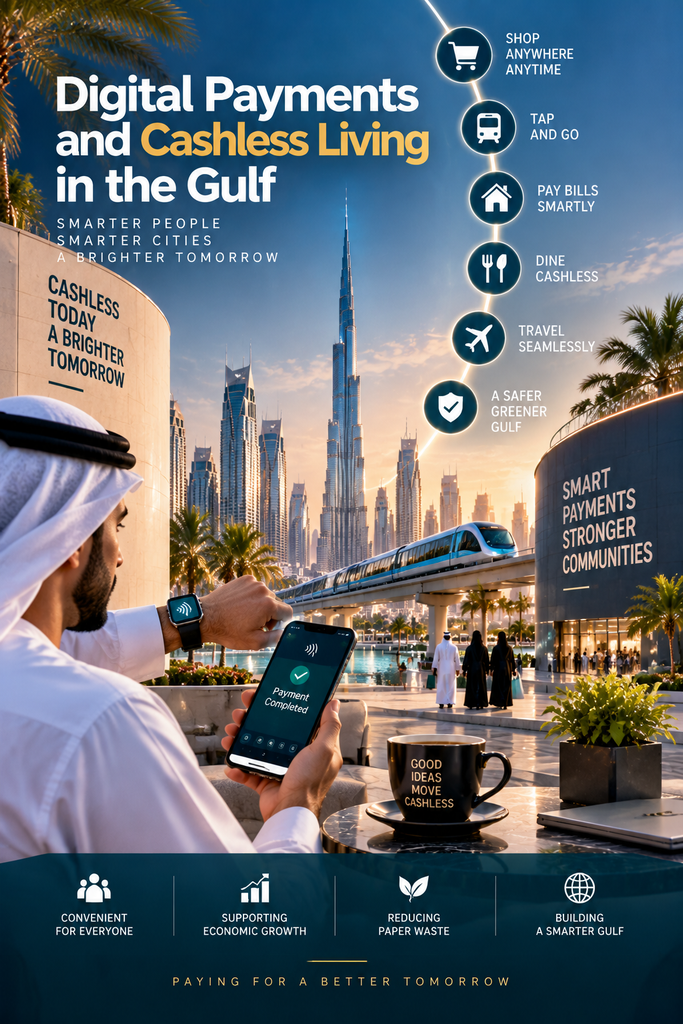
Bahrain has developed one of the Gulf’s most established mobile-payment ecosystems through BenefitPay and the national Electronic Funds Transfer System.
In 2025, electronic transfer services processed 494 million transactions worth BD 37.5 billion, according to BENEFIT.
BenefitPay itself accounted for 466 million transactions across the Fawri, Fawri+ and Fawateer services.
The Fawri+ instant-transfer system has become especially important. Bahrain increased the daily transfer limit from BD1,000 to BD3,000 per bank account in July 2025 as demand for instant payments continued growing.
Bahrain has also introduced digital direct debit through BenefitPay, allowing recurring payments to be authorised electronically instead of relying on paper-based processes.
This shows how cashless living eventually moves beyond shopping into almost every financial activity.
Kuwait’s Wamdh Is Making Instant Transfers Routine
Kuwait has also developed a rapidly expanding instant-payment ecosystem through Wamdh.
Central Bank of Kuwait statistics show how quickly the service expanded during 2025.
In January 2025, Wamdh processed approximately 5.9 million transactions worth KD483.8 million. By December, monthly activity had reached around 13.8 million transactions worth KD903.3 million.
How Wamdh Grew During 2025
| Month | Transactions | Value |
|---|---|---|
| January | 5.9 million | KD483.8m |
| March | 8.1 million | KD615.7m |
| June | 9.5 million | KD700m |
| September | 11.6 million | KD832m |
| December | 13.8 million | KD903.3m |
This is a useful example of how quickly consumer habits can change once instant payments become convenient.
Instead of withdrawing cash or entering long bank-account details, users can increasingly move money digitally within seconds.
Why Are Instant Payments Becoming So Important?
Traditional bank transfers can feel slow when consumers are accustomed to instant digital services.
Instant payments change that expectation.
Money can often move between accounts within seconds and outside traditional banking hours.
Instant payment systems solve several everyday problems:
Splitting restaurant bills: One person pays and everyone transfers their share immediately.
Small business payments: Customers can transfer money directly to merchants.
Family transfers: Money can reach relatives instantly.
Rent and services: Payments can be completed without cheques or cash.
Online commerce: Sellers can receive confirmation almost immediately.
The faster payments become, the less difference consumers perceive between exchanging cash and transferring digital money.
Contactless Payments Have Changed Small Purchases
One reason cash remained useful for so long was speed.
Paying a small amount with a card once required inserting it into a machine, entering a PIN and waiting for approval.
Contactless technology changed that experience.
A customer can now tap a card, smartphone or smartwatch against a terminal and complete many purchases almost immediately.
This matters because small transactions make up a large share of everyday spending.
Coffee, parking, convenience-store purchases and transport fares are exactly the kinds of transactions where consumers once reached automatically for cash.
When digital payment becomes equally fast, the advantage of carrying physical money becomes smaller.
Digital Payments and E-Commerce Are Growing Together
Cashless payments are one of the foundations of online retail.
A customer can discover a product on social media, order it through an application and pay without ever interacting with physical money.
This relationship works both ways.
E-commerce encourages consumers to become comfortable with digital payments, while better payment systems make online shopping easier.
The growth of instant transfers, digital wallets and tokenised cards can also make checkout faster.
Instead of repeatedly entering card information, customers can increasingly confirm payments through fingerprints, facial recognition or another secure authentication method.
Every additional step removed from checkout can make digital shopping feel more natural.
Cashless Payments Are Helping Small Businesses Go Digital
Digital payments are not only useful for major retailers.
They can be particularly valuable for smaller merchants.
A freelancer, home business or small café may be able to accept money through QR codes or instant transfers without investing in complicated cash-management systems.
For Small Businesses, Cashless Payments Can Mean
| Benefit | Why It Helps |
|---|---|
| Faster settlement | Money reaches accounts sooner |
| Easier bookkeeping | Digital transaction records are automatic |
| Less cash handling | Lower need for counting and storing cash |
| Remote payments | Customers can pay without being physically present |
| Easier online selling | Payments connect directly with digital commerce |
| Better analytics | Businesses can analyse transaction patterns |
Digital payments can therefore support entrepreneurship as well as convenience.
For governments, formal electronic transactions can also make economic activity more transparent.
Tourists Are Benefiting From Cashless Gulf Cities
Tourism provides another reason Gulf cities are investing in simple digital payments.
International visitors do not always want to exchange large amounts of currency immediately after landing.
Contactless cards and mobile wallets allow visitors to begin spending almost immediately.
Hotels, restaurants, malls, attractions and transport systems increasingly accept electronic payments.
The experience becomes easier because tourists can use familiar payment methods rather than learning a completely new cash system.
As the UAE, Saudi Arabia, Qatar and other GCC countries continue expanding tourism, payment convenience becomes part of the overall visitor experience.
Are Gulf Countries Becoming Completely Cashless?
Not yet, and complete elimination of cash is not necessarily the goal.
Physical currency still performs several useful functions.
Some consumers prefer cash for budgeting. Small merchants may still use it, while cash can provide an alternative when digital systems or telecommunications experience temporary disruption.
The transition is better described as cash-light.
Cash Will Probably Remain Useful For
- Emergency backup
- Certain small businesses
- People less comfortable with technology
- Transactions during network outages
- Specific personal budgeting preferences
The important change is that cash is moving from being essential to being optional in more situations.
Security Becomes More Important as Payments Go Digital
Convenience creates new risks.
A stolen banknote can usually affect only the amount physically taken. Digital fraud can potentially target much larger balances or many victims simultaneously.
That makes cybersecurity central to cashless living.
Common digital payment risks include:
- Phishing messages
- Fake payment links
- Stolen login credentials
- Fraudulent QR codes
- Social-engineering scams
- SIM-related fraud
- Account takeover
- Fake online stores
Banks and payment companies increasingly use biometric authentication, transaction monitoring, tokenisation and fraud-detection algorithms to reduce these risks.
Consumers still remain part of the security system. A payment platform cannot protect someone who willingly gives an authentication code to a scammer.
Five Simple Rules for Safer Digital Payments
Digital payments are convenient, but users should develop basic security habits.
1. Never share one-time passwords.
Banks and legitimate payment providers should not require customers to send authentication codes to strangers.
2. Check payment requests carefully.
Confirm the recipient name and amount before approving any transfer.
3. Avoid unknown payment links.
Open official apps directly instead of clicking suspicious messages.
4. Protect your phone.
Use biometric authentication, screen locks and remote-device protection.
5. Check transactions regularly.
Small unauthorised payments can be easier to detect when accounts are reviewed frequently.
Good payment technology and good user behaviour need to work together.
Biometrics Could Make Payments Nearly Invisible
Passwords and PIN numbers may gradually become less important.
Smartphones already allow users to approve transactions through facial recognition or fingerprints.
Future systems may combine several signals automatically, including device identity, location and behavioural patterns.
A low-risk transaction could be approved with minimal interaction, while an unusual transaction may require additional verification.
This approach is known as risk-based authentication.
The payment experience could therefore become simpler for legitimate users while becoming more difficult for criminals.
AI Will Play a Bigger Role in Digital Payments
Artificial intelligence is likely to become increasingly important in payment systems.
Banks can use AI to analyse transaction patterns and identify unusual behaviour.
Imagine a customer who normally spends inside Dubai suddenly attempting several high-value transactions from another continent.
An intelligent fraud system can identify the difference and trigger additional verification.
AI can also support customer service, merchant analytics and payment routing.
For consumers, much of this technology will operate invisibly in the background.
The best payment system may eventually be one that users barely notice.
Cross-Border GCC Payments Could Become Easier
Domestic instant payment systems solve only part of the problem.
The next challenge is making payments between GCC countries similarly convenient.
GCC states have already created regional payment infrastructure and continue working on stronger integration.
In August 2026, the GCC Technical Committee for Payment Systems discussed current developments involving Gulf payment systems and future regional cooperation.
The GCC has also highlighted expansion of shared financial infrastructure and regional payment systems as priorities for deeper financial integration.
If regional interoperability continues improving, sending money between Dubai, Riyadh, Doha, Muscat, Manama and Kuwait City could gradually become easier and potentially cheaper.
What Would Truly Connected GCC Payments Look Like?
Imagine travelling from the UAE to Saudi Arabia without thinking about currency exchange or payment compatibility.
Your existing banking application could recognise the transaction, convert or settle funds efficiently and complete the payment instantly.
A merchant might receive money in local currency while the customer pays from an account elsewhere in the GCC.
That level of interoperability would benefit more than tourists.
It could help:
✓ GCC businesses
✓ Cross-border e-commerce
✓ Freelancers
✓ Families living across different Gulf states
✓ Regional investors
✓ Tourism operators
✓ SMEs selling throughout the GCC
Payment integration could eventually become another element of the GCC common economic market.
Digital Currencies Could Add Another Layer
Central banks around the world are also studying central bank digital currencies.
Unlike cryptocurrencies, a central bank digital currency would represent official national money issued within a regulated monetary system.
The UAE has already been developing its Digital Dirham as part of the Central Bank’s Financial Infrastructure Transformation programme. The CBUAE has also participated in international projects examining central bank digital currency and cross-border settlement.
Digital currencies could eventually support programmable payments, instant settlement and new forms of financial infrastructure.
However, they are likely to complement existing payment systems rather than immediately replace bank accounts, cards or mobile wallets.
Digital Payments Are Creating More Data
Every electronic transaction produces information.
Retailers can analyse which products sell at particular times. Banks can identify spending patterns. Payment companies can understand how customers use different channels.
This data can improve services, but it also creates questions about privacy.
Consumers increasingly need to understand how financial data is stored, processed and shared.
Regulators therefore face an important balancing act.
Digital payments should be easy enough to encourage innovation while remaining secure enough to protect consumers and the wider financial system.
How the Six GCC Countries Compare
Each Gulf country is following a slightly different route toward cashless living.
| Country | Key Cashless Development |
|---|---|
| UAE | Aani instant payments, Jaywan and advanced digital banking |
| Saudi Arabia | 85% electronic share of retail payments in 2025 |
| Qatar | Fawran and Qatar Mobile Payment infrastructure |
| Oman | Rapid gateway, POS and QR payment growth |
| Bahrain | BenefitPay, Fawri+, Fawateer and digital direct debit |
| Kuwait | Fast-growing Wamdh instant-payment service |
The exact platforms differ, but the direction is remarkably similar.
All six markets are investing in faster electronic payments, stronger fintech infrastructure and easier mobile transactions.
Cashless Living: Convenience vs Challenges
The move toward digital payments creates significant advantages, but it also introduces new considerations.
| Advantages | Challenges |
|---|---|
| Faster transactions | Cybersecurity threats |
| Easier online shopping | Digital fraud |
| Less need to carry cash | Dependence on technology |
| Better financial records | Privacy concerns |
| Instant money transfers | Network outages |
| Easier merchant payments | Some users may be excluded |
| Stronger e-commerce | Need for digital literacy |
A successful cashless economy therefore needs more than technology.
It requires regulation, cybersecurity, consumer education and reliable telecommunications infrastructure.
What Could Slow the Cashless Transition?
The GCC already has strong payment infrastructure, but several barriers remain.
Digital exclusion: Elderly users or people with limited technology skills may find some systems difficult.
Fraud: Scam activity can reduce confidence if consumers repeatedly encounter fake links or payment requests.
Merchant costs: Small businesses need digital acceptance options that remain affordable.
Cybersecurity: Payment networks are critical national infrastructure and must remain resilient.
System outages: Consumers need alternatives if networks temporarily fail.
Fragmentation: Too many incompatible wallets or payment systems can reduce convenience.
These problems are manageable, but they show why becoming cashless involves more than asking consumers to stop carrying money.
What the Next Generation of Gulf Payments Could Look Like
The next stage will probably make payments even less visible.
A customer could enter a store, select products and leave while cameras and digital accounts automatically identify the purchase.
Cars may pay automatically for parking, charging or road services.
AI assistants could manage recurring bills and choose the most efficient payment account.
Cross-border transfers could become nearly instant.
Biometric systems might allow consumers to approve purchases without cards or phones in certain environments.
At the same time, QR payments and inexpensive digital acceptance tools could allow even the smallest merchants to participate.
The future payment system may therefore become both more technologically advanced and more accessible.
Quick Takeaway: What Is Driving the Gulf Cashless Economy?
The transformation can be understood through six connected shifts:
- Cash to cards for everyday retail payments.
- Cards to phones through digital wallets.
- Bank details to mobile numbers through instant-payment systems.
- Payment terminals to QR codes for smaller merchants.
- Domestic systems to GCC connectivity for regional transactions.
- Manual payments to intelligent payments using AI and automation.
Each step removes friction from the transaction.
That convenience is ultimately what changes consumer behaviour.
Digital Payments in the Gulf Are Becoming the New Normal
Digital payments in the Gulf are no longer simply a fintech trend. They are becoming basic infrastructure for everyday life.
Saudi Arabia recorded an 85 percent electronic share of retail payments in 2025, while the UAE’s Aani platform exceeded 12.5 million registered users in 2026. Oman recorded strong growth in payment-gateway transactions, Bahrain’s electronic transfer ecosystem processed hundreds of millions of transactions and Kuwait’s Wamdh service expanded rapidly throughout 2025.
Qatar is also expanding mobile and instant-payment infrastructure, demonstrating that this transformation is taking place across all six GCC markets.
The most important change is not the technology itself. It is the way that technology changes expectations.
Consumers increasingly expect money to move instantly. They expect payment to work with a phone. They expect online and offline purchases to connect seamlessly, and they expect financial services to remain available around the clock.
Cash is unlikely to disappear completely. But across the Gulf, it is becoming less essential.
The region is moving toward a future where paying may take only seconds and, in many situations, may require little more than a phone, a fingerprint or a simple tap.
Do follow us on Instagram
Read More – E-Commerce Across the GCC: How Online Shopping Is Transforming Gulf Retail