


How Traditional Gulf Design Supports Sustainable Architecture
Sustainable architecture in GCC cities is changing the way buildings are designed, constructed and operated across the Gulf. From Abu Dhabi and Dubai to Riyadh, Doha, Muscat, Manama and Kuwait City, architects and developers are increasingly looking beyond appearance and asking a more important question: how can buildings remain comfortable in an extremely hot climate while using less energy and water?
- Why Sustainable Architecture in GCC Cities Is Growing
- Gulf Architecture Is Learning From Traditional Design
- Passive Design Can Reduce Cooling Demand
- The UAE Is Developing Strong Green Building Standards
- Dubai Is Also Focusing on Existing Buildings
- Saudi Arabia Is Expanding Sustainable Building Standards
- Sustainable Communities Matter More Than Individual Green Buildings
- Qatar Is Combining Heritage With Sustainable Urban Design
- Qatar’s GSAS System Addresses Gulf-Specific Conditions
- Oman Is Planning for More Sustainable Cities
- Bahrain Is Bringing Renewable Energy Into Building Design
- Kuwait Is Increasing Its Focus on Green Buildings
- District Cooling Can Make Dense Cities More Efficient
- Solar Energy Fits Naturally With Gulf Architecture
- Water Efficiency Is Essential for Gulf Buildings
- Smart Buildings Can Reduce Waste Automatically
- Construction Materials Are Becoming Part of the Sustainability Debate
- Green Architecture Can Improve Life for People Too
- Green Buildings Can Also Make Economic Sense
- What Challenges Still Face Sustainable Architecture in the GCC?
- What the Next Generation of GCC Buildings Could Look Like
- Sustainable Architecture in GCC Cities Is Becoming the New Standard
For decades, rapid urban development transformed Gulf skylines through high-rise towers, large shopping centres, hotels, residential communities and major commercial districts. Many of these buildings depend heavily on air-conditioning because summer temperatures can reach extreme levels. Water is also a valuable resource, while construction itself requires large quantities of concrete, steel, glass and other materials.
Today, these conditions are encouraging a different approach to architecture.
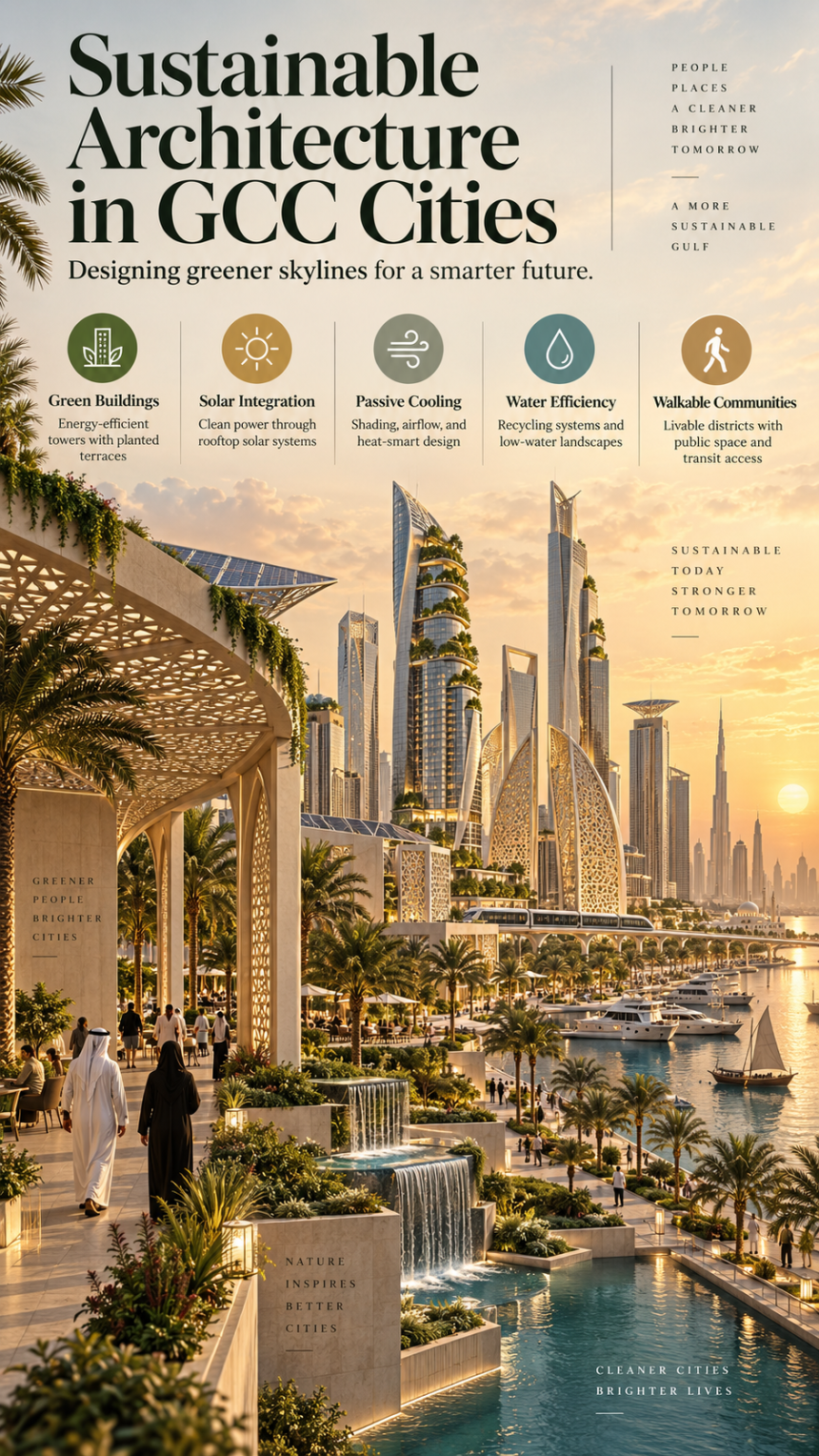
New projects are using better insulation, shaded streets, efficient glass, solar energy, district cooling, recycled water, smart building technology and climate-responsive layouts. At the same time, designers are rediscovering ideas that were common in traditional Gulf architecture long before modern air-conditioning existed.
The result is an architectural movement that combines advanced technology with lessons from the region’s past.
Why Sustainable Architecture in GCC Cities Is Growing
Sustainability has become increasingly important because buildings consume energy throughout their entire life cycle.
Energy is required to manufacture construction materials, transport them to sites, construct buildings and then operate those buildings for decades. In Gulf cities, cooling usually represents one of the most important operational requirements because of the long, hot summers.
Governments are therefore creating building standards and sustainability frameworks designed to improve energy efficiency, reduce water consumption and encourage better construction practices.
The UAE, Saudi Arabia and Qatar already have established green-building assessment systems, while Oman, Bahrain and Kuwait are also strengthening sustainability within their wider urban-development strategies.
The transformation is being driven by several factors:
| Driver | Impact on GCC Architecture |
|---|---|
| Extreme temperatures | Greater focus on insulation, shading and cooling efficiency |
| High cooling demand | More efficient façades and district cooling systems |
| Water scarcity | Low-flow systems, recycled water and efficient landscaping |
| Net-zero ambitions | Greater use of renewable energy and efficient buildings |
| Rapid urban growth | Opportunity to design entire sustainable communities |
| New building regulations | Higher minimum efficiency standards |
| Technology | Smart systems can monitor and reduce energy consumption |
| Investor demand | Green certification is becoming more valuable for major properties |
Sustainability is therefore becoming part of mainstream real-estate development rather than remaining limited to experimental projects.
Gulf Architecture Is Learning From Traditional Design
Some of the most useful sustainable ideas in Gulf architecture are not new at all.
Before modern air-conditioning, buildings across the Arabian Peninsula had to respond directly to the environment. Houses were often designed with courtyards, shaded passages, thick walls and relatively small external openings.
Traditional wind towers helped direct air through buildings. Narrow streets created shade, while courtyards encouraged natural ventilation and provided protected outdoor areas.
Modern architects are increasingly adapting these principles rather than copying them directly.
A contemporary office tower may use computer-controlled shading instead of traditional wooden screens. A modern residential development may use narrow streets and building orientation to reduce direct sunlight. High-performance insulation can perform a similar role to the thick walls used in older Gulf homes.
This combination of traditional environmental knowledge and modern technology could become one of the defining characteristics of sustainable architecture across the GCC.
Passive Design Can Reduce Cooling Demand
One of the most important principles of sustainable architecture is reducing energy demand before adding complicated technology.
This is known as passive design.
Masdar City in Abu Dhabi provides a major regional example. Its buildings, streets and public spaces are designed and oriented to improve thermal comfort while reducing energy and water demand. Masdar City says passive design is central to its approach, with building orientation, shading and other architectural decisions responding specifically to the local climate.
Passive design can include several techniques:
- Positioning buildings to reduce direct solar exposure
- Shading windows and façades
- Using highly insulated walls and roofs
- Choosing glass that limits unwanted heat gain
- Creating shaded pedestrian routes
- Using courtyards and landscaping to improve outdoor comfort
- Designing streets to take advantage of prevailing winds
Each measure may appear relatively simple, but together they can significantly reduce the amount of mechanical cooling required.
The important principle is straightforward: the most efficient cooling energy is the energy a building never needs to use.
The UAE Is Developing Strong Green Building Standards
The UAE has become one of the Gulf’s most active markets for sustainable architecture.
Dubai’s Al Sa’fat Green Building System provides standards intended to improve building performance in areas including energy, water, materials, public health and environmental quality. Dubai Municipality updated the system in 2020 and again in 2023.
This means sustainability is increasingly embedded in building regulation rather than depending entirely on individual developers voluntarily choosing green features.
Abu Dhabi has also developed a strong sustainable-building ecosystem, with Masdar City serving as one of its best-known examples.
Masdar City’s master plan combines building efficiency, renewable energy, landscaping, transportation and public spaces. More than 11 MW of photovoltaic capacity has been installed across the development, according to Masdar City.
Several upcoming buildings at Masdar City are also planned to pursue Zero Energy Certification, which requires buildings to demonstrate that renewable energy production can match their annual energy demand after efficiency measures are applied.
These projects show how Gulf sustainable architecture is moving beyond simply reducing consumption toward buildings that may eventually generate as much energy as they use.
Dubai Is Also Focusing on Existing Buildings
New buildings usually receive most of the attention when discussing sustainable architecture, but existing buildings represent an equally important challenge.
Cities cannot simply replace every inefficient tower, hotel or residential building.
Instead, older properties need to be upgraded.
Dubai Municipality provides guidance for retrofitting existing buildings to make them greener and more environmentally efficient.
Retrofitting can involve improvements such as:
- Installing better insulation
- Replacing inefficient lighting
- Upgrading air-conditioning systems
- Improving building-management software
- Replacing inefficient windows
- Installing solar panels
- Introducing water-saving fixtures
- Improving sensors and occupancy controls
For property owners, these improvements can reduce operating expenses while extending the useful life of the building.
As GCC cities mature, retrofitting is likely to become as important as sustainable new construction.
Saudi Arabia Is Expanding Sustainable Building Standards
Saudi Arabia’s rapid construction growth is creating one of the region’s largest opportunities for sustainable architecture.
The Kingdom’s Mostadam system evaluates sustainability in residential buildings, commercial properties and communities. It considers factors such as energy efficiency, water performance, indoor environmental quality and site management.
Mostadam certification is available at five levels: Green, Bronze, Silver, Gold and Diamond. The programme is linked with Saudi Vision 2030 and aims to improve construction quality, resource efficiency and quality of life.
This matters because Saudi Arabia is simultaneously building new residential districts, commercial centres, tourism destinations and major urban developments.
Building sustainability requirements into projects from the beginning is generally easier than trying to retrofit them decades later.
The Kingdom therefore has an unusual opportunity. Instead of adapting an entirely mature building stock, many new districts can be planned around contemporary energy, water and environmental standards from their earliest stages.
Sustainable Communities Matter More Than Individual Green Buildings
A highly efficient tower surrounded by highways and enormous parking areas may still create significant environmental impact.
This is why sustainable architecture is gradually expanding into sustainable urban planning.
The focus is shifting from individual buildings toward complete communities.
A sustainable district may combine:
- Energy-efficient buildings
- Public transportation
- Walkable streets
- Shaded pedestrian routes
- Cycling infrastructure
- Mixed residential and commercial development
- Parks and landscaped areas
- District cooling
- Renewable energy
- Water recycling
This approach can reduce the need for residents to drive for every activity.
Saudi Arabia’s Mostadam framework includes sustainability assessment for communities as well as individual residential and commercial buildings, demonstrating how sustainability is increasingly being evaluated at neighbourhood scale.
Future GCC cities may therefore be judged not only by the efficiency of individual towers but by how efficiently entire districts function.
Qatar Is Combining Heritage With Sustainable Urban Design
Doha offers one of the region’s strongest examples of contemporary architecture inspired by traditional Gulf urban planning.
Msheireb Downtown Doha was designed as a smart and sustainable urban regeneration district. Its streets are oriented to capture breezes and create shade, while buildings use recessed windows, thicker walls, heat-isolating glass and light-coloured materials to reduce cooling requirements.
The development reports that these measures contribute to an approximately 30 percent reduction in energy consumption.
Renewable energy is also integrated into the district. Msheireb says it uses more than 6,400 photovoltaic panels and 1,400 solar thermal panels, with approximately 1.4 MW of installed solar capacity.
The project also contains a large concentration of LEED-certified buildings, including 50 Platinum and 49 Gold certifications.
What makes Msheireb particularly relevant is that it demonstrates how sustainable architecture does not have to look completely futuristic.
Traditional proportions, shaded streets and local architectural identity can coexist with modern energy systems and smart-building technology.
Qatar’s GSAS System Addresses Gulf-Specific Conditions
International certification programmes such as LEED are widely used across the Gulf, but Qatar has also developed its own regional sustainability system.
The Global Sustainability Assessment System, or GSAS, was developed by the Gulf Organisation for Research and Development.
GSAS describes itself as the first integrated, performance-based sustainability rating system developed in the Middle East and North Africa. Its framework evaluates design, construction and building operations while considering environmental challenges specific to the region.
This regional approach is important because sustainable architecture cannot always rely on standards created for completely different climates.
A building in northern Europe has different cooling, sunlight and water requirements from a building in Doha, Riyadh or Dubai.
Regional sustainability standards can therefore help designers focus on the environmental issues that matter most in Gulf conditions.
Oman Is Planning for More Sustainable Cities
Oman’s sustainability ambitions extend beyond individual buildings.
Oman Vision 2040 identifies sustainable cities and balanced urban development as national priorities. The strategy calls for modern cities with advanced services and technology while improving liveability and supporting economic development.
Oman’s architectural environment also provides opportunities for climate-responsive design.
Traditional Omani settlements often use thick walls, courtyards, narrow shaded paths and building forms suited to hot conditions. Modern developments can reinterpret these principles using contemporary materials and technology.
Muscat’s lower-rise urban form also differs from skyscraper-dominated districts elsewhere in the Gulf. This creates opportunities to use rooftop solar systems, natural shading and landscape-based cooling at different scales.
As new districts and smart-city projects develop, Oman can increasingly combine its architectural identity with modern sustainability standards.
Bahrain Is Bringing Renewable Energy Into Building Design
Bahrain has also been developing sustainability and green-building requirements.
The country’s official construction and urban-planning information notes that sustainability and green-building requirements have been incorporated into government work on buildings and infrastructure since 2010.
Bahrain’s National Renewable Energy Action Plan has also outlined a renewable-energy mandate for new buildings and real-estate developments, covering technologies such as rooftop photovoltaic panels, building-integrated solar power and solar water heating.
Thermal insulation is another important area because reducing heat transfer into buildings can lower cooling demand. Bahrain’s Electricity and Water Authority regulates certification for companies working on thermal insulation installations.
Because Bahrain is geographically compact and highly urbanised, sustainable building design can have an important impact on overall energy demand.
Kuwait Is Increasing Its Focus on Green Buildings
Kuwait is also discussing how sustainability can become more deeply integrated into construction.
In February 2026, a Kuwait Municipal Council member proposed making green-building requirements mandatory for future government facilities. The proposal focused on energy efficiency, water use and reducing building operating costs. At that stage, it was a proposal rather than an established nationwide requirement.
The discussion reflects a wider challenge facing Kuwait.
The country’s hot climate creates heavy demand for air-conditioning, while traditional courtyard architecture once offered passive ways of dealing with heat and privacy.
Future sustainable architecture in Kuwait could therefore combine stronger efficiency standards with renewed interest in climate-responsive local design.
Kuwait’s transition may progress differently from the UAE, Saudi Arabia or Qatar, but greater attention to green government buildings, urban infrastructure and energy performance indicates that sustainable construction is becoming a larger part of the national conversation.
District Cooling Can Make Dense Cities More Efficient
Air-conditioning is essential across most GCC cities, which means sustainable architecture cannot simply eliminate mechanical cooling.
Instead, buildings need to make cooling more efficient.
District cooling offers one solution.
Instead of every building operating completely separate cooling equipment, a central facility produces chilled water and distributes it through a network to multiple buildings.
This can be particularly effective in high-density districts containing offices, hotels, residences and shopping facilities.
Msheireb Downtown Doha uses high-efficiency district cooling as part of its energy strategy.
District systems can also allow equipment to operate at larger scale and potentially integrate more efficiently with future renewable-energy or thermal-storage systems.
For dense Gulf developments, the question may therefore shift from how efficiently one building is cooled to how efficiently an entire district manages cooling.
Solar Energy Fits Naturally With Gulf Architecture
The Gulf receives abundant sunlight, making solar power an obvious part of sustainable building strategies.
Rooftops, parking structures and building façades can all potentially support photovoltaic systems.
However, sustainable architecture requires more than simply attaching solar panels to an inefficient building.
The best approach is usually to reduce demand first through insulation, shading and efficient systems, then use renewable energy to supply part of the remaining requirement.
Masdar City demonstrates this combined approach through passive design and more than 11 MW of installed photovoltaic capacity.
Msheireb Downtown Doha similarly combines energy-efficient building envelopes with thousands of solar panels.
Future technologies may make solar power even more closely integrated with architecture. Building-integrated photovoltaics can potentially allow façades, canopies or other surfaces to generate electricity while remaining part of the building design itself.
Water Efficiency Is Essential for Gulf Buildings
A genuinely sustainable Gulf building must consider water as carefully as energy.
The region’s dry climate means landscaping, cooling systems, hotels, homes and commercial properties can create significant water demand.
Sustainable buildings can reduce this demand through low-flow fixtures, efficient irrigation, leak detection and recycled water.
Landscaping also matters.
Using native and drought-tolerant plants can reduce irrigation requirements compared with landscapes designed around species requiring large quantities of water.
Msheireb Downtown Doha uses non-potable municipal water for irrigation, toilet flushing and district-cooling requirements while using efficient irrigation and drought-tolerant plants.
Smart meters can further help building operators identify unusual consumption and detect leaks more quickly.
Future buildings may therefore treat water in much the same way modern buildings treat electricity: something that is continuously measured, analysed and optimised.
Smart Buildings Can Reduce Waste Automatically
Digital technology is adding another layer to sustainable architecture.
Modern building-management systems can monitor temperature, lighting, air quality, occupancy and energy consumption in real time.
Instead of cooling every room at the same intensity throughout the day, smart systems can respond to actual occupancy.
Lights can switch off automatically when rooms are empty. Air-conditioning can adjust based on demand. Sensors can identify equipment that is consuming unusually high levels of electricity.
Predictive maintenance can also reduce waste.
If software identifies an air-conditioning unit becoming less efficient before it fails, maintenance can be performed earlier, potentially reducing energy consumption and preventing expensive breakdowns.
Artificial intelligence could make these systems increasingly sophisticated.
The building of the future may constantly adjust itself according to temperature, sunlight, occupancy, energy prices and weather conditions.
Construction Materials Are Becoming Part of the Sustainability Debate
Energy consumption after construction is only one part of a building’s environmental impact.
Large quantities of carbon emissions can also be associated with producing concrete, steel, aluminium, glass and other construction materials.
This is known as embodied carbon.
As GCC sustainability standards become more advanced, developers are likely to pay greater attention to where materials come from, how they are manufactured and whether they can be reused or recycled.
Possible solutions include lower-carbon concrete mixtures, recycled steel, responsibly sourced materials and prefabricated building components that reduce waste.
Local sourcing can sometimes reduce transportation requirements as well.
Designers may also consider whether buildings can be adapted rather than demolished when their original use changes.
A building capable of serving several functions over many decades can be more sustainable than one that becomes obsolete quickly.
Green Architecture Can Improve Life for People Too
Sustainable architecture is sometimes discussed entirely through electricity and water statistics.
Human wellbeing is equally important.
Buildings influence air quality, daylight, temperature, noise, movement and how connected people feel to their surroundings.
A sustainable building should therefore be healthy and comfortable as well as efficient.
Natural daylight can reduce reliance on artificial lighting while improving the quality of interior spaces. Better ventilation and filtration can improve indoor air quality. Shaded outdoor spaces can make walking more comfortable.
Mixed-use communities can place homes, offices, shops and recreational spaces closer together.
Masdar City also incorporates wellbeing-focused certification alongside environmental building standards, demonstrating how occupant health is increasingly being considered as part of sustainable design.
This broader definition of sustainability is likely to become increasingly important across GCC cities.
Green Buildings Can Also Make Economic Sense
Sustainable architecture is not only an environmental issue.
Efficient buildings can potentially reduce electricity and water consumption throughout decades of operation.
For owners of hotels, shopping centres, offices and residential towers, these savings can become significant over the building’s lifetime.
Green certification may also strengthen the marketability of certain properties, particularly among multinational companies and investors with sustainability requirements.
A well-designed building may also require smaller cooling equipment because the building itself limits heat gain.
The economics therefore need to be considered over the entire life cycle rather than only during construction.
Some sustainability features may increase upfront costs, but lower operating expenses and longer equipment life can change the financial calculation over time.
What Challenges Still Face Sustainable Architecture in the GCC?
Despite rapid progress, major challenges remain.
Extreme climate: Buildings must remain comfortable during intense summer heat without allowing cooling demand to become excessive.
Existing building stock: Millions of square metres were constructed before today’s sustainability standards and may require expensive upgrades.
Construction costs: Some advanced materials and systems can increase initial project budgets.
Water scarcity: Landscaping and cooling strategies must work with limited freshwater resources.
Embodied carbon: Rapid construction requires enormous quantities of carbon-intensive materials.
Behaviour: An efficient building can still consume excessive energy if systems are badly managed or occupants use them inefficiently.
Performance gaps: A building designed to be efficient does not automatically perform efficiently after people move in.
This final challenge is particularly important.
Future green-building standards will increasingly need to measure actual performance rather than relying only on what was promised during the design stage.
What the Next Generation of GCC Buildings Could Look Like
The next generation of Gulf buildings may be considerably different from many constructed during earlier periods of rapid development.
Façades could automatically respond to sunlight.
Windows may become smarter and control heat transmission dynamically. Solar panels could be integrated directly into roofs and building skins. Artificial intelligence could constantly optimise cooling and lighting.
Buildings may store energy in batteries and interact with electricity grids.
Recycled water could be used for landscaping and cooling. Construction materials may increasingly be selected according to their carbon footprint.
At the same time, architectural design may become more local rather than less.
Courtyards, shaded streets, screens, wind-responsive layouts and regional materials can return in contemporary forms.
The most advanced Gulf buildings may therefore look futuristic while using principles that residents of the region understood centuries ago.
Sustainable Architecture in GCC Cities Is Becoming the New Standard
Sustainable architecture in GCC cities is evolving from a specialist idea into an increasingly important part of mainstream urban development.
Dubai has established green-building regulations through Al Sa’fat. Abu Dhabi’s Masdar City continues to experiment with passive design, renewable energy and zero-energy buildings. Saudi Arabia is expanding the Mostadam sustainability framework across buildings and communities, while Qatar’s GSAS provides a sustainability system designed specifically for regional conditions.
Oman is placing sustainable cities within Vision 2040. Bahrain is incorporating renewable energy and efficiency into its building strategy, while Kuwait is increasing discussion around stronger green-building requirements.
The transformation will not happen through solar panels alone.
The future of sustainable Gulf architecture will depend on how buildings are oriented, shaded, cooled, constructed, operated and connected to the surrounding city.
It will also depend on rediscovering an idea that traditional Gulf architecture understood very well: good buildings should respond to the climate rather than fight against it.
As GCC cities continue expanding, sustainable architecture offers an opportunity to create urban environments that consume fewer resources while remaining comfortable, modern and recognisably connected to the region.
The Gulf’s next architectural era may therefore be defined not simply by how tall or impressive its buildings become, but by how intelligently they use energy, water, land and materials.
Do follow us on Instagram
Read More – Electric Vehicles Across the Gulf: How EV Adoption Is Growing