


Quick Comparison of the Best Gulf Countries for International Students
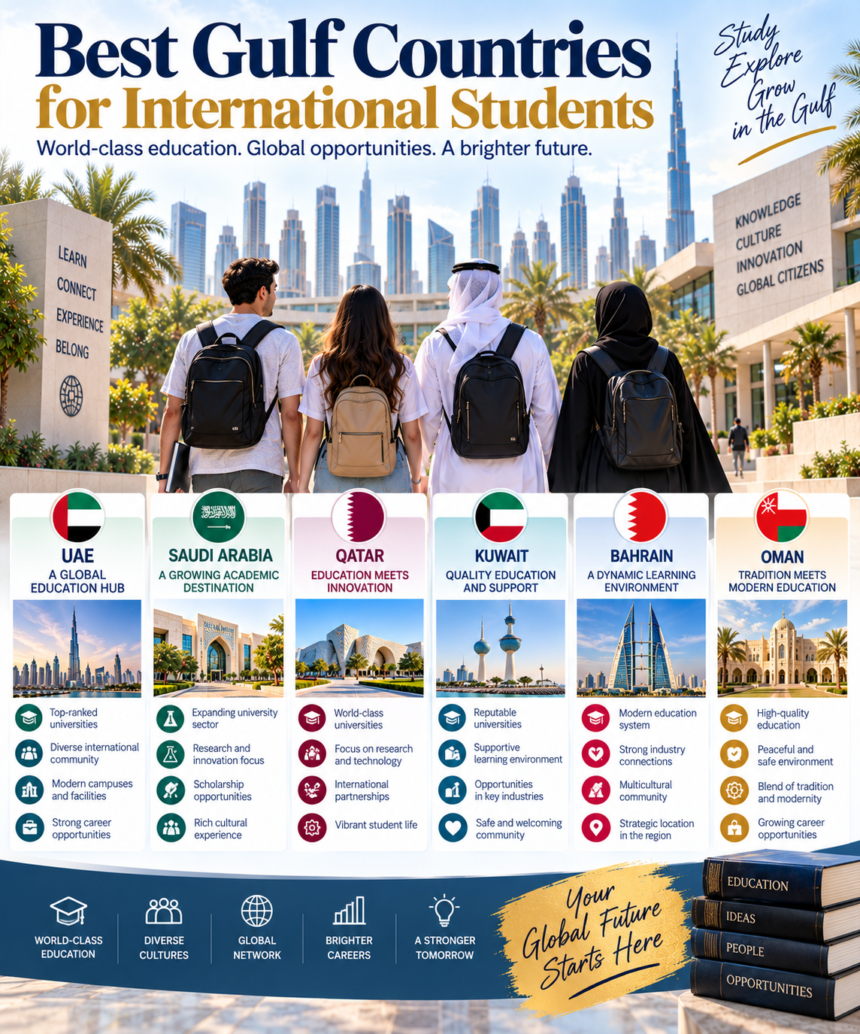
Best Gulf Countries for International Students include the UAE, Saudi Arabia, Qatar, Bahrain, Oman and Kuwait, but each destination offers a very different university experience. Some stand out for international branch campuses and large expatriate communities, while others offer stronger scholarship possibilities, research opportunities, lower-key student lifestyles or highly specialised academic programmes.
- International Higher Education Across the Gulf
- Quick Comparison of the Best Gulf Countries for International Students
- 1. United Arab Emirates
- 2. Saudi Arabia
- 3. Qatar
- 4. Bahrain
- 5. Oman
- 6. Kuwait
- University Quality and Degree Recognition
- International Branch Campuses in the Gulf
- Scholarships and Financial Support
- Tuition Fees and Living Costs
- Student Visas and Residency
- Best Gulf Countries for Technology and AI Students
- Best Gulf Countries for Business and Finance Students
- Best Gulf Countries for Medicine and Healthcare Students
- Campus Life and International Student Communities
- Career Opportunities After Graduation
- English-Taught University Programmes
- Accommodation and Everyday Student Life
- Choosing the Right Gulf Country for Your Degree
- Common Mistakes International Students Should Avoid
- Practical GCC University Comparison Checklist
- Final Thoughts on the Best Gulf Countries for International Students
Higher education across the GCC has changed considerably over the past two decades. Students no longer need to view the Gulf only as a place to find employment after graduating elsewhere. The region now includes government universities, private institutions, international university branches, specialist medical colleges, research universities and programmes in fields ranging from artificial intelligence and engineering to business, finance, medicine, media and design.
For an international student, however, choosing a Gulf country requires more than comparing university rankings.
Degree recognition, tuition, scholarships, student visas, accommodation, language, campus culture and long-term career plans all matter.
A student interested in technology may have different priorities from someone studying medicine. Someone seeking a major international city may prefer Dubai, while another student may value the concentrated university ecosystem of Doha or scholarship opportunities available through Saudi Arabia.
The most useful approach is therefore to compare each GCC country according to the type of student it suits best.
International Higher Education Across the Gulf
The six GCC countries have invested heavily in universities and research, but their higher education sectors have developed in different ways.
The UAE has one of the broadest private and international university markets in the region. Its Ministry of Higher Education and Scientific Research maintains an official system for licensed higher education institutions, making accreditation an important part of university selection.
Saudi Arabia has taken a particularly direct approach to attracting international students. Its official Study in Saudi Arabia platform provides a central route for international students, researchers and professional learners. The platform states that Saudi Arabia has more than 50 public and private universities and offers fully funded, partially funded and self-funded study options.
Qatar has built a distinctive model through Education City, where Qatar Foundation currently lists eight higher education institutions alongside research organisations, student housing and other academic infrastructure.
Oman also operates a dedicated higher education system with government and private institutions, qualification recognition services and an official Study in Oman route for prospective students.
Bahrain and Kuwait have smaller university markets but remain relevant for students looking for regional higher education options, particularly those already living with families in the Gulf.
Quick Comparison of the Best Gulf Countries for International Students
| GCC country | Particularly attractive for | University environment | Overall consideration |
|---|---|---|---|
| UAE | International campuses, business, technology, media | Very diverse | Strongest all-round international choice |
| Saudi Arabia | Scholarships, research, engineering, science | Large and expanding | Particularly attractive for funded study |
| Qatar | Elite specialised programmes, research, medicine | Compact and highly international | Strong for focused academic pathways |
| Bahrain | Business, medicine and regional study | Smaller and accessible | Useful for students wanting a compact environment |
| Oman | Engineering, business, applied study | Calm and developing | Attractive for lifestyle and regional education |
| Kuwait | Local and regional higher education | More concentrated | Stronger for students with existing Gulf ties |
This is not an official ranking. The “best” destination changes according to the student’s degree, budget, scholarship eligibility and future career.
1. United Arab Emirates
The UAE is arguably the easiest starting point for many international students comparing Gulf destinations because of the scale and variety of higher education available.
Dubai and Abu Dhabi in particular contain a mix of local universities, private institutions and international university campuses. Students can find programmes in:
- Business and management
- Finance
- Artificial intelligence
- Computer science
- Engineering
- Architecture
- Media
- Design
- Hospitality
- Medicine and health sciences
The UAE Ministry of Higher Education and Scientific Research maintains an official directory of licensed higher education institutions, which students should check before enrolling.
International environment
One major advantage is the international population. Students in Dubai frequently study alongside classmates from South Asia, Africa, Europe, the Middle East and other regions.
This can make the adjustment easier for someone moving abroad for the first time.
English is also widely used as the teaching language in many private and international universities, although programme requirements differ.
Career exposure
Dubai and Abu Dhabi provide access to major industries including finance, aviation, technology, tourism, logistics, real estate and professional services.
This can make internships and industry networking an important part of the university experience.
Students should nevertheless check the current visa and employment rules rather than assuming a student residence automatically permits unrestricted employment.
Main drawback
Cost can be significant.
Tuition at private or international institutions can be high, while accommodation and everyday living in Dubai can add substantially to the total education budget.
The UAE may therefore offer excellent choice, but families need to calculate the full annual cost rather than tuition alone.
Best suited to: students seeking a highly international environment, broad university choice and strong exposure to private-sector careers.
2. Saudi Arabia
Saudi Arabia is becoming one of the most interesting GCC destinations for international higher education.
The country’s official Study in Saudi platform now gives foreign applicants a dedicated route for exploring institutions, academic programmes, scholarships and educational visas.
Saudi authorities state that students can choose between fully funded scholarships, partially funded scholarships and self-funded programmes. The official platform is designed for academic students, researchers, scholars and professional learners.
This is a major advantage for students who want to consider the Gulf but cannot finance an expensive private university independently.
Large university system
Study in Saudi states that the Kingdom has more than 50 public and private universities and describes its international student community as including learners from more than 170 countries.
Saudi institutions are particularly relevant in areas connected to the country’s research and economic priorities, including:
- Engineering
- Energy
- Computer science
- Artificial intelligence
- Medicine
- Science
- Business
- Islamic studies
- Research
Educational visa
Saudi Arabia’s official platform also identifies a dedicated educational visa for international students and researchers studying at Saudi universities.
This makes the pathway more visible than in some destinations where students must navigate separate university and immigration systems independently.
Student lifestyle
Riyadh, Jeddah and other Saudi cities have changed rapidly, with expanding entertainment, cultural and business sectors.
International students should nevertheless research the city itself as carefully as the university.
Life in Riyadh can feel very different from studying in Jeddah or another region.
Best suited to: students prioritising scholarship opportunities, science, technology, engineering, research and large university options.
3. Qatar
Qatar offers one of the Gulf’s most distinctive higher education environments.
Its major advantage is not necessarily the largest number of universities. It is the concentration of internationally recognised academic institutions and research organisations within a comparatively compact ecosystem.
Qatar Foundation’s Education City currently lists eight universities: Carnegie Mellon University in Qatar, Georgetown University in Qatar, Hamad Bin Khalifa University, HEC Paris Doha, Northwestern University in Qatar, Texas A&M University at Qatar, Virginia Commonwealth University School of the Arts in Qatar and Weill Cornell Medicine-Qatar.
Students should always confirm the current status and intake of individual programmes directly with institutions because branch-campus offerings can change.
Academic specialisation
Education City provides pathways in areas including:
- Medicine
- Computer science
- Business
- International affairs
- Journalism and communication
- Art and design
- Research
Qatar Foundation also integrates universities with research institutes focusing on areas such as computing, biomedical research, environmental and energy research, artificial intelligence and precision health.
This can be particularly valuable to students who want a strong research environment.
Campus ecosystem
Education City also includes student housing, recreation, research opportunities and shared community facilities. Qatar Foundation presents higher education, student life and research as parts of the same wider academic ecosystem.
The compact nature of Doha can also make the student experience quite different from Dubai’s spread-out metropolitan environment.
Main consideration
Programme choice is more concentrated. A student whose preferred degree does not fit Qatar’s areas of strength may find more options elsewhere.
Best suited to: students seeking selective international programmes, medicine, computing, international affairs, media, design and research.
4. Bahrain
Bahrain offers a smaller higher education market than the UAE or Saudi Arabia, but that can be an advantage for some students.
The country has public and private university options, including programmes in business, medicine, engineering, law and other professional areas.
Its relatively compact geography can make everyday student life simpler. Commutes between residential areas and university campuses can be more manageable than in much larger Gulf cities.
Regional education environment
Bahrain has long served as a business and financial centre, meaning students interested in banking, finance and business can study in a country with a developed professional-services sector.
Healthcare and medical education also form an important part of its higher education landscape.
International students
Students coming from abroad should check admission eligibility and residency requirements directly with individual institutions.
They should also verify degree recognition through the relevant Bahraini education authorities before paying tuition.
Main advantage
Bahrain can suit students who want Gulf education without the scale and pace of Dubai or Riyadh.
Best suited to: students seeking a smaller, manageable environment with options in business, medicine and professional education.
5. Oman
Oman provides a different type of student experience.
Its higher education sector includes government institutions, private universities and colleges, with programmes across engineering, business, applied sciences and other fields.
The Ministry of Higher Education, Research and Innovation maintains separate information for private and government higher education institutions and provides services for students studying inside and outside Oman. The Ministry also operates qualification recognition and equivalency services.
Importantly for prospective overseas students, the Ministry links directly to an official Study in Oman initiative.
Student lifestyle
Muscat offers a quieter atmosphere than several of the Gulf’s larger commercial centres.
For some students, this can mean fewer distractions and a more relaxed pace of life.
Oman also has a distinctive natural environment, with mountains, coastline and outdoor activities providing a student experience very different from a purely high-rise city environment.
Academic options
Engineering, technology, business and applied programmes can be particularly relevant given Oman’s economic and industrial sectors.
International students should check whether the chosen programme is formally approved and how the qualification will be recognised in the country where they eventually intend to work.
Best suited to: students looking for a calmer Gulf lifestyle, engineering, applied education and an alternative to the region’s largest cities.
6. Kuwait
Kuwait has an established higher education system that includes public and private institutions.
For international students, however, it may be less straightforward as a general study-abroad destination than the UAE, Saudi Arabia or Qatar.
That does not mean it should be ignored.
Students who already live in Kuwait with expatriate families may find local university education attractive because it allows them to continue living at home while reducing accommodation and international relocation costs.
Areas of study
Programmes are available across disciplines including:
- Business
- Engineering
- Computing
- Humanities
- Medicine and health-related fields
Students should confirm international admission rules directly with universities and check the recognition status of the specific programme.
This is particularly important for students who intend to work elsewhere in the GCC after graduation.
Best suited to: students already based in Kuwait, regional families and applicants whose chosen programme has a strong local option.
University Quality and Degree Recognition
Country selection should come after programme recognition.
A student should never choose a Gulf university solely because the campus looks impressive or the university uses an internationally familiar brand.
Check:
- Institutional licensing
- Programme accreditation
- Degree-awarding institution
- Professional recognition
- Postgraduate recognition
- Recognition in the student’s home country
The UAE provides an official federal directory of licensed institutions, while Oman operates qualification-recognition and equivalency services through its higher education ministry.
Recognition becomes especially important for regulated careers such as medicine, dentistry, engineering, teaching and law.
International Branch Campuses in the Gulf
International branch campuses are one of the GCC’s strongest educational features.
They allow students to study closer to home while accessing programmes connected to foreign universities.
Dubai has a large international higher education community, while Qatar’s Education City provides an especially concentrated model of overseas university participation. Qatar Foundation currently lists multiple US and international institutions within one academic ecosystem.
Students should confirm:
- Who awards the final qualification
- Whether the Gulf-campus programme matches the home institution
- Accreditation in the GCC country
- Overseas transfer opportunities
- Graduate recognition
The brand name alone should never be the final reason for enrolling.
Scholarships and Financial Support
Scholarship opportunities can completely change which GCC country represents the best value.
Saudi Arabia currently provides the clearest centralised international pathway. Its Study in Saudi platform explicitly separates fully funded, partially funded and self-funded programmes.
Elsewhere in the Gulf, funding is more likely to depend heavily on the university.
Students may find:
- Academic merit scholarships
- Need-based financial aid
- Sports scholarships
- Research funding
- Early application discounts
- Graduate assistantships
- University-specific grants
Do not assume a scholarship advertised as “up to 50%” means every accepted student receives that reduction.
Read eligibility rules and renewal requirements carefully.
Tuition Fees and Living Costs
There is no single GCC university cost.
A student studying at a government institution with funding may spend very differently from someone attending a premium international campus in Dubai.
The full budget should include:
Tuition + university charges + housing + food + transportation + health insurance + books + technology + personal expenses.
Accommodation is particularly important.
A student whose family already lives in the UAE, Kuwait, Bahrain or another GCC state may save substantially by continuing to live at home.
For international students moving independently, university housing can simplify the first year but should be compared with private accommodation costs.
Student Visas and Residency
International students normally need appropriate residence permission to study long term in a GCC country.
The university often plays an important role in the process.
Saudi Arabia’s Study in Saudi programme provides a particularly clear example through its educational visa pathway for international students and researchers.
Elsewhere, requirements can depend on factors such as:
- Nationality
- University
- Existing family sponsorship
- Programme length
- Age
- Scholarship status
Students should confirm visa arrangements before paying non-refundable tuition.
They should also check whether their residence status permits internships or employment and what additional permissions might be required.
Best Gulf Countries for Technology and AI Students
For technology students, the UAE, Saudi Arabia and Qatar deserve particularly close attention.
The UAE provides access to a highly active private technology economy in Dubai and Abu Dhabi.
Saudi Arabia combines large universities, research activity and growing investment in digital industries.
Qatar brings together universities and specialist research institutions within Education City, including organisations working in computing, artificial intelligence and advanced research.
Students should compare the actual degree content rather than choosing a programme simply because it includes “AI” in its title.
Strong foundations in mathematics, statistics, programming and computer science remain important.
Best Gulf Countries for Business and Finance Students
The UAE is particularly attractive for business students because Dubai and Abu Dhabi provide direct exposure to international companies, banks, professional-services firms and startups.
Bahrain also deserves consideration because of its long-standing financial-services sector.
Saudi Arabia’s economic expansion makes Riyadh increasingly relevant for business, management and finance education.
Qatar offers specialised international programmes in areas including business and international affairs through institutions within Education City.
For business students, internship access can matter as much as classroom teaching.
Best Gulf Countries for Medicine and Healthcare Students
Medicine requires more careful selection than many other subjects because professional licensing follows graduation.
Qatar is particularly notable because Education City includes Weill Cornell Medicine-Qatar and health-related research institutions.
Saudi Arabia also has a large medical and health-sciences education sector, while the UAE and Bahrain provide additional options.
Before enrolling, students should check whether the medical qualification will allow them to pursue licensing and postgraduate training in their intended country.
A recognised university degree does not automatically grant permission to practise medicine.
Campus Life and International Student Communities
Academic quality is only part of studying abroad.
Students should also investigate:
- Clubs and societies
- Sports
- Student housing
- Counselling
- Cultural activities
- International student support
- Career services
- Research opportunities
Saudi Arabia’s international platform specifically promotes student support and describes a student community from more than 170 countries.
Qatar Foundation integrates higher education with student housing, recreation and shared community facilities at Education City.
Dubai provides another highly international environment because of the city’s broader expatriate population.
Career Opportunities After Graduation
Students should think about careers before choosing a country.
University location can influence access to internships, employers and professional networks.
Dubai can be particularly useful for finance, hospitality, media, logistics, technology and business.
Riyadh is increasingly important for technology, consulting, finance, engineering and large development projects.
Doha offers opportunities connected to energy, aviation, research, medicine and professional services.
However, graduating from a GCC university does not automatically guarantee the right to remain and work permanently.
Students should check current immigration and employment rules when approaching graduation.
English-Taught University Programmes
Many international and private university programmes across the GCC are delivered in English.
This is particularly common in business, engineering, technology and international branch campuses.
Students may nevertheless need to demonstrate English ability through:
- IELTS
- TOEFL
- School qualifications
- University placement tests
Arabic remains important socially and professionally across the region, but international students can complete many degree programmes without being fluent before arrival.
Learning some Arabic can still enhance daily life and future employability.
Accommodation and Everyday Student Life
The ideal university city depends heavily on personality.
Dubai offers the largest-city experience, with extensive entertainment, shopping and international communities.
Riyadh provides a rapidly changing metropolitan environment and major professional opportunities.
Doha is more compact and includes a highly concentrated university ecosystem.
Manama offers a smaller urban environment.
Muscat provides a quieter lifestyle with access to nature.
Kuwait City can be particularly practical for students whose families already live in the country.
Students should consider lifestyle fit alongside university quality.
Choosing the Right Gulf Country for Your Degree
A simple starting point is to match the destination with the student’s main priority.
| Main priority | Gulf countries to consider first |
|---|---|
| Broadest international university choice | UAE |
| Scholarship possibilities | Saudi Arabia |
| Concentrated international academic ecosystem | Qatar |
| Finance and business environment | UAE, Bahrain, Saudi Arabia |
| Technology and AI | UAE, Saudi Arabia, Qatar |
| Medicine and research | Qatar, Saudi Arabia, UAE |
| Quieter lifestyle | Oman, Bahrain |
| Existing expatriate family in country | Often the country where the family already lives |
| International branch campus experience | UAE, Qatar |
| Research-focused postgraduate study | Saudi Arabia, Qatar, UAE |
No table can replace detailed programme research.
The degree itself should remain the primary factor.
Common Mistakes International Students Should Avoid
Choosing a country before choosing the programme
The best country overall may not offer the best course for your career.
Ignoring accreditation
Recognition should be checked before enrolment.
Looking only at tuition
Accommodation and everyday living can significantly change the final cost.
Assuming scholarships are guaranteed
Check eligibility and renewal conditions.
Choosing by rankings alone
A lower-ranked institution may have a stronger programme in one particular field.
Ignoring internship access
Practical experience can be extremely important.
Not checking visa requirements early
Residence procedures can affect enrolment timing.
Assuming studying in the GCC guarantees employment
Graduation and employment residency are separate processes.
Practical GCC University Comparison Checklist
Before selecting a Gulf study destination, compare:
- Programme accreditation
- University licensing
- Degree recognition
- Entry requirements
- Language of instruction
- Tuition
- Scholarships
- Housing
- Student visa
- Cost of living
- Campus facilities
- International community
- Research opportunities
- Internships
- Career services
- Graduate pathways
For regulated professions, add professional licensing requirements to the checklist.
Final Thoughts on the Best Gulf Countries for International Students
The Best Gulf Countries for International Students depend on what the student wants from university.
For the broadest range of international institutions and exposure to a highly global business environment, the UAE is one of the strongest all-round choices.
For students focused on scholarships, major universities and research opportunities, Saudi Arabia deserves serious consideration. Its official Study in Saudi platform now provides a dedicated international route, including fully funded, partially funded and self-funded programmes as well as educational visas.
For students seeking a concentrated international academic environment, Qatar is distinctive. Education City brings several international universities and research institutions together within one integrated ecosystem.
Bahrain can appeal to students who want a smaller Gulf environment with business, healthcare and professional programmes.
Oman provides a calmer lifestyle alongside government and private higher education options, with official services for institutions, programmes and qualification recognition.
Kuwait remains particularly relevant for students already based there with their families or those who identify a strong local programme matching their career plans.
The best decision is therefore not based on asking which GCC country has the most famous skyline or university.
Choose the degree first, verify its accreditation, compare the total cost, investigate scholarships and examine what graduates actually do afterward.
The right Gulf country is the one that gives the student the strongest combination of academic quality, affordability, recognised qualifications, personal comfort and realistic career opportunities.
Do follow us on Instagram
Read More – University Education Options Across GCC Countries: 12 Essential Choices for Students in 2026