


Higher Education Across the GCC
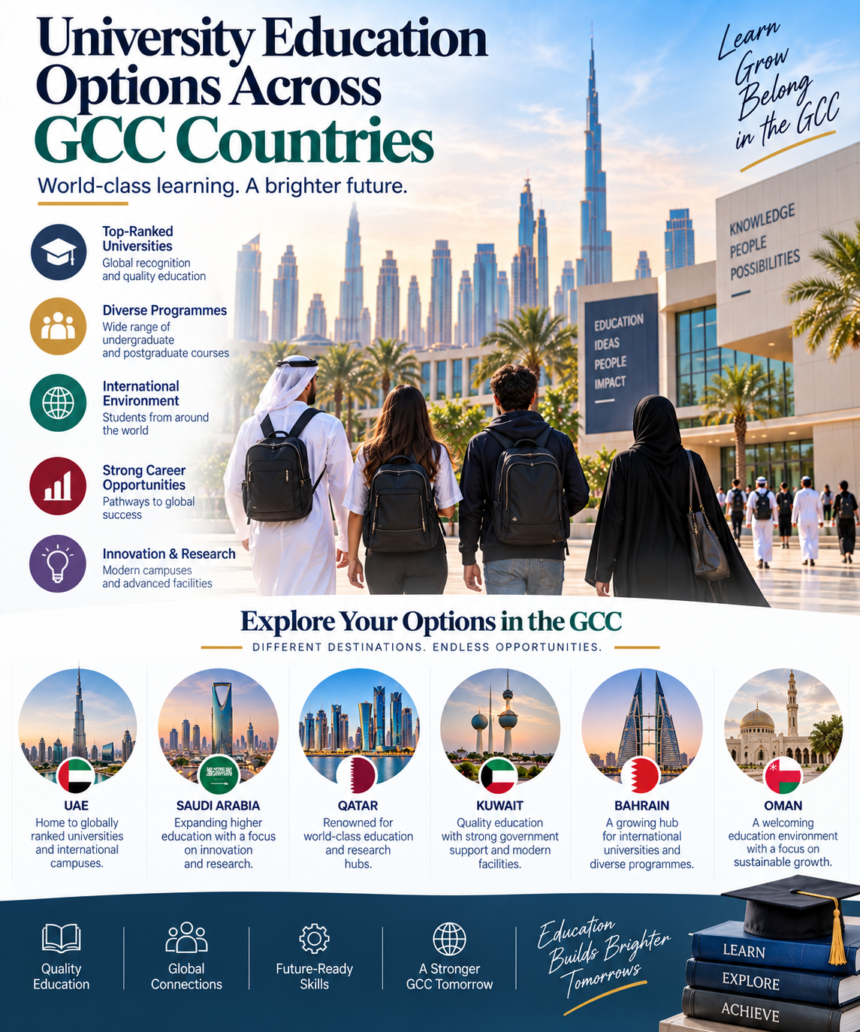
University Education Options Across GCC Countries have expanded considerably, giving students in the UAE, Saudi Arabia, Qatar, Bahrain, Oman and Kuwait access to public universities, private colleges, international branch campuses, specialist institutions and an increasing number of postgraduate and research programmes.
- University Education Options Across GCC
- 1. Public Universities
- 2. Private Universities and Colleges
- 3. International Branch Campuses
- 4. Undergraduate Degree Options
- 5. Postgraduate and Research Programmes
- 6. Technical and Applied Education
- 7. Medicine and Healthcare Degrees
- 8. Engineering, Technology and AI Programmes
- 9. Business, Finance and Management Education
- 10. Scholarships and Financial Support
- 11. University Accreditation and Degree Recognition
- 12. International Student Admission and Visas
- University Education in the UAE
- University Education in Saudi Arabia
- University Education in Qatar
- University Education in Bahrain
- University Education in Oman
- University Education in Kuwait
- Comparing University Costs Across the GCC
- Choosing a Degree Based on Career Plans
- Campus Life and Student Accommodation
- Studying Close to Home as an Expat Family
- Transferring Between Universities in the Gulf
- Degree Recognition for International Careers
- Common Mistakes When Choosing a Gulf University
- Practical University Comparison Checklist
- Final Thoughts on University Education Across GCC Countries
For families already living in the Gulf, this can completely change the university decision.
A student attending an international school in Dubai, Riyadh, Doha or another GCC city no longer automatically needs to move to the UK, United States, Canada, Australia or Europe to obtain an internationally oriented degree. Depending on the course and country, students may now be able to study closer to home while accessing international curricula, foreign university partnerships, specialist research facilities and degrees taught in English.
At the same time, higher education across the Gulf is not one uniform system.
Admission procedures, tuition fees, scholarship eligibility, degree recognition, public-university access and international-student rules differ substantially between the six countries. Even within one country, a public university, private university and foreign branch campus can operate very differently.
Students should therefore compare universities according to their academic programme, accreditation, cost, career outcomes, language of instruction and long-term recognition, rather than simply choosing the most famous name.
University Education Options Across GCC
The Gulf’s higher education sector combines several different models.
Students can find:
- Government universities
- Private universities
- Specialist colleges
- International university branches
- Medical universities
- Technical colleges
- Business schools
- Research universities
- Applied-science institutions
- Postgraduate institutes
The scale varies between countries.
The UAE maintains an official federal list of licensed higher education institutions through the Ministry of Higher Education and Scientific Research, while the Commission for Academic Accreditation publishes accredited institutions and academic programmes.
Saudi Arabia has developed a dedicated Study in Saudi Arabia platform for international students. It includes fully funded scholarships, partially funded opportunities and self-funded programmes, as well as an educational visa route for eligible international students and researchers.
Qatar’s Ministry of Education and Higher Education publishes information on its public and private higher education sector, while Qatar Foundation’s Education City hosts several international university programmes and a major research ecosystem.
The overall result is far greater choice than many families expect.
1. Public Universities
Public universities remain central to higher education throughout the GCC.
These institutions are generally supported by national governments and often play an important role in research, teacher training, healthcare education, engineering and national workforce development.
Public institutions can include both traditional universities and specialised colleges.
For citizens, government universities may offer particularly attractive tuition arrangements or scholarship opportunities. Access for expatriates and international students varies significantly, however.
Foreign students should never assume that a government university admitting citizens will automatically accept international applicants under the same conditions.
Saudi Arabia is notable because its official Study in Saudi platform explicitly provides routes for international applicants across participating Saudi institutions. The platform offers information for scholarship students as well as those studying at their own expense.
Qatar’s Ministry of Education and Higher Education lists public institutions including Qatar University and other specialised higher education providers.
Students considering a public institution should check:
- International admission eligibility
- Language requirements
- Tuition rules
- Scholarship eligibility
- Programme availability
- Accommodation
- Student visa arrangements
Public does not necessarily mean free for every student.
2. Private Universities and Colleges
Private universities provide much of the flexibility available to expatriate and international students in the Gulf.
These institutions may offer undergraduate and postgraduate programmes in fields such as:
- Business
- Finance
- Engineering
- Computing
- Artificial intelligence
- Law
- Media
- Design
- Healthcare
- Architecture
- Tourism
- Logistics
The UAE has developed a particularly large private higher education market. Its official federal directory includes institutions operating across several emirates, while the CAA provides a searchable database of accredited programmes.
Oman has also built a significant private higher education sector. The Ministry of Higher Education, Research and Innovation maintains dedicated information on private higher education institutions and provides a search service allowing students to explore universities, colleges, majors and programmes approved within Oman.
Private universities can offer greater accessibility for expatriates, but tuition can be substantial.
Students should compare the degree itself rather than simply the institution’s branding.
3. International Branch Campuses
One of the Gulf’s most distinctive higher education developments has been the growth of international university branches.
These campuses allow students to study programmes connected to established overseas universities without necessarily leaving the GCC.
Qatar’s Education City is perhaps the clearest example. Qatar Foundation describes the campus as bringing together branch campuses of leading global universities alongside a homegrown research university and research institutions. Current Education City higher education offerings cover areas including medicine, computer science, international affairs, media, arts and business.
The UAE also has a substantial international higher education presence, particularly in Dubai and Abu Dhabi.
International branches can be attractive because students may gain access to overseas academic systems and international faculty while remaining relatively close to their families.
However, parents and students should verify:
- Which institution legally awards the degree
- Whether the programme is locally accredited or recognised
- Whether the curriculum is identical to the home campus
- Opportunities for study abroad
- Graduate recognition
- Campus-specific facilities
- Long-term programme availability
A famous university name should not replace proper accreditation research.
4. Undergraduate Degree Options
Bachelor’s degrees remain the main entry point into Gulf higher education.
Common programmes include:
- Business administration
- Finance
- Economics
- Computer science
- Engineering
- Medicine
- Nursing
- Law
- Psychology
- Architecture
- Media
- Design
- Education
- Hospitality
- Logistics
Programme length depends on subject and educational system.
A general bachelor’s degree may take three or four years, while engineering, architecture and health-related programmes can follow longer structures.
Students from British schools, American high schools, IB programmes and other international curricula should check the university’s exact entry requirements.
For example, admission may depend on:
- A Level subjects
- IB Diploma points
- American High School Diploma results
- Advanced Placement courses
- Standardised tests
- English-language scores
- Mathematics or science prerequisites
University selection should therefore begin before the final school year.
A student interested in engineering may discover that advanced mathematics is required, while medicine may require specific science subjects.
5. Postgraduate and Research Programmes
The Gulf is increasingly important for students considering master’s degrees, doctorates and research careers.
Postgraduate programmes are available across areas including business, engineering, AI, healthcare, public policy, education, sustainability and finance.
Research is particularly important to universities connected with national strategies around technology, energy, healthcare and economic diversification.
Saudi Arabia’s official international-study platform specifically includes researchers and scholars among the people it is designed to support.
Qatar Foundation’s Education City combines universities with research institutes and technology infrastructure, creating opportunities extending from undergraduate study to advanced research.
Students considering postgraduate education should compare:
- Faculty expertise
- Research supervisors
- Laboratory facilities
- Industry partnerships
- Publication opportunities
- Funding
- Assistantships
- Thesis requirements
For research degrees, the academic supervisor can sometimes matter more than the university’s overall ranking.
6. Technical and Applied Education
Not every student needs a traditional university degree.
Technical and applied education can provide a more direct path into employment.
Areas can include:
- Aviation
- Engineering technology
- Cybersecurity
- Logistics
- Hospitality
- Technical maintenance
- Applied computing
- Health sciences
- Business technology
These programmes can be particularly valuable in Gulf economies where infrastructure, aviation, logistics, construction and technology create strong demand for technically skilled workers.
Students should compare diplomas and applied degrees carefully.
Confirm the qualification level and whether graduates can later transfer into a bachelor’s programme if they want to continue studying.
Recognition becomes particularly important for students who may eventually work outside the country.
7. Medicine and Healthcare Degrees
Healthcare education is one of the most specialised university choices in the GCC.
Medical degrees require significantly more research because recognition affects the graduate’s ability to complete professional licensing and postgraduate training.
The Gulf includes universities and specialist institutions offering programmes in:
- Medicine
- Dentistry
- Pharmacy
- Nursing
- Public health
- Physiotherapy
- Biomedical sciences
For example, Bahrain-based Arabian Gulf University operates medical education designed around the health needs of GCC countries and continues to train medical students from across the region.
Before enrolling in any healthcare programme, students should verify accreditation and professional recognition directly with the relevant authorities.
A university degree and a professional licence are not the same thing.
Graduates may need additional examinations, supervised training or registration before practising medicine, nursing, dentistry or another regulated profession.
8. Engineering, Technology and AI Programmes
Technology has become one of the fastest-growing areas of Gulf education.
Governments across the GCC are investing in digital transformation, artificial intelligence, cybersecurity, renewable energy and advanced industry.
Universities are responding with programmes in:
- Artificial intelligence
- Data science
- Cybersecurity
- Computer science
- Robotics
- Software engineering
- Mechanical engineering
- Electrical engineering
- Renewable energy
- Civil engineering
This can be particularly attractive for students planning to build careers inside the Gulf.
However, course titles can be misleading.
An AI degree should not be chosen simply because artificial intelligence is currently popular. Students should inspect the actual curriculum.
Look for strong foundations in mathematics, programming, algorithms, data structures and statistics alongside specialist AI modules.
Engineering students should similarly check whether the programme has appropriate professional accreditation where relevant.
9. Business, Finance and Management Education
Business remains one of the most widely available university subjects across the Gulf.
Major financial and commercial centres such as Dubai, Abu Dhabi, Riyadh, Doha, Manama and Kuwait City create strong demand for graduates in areas such as:
- Accounting
- Finance
- Banking
- Marketing
- Management
- Entrepreneurship
- Human resources
- Supply chain
- International business
Students should look beyond the phrase Bachelor of Business Administration.
Compare concentrations, internship opportunities and industry connections.
A strong programme should help students develop practical skills alongside theory.
Location can also create advantages. A finance student studying near a financial centre may have better access to internships and networking than a student whose university has few industry relationships.
For master’s students, MBA programmes should be compared carefully because tuition, work-experience requirements and accreditation vary significantly.
10. Scholarships and Financial Support
Scholarships are available across parts of the GCC, but eligibility varies widely.
Some programmes primarily support citizens. Others are available to international students.
Saudi Arabia stands out because the official Study in Saudi platform explicitly includes fully funded scholarships, partially funded scholarships and self-funded programmes for international applicants.
Qatar also operates a government scholarship platform, although individual eligibility conditions and approved institutions apply.
The UAE Ministry of Higher Education and Scientific Research maintains approved universities and majors for government scholarship programmes, with its lists reviewed according to specified academic ranking criteria.
University-specific scholarships may also be based on:
- Academic achievement
- Sport
- Financial need
- Research potential
- Nationality
- Professional experience
Families should apply early because scholarship deadlines may close well before general admission.
11. University Accreditation and Degree Recognition
Accreditation is one of the most important parts of choosing a university in the Gulf.
A beautiful campus and international name are not enough.
Students should confirm that both the institution and programme meet the applicable recognition requirements.
In the UAE, the Commission for Academic Accreditation publishes lists of higher education institutions and accredited programmes. The Ministry also provides services relating to recognition of qualifications earned both within and outside the UAE.
Kuwait’s Ministry of Higher Education provides dedicated services for searching accredited universities and qualification-equivalency decisions.
Oman’s Ministry of Higher Education, Research and Innovation maintains a qualification equivalency and recognition department and advises students to confirm approved institutions and study modes.
Bahrain likewise provides an official recommended-university search service.
This matters particularly if the graduate plans to work in government, continue postgraduate education or enter a regulated profession.
12. International Student Admission and Visas
International student procedures differ across the GCC.
Students may need:
- Passport
- School-leaving certificate
- Academic transcript
- Certificate attestation
- English-language test
- Medical documentation
- Financial evidence
- University admission letter
- Student visa or residence permit
Saudi Arabia now has a particularly visible international route through its Study in Saudi platform and educational visa framework.
Other countries generally manage student residency through universities and national immigration systems.
International applicants should contact the university admissions department early.
Do not assume that being the child of an expatriate resident automatically means the same residency arrangement can continue after full-time university enrolment.
Rules can depend on age, sponsorship and the university.
University Education in the UAE
The UAE offers one of the broadest higher education markets in the Gulf.
Students can choose from federal universities, local private universities and international university campuses.
The federal Ministry of Higher Education and Scientific Research publishes a list of licensed institutions inside the UAE, while CAA resources allow students to check accredited programmes.
Universities offer programmes covering engineering, business, medicine, aviation, technology, design and many other fields.
For students from expatriate families already living in Dubai or Abu Dhabi, staying in the UAE can have a major practical advantage: they may be able to continue living at home while studying.
This can substantially reduce accommodation and relocation costs.
However, private university tuition can still be significant.
Students should compare academic quality, accreditation and graduate outcomes rather than making a decision based only on convenience.
University Education in Saudi Arabia
Saudi Arabia’s university sector has become increasingly accessible to international applicants.
Its Ministry of Education operates the Study in Saudi platform specifically to help international students and researchers explore universities, scholarships and educational visas.
The platform includes fully funded, partially funded and self-funded opportunities and promotes Saudi institutions to students internationally.
The country’s universities are particularly important in fields such as engineering, energy, medicine, science, technology and research.
For international applicants, Saudi Arabia can therefore be worth considering even if their family does not already live in the Kingdom.
Admission conditions and scholarship availability vary by institution and programme.
University Education in Qatar
Qatar combines national higher education institutions with a distinctive international university ecosystem.
The Ministry of Education and Higher Education lists public and private institutions operating in the country.
Education City adds another dimension.
Qatar Foundation’s campus brings together international university programmes and a research university in one academic environment, with fields including medicine, computer science, media, international affairs, arts and business.
This makes Qatar particularly interesting for students seeking specialised programmes from international institutions while remaining within the Gulf.
Students should still confirm the current programme portfolio before applying because branch-campus offerings can change over time.
University Education in Bahrain
Bahrain has a compact but diverse higher education market.
Students can consider government universities, private universities and specialist institutions.
Higher education is overseen through the Ministry of Education and Higher Education Council framework, which continues to regulate academic programmes and institutional partnerships. The Council was actively approving academic collaborations and programmes during 2026.
Bahrain’s government also provides tools for finding educational institutions and checking recommended universities.
The country’s size can offer a practical advantage because university commuting may be simpler than in some larger Gulf metropolitan areas.
Students interested in healthcare, business and other professional degrees can find several established options.
University Education in Oman
Oman’s higher education system combines government institutions with private universities and colleges.
The Ministry of Higher Education, Research and Innovation maintains official directories covering government and private higher education and allows students to search institutions, majors and programmes.
The Ministry has also encouraged private institutions to build academic partnerships with reputable international universities as part of quality development.
Oman can be especially relevant for students looking at engineering, technology, business and applied education.
Recognition should still be verified before enrolling, particularly where international academic partnerships or online study are involved.
University Education in Kuwait
Kuwait provides public and private higher education options and maintains a formal framework for accreditation and qualification recognition.
The Ministry of Higher Education’s affiliated entities include Kuwait University, Abdullah Al-Salem University, the Private Universities Council and the National Bureau for Academic Accreditation and Education Quality Assurance.
The Ministry also provides accredited-university and qualification-equivalency services.
For expatriate students, the key issue is checking admission eligibility directly with each university because public and private institutions can have different policies.
Internationally mobile students should pay particular attention to degree recognition if they expect to continue their studies or careers outside Kuwait.
Comparing University Costs Across the GCC
There is no useful single figure for the cost of university education in the Gulf.
Fees can vary dramatically according to:
- Country
- Institution
- Programme
- Degree level
- Medical or laboratory requirements
- Public or private status
- Scholarship eligibility
Medicine and specialist healthcare programmes are usually among the more expensive options.
Business and humanities degrees may cost less, although premium international institutions can still charge substantial tuition.
Families should calculate:
Tuition + registration + books + technology + transport + accommodation + insurance + everyday living expenses.
If the student can continue living at home with parents, a higher tuition fee may still produce a lower overall education cost than studying abroad.
Choosing a Degree Based on Career Plans
A degree should not be chosen simply because the subject is popular.
Begin with career direction.
A student interested in medicine needs to understand professional licensing.
An engineering student should examine accreditation.
A technology student should compare practical skills, internships and technical content.
Business students should investigate employer relationships.
For regulated careers, recognition matters particularly strongly.
Career planning does not mean an 18-year-old must know exactly what they will do for the next forty years. It means making sure the degree keeps sensible pathways open.
Campus Life and Student Accommodation
University life is more than lectures.
Students should compare:
- Clubs and societies
- Sports
- Laboratories
- Libraries
- Student support
- Counselling
- Career services
- Internships
- Accommodation
- Campus transport
Some students benefit from living on campus and developing independence.
Others may prefer commuting from the family home.
International students should investigate accommodation early because availability can be limited and prices can significantly affect the overall cost of studying.
Studying Close to Home as an Expat Family
For long-term Gulf expatriates, local university study deserves serious consideration.
A child may have spent most of their life in Dubai, Doha or Riyadh and already view the Gulf as home.
Studying locally can allow the student to retain family support, friendships and professional networks.
It may also provide better access to employers in the market where they plan to begin their career.
However, families should still compare Gulf universities with overseas alternatives objectively.
Convenience should not replace academic fit.
Transferring Between Universities in the Gulf
University transfers can be more complicated than school transfers.
The receiving institution decides which previous credits it will accept.
Course titles may look similar while covering different academic content.
Oman, for example, provides a formal government service for transferring between private higher education institutions.
Before changing university, students should request a written credit evaluation.
Do not withdraw from the existing institution until the new university confirms admission and transfer-credit arrangements.
Degree Recognition for International Careers
Students planning careers across several countries need to think beyond graduation day.
A degree accepted by one private employer may still require formal recognition for:
- Government jobs
- Postgraduate education
- Professional licensing
- Immigration
- Teaching
- Healthcare
- Engineering
Keep copies of transcripts, accreditation records and course information.
If you later move from one GCC country to another, the new country may have its own qualification-recognition procedure.
Recognition should therefore be checked before enrolment, not only after graduation.
Common Mistakes When Choosing a Gulf University
Choosing by ranking alone
Rankings can provide context but do not prove that a specific programme is right for a particular student.
Ignoring programme accreditation
Institutional reputation does not replace degree recognition.
Looking only at tuition
Accommodation and living costs can change the real price significantly.
Choosing a fashionable subject
AI, finance and other popular fields still require genuine ability and interest.
Ignoring internships
Work experience can be extremely valuable in the Gulf employment market.
Not checking professional licensing
This is particularly risky for medicine, healthcare and other regulated professions.
Assuming an overseas university branch is identical to the home campus
Check the specific Gulf programme.
Waiting too long to investigate scholarships
Funding deadlines may be early.
Practical University Comparison Checklist
| Factor | Details to compare |
|---|---|
| Institution | Public, private or international branch |
| Accreditation | Institution and programme recognition |
| Degree | Bachelor, diploma, master’s or doctorate |
| Entry requirements | School results and subject prerequisites |
| Language | English, Arabic or another language |
| Tuition | Full annual cost |
| Scholarships | Eligibility and deadlines |
| Housing | Campus or private accommodation |
| Location | Commute and transport |
| Faculty | Qualifications and research |
| Facilities | Laboratories, library and technology |
| Internships | Employer partnerships |
| Career services | Graduate and placement support |
| Transfer options | Credit recognition |
| International recognition | Important for future mobility |
| Student life | Clubs, sport and wellbeing support |
A university does not need to lead every category.
The goal is to find the strongest overall match for the student.
Final Thoughts on University Education Across GCC Countries
University Education Options Across GCC Countries now cover a far broader range of pathways than many families realise.
The UAE provides extensive choice across local universities, private institutions and international campuses.
Saudi Arabia is expanding its international reach through the official Study in Saudi platform, including scholarship and self-funded routes for overseas students.
Qatar combines national universities with Education City’s distinctive international higher education and research ecosystem.
Bahrain offers government, private and specialist institutions within a regulated higher education framework.
Oman maintains government and private higher education options with official services allowing students to verify universities and programmes.
Kuwait combines public and private institutions with formal accreditation and equivalency systems managed through its higher education authorities.
For students and expatriate families, this creates a genuine alternative to automatically studying overseas.
The smartest decision begins with the programme rather than the country.
Check the degree. Verify accreditation. Understand tuition and scholarships. Compare internships and career outcomes. Investigate student life and accommodation. Most importantly, consider where the qualification needs to take the student after graduation.
A university should not simply provide a place to spend the next three or four years.
It should provide a recognised academic foundation, practical skills and a realistic route towards the student’s future career.
Do follow us on Instagram
Read More – How to Choose an International School in the Gulf: 12 Essential Tips for Parents