

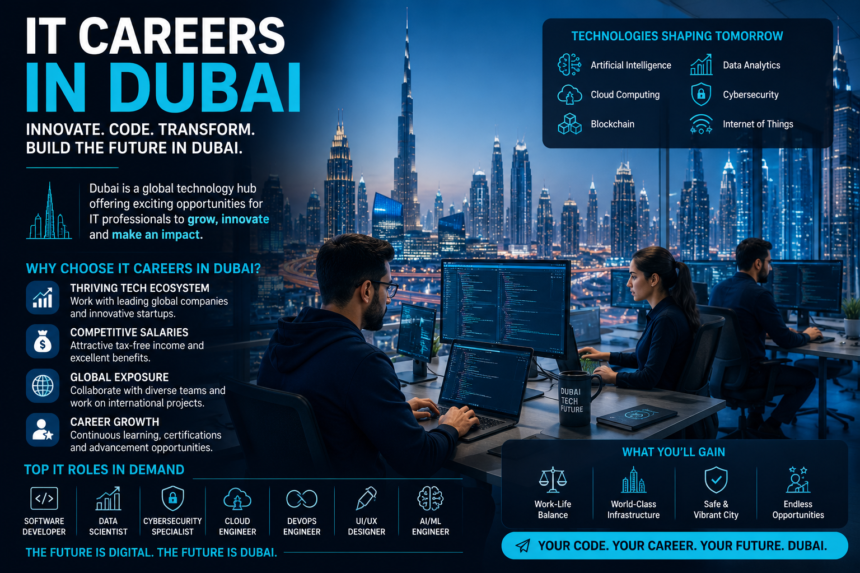
IT Careers in Dubai Offering Exciting Future Opportunities
Dubai is no longer known only for skyscrapers, luxury tourism and real estate. Technology is becoming an increasingly important part of the city’s economic identity.
- Why IT Careers in Dubai Are Growing
- 1. Artificial Intelligence Engineers
- 2. Machine Learning Engineers
- 3. Cybersecurity Specialists
- 4. Software Developers
- 5. Cloud Engineers
- 6. Data Scientists
- 7. Data Engineers
- 8. DevOps Engineers
- 9. IT Project Managers
- 10. Product Managers
- 11. UI and UX Professionals
- 12. Fintech Technology Specialists
- IT Careers in Dubai at a Glance
- AI Is Changing IT Careers in Dubai
- Dubai’s Startup Ecosystem Creates New Technology Opportunities
- IT Jobs Exist Far Beyond Technology Companies
- Technical Skills That Can Improve Your Dubai Career
- Professional Certifications Can Help
- Build a Portfolio Instead of Only Collecting Certificates
- IT Careers in Dubai for Fresh Graduates
- IT Careers in Dubai for Experienced Professionals
- Communication Skills Are Extremely Important
- Do You Need Arabic for IT Jobs in Dubai?
- How Much Do IT Professionals Earn in Dubai?
- Look at the Complete Employment Package
- Where to Find IT Jobs in Dubai
- How to Create a Strong Dubai IT CV
- LinkedIn Can Be Particularly Important
- Common Mistakes IT Job Seekers Make
- Be Careful With Fake Dubai IT Jobs
- The Future of IT Careers in Dubai
- Frequently Asked Questions
- Conclusion
For professionals researching IT Careers in Dubai, this transformation is creating opportunities across artificial intelligence, cybersecurity, cloud computing, software engineering, data analytics, fintech and digital product development.
The wider ecosystem is growing quickly. Dubai Chamber of Digital Economy says it supported 1,690 digital startups with establishment and expansion during 2025. It also organised 36 events supporting the digital economy and connected more than 2,000 startups with 1,200 investors through Expand North Star.
Dubai’s economic strategy provides another important signal. The Dubai Economic Agenda D33 aims to double the size of the emirate’s economy by 2033, while digital transformation projects are targeted to contribute AED 100 billion annually to Dubai’s economy.
This does not mean that every technology professional can easily find employment.
Competition is international.
Employers can recruit developers, engineers and technology specialists from around the world. Professionals therefore need relevant technical skills, practical experience and the ability to demonstrate what they have actually built or achieved.
Why IT Careers in Dubai Are Growing
Technology now touches almost every major Dubai industry.
Banks need cybersecurity professionals.
Airlines need software engineers.
Retail companies need data analysts.
Hospitals need digital systems.
Real estate companies need technology platforms.
Government services require cloud infrastructure, cybersecurity and digital applications.
Startups need developers, product managers and AI specialists.
Dubai Chamber of Digital Economy was specifically created to strengthen Dubai’s digital economy, attract international technology companies and talent, and support advanced technology businesses.
This creates a broader technology employment environment than many job seekers initially expect.
An IT professional does not necessarily need to work for a company that describes itself as a technology company.
1. Artificial Intelligence Engineers
Artificial intelligence is one of the most exciting areas for IT Careers in Dubai.
AI engineers can work on systems involving:
Machine learning
Generative AI
Natural language processing
Computer vision
Automation
Recommendation systems
Predictive analytics
Dubai’s technology strategy increasingly emphasises AI and other transformative technologies. Dubai Chamber’s 2025 Startup Guide identifies artificial intelligence alongside Web3, gaming, fintech and green industries as areas receiving attention within the city’s digital economy.
The strongest AI candidates need more than the ability to use consumer AI tools.
Employers may value skills involving Python, machine learning frameworks, data engineering, model deployment and cloud infrastructure.
2. Machine Learning Engineers
Machine learning engineering is closely connected with AI but often involves more specialised technical work.
Professionals may develop systems capable of analysing data and improving predictions automatically.
Applications can include:
Fraud detection
Customer recommendations
Financial risk
Logistics optimisation
Healthcare analytics
Demand forecasting
Machine learning engineers generally need strong programming and mathematics.
Knowledge of Python, statistics, algorithms and cloud platforms can be particularly valuable.
Candidates who can demonstrate real projects are often more convincing than those who simply list AI courses on a CV.
3. Cybersecurity Specialists
As Dubai becomes more digital, cybersecurity becomes more important.
Every connected business creates potential security risks.
Cybersecurity professionals can work in:
Network security
Cloud security
Application security
Security operations
Penetration testing
Identity management
Incident response
Governance and risk
Cybersecurity careers can exist across banking, government, aviation, healthcare, telecommunications and technology companies.
Experienced professionals who understand both technical security and business risk can be especially valuable.
Cybersecurity is also a field where professional certifications can strengthen a profile when combined with real experience.
4. Software Developers
Software development remains one of the foundations of the digital economy.
Companies need professionals capable of building:
Web platforms
Mobile applications
Enterprise systems
Ecommerce platforms
Internal business tools
Customer applications
Dubai’s Create Apps initiative demonstrates the city’s interest in application development. The programme provides training, mentorship, development resources and educational opportunities designed to develop digital skills and encourage mobile application creation.
Developers can specialise in frontend, backend, mobile or full stack development.
The most useful programming language depends on the role.
JavaScript, TypeScript, Python, Java, C Sharp, Swift and Kotlin can all be relevant depending on the technology environment.
5. Cloud Engineers
Cloud computing has changed how businesses operate technology infrastructure.
Instead of maintaining everything on physical servers inside an office, organisations increasingly use cloud services.
This creates careers for:
Cloud engineers
Cloud architects
Cloud security specialists
DevOps engineers
Site reliability engineers
Infrastructure engineers
Dubai Chamber of Digital Economy specifically highlights world class digital infrastructure as an important part of developing Dubai’s startup and technology ecosystem.
Professionals familiar with major cloud platforms and infrastructure automation can therefore build valuable skills.
Cloud security knowledge can make the profile even stronger.
6. Data Scientists
Companies collect enormous amounts of information.
The challenge is turning it into useful decisions.
Data scientists analyse information to identify patterns and make predictions.
They may work across:
Banking
Retail
Healthcare
Real estate
Logistics
Ecommerce
Government
Useful technical skills can include Python, SQL, statistics, machine learning and data visualisation.
But technical skills alone are not enough.
A good data scientist must also understand the business problem.
Building an impressive model is pointless if nobody can use the result to make a better decision.
7. Data Engineers
Data scientists receive a lot of attention, but data engineers are equally important.
Someone needs to build the systems that collect, clean, move and store data.
Data engineers can work with:
Data pipelines
Databases
Cloud platforms
Data warehouses
ETL systems
Large scale processing
As companies become more dependent on analytics and AI, reliable data infrastructure becomes essential.
Poor data creates poor AI.
This means data engineering can become one of the strongest technical foundations for professionals interested in the future of AI.
8. DevOps Engineers
Modern companies want software delivered quickly and reliably.
DevOps engineers help connect software development with infrastructure and operations.
Their work can involve:
Continuous integration
Continuous deployment
Infrastructure automation
Cloud platforms
Monitoring
Containers
System reliability
DevOps professionals often work with technologies such as Docker, Kubernetes, Git and cloud services.
This role can be attractive to professionals who enjoy both programming and infrastructure.
9. IT Project Managers
Not every technology career requires daily coding.
IT project managers coordinate technology projects from planning through delivery.
Responsibilities can include:
Project schedules
Budgets
Technical teams
Stakeholders
Risk management
Vendors
Delivery milestones
Dubai’s organisations frequently operate across multiple countries and cultures.
This makes communication especially important.
A project manager may need to explain technical problems to senior executives who do not have technical backgrounds.
Strong IT project managers understand enough technology to communicate effectively with engineers while maintaining focus on business outcomes.
10. Product Managers
Product management has become increasingly important as Dubai’s startup and digital business ecosystem expands.
A product manager helps decide what should be built and why.
The role can involve:
Customer research
Product strategy
Feature prioritisation
Roadmaps
Developer coordination
Performance analysis
Dubai’s startup ecosystem provides a particularly interesting environment for product professionals. Dubai Chamber of Digital Economy says it supported 1,690 digital startups during 2025.
Product managers need a combination of business, technology and communication skills.
They do not necessarily need to be expert programmers, but understanding how digital products are built is highly valuable.
11. UI and UX Professionals
Technology succeeds only when people can use it.
User interface and user experience professionals help make websites, apps and digital services easier and more enjoyable to use.
Career roles can include:
UX designer
UI designer
Product designer
UX researcher
Interaction designer
Professionals may work across ecommerce, fintech, travel, government services and technology startups.
Strong portfolios matter greatly in this field.
Employers want to see the problem you were solving, how you approached it and what changed because of your design.
12. Fintech Technology Specialists
Dubai’s position as a major financial centre creates opportunities where finance and technology meet.
Fintech careers can involve:
Digital payments
Banking technology
Blockchain
Financial cybersecurity
RegTech
Trading technology
Digital wallets
Fraud detection
The Dubai Startup Guide specifically identifies fintech as one of the transformative technology areas being developed as part of the city’s broader digital ambitions.
Professionals who understand both financial systems and technology can have a valuable combination of skills.
IT Careers in Dubai at a Glance
| Career | Important Skills |
|---|---|
| AI Engineer | Python, machine learning, AI |
| Machine Learning Engineer | Algorithms, Python, statistics |
| Cybersecurity Specialist | Security, cloud, networks |
| Software Developer | Programming and development |
| Cloud Engineer | Cloud platforms, infrastructure |
| Data Scientist | Python, SQL, analytics |
| Data Engineer | Databases and data pipelines |
| DevOps Engineer | Cloud, automation, containers |
| IT Project Manager | Technology and leadership |
| Product Manager | Product strategy and business |
| UI UX Professional | Design and user research |
| Fintech Specialist | Finance and technology |
AI Is Changing IT Careers in Dubai
Artificial intelligence is not simply creating new jobs.
It is changing existing jobs.
Software developers increasingly use AI assisted coding tools.
Cybersecurity teams use AI to detect unusual activity.
Marketing teams use automated analytics.
Customer service platforms use AI assistants.
Data professionals are building AI pipelines.
The important lesson is that professionals should not think only about whether AI will replace jobs.
A better question is how AI will change their profession.
Developers who learn to use AI effectively may become more productive.
Analysts who combine domain knowledge with AI can solve larger problems.
Cybersecurity professionals who understand AI related threats may become more valuable.
Dubai’s Startup Ecosystem Creates New Technology Opportunities
Startups provide a different career environment from large corporations.
Employees may work across multiple responsibilities.
A developer may participate in product discussions.
A product manager may help with customer acquisition.
A designer may work closely with founders.
Dubai is actively supporting this ecosystem. Dubai Chamber of Digital Economy reported supporting 1,690 digital startups with establishment and expansion during 2025.
The Chamber’s mission also includes attracting global companies and talent and increasing the digital economy’s contribution to Dubai.
For professionals, startups can provide rapid learning opportunities.
However, candidates should evaluate business stability, funding and role expectations carefully.
IT Jobs Exist Far Beyond Technology Companies
One of the biggest mistakes job seekers make is searching only for software companies.
Dubai’s traditional industries are becoming technology businesses too.
Banks need developers and security teams.
Hotels need digital platforms.
Airlines need data engineers.
Retail companies need ecommerce specialists.
Construction companies need digital systems.
Hospitals need health technology professionals.
Government organisations need digital transformation expertise.
This means IT professionals should search by job function as well as industry.
Technical Skills That Can Improve Your Dubai Career
The right skills depend on your chosen career.
However, commonly useful areas include:
- Python
- JavaScript
- SQL
- Cloud computing
- Cybersecurity
- Machine learning
- Data analytics
- DevOps
- API development
- AI tools
Do not try to learn everything simultaneously.
Choose a career direction first.
Then build the skills that support it.
A cybersecurity specialist does not need exactly the same learning path as a mobile application developer.
Professional Certifications Can Help
Certifications can strengthen a technology CV when they match the job.
Examples can include credentials connected with:
Cloud computing
Cybersecurity
Networking
Project management
Data analytics
DevOps
However, certifications should support experience rather than replace it.
An employer is more likely to value someone who has actually deployed cloud infrastructure than someone who has collected several certificates without practical experience.
Build a Portfolio Instead of Only Collecting Certificates
This is particularly important for early career professionals.
Build something.
Create a web application.
Develop a mobile app.
Build a machine learning project.
Create a cybersecurity lab.
Develop a data dashboard.
Publish technical work where appropriate.
A portfolio allows an employer to see what you can do.
Dubai Chamber’s Create Apps initiative similarly emphasises practical development, mentorship, prototyping and application building alongside education.
Practical work creates evidence.
IT Careers in Dubai for Fresh Graduates
Dubai can be competitive for fresh graduates.
International candidates are competing with professionals from many countries.
Fresh graduates should therefore focus on becoming job ready rather than simply degree qualified.
A strong graduate profile might include:
Degree
Internships
Portfolio
Technical projects
GitHub activity
Relevant certifications
Communication skills
Instead of applying immediately for senior sounding positions, focus on roles that create real experience.
Your first two years can shape the next ten.
IT Careers in Dubai for Experienced Professionals
Experienced professionals should approach the market differently.
Employers may care less about university grades and more about achievements.
For example:
How many users did your platform support?
How much cloud infrastructure did you manage?
What security problems did you solve?
How large was your engineering team?
What business result did your project produce?
Numbers can make a technology CV stronger.
Instead of writing:
“Responsible for cloud migration.”
write:
“Led migration of 40 business applications to cloud infrastructure while improving system availability.”
Specific achievements create credibility.
Communication Skills Are Extremely Important
Technology professionals sometimes underestimate communication.
Dubai workplaces are highly international.
A developer may work with colleagues from several countries.
A cybersecurity specialist may need to explain risks to management.
A data scientist may need to present findings to a sales team.
A project manager may coordinate engineers and executives.
Clear English communication can therefore become a major career advantage.
Technical expertise gets you into the conversation.
Communication often determines how far you progress.
Do You Need Arabic for IT Jobs in Dubai?
Arabic can be useful but is not mandatory for many private sector technology jobs.
English is widely used in international business and technology environments.
However, Arabic can become an advantage in:
Government projects
Customer facing roles
Regional product development
Sales engineering
Localisation
Professionals who speak both languages may be particularly valuable for products serving Arabic speaking markets.
How Much Do IT Professionals Earn in Dubai?
Technology salaries vary considerably.
Factors include:
Experience
Specialisation
Company
Industry
Technical skills
Leadership responsibilities
AI, cybersecurity, cloud and specialised engineering expertise can potentially attract stronger compensation when talent is difficult to find.
But candidates should avoid trusting one generic “Dubai IT salary.”
A junior help desk employee and an AI engineering director are both technology professionals, but their compensation cannot meaningfully be compared.
Research the exact job title.
Look at the Complete Employment Package

Salary is only one part of an offer.
Consider:
Basic salary
Housing arrangements
Medical insurance
Bonus
Annual leave
Flights
Remote working policy
Professional development
Dubai living costs can be significant.
A slightly higher salary may not necessarily produce higher savings if the job requires expensive housing or transportation.
Compare total compensation against realistic monthly expenses.
Where to Find IT Jobs in Dubai
Professionals can search through:
Company career pages
Technology recruiters
Startup communities
Professional networks
Industry events
Technology conferences can also help professionals build relationships.
Dubai Chamber of Digital Economy organised 36 events supporting digital economy growth in 2025 and conducted 17 international roadshows.
Networking matters particularly for experienced professionals because some opportunities emerge through professional relationships rather than public job advertisements.
How to Create a Strong Dubai IT CV
Your CV should quickly answer four questions.
What do you do?
How experienced are you?
What technology do you know?
What have you achieved?
Avoid filling the first page with generic statements such as:
Hardworking professional
Team player
Passionate about technology
Instead, provide evidence.
Mention:
Projects
Technologies
Users
Performance improvements
Team sizes
Revenue impact where relevant
Cost savings
Security improvements
The goal is to make your value visible within seconds.
LinkedIn Can Be Particularly Important
Recruiters actively search professional networks for technology talent.
Your profile should include relevant keywords.
For example, instead of:
Software Engineer
a stronger headline might be:
Backend Software Engineer with Python, AWS and Fintech Experience
Specific keywords make profiles easier to discover.
Keep the profile aligned with your target job.
Common Mistakes IT Job Seekers Make
Avoid these common problems:
- Applying for every IT position
- Using the same CV for every role
- Listing technologies you barely know
- Collecting certificates without building projects
- Ignoring communication skills
- Applying only through job portals
- Failing to quantify achievements
- Ignoring startup opportunities
- Trusting guaranteed job offers
- Paying unverified recruiters
A focused application strategy is usually stronger than sending hundreds of random applications.
Be Careful With Fake Dubai IT Jobs
Technology professionals can also become targets of employment scams.
Warning signs include:
Guaranteed employment
No real interview
Unrealistically high salaries
Requests for upfront visa payments
Recruiters using suspicious personal email accounts
Pressure to transfer money quickly
Always verify the company independently.
Never assume a document is genuine simply because it contains a company logo.
The Future of IT Careers in Dubai
Dubai’s technology market is likely to become increasingly connected with AI, cloud infrastructure, cybersecurity, fintech and digital entrepreneurship.
The city’s strategic direction strongly supports this development.
Dubai Chamber of Digital Economy says its priorities include attracting international businesses, growing the digital economy and supporting technology companies.
Dubai’s D33 strategy also targets an annual AED 100 billion contribution from digital transformation projects to the emirate’s economy.
The professionals who benefit most will not necessarily be those who know the largest number of programming languages.
They will be the people who can use technology to solve valuable problems.
Frequently Asked Questions
Are IT Careers in Dubai in demand in 2026?
Dubai continues expanding its digital economy and technology ecosystem. Dubai Chamber of Digital Economy supported 1,690 digital startups with establishment and expansion in 2025, demonstrating substantial activity within the sector.
Which IT career is best in Dubai?
AI, cybersecurity, cloud computing, software engineering, data engineering, DevOps and fintech technology are among the areas worth watching. The best choice depends on your experience and technical strengths.
Are AI jobs growing in Dubai?
AI is a major part of Dubai’s wider digital economy ambitions, alongside areas including fintech, Web3 and other advanced technologies.
Can fresh graduates get IT jobs in Dubai?
Yes, but competition can be strong. Internships, practical projects, portfolios and relevant technical skills can make graduates more competitive.
Do I need Arabic for Dubai IT jobs?
Not necessarily. English is widely used across Dubai’s international technology sector, although Arabic can provide an advantage for certain government, customer facing and regional roles.
Are software developers in demand in Dubai?
Software development remains fundamental to Dubai’s digital ecosystem. Initiatives such as Create Apps in Dubai are specifically designed to develop application skills and support digital ventures.
Which skills should I learn for Dubai technology jobs?
The answer depends on the target role, but Python, JavaScript, SQL, cloud computing, cybersecurity, AI, data engineering and DevOps skills can be valuable.
Conclusion
IT Careers in Dubai are entering an exciting period.
Software development remains important, but the technology market now extends far beyond conventional programming.
Artificial intelligence is changing how companies operate.
Cybersecurity is becoming essential as businesses digitise.
Cloud computing supports increasingly complex infrastructure.
Data science and engineering help companies turn information into decisions.
Fintech connects Dubai’s financial strength with technological innovation.
And the startup ecosystem is creating opportunities for developers, designers, product managers and entrepreneurs.
Dubai’s direction is clear. The Dubai Economic Agenda D33 places digital transformation at the centre of future economic growth, while Dubai Chamber of Digital Economy continues working to attract technology businesses, talent and investment.
For job seekers, however, opportunity does not remove competition.
A degree alone is unlikely to be enough.
The strongest candidates will combine technical expertise, practical projects, communication skills, business understanding and the willingness to continuously learn.
Technology changes quickly.
The programming language that is popular today may eventually change.
The tools will evolve.
AI models will improve.
New platforms will appear.
But the ability to understand problems and build effective solutions will remain valuable.
For professionals prepared to keep developing those abilities, Dubai’s growing digital economy can provide an increasingly interesting place to build a technology career.
follow us on Instagram
Read More – Engineering Jobs in Dubai: 12 Amazing Careers