


Understanding Online Business Models
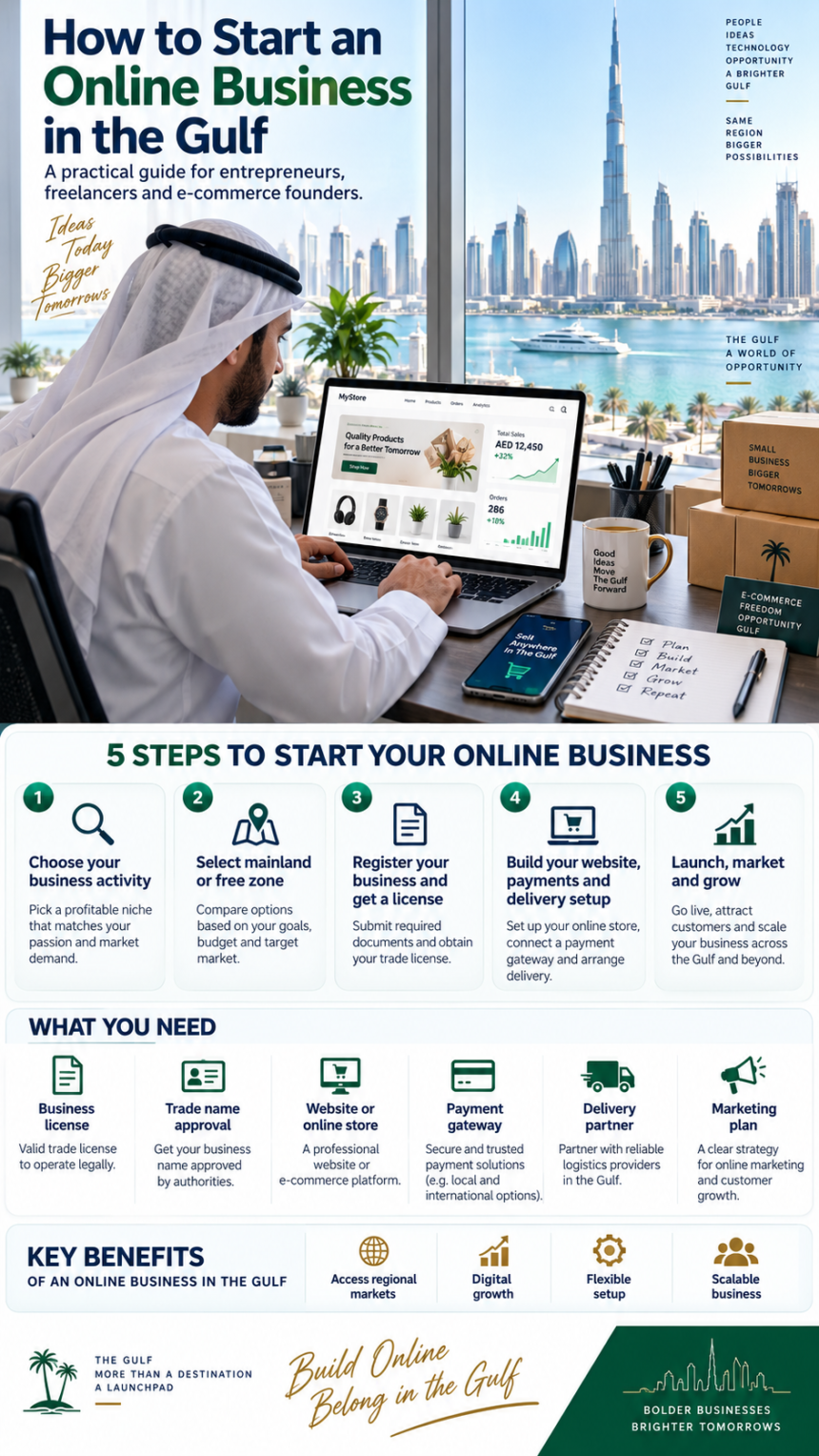
Online Business in the Gulf has become one of the most accessible ways for entrepreneurs to enter the GCC market, whether they plan to sell physical products, offer professional services, develop digital products or operate an online marketplace. However, opening an Instagram account or building a website does not automatically make a business legally ready to trade.
- Online Business in the Gulf: 2026 Overview
- Understanding Online Business Models
- 1. Choosing the Right Online Business Idea
- 2. Selecting the Best GCC Country
- 3. Choosing a Legal Business Structure
- 4. Getting an E-Commerce or Business Licence
- 5. Choosing Mainland or Free Zone Setup
- 6. Building an Online Store or Website
- 7. Setting Up Online Payments
- 8. Understanding Consumer Protection Rules
- 9. Managing Delivery and Logistics
- 10. Understanding Tax and Accounting
- 11. Marketing an Online Business
- 12. Planning for Regional GCC Expansion
- Online Business in the UAE
- Online Business in Saudi Arabia
- Online Business in Qatar
- Online Business in Bahrain
- Online Business in Oman
- Online Business in Kuwait
- E-Commerce Store vs Online Service Business
- Social Media Businesses in the Gulf
- Online Business for Expats
- Online Business Costs in the GCC
- Common Online Business Mistakes
- Online Business Setup Checklist
- Final Thoughts on Online Business in the Gulf
Online businesses across the UAE, Saudi Arabia, Qatar, Bahrain, Oman and Kuwait normally still need appropriate commercial registration or licensing.
The exact requirements depend on the country, business activity and ownership structure.
The UAE’s current e-commerce framework, for example, requires online sellers to obtain the appropriate business licence and regulates digital trading through Federal Decree Law No. 14 of 2023 on Modern Technology-Based Trade. The framework applies to websites, mobile apps, social media platforms and digital marketplaces.
Saudi Arabia similarly requires online stores to operate through recognised business structures. The Ministry of Commerce’s current commercial registration system specifically includes e-commerce information as part of the registration process where applicable.
Bahrain has detailed requirements for internet retail businesses, while Oman introduced a dedicated regulatory framework for e-commerce and now operates Ma’roof Oman to help customers verify licensed online sellers.
The opportunity is therefore significant, but successful online businesses need more than social media followers. They need the correct licence, payment systems, customer policies, logistics, financial records and a business model that can scale.
Online Business in the Gulf: 2026 Overview
An online business can take many forms.
| Business Model | Examples | Main Requirement |
|---|---|---|
| E-commerce store | Fashion, electronics, home products | Trading/e-commerce licence |
| Online services | Marketing, consulting, design | Professional/service licence |
| Digital products | Courses, software, subscriptions | Suitable digital activity |
| Marketplace | Seller platform or app | Marketplace/platform licence |
| Social commerce | Instagram, TikTok, WhatsApp selling | Commercial licence usually required |
| Subscription business | Software, memberships | Appropriate service activity |
| Online education | Courses, tutoring | May need education approval |
| Food delivery brand | Online restaurant/cloud kitchen | Food and municipality approvals |
| Freelancing | Writing, design, consulting | Freelance/professional permit where available |
The easiest businesses to start are often digital service businesses because they do not require inventory, warehousing or delivery.
Physical e-commerce involves additional responsibilities such as sourcing products, customs, storage, returns and logistics.
Entrepreneurs should therefore choose the model before selecting a licence.
Understanding Online Business Models
The term online business covers several very different activities.
E-commerce retail
The company buys or manufactures products and sells them through a website, app or online marketplace.
Online services
The entrepreneur sells expertise rather than physical goods.
Examples include:
- Marketing
- Graphic design
- Business consulting
- Web development
- Recruitment services
- Content production
Digital products
These businesses sell items that can be delivered electronically.
Examples include:
- Software
- Templates
- Online courses
- Memberships
- Digital subscriptions
Marketplace
A marketplace connects other sellers with customers and may earn money through commissions, advertising or subscriptions.
Different business models can require different licences.
A marketplace connecting independent sellers is not necessarily licensed in the same way as a company purchasing products and reselling them directly.
Bahrain’s Ministry of Industry and Commerce, for example, distinguishes between “Retail sale via Internet” and the operation of e-marketplaces or websites connecting suppliers and customers.
Define the revenue model clearly before registration.
1. Choosing the Right Online Business Idea
Successful digital businesses usually solve a specific customer problem.
Do not start by asking:
What product can I sell online?
Start with:
What problem does my target customer already spend money solving?
Potential Gulf opportunities include:
- Fashion
- Beauty
- Home products
- Business services
- Technology
- Education
- Tourism services
- Fitness
- Professional consulting
- Food-related concepts
- B2B services
However, regulated products need additional approvals.
Selling cosmetics, food, healthcare products or financial services can involve more regulatory requirements than selling ordinary household products.
The business should therefore be tested from three perspectives:
Demand: Do customers want it?
Margin: Can it generate enough profit after delivery and marketing?
Regulation: Can you legally sell it through the planned structure?
A highly popular product can still become a bad business if advertising, fulfilment and returns consume most of the margin.
2. Selecting the Best GCC Country
The GCC should not be treated as one online-business jurisdiction.
Each country has its own:
- Commercial registration
- Foreign ownership rules
- E-commerce laws
- Payment infrastructure
- Tax system
- Consumer protection
- Customs rules
The UAE is particularly attractive for international founders because it offers mainland and free-zone structures and extensive foreign ownership options.
Saudi Arabia offers access to the GCC’s largest population and a rapidly developing digital-commerce ecosystem.
Qatar has a smaller but high-income consumer market.
Bahrain provides relatively straightforward digital business registration and detailed e-commerce licensing guidance.
Oman has been actively formalising and expanding its e-commerce ecosystem.
Kuwait provides strong consumer purchasing power, although foreign ownership and company setup can require more careful structuring.
The best jurisdiction depends on where your customers are.
A company targeting Saudi consumers may gain little from choosing another country simply because its licence is cheaper.
3. Choosing a Legal Business Structure
An online company still needs a legal structure.
Common options across the GCC include:
- Limited Liability Company
- Single-person company
- Sole establishment
- Free-zone company
- Foreign company branch
For many entrepreneurs, an LLC provides a useful combination of ownership flexibility and limited liability.
Solo founders may use a one-person company where available.
A freelancer offering professional services may find a freelance or sole-business structure simpler.
An established international business entering a Gulf country may use a branch.
The structure should reflect future plans.
If you intend to bring investors into the company, a flexible corporate structure may be preferable to a simple individual licence.
If you plan to remain a solo consultant, creating a complex corporate structure may add unnecessary cost.
4. Getting an E-Commerce or Business Licence
Running an online business does not usually eliminate licensing requirements.
The UAE Government explicitly states that businesses selling online must obtain the appropriate licence and approvals. Its e-commerce law applies to digital and physical products sold through websites, applications, social media and marketplaces.
Mainland online sellers generally need a commercial licence containing the relevant e-commerce activity from the appropriate emirate’s economic authority.
Saudi Arabia also integrates e-commerce information into commercial registration applications. Its Ministry of Commerce says an establishment applicant selects business activities and enters e-commerce information where applicable through the Saudi Business Center.
Saudi authorities also require e-store verification through the Business Platform. The Ministry has stated that a commercial registration or valid professional certificate together with a commercial bank account is required for store verification.
Never assume selling only through Instagram or TikTok means you do not need a licence.
The commercial activity still exists even if there is no physical shop.
5. Choosing Mainland or Free Zone Setup
This question is particularly important in the UAE.
A mainland online company can be attractive when the primary target is customers inside the UAE.
A free-zone company can work well for:
- International services
- Technology
- Digital consulting
- International trading
- Startups
The UAE Government confirms that free zones offer specialised e-commerce licences for online companies and digital businesses.
However, selling directly into the UAE mainland can require additional arrangements depending on the activity and structure.
This means entrepreneurs should not choose a free zone simply because the setup package is inexpensive.
Ask:
- Where are my customers?
- Where will goods be stored?
- Who will import them?
- Do I need employees?
- Do I need a warehouse?
- Will I sell internationally?
A slightly more expensive licence can be cheaper long term if it avoids restructuring later.
6. Building an Online Store or Website
A serious e-commerce business needs an online presence customers can trust.
Important website elements include:
- Clear company name
- Product descriptions
- Prices
- Contact details
- Delivery information
- Returns policy
- Privacy policy
- Terms and conditions
- Secure checkout
This is not only good marketing.
Some jurisdictions require specific information and policies.
Bahrain currently requires online retailers to have an active website, returns and refund policy, terms of use, consumer or data-protection policies, secure electronic payment and an active shopping cart before operating the online retail activity.
The UAE’s e-commerce framework similarly requires accurate product information, transparent practices, protection of customer data and digital invoices.
Customers are increasingly careful about unknown online stores.
A professional site can therefore support both compliance and conversion.
7. Setting Up Online Payments
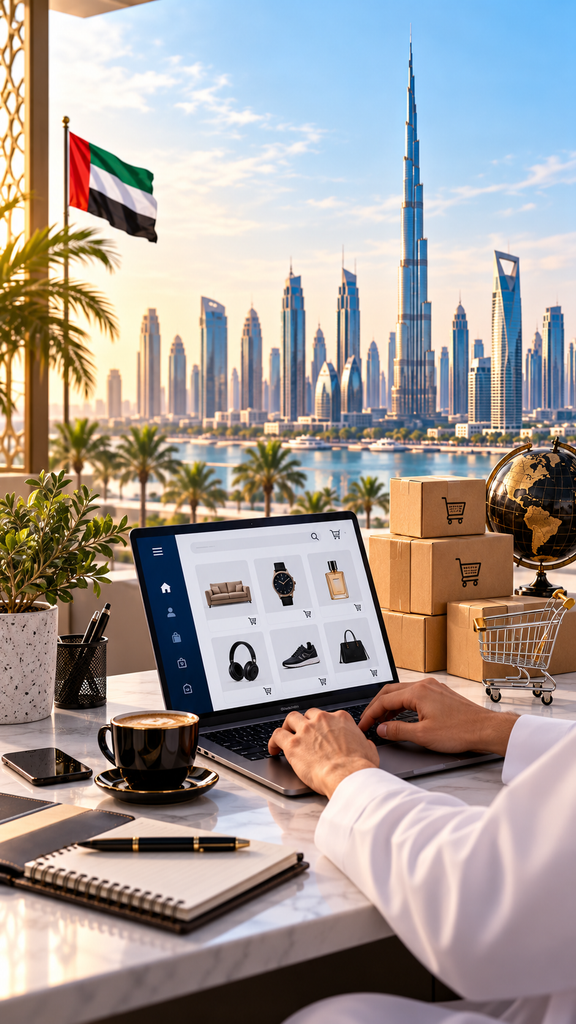
Online payments are central to e-commerce.
Common payment methods can include:
- Credit cards
- Debit cards
- Digital wallets
- Bank transfers
- Buy now, pay later
- Cash on delivery
The exact mix depends on the country and customer profile.
Business owners should compare payment gateways based on:
- Transaction fee
- Monthly cost
- Settlement time
- Supported currencies
- Refund process
- Fraud protection
- International cards
- Integration
A cheaper gateway is not always better.
If payment failures cause customers to abandon checkout, the lost revenue may exceed the saving in processing fees.
Business banking is equally important.
Saudi Arabia’s e-store verification framework specifically requires a commercial bank account, reflecting the importance of separating business and personal payments.
Online entrepreneurs should avoid collecting business revenue through personal accounts unless local regulations clearly permit that structure.
8. Understanding Consumer Protection Rules
Online customers have the same basic need for protection as customers purchasing from physical stores.
Businesses should clearly communicate:
- Product details
- Final price
- Delivery terms
- Refund rules
- Seller identity
- Contact details
The UAE’s e-commerce framework requires online sellers to provide accurate information, avoid misleading practices and issue clear digital invoices. It also requires businesses to protect user information and comply with privacy and marketing rules.
Bahrain requires internet retailers to maintain refund and consumer-protection policies before operating.
Qatar’s Ministry of Commerce and Industry requires traders to provide detailed consumer invoices and states that merchants must operate only within the activities listed in their commercial registration and licence.
Ignoring consumer rights can damage both the licence and the brand.
Transparent policies are therefore part of the business model, not merely website decoration.
9. Managing Delivery and Logistics
Physical e-commerce depends heavily on fulfilment.
A customer may love the product but never buy again if delivery takes too long.
Online retailers need to decide whether to use:
- Own warehouse
- Third-party logistics provider
- Fulfilment centre
- Supplier dropshipping
- Courier company
Important costs include:
- Storage
- Picking and packing
- Last-mile delivery
- Failed delivery
- Returns
- Packaging
- Cross-border customs
Cash-on-delivery orders deserve particular attention.
Customers who cancel at the door can generate delivery costs without revenue.
Businesses should therefore monitor:
Average order value
Delivery cost per order
Return rate
Failed delivery rate
Gross margin after fulfilment
Revenue can grow rapidly while profit disappears if logistics are poorly managed.
10. Understanding Tax and Accounting
Online businesses are real businesses and usually have accounting obligations.
Depending on the country and structure, these can include:
- Corporate tax
- VAT
- Business income tax
- Zakat
- Financial records
- Annual filings
Entrepreneurs should understand the tax system before setting prices.
A business selling a product for 100 does not necessarily keep 100.
The final margin may need to absorb:
- Tax
- Product cost
- Payment fee
- Advertising
- Delivery
- Returns
Cross-border e-commerce introduces additional complexity because goods may enter several customs and tax jurisdictions.
Keep separate business records from day one.
This makes it far easier to calculate actual profit and meet filing requirements.
11. Marketing an Online Business
Having a website does not create customers automatically.
Online businesses usually depend on several marketing channels.
These can include:
- Google search
- TikTok
- YouTube
- Influencer partnerships
- Paid advertising
- Marketplace listings
The strongest businesses avoid depending entirely on one platform.
An Instagram store can lose traffic when an algorithm changes.
Advertising costs can also rise rapidly.
Building an email database and repeat customer base provides more control.
Measure marketing using actual commercial metrics:
- Customer acquisition cost
- Conversion rate
- Average order value
- Repeat purchase rate
- Return on advertising spend
Follower count is not a business model.
An account with 5,000 loyal customers can be more valuable than one with 500,000 followers who rarely buy.
12. Planning for Regional GCC Expansion
One advantage of building a Gulf online company is the possibility of regional expansion.
A business successful in Dubai may eventually sell to:
- Saudi Arabia
- Qatar
- Bahrain
- Oman
- Kuwait
However, a UAE business licence does not automatically provide unrestricted legal trading rights in every GCC country.
Cross-border sellers need to examine:
- Customs
- Local VAT
- Product registration
- Consumer protection
- Warehousing
- Importers
- Local licences
Regional expansion should therefore happen strategically.
Test customer demand first.
If a particular country begins producing substantial sales, it may eventually make sense to establish local warehousing or a local company.
Do not create six companies before proving demand in one market.
Online Business in the UAE
The UAE provides one of the region’s most developed digital-business environments.
Its current e-commerce law covers commercial activity conducted through websites, apps, social media and digital marketplaces.
Online sellers must obtain the relevant licences and approvals.
Mainland companies can obtain commercial licences that include e-commerce activities through the economic authority in the relevant emirate.
Free zones also provide specialised online-business licences.
The UAE Government currently highlights free-zone options including Dubai CommerCity, EZDubai, Masdar City Free Zone, Sharjah Media City, RAKEZ and Ajman Free Zone for different digital and e-commerce activities.
Entrepreneurs should decide between mainland and free zone based primarily on customer location and business activity rather than foreign ownership, since full foreign ownership is now available across many mainland activities as well.
The UAE is particularly attractive for businesses targeting international markets because of logistics infrastructure and its position between Asia, Europe and Africa.
Online Business in Saudi Arabia
Saudi Arabia provides access to the GCC’s largest consumer market and has streamlined much of business registration through the Saudi Business Center.
The Ministry of Commerce’s current registration service asks applicants to specify business activities and e-commerce information where applicable.
Online stores are also verified through the Business Platform.
The Ministry states that verification requires a commercial registration or valid professional certificate together with a business bank account.
Saudi entrepreneurs can therefore build businesses ranging from online stores to digital-service companies, but the legal activity should correspond to what is actually sold.
Foreign investors may require the appropriate investment registration and company structure before obtaining commercial registration.
The Ministry of Commerce provides a specific electronic establishment route for companies operating under foreign investment approval.
Given the size of Saudi Arabia, delivery economics also require careful planning. Serving Riyadh alone is very different from providing next-day delivery nationwide.
Online Business in Qatar
Qatar’s online companies operate within the country’s general commercial registration and licensing framework.
The Ministry of Commerce and Industry requires businesses to operate only within the activities stated in their commercial registration and licence.
Qatar supports company structures including LLCs, one-person LLCs, partnerships and shareholding companies, with foreign ownership above 49% and up to 100% available in qualifying activities under the applicable investment framework.
Entrepreneurs should therefore first determine the online activity and then obtain the correct commercial registration and any required approvals.
Qatar’s relatively compact geography can simplify domestic delivery compared with much larger markets.
However, the smaller population means businesses should pay close attention to market size.
Digital services or high-value specialist products may sometimes offer more scalable opportunities than highly competitive mass-market retail.
Online Business in Bahrain
Bahrain has particularly detailed official e-commerce guidance.
Its Ministry of Industry and Commerce provides a Retail sale via Internet activity as well as separate activities for e-marketplaces, websites and portals.
For online retail, requirements include:
- Active website
- Refund and returns policy
- Terms of use
- Consumer or data-protection policy
- Secure online payment
- Active shopping cart
- Delivery service
Bahrain also offers the Sijili virtual commercial registration for certain online activities, but important eligibility restrictions apply.
The Ministry states that the virtual CR route for internet retail is available to Bahraini nationals under specific conditions and excludes certain regulated products.
Foreign entrepreneurs should therefore distinguish between Bahrain’s general company structures and the special virtual CR scheme rather than assuming Sijili is available to everyone.
Online Business in Oman
Oman’s e-commerce market has expanded rapidly.
The Ministry of Commerce, Industry and Investment Promotion reported more than 10,500 businesses licensed to operate online by mid-July 2025, with growth strongly influenced by Instagram, TikTok and WhatsApp commerce.
Oman introduced its dedicated e-commerce regulatory framework through Ministerial Decision No. 499/2023.
The country has also continued strengthening Ma’roof Oman, a government-supervised platform that helps customers verify licensed online businesses.
In February 2026, the Ministry described Ma’roof Oman as a national tool designed to improve trust in digital transactions and allow customers to verify whether sellers hold official licences.
This is particularly relevant for social-commerce businesses.
Selling through Instagram or WhatsApp may feel informal, but the commercial activity still needs to operate within Oman’s licensing framework.
Online Business in Kuwait
Kuwait offers a strong consumer market for online retail and digital services, but foreign entrepreneurs should pay particular attention to the ownership structure through which the company will operate.
Ordinary commercial registration requirements depend on the business activity and legal entity.
For qualifying international investors seeking full foreign ownership, Kuwait Direct Investment Promotion Authority provides a separate direct-investment route.
KDIPA requires applicants to identify their economic activity, prepare a business plan and select the proposed investment entity before licensing.
This route is generally more substantial than simply obtaining a small e-commerce licence and therefore may not be suitable for every startup.
International founders should confirm whether a standard local commercial structure, local partnership or qualifying investment route is appropriate before launching.
E-Commerce Store vs Online Service Business
Physical e-commerce and online services have very different economics.
| Factor | E-Commerce Store | Online Service Business |
|---|---|---|
| Inventory | Usually required | Usually none |
| Delivery | Required | Digital |
| Returns | Common | Limited |
| Initial capital | Higher | Often lower |
| Warehousing | May be required | Usually not |
| Scalability | High | High |
| Gross margins | Product dependent | Often higher |
| Operational complexity | Higher | Lower |
For first-time entrepreneurs with limited capital, services can often be easier.
A marketing consultant might need only a licence, website and laptop.
A fashion e-commerce company may need inventory, warehouse space, photography, fulfilment and returns management before earning its first sale.
Neither is automatically better.
The choice depends on skills and capital.
Social Media Businesses in the Gulf
Social media has created a category of businesses that sometimes appear informal but are commercially significant.
Products can now be sold through:
- TikTok
- Snapchat
However, using social media does not remove licensing requirements.
The UAE’s current e-commerce legislation specifically covers social media platforms used for commercial transactions.
Oman’s government has also highlighted social media as an important driver behind the rapid increase in licensed online businesses.
Creators selling their own products, services or subscriptions should therefore check whether their activity requires a business or professional licence.
Influencer activity and paid advertising can also have separate regulatory requirements.
Online Business for Expats
Expats can establish online businesses in several GCC countries, but ownership rules vary.
The UAE is among the easiest jurisdictions because many mainland and free-zone businesses permit 100% foreign ownership.
Oman similarly allows full foreign ownership across most activities under its investment framework.
Saudi Arabia provides foreign ownership opportunities subject to investment registration and activity requirements.
Qatar permits up to full foreign ownership in qualifying sectors.
Bahrain also allows full foreign ownership across many activities.
Kuwait can provide 100% ownership for qualifying investments through KDIPA but requires more careful structuring.
Expats should not assume their employment residence visa automatically allows them to operate a separate commercial activity.
Company ownership, residence status and employment permissions should all be checked.
Online Business Costs in the GCC
Online business costs depend heavily on the business model.
Typical expenses include:
| Cost | Examples |
|---|---|
| Registration | Company and commercial registration |
| Licence | E-commerce or professional activity |
| Website | Domain, hosting, development |
| Payments | Gateway and transaction fees |
| Marketing | Social and search advertising |
| Inventory | Products for resale |
| Logistics | Storage and delivery |
| Accounting | Bookkeeping and tax |
| Visas | Founder and employee visas |
| Renewal | Annual licence costs |
A service company can begin with relatively little operating capital.
A physical-product company may require significantly more.
Before launching, create a 12-month cash-flow forecast.
Include conservative sales assumptions rather than expecting immediate viral growth.
Common Online Business Mistakes
Starting without the correct licence
Online businesses remain regulated commercial activities.
Choosing a licence only because it is cheap
The activity may not support the actual business model.
Buying too much inventory
Test demand before placing large orders.
Ignoring product margin
Revenue does not equal profit.
Spending heavily on advertising before testing conversion
Fix the website and offer first.
Ignoring returns
Returns can destroy margins in fashion and other categories.
Using personal banking for a growing company
Separate business finances early.
Ignoring customer policies
Refund, privacy and delivery rules matter.
Relying entirely on Instagram
Build your own website, database and customer relationships.
Expanding across the GCC too quickly
Prove one market before entering six.
Online Business Setup Checklist
Before launching:
- Choose your online business model
- Identify the main target customer
- Select the GCC country
- Check foreign ownership eligibility
- Choose the legal structure
- Select the correct commercial activity
- Obtain the required licence
- Check regulated-product approvals
- Open a corporate bank account
- Choose a payment gateway
- Register the domain
- Build the website or store
- Add terms and conditions
- Add privacy policy
- Add refund and return policy
- Create a delivery strategy
- Set up bookkeeping
- Check tax obligations
- Calculate product margins
- Calculate customer acquisition cost
- Test checkout
- Test delivery
- Start with a controlled marketing budget
- Track profitability rather than only revenue
Final Thoughts on Online Business in the Gulf
Starting an Online Business in the Gulf has become easier as GCC governments expand digital licensing, e-commerce regulation and online business services.
However, online does not mean unregulated.
The UAE requires appropriate licensing for e-commerce and regulates digital sales conducted through websites, apps, social media and online marketplaces.
Saudi Arabia integrates e-commerce information into commercial registration and uses the Saudi Business Center’s Business Platform for official e-store registration and verification.
Qatar requires businesses to operate within their registered commercial activities and provides several company structures for entrepreneurs and foreign investors.
Bahrain has detailed internet retail requirements covering websites, secure payments, refund policies and delivery, while also providing a virtual commercial registration system for eligible Bahraini entrepreneurs.
Oman has developed a dedicated e-commerce regulatory framework and continues strengthening Ma’roof Oman as a verification system for licensed digital sellers.
Kuwait offers online-business opportunities but foreign founders need to pay particular attention to ownership structures and whether an ordinary commercial route or KDIPA investment framework is appropriate.
For new entrepreneurs, the most important step is to avoid confusing an online audience with a real business.
A social account is not a business model.
A website is not a business model.
Even strong sales are not enough if fulfilment, advertising and returns consume every dirham, riyal or dinar of margin.
The strongest online businesses combine a genuine customer need, correct legal setup, reliable payment systems, efficient delivery and disciplined financial management.
Start with one clear product or service.
Prove that customers will pay for it.
Build a legal and operational structure around that demand.
Then expand gradually into additional products and GCC markets.
That approach gives an online business a much stronger chance of becoming a sustainable company rather than simply another short-lived digital store.
Do follow us on Instagram
Read More – Gulf Business Structures: 10 Essential Options for Entrepreneurs in 2026