




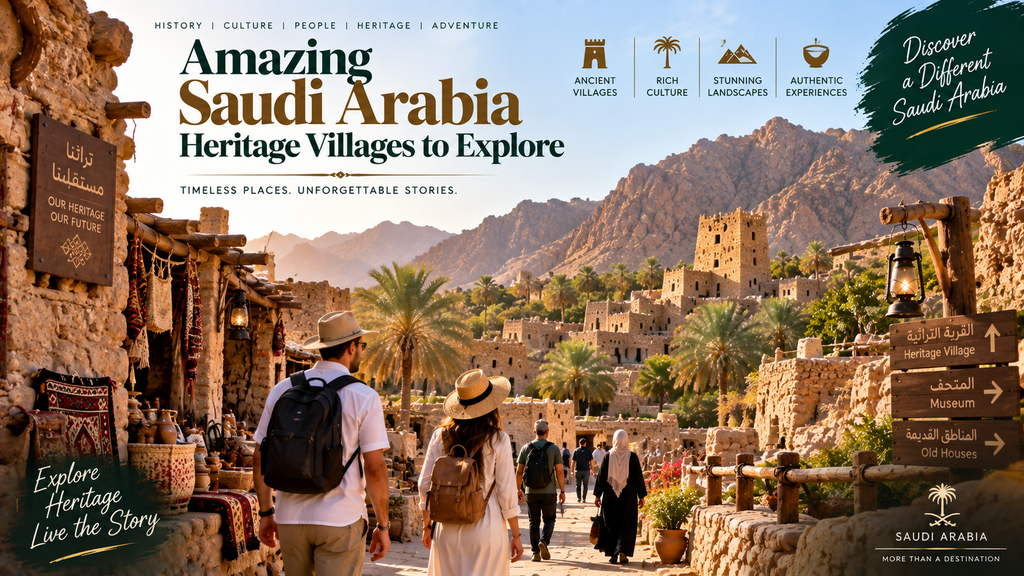
Saudi Arabia heritage villages featuring traditional stone and mud-brick architecture
Saudi Arabia’s heritage is not found only inside museums or famous archaeological sites. Across the Kingdom, entire villages and historic towns preserve traditional houses, narrow lanes, old mosques, markets, forts, farms and architectural styles that developed in response to very different landscapes.
- Saudi Arabia Heritage Villages at a Glance
- 1. Rijal Almaa: One of the Most Striking Saudi Arabia Heritage Villages
- 2. Thee Ain: A Stone Village Rising From Al-Baha’s Mountains
- 3. Ushaiqer: Walk Through 1,500 Years of Najdi History
- 4. Shaqra Heritage Village: Traditional Najd Beyond Riyadh
- 5. Al-Khabra: A Mud-Brick Settlement in Qassim
- 6. Al-Midhnab: A Living Example of Traditional Najdi Town Planning
- 7. Uyun al-Jiwa: One of the Quieter Saudi Arabia Heritage Villages and Towns
- 8. Al-Qassar: Heritage Among the Palms of Farasan Island
- 9. AlUla Old Town: Where Heritage Meets a Global Tourism Destination
- What Makes Saudi Arabia Heritage Villages So Different From Each Other?
- Best Saudi Arabia Heritage Villages for Different Travelers
- How to Build a Saudi Heritage Road Trip
- Best Time to Explore Saudi Arabia Heritage Villages
- How to Visit Heritage Villages Respectfully
- What to Look For Beyond the Buildings
- Frequently Asked Questions About Saudi Arabia Heritage Villages
- Why Saudi Arabia Heritage Villages Deserve More Attention
- Final Thoughts on Saudi Arabia Heritage Villages
Exploring Saudi Arabia Heritage Villages can take you from the dark stone tower houses of the green Aseer mountains to the bright stone buildings of Al-Baha, the earth-coloured mud-brick settlements of Najd and palm-filled communities on the Farasan Islands. Each region developed its own solutions for heat, rainfall, farming, trade and community life.
These destinations also reveal how diverse Saudi Arabia really is. Rijal Almaa looks completely different from Ushaiqer, while the island architecture of Al-Qassar has little in common with the compact mud houses of AlUla Old Town. Together, they provide a journey through Saudi history that extends far beyond one architectural style.
Some of these places are restored visitor attractions. Others still maintain close connections with local communities, farms, traditional crafts and family histories. That makes them valuable not only as photography stops but as places to understand how people actually lived.
This guide explores nine remarkable heritage villages and historic settlements across Saudi Arabia, along with practical advice on when to visit, what makes each destination different and how to plan a heritage-focused journey around the Kingdom.
Saudi Arabia Heritage Villages at a Glance
Saudi Arabia is geographically enormous, so these villages should not be treated as attractions that can all be covered during one road trip. They are spread across Aseer, Al-Baha, Riyadh, Qassim, Jazan and AlUla.
| Heritage Destination | Region | Known For | Ideal For |
|---|---|---|---|
| Rijal Almaa | Aseer | Multi-storey stone forts and Al-Qatt Al-Asiri | Architecture and photography |
| Thee Ain | Al-Baha | Stone village on a white rocky hill | Mountain scenery |
| Ushaiqer | Riyadh Province | Najdi mud-brick houses and alleys | Riyadh road trips |
| Shaqra Heritage Village | Riyadh Province | Old walls, houses and watchtowers | Najdi history |
| Al-Khabra | Qassim | Hundreds of mud-brick houses | Urban heritage |
| Al-Midhnab | Qassim | Traditional market and Najdi layout | Markets and local culture |
| Uyun al-Jiwa | Qassim | Historic mosque and old market | Quiet heritage exploration |
| Al-Qassar | Farasan Islands, Jazan | Palm-filled stone village | Island culture |
| AlUla Old Town | AlUla | Mud-brick houses and historic lanes | Heritage plus desert travel |
The biggest differences are not simply age. Climate, building materials, geography and trade routes influenced everything from the thickness of walls to the number of floors and the shape of streets.
1. Rijal Almaa: One of the Most Striking Saudi Arabia Heritage Villages
Rijal Almaa is one of the most visually recognisable traditional settlements in Saudi Arabia. Located around 45 kilometres west of Abha in Aseer Province, the village contains approximately 60 closely grouped stone buildings and forts, some rising between three and seven storeys. Saudipedia dates the settlement to around 900 years ago.
The dark stone architecture contrasts dramatically with the greener mountain landscape of Aseer. White quartz details decorate façades, while interior walls traditionally feature brightly coloured Al-Qatt Al-Asiri, the geometric decorative art associated with the region.
Several historic structures once performed defensive functions. Saudipedia identifies forts including Razih, Al Jaber, Al Mismar and Al Hawat, while the settlement also contains narrow streets, open courtyards and a traditional mosque.
What makes Rijal Almaa special? Its architecture feels vertical. Instead of low mud homes spreading across flat desert land, tall stone structures rise against mountain slopes, reflecting both the terrain and the defensive needs of earlier communities.
The village also has a strong museum element. The Alma Permanent Heritage Museum was established in 1985 and contains around 2,800 objects covering clothing, household utensils, agriculture, education and traditional daily life.
Visit Saudi currently states that visitors do not need a ticket to enter the Rijal Almaa Village Visitor Center.
| Rijal Almaa Highlight | Why It Matters |
|---|---|
| Multi-storey stone houses | Distinctive Aseer architecture |
| Al-Qatt Al-Asiri | Traditional regional decorative art |
| Heritage museum | Thousands of historic objects |
| Mountain setting | Excellent landscape photography |
| Narrow alleys | Creates an immersive village experience |
For travelers staying in Abha, Rijal Almaa is one of the strongest heritage-focused day trips in the region.
2. Thee Ain: A Stone Village Rising From Al-Baha’s Mountains
Thee Ain, also written Dhee Ayn or Dhi Ain, has one of the most dramatic locations among Saudi Arabia Heritage Villages. The settlement sits on top of a pale rocky mountain in Al-Makhwah Governorate, around 25 kilometres from Al-Baha city.
The village dates to approximately the sixteenth century and appears almost like a single fortress when seen from a distance. Saudipedia records around 85 multi-storey houses, some reaching five levels, constructed using granite and other locally sourced stone.
Its name comes from a natural spring flowing through the area. That water supported agricultural production including bananas, lemons and aromatic plants, creating a striking contrast between the rocky settlement and vegetation below.
The landscape is arguably as important as the architecture. Rugged mountains surround the village on every side, while cultivated areas and palms fill the lower valley.
Why visit Thee Ain? Few places demonstrate the connection between settlement and environment so clearly. The architecture follows the shape of the rocky hill rather than trying to flatten or replace it.
Visit Saudi currently lists the archaeological village as accessible without an entry ticket and provides operating hours of 8:00 AM to 6:00 PM daily, although travelers should verify timings before making a dedicated journey because visitor arrangements can change.
Thee Ain is particularly attractive during late afternoon, when shadows across the stone buildings reveal the different levels and textures of the settlement.
3. Ushaiqer: Walk Through 1,500 Years of Najdi History
Travelers based in Riyadh do not need to cross the entire country to find significant heritage architecture. Ushaiqer lies approximately 200 kilometres northwest of the capital and around 18 kilometres north of Shaqra.
The heritage village was first inhabited around 1,500 years ago, according to Saudipedia. Its springs and gardens eventually made it an important stopping place for pilgrims traveling toward Makkah.
What visitors see today is classic Najdi architecture: yellow-brown mud-brick walls, limestone foundations, timber-supported roofs, palm trunks and narrow alleys designed around the needs of a traditional settlement.
Hundreds of old mud houses fill the village, while historic landmarks include mosques, wells, gates, markets and traditional homes. The Al-Salem Museum displays clothing, jewellery, ceramics, utensils and other objects connected with local culture.
The best way to experience Ushaiqer is on foot. The narrow passages constantly reveal wooden doors, shaded corners, small courtyards and restored façades that are easy to miss if you move too quickly.
| Ushaiqer Experience | What to Look For |
|---|---|
| Mud-brick alleys | Traditional Najdi planning |
| Historic mosques | Community architecture |
| Al-Salem Museum | Local artefacts |
| Old wells | Connection with oasis settlement |
| Palm farms | Agriculture around the village |
| Main square | Traditional social and commercial centre |
Visit Saudi currently offers heritage tours combining Ushaiqer and Shaqra, confirming that the two destinations work particularly well together as a day trip from Riyadh.
4. Shaqra Heritage Village: Traditional Najd Beyond Riyadh
Shaqra makes a natural companion to Ushaiqer but deserves attention in its own right.
The heritage village lies in the centre of Shaqra Governorate and preserves the traditional Najdi pattern of mosques, houses, markets, walls and defensive structures.
Historic residential buildings include the Al-Subaie House, also known as Bayt al-Mal, which was built in 1909 and later used for official purposes during the reign of King Abdulaziz. Other old houses belonged to scholars, merchants and prominent local families.
The town’s defensive architecture adds another layer. Saudipedia records an old wall dating to 1817, a newer wall from 1901 and several watchtowers built around the surrounding terrain.
Unlike destinations built around one monumental structure, Shaqra is interesting because the urban fabric itself becomes the attraction. Streets, neighbourhoods and restored homes show how traditional Najdi towns operated as connected communities.
For travelers interested in architecture, visiting Ushaiqer and Shaqra on the same day provides a useful comparison. The materials and regional character are similar, but each settlement developed its own arrangement of houses, public spaces and fortifications.
A guided visit can also help explain the purpose of seemingly simple architectural details, such as narrow lanes, shaded spaces, courtyards and thick mud walls.
5. Al-Khabra: A Mud-Brick Settlement in Qassim
Qassim contains several important historic settlements, making it one of the best regions for travelers who want to understand traditional central Saudi architecture.
Al-Khabra Historical Village sits on the northern bank of Wadi al-Rummah, about 60 kilometres from Buraydah. Saudipedia dates the settlement to 1703 and records an area of around 80,000 square metres containing approximately 400 mud-brick houses.
The village developed around a landscape shaped by water. Its name is associated with low ground where rainwater from Wadi al-Rummah once accumulated, illustrating once again how geography influenced Saudi settlement patterns.
Many of the original buildings suffered damage from flooding before restoration efforts helped revive the heritage area. Today, the settlement provides an opportunity to examine the dense urban pattern and traditional materials associated with Qassim.
Why include Al-Khabra in a Qassim trip? Because it adds scale. Hundreds of traditional houses create a much stronger sense of historical urban life than a single restored palace or isolated museum.
Combine it with Buraydah or other Qassim heritage towns rather than visiting solely for a quick photograph. The region’s food, markets and agricultural traditions make the wider journey more rewarding.
6. Al-Midhnab: A Living Example of Traditional Najdi Town Planning
Al-Midhnab Heritage Village is another major heritage destination in Qassim. The settlement dates back more than 700 years and has been restored as an example of historical Najdi residential and urban planning.
At the centre is a traditional square surrounded by 33 shops, which functioned as a marketplace for more than 150 years. Saudipedia also records more than 5,000 heritage objects associated with the village.
The surviving and restored landmarks make the village particularly useful for travelers interested in how an entire community functioned.
Among its notable sites are Ibn Dakhil School, the former city jail, traditional houses, Bahla Palace and Souq al-Majlis.
| Heritage Element | What It Reveals |
|---|---|
| Old school | Traditional education |
| Historic market | Trade and community life |
| Residential houses | Najdi domestic architecture |
| Palace | Local administration and social history |
| Village square | Community gathering space |
| Heritage collections | Everyday objects and tools |
The village has also hosted cultural festivals featuring traditional games, crafts, exhibitions and activities linked to local heritage.
For travelers who find ruins difficult to interpret, Al-Midhnab may be easier to understand because so many different parts of everyday life are represented within the same historic area.
7. Uyun al-Jiwa: One of the Quieter Saudi Arabia Heritage Villages and Towns
Not every heritage destination needs to be large or internationally famous. Uyun al-Jiwa in northwestern Qassim provides a more compact experience built around architecture, religion, education and traditional commerce.
The heritage town covers around 6,000 square metres and contains historic buildings designed in the old Najdi style. Its old mosque is particularly important, with tall ceilings, decorative arches and a traditional open space associated with prayer.
Beside the mosque is a small Kuttab, or traditional Qur’anic school, illustrating how education and worship were physically connected within the town.
The old Majlis market adds another dimension. Saudipedia records more than 50 shops that once sold livestock, agricultural products, clarified butter and other goods. Qassim’s position on caravan routes helped support this commercial activity.
Restoration efforts have preserved the traditional architectural appearance without fundamentally changing the site’s old character.
Uyun al-Jiwa is a good choice for travelers who prefer quiet heritage exploration rather than heavily developed tourist attractions. It can also be combined with other Qassim sites to create a broader cultural road trip.
8. Al-Qassar: Heritage Among the Palms of Farasan Island
Most Saudi heritage villages are associated with desert or mountain landscapes. Al-Qassar Heritage Village offers something completely different.
Located on Farasan Island in Jazan Province, around five kilometres south of the island’s main settlement, Al-Qassar developed in an environment shaped by palms, freshwater wells and the sea.
The village contains around 400 houses built with carefully shaped stone. Traditional roofs were constructed using palm trunks, palm branches and other locally available materials.
Fresh groundwater was extremely important. Wells provided drinking water and supported agriculture, helping explain why the settlement became an important seasonal home for Farasan residents.
Archaeological discoveries add much greater historical depth. Saudipedia reports inscriptions in Himyaritic, ancient Latin and southern Musnad scripts, along with archaeological evidence connected with different historical periods.
What makes Al-Qassar unique?
- Island environment rather than inland desert.
- Palm-filled setting around stone houses.
- Traditional wells and farming.
- Architecture adapted to locally available materials.
- Archaeological traces from several historical periods.
- Strong connection with Farasan community traditions.
A visit to Al-Qassar works best as part of a wider Farasan Islands trip rather than as an isolated attraction. The sea, island wildlife and traditional settlement together create one of the most unusual heritage experiences in Saudi Arabia.
9. AlUla Old Town: Where Heritage Meets a Global Tourism Destination
AlUla Old Town differs slightly from the other settlements in this guide because it developed into a historic urban centre rather than remaining simply a village. However, it was selected among the UN World Tourism Organization’s Best Tourism Villages in 2022, making it highly relevant to any exploration of Saudi rural and community heritage.
The town contains approximately 900 mud-brick houses, five courtyards and 400 historical shops. Its tightly packed buildings are connected by winding lanes that once helped protect residents and provide shade.
Its current urban form dates back around a thousand years, although human settlement in the wider AlUla area extends much further into the past. The town’s development was closely connected with pilgrimage and trade routes linking the Levant with Makkah.
One of the most recognisable local landmarks is Al-Tantora, a traditional sundial used historically to help determine seasons, agricultural timing and water distribution.
Today, restaurants, shops and visitor experiences around the Old Town make it one of the easiest heritage settlements in Saudi Arabia to combine with a full tourist itinerary.
Travelers can connect the Old Town with Hegra, Jabal Ikmah, Dadan and other major AlUla sites, creating a heritage journey spanning several civilizations rather than just one period.
What Makes Saudi Arabia Heritage Villages So Different From Each Other?
The most interesting thing about these villages is how clearly architecture changes from region to region.
In Aseer, taller stone buildings responded to mountainous terrain and local construction traditions. Al-Baha developed compact stone settlements built directly onto rocky hillsides. Najd relied heavily on mud brick because those materials provided insulation against extreme temperature changes.
Farasan developed with stone, palms and materials connected with island life, while AlUla’s dense mud settlement evolved around oasis agriculture and major travel routes.
| Region | Traditional Material | Landscape Influence |
|---|---|---|
| Aseer | Dark stone, wood and mud | Mountain slopes |
| Al-Baha | Granite and stone | Rocky highlands |
| Najd | Mud brick and timber | Dry interior |
| Qassim | Mud brick | Oasis and caravan routes |
| Farasan | Stone and palm materials | Island environment |
| AlUla | Mud brick and stone | Oasis valley |
This diversity is why visiting several heritage villages can be much more informative than seeing one reconstructed heritage museum.
The villages allow travelers to compare real regional responses to climate, security, agriculture and social life.
Best Saudi Arabia Heritage Villages for Different Travelers
Not every destination will appeal equally to every visitor.
A photographer may prioritise dramatic mountain settlements, while someone traveling from Riyadh may prefer a practical weekend road trip. Families may value restored visitor infrastructure, while archaeology enthusiasts may be more interested in places where settlement history stretches across different civilizations.
| Your Interest | Best Choice |
|---|---|
| Dramatic photography | Rijal Almaa |
| Mountain landscapes | Thee Ain |
| Easy Riyadh road trip | Ushaiqer and Shaqra |
| Traditional Najdi planning | Al-Midhnab |
| Large mud-brick settlement | Al-Khabra |
| Quiet heritage experience | Uyun al-Jiwa |
| Island culture | Al-Qassar |
| Full tourism infrastructure | AlUla Old Town |
| Museums and crafts | Rijal Almaa or Ushaiqer |
For first-time visitors with limited time, choose villages that naturally fit the rest of your Saudi itinerary rather than traveling enormous distances solely to complete a list.
How to Build a Saudi Heritage Road Trip
Saudi Arabia’s scale means one nationwide heritage route would require extensive driving and multiple domestic flights. A better strategy is to create regional clusters.
From Riyadh, combine Ushaiqer and Shaqra. Visit Saudi currently lists a full-day guided experience covering these heritage destinations together, which reflects how naturally the two fit into one itinerary.
In Qassim, combine Al-Khabra, Al-Midhnab and Uyun al-Jiwa with Buraydah and regional food experiences.
In southwest Saudi Arabia, use Abha for Rijal Almaa and Al-Baha for Thee Ain. These villages should usually be treated as separate regional excursions because of mountain driving distances.
In Jazan, add Al-Qassar while staying on the Farasan Islands.
In northwestern Saudi Arabia, AlUla Old Town can become part of a multi-day itinerary covering archaeological and natural destinations around AlUla.
This regional strategy reduces time spent in the car and allows visitors to understand the wider culture surrounding each village.
Best Time to Explore Saudi Arabia Heritage Villages
Weather should influence planning because much of the experience involves walking outdoors through lanes, courtyards and exposed historic sites.
Central Saudi destinations such as Ushaiqer, Shaqra and Qassim are generally more comfortable during the cooler months. Extended midday walking can become difficult during peak summer.
Aseer and Al-Baha are different. Their elevation gives them comparatively milder summer weather, making them popular when lower regions become much hotter.
| Destination Area | More Comfortable Period |
|---|---|
| Riyadh Province | Late autumn to early spring |
| Qassim | Autumn, winter and early spring |
| Aseer | Particularly attractive in summer and cooler seasons |
| Al-Baha | Spring through summer for mountain scenery |
| Farasan | Cooler months for outdoor exploration |
| AlUla | Autumn through spring |
Sun protection and drinking water remain important even during cooler seasons. Historic villages may also contain uneven surfaces, steep steps and unpaved lanes.
How to Visit Heritage Villages Respectfully
Historic villages are not theme parks. Many are connected with local families, mosques, burial grounds, traditional businesses and communities that maintain strong relationships with these places.
Dress modestly and avoid photographing individuals closely without permission. This is particularly important inside small villages where visitors may move near private homes or community spaces.
Respect barriers around fragile buildings. Mud-brick structures can be easily damaged, and climbing onto walls for photographs may accelerate erosion even when the structure appears strong.
Inside museums or restored houses, follow photography instructions. Some privately operated heritage museums may have different rules from open outdoor spaces.
Finally, take time to buy locally produced crafts, food or heritage products when appropriate. Tourism has greater cultural value when the surrounding community benefits from preserving its traditions.
What to Look For Beyond the Buildings
Architecture is usually the first thing visitors notice, but the best heritage trips go much deeper.
Look at wooden doors and their metalwork. Notice how windows are positioned, where lanes become narrower and how walls create shade.
Visit traditional markets when they are active and ask about regional crafts. In Aseer, decorative art is an important part of architectural identity. In central Saudi Arabia, mud construction and courtyard design tell another story.
Agriculture matters too. The springs and gardens of Ushaiqer, Thee Ain’s water source, Farasan’s wells and AlUla’s oasis remind visitors that settlements could survive only when communities developed effective relationships with limited water resources.
| Look Beyond | Ask Yourself |
|---|---|
| Houses | Why was this material used? |
| Streets | How did they create shade or security? |
| Wells | How was water managed? |
| Markets | What products were traded? |
| Mosques | Where did community life centre? |
| Farms | What could grow in this climate? |
| Decoration | Which regional artistic traditions appear? |
Thinking about those questions turns sightseeing into a much richer cultural experience.
Frequently Asked Questions About Saudi Arabia Heritage Villages
What are the most famous Saudi Arabia heritage villages?
Rijal Almaa, Thee Ain and Ushaiqer are among the most widely known. Other important heritage settlements include Shaqra, Al-Khabra, Al-Midhnab, Uyun al-Jiwa, Al-Qassar and AlUla Old Town. Their architecture varies significantly depending on region and landscape.
Which heritage village is near Riyadh?
Ushaiqer is approximately 200 kilometres northwest of Riyadh and around 18 kilometres north of Shaqra. The two can be combined into a heritage-focused road trip from the capital.
What is special about Rijal Almaa?
Rijal Almaa is famous for tall stone structures that reach up to seven floors, white quartz façade details and colourful interior decoration associated with Al-Qatt Al-Asiri. It also contains a heritage museum with around 2,800 objects.
Is Thee Ain free to visit?
Visit Saudi currently lists admission to Thee Ain Heritage Village without a ticket and shows daily operating hours from 8:00 AM until 6:00 PM. Check current information before visiting because operating arrangements can change.
Which heritage village should photographers choose?
Rijal Almaa and Thee Ain are particularly striking because of their mountain environments. AlUla Old Town is also excellent for photography, especially when combined with the surrounding oasis and sandstone landscapes.
Are there heritage villages on Saudi islands?
Yes. Al-Qassar Heritage Village is located on Farasan Island in Jazan Province. It contains around 400 traditional stone houses surrounded by palms and has a long connection with island agriculture and freshwater wells.
How old is Ushaiqer Heritage Village?
Saudipedia states that the village was first inhabited around 1,500 years ago. It later became an important stopping point for pilgrims because of its springs and gardens.
Is AlUla Old Town a heritage village?
Technically, it is generally described as a historic town or settlement. However, it was selected by the World Tourism Organization as one of its Best Tourism Villages in 2022, making it relevant to Saudi Arabia’s heritage-village tourism story.
Why Saudi Arabia Heritage Villages Deserve More Attention
Modern Saudi tourism is often associated with large new developments, luxury resorts, desert adventures and major entertainment projects. Heritage villages provide a completely different perspective.
They show what Saudi communities built with materials available locally, how they managed water, how markets developed and how houses were shaped by temperature, mountains, agriculture and security.
Rijal Almaa demonstrates the architectural traditions of Aseer through multi-storey stone forts. Thee Ain reveals how a settlement could climb directly across a rocky mountain. Ushaiqer, Shaqra and the villages of Qassim preserve the earth-toned architecture of Najd, while Al-Qassar adds an island chapter shaped by palms and freshwater wells.
AlUla Old Town then connects local settlement history with one of the Kingdom’s most internationally recognised cultural destinations, demonstrating how heritage can become part of a larger tourism economy without losing its historical story.
The best approach is not simply to photograph a restored doorway and move on. Walk through the lanes, study the building materials, visit the museums, notice the relationship between houses and farms and learn why each settlement developed where it did.
Final Thoughts on Saudi Arabia Heritage Villages
Exploring Saudi Arabia Heritage Villages is one of the most rewarding ways to understand how varied the Kingdom’s cultural landscape really is. These places reveal different versions of Saudi history rather than repeating a single architectural story.
In Aseer, heritage rises vertically in dark stone against mountain slopes. In Al-Baha, houses appear to grow from pale rock. Around Riyadh and Qassim, mud-brick lanes, old markets and shaded courtyards introduce the traditional architecture of Najd. Farasan adds island life, while AlUla combines an old mud-built settlement with one of Saudi Arabia’s largest cultural-tourism destinations.
The strongest trip will usually focus on one region rather than trying to cover the entire country. Spend a day around Ushaiqer and Shaqra, build a Qassim heritage route, explore Rijal Almaa from Abha or combine Al-Qassar with a Farasan Islands stay.
Whichever route you choose, travel slowly. These villages are most interesting when you look beyond their photogenic walls and understand the communities, climate, craftsmanship and everyday lives that created them.
That is what makes Saudi Arabia Heritage Villages much more than preserved architecture. They are physical records of how generations adapted to mountains, deserts, oases and islands, and they remain some of the clearest places to experience the depth and diversity of Saudi cultural heritage.
Do follow us on Instagram
Read More – World’s Best Smart Cities: 10 Cities Leading Urban Innovation in 2026