Why Shared Manufacturing Could Transform GCC Entrepreneurship
Starting a manufacturing business requires more than developing a promising product. Entrepreneurs must find suitable premises, purchase equipment, arrange electricity and water connections, meet regulatory requirements, recruit workers, and establish reliable production processes before they can serve customers consistently.
- 1. Why Shared Manufacturing Facilities in the Gulf Matter for Small Businesses
- 2. How Shared Equipment and Facilities Could Reduce Manufacturing Costs
- 3. What UAE Industrial Incubators and Shared Facilities Reveal About New Opportunities
- 4. How Saudi Arabia and Oman Are Supporting Smaller Manufacturers
- 5. How Shared Manufacturing Could Improve Innovation, Quality, and Supply Chains
- 6. The Risks and Challenges of Using Shared Manufacturing Facilities
- 7. The Future of Shared Manufacturing Facilities for Gulf SMEs
- Conclusion
For small businesses, these expenses can create significant barriers to entering the manufacturing sector.
Across the Gulf Cooperation Council, governments and industrial developers are exploring ways to make industrial infrastructure more accessible to entrepreneurs and smaller manufacturers. One approach involves providing shared production spaces, ready-equipped facilities, industrial incubators, and common services that businesses can use without constructing an entire factory independently.
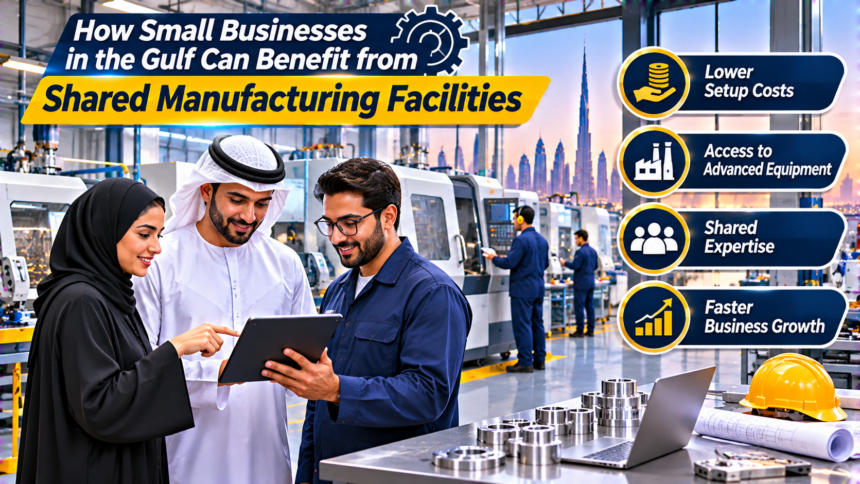
Shared manufacturing facilities in the Gulf could become increasingly valuable as the region seeks to encourage local production, support small enterprises, and diversify industrial activity.
These facilities can take several forms. A food entrepreneur might rent a licensed commercial kitchen for scheduled production sessions. A product designer could use shared machinery to create prototypes. A small manufacturer might lease a ready-built industrial unit within a development that provides common infrastructure and logistics services.
Although these models differ, they address a similar challenge: the difficulty of accessing professional manufacturing resources at an affordable and appropriate scale.
The UAE, Saudi Arabia, and Oman provide examples of industrial ecosystems supporting smaller businesses through ready-built facilities, incubators, and shared services.
In Abu Dhabi, KEZAD announced a dedicated SME Hub intended to help businesses move from early-stage operations toward larger production. Saudi Arabia’s MODON provides ready-built factories designed partly for smaller manufacturers, while Dubai’s DMCC Agro Ecosystem identifies shared commercial kitchen facilities as an option for food businesses.
However, shared facilities do not automatically guarantee lower production costs or business success. Entrepreneurs must still assess licensing, operating expenses, product quality, equipment access, and commercial demand.
Understanding these opportunities and limitations reveals how shared manufacturing could strengthen Gulf entrepreneurship and support the development of more diverse regional industries.
1. Why Shared Manufacturing Facilities in the Gulf Matter for Small Businesses
Manufacturing often requires higher initial investment than many service-based businesses.
An entrepreneur establishing a consulting company may begin with relatively limited physical infrastructure. By contrast, a manufacturer may need specialised machinery, storage space, ventilation, safety equipment, and production utilities.
Even before selling its first product, the business may have committed substantial capital.
Understanding Shared Manufacturing
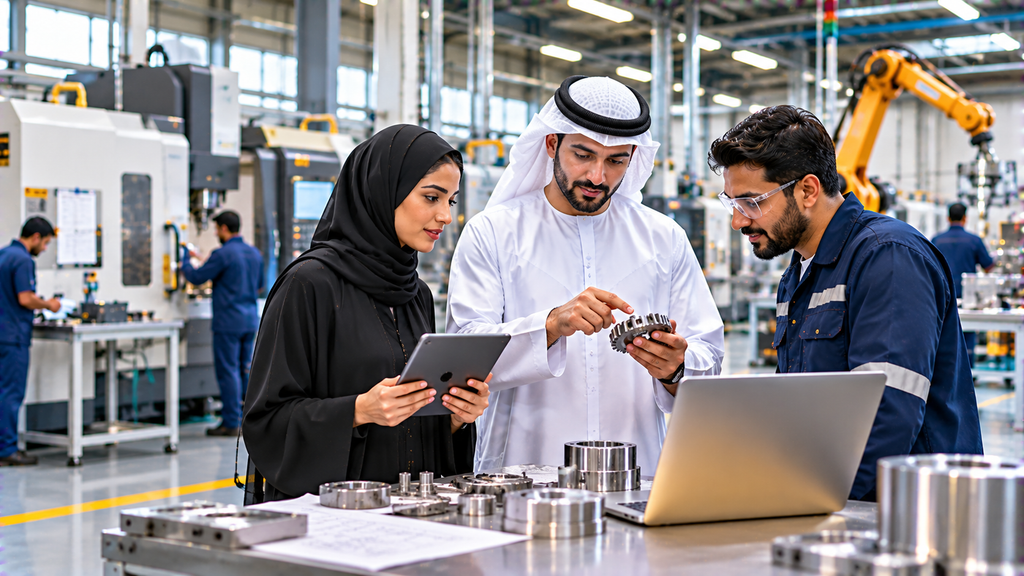
Shared manufacturing refers to arrangements in which multiple businesses access production-related resources through a common facility or service provider.
These resources might include machinery, workspaces, technical staff, testing laboratories, warehouses, or utility infrastructure.
However, the degree of sharing varies.
Some facilities allow several businesses to use the same equipment at different times. Others provide separate leased production units within an industrial development offering common services.
These arrangements should not be treated as identical.
Why Traditional Factory Ownership Can Be Difficult
Purchasing industrial machinery creates financial obligations regardless of how frequently the equipment is used.
A machine that operates for only a few hours each week may still require maintenance, insurance, and suitable premises.
For businesses with uncertain demand, this can produce substantial fixed costs.
Shared access may allow entrepreneurs to pay for production resources more closely aligned with actual use.
However, the financial advantage depends on pricing and utilisation.
Different Models of Shared Manufacturing
| Facility Model | How It Operates | Suitable Business Stage |
|---|---|---|
| Shared Commercial Kitchen | Multiple food businesses book production space | Early-stage food production |
| Makerspace | Members access fabrication equipment | Prototyping and product development |
| Industrial Incubator | Small businesses receive space and support | Startup and testing |
| Shared Production Line | Businesses use equipment under scheduling arrangements | Small-batch manufacturing |
| Ready-Built Factory | Individual company leases prepared industrial premises | Established production |
| Industrial Cluster | Companies share selected infrastructure and services | Growing manufacturers |
| Contract Manufacturing | Third-party manufacturer produces goods | Outsourced production |
What International Research Suggests
UNIDO identifies industrial parks and common services as potential ways to reduce market-entry barriers.
Shared infrastructure may help smaller companies access facilities that would otherwise be difficult to establish independently.
However, outcomes depend on location, management quality, industrial specialisation, and demand.
The presence of an industrial park alone does not guarantee that its tenants will be profitable.
2. How Shared Equipment and Facilities Could Reduce Manufacturing Costs
One of the main attractions of shared manufacturing is the possibility of reducing initial capital requirements.
Instead of purchasing every machine and constructing a dedicated facility, businesses may access resources through rental fees, membership arrangements, or production contracts.
Reducing Initial Equipment Investment
A small packaging company may need cutting, printing, or sealing equipment.
Purchasing these machines could require substantial investment before the business develops a reliable order pipeline.
A shared facility may allow the company to use selected equipment for smaller production runs.
However, businesses must compare usage fees with the long-term cost of owning machinery.
If demand becomes stable and production volumes increase, independent equipment may eventually be more economical.
Access to Utilities and Industrial Infrastructure
Manufacturing facilities may require reliable electricity, water, ventilation, waste management, and loading access.
Industrial developments can provide infrastructure designed for production activities.
UNIDO notes that common infrastructure can help reduce costs associated with industrial development and support more efficient resource management.
However, access charges and service limitations should be reviewed carefully.
An Illustrative Cost Comparison
Consider a hypothetical entrepreneur evaluating two production models.
<escape>Example figures below are illustrative assumptions, not actual GCC market quotations.</escape>
| Expense | Independent Factory | Shared Facility |
|---|---|---|
| Initial equipment and installation | AED 180,000 | AED 15,000 |
| Initial premises setup | AED 70,000 | AED 10,000 |
| Initial capital requirement | AED 250,000 | AED 25,000 |
| Monthly facility and equipment charges | AED 8,000 | AED 16,000 |
The shared arrangement reduces the assumed initial capital requirement considerably but has higher ongoing charges.
Over time, the most economical option depends on production volume, maintenance, financing, utilisation, and the duration of the agreement.
This example excludes labour, materials, permits, taxes, and numerous other business expenses.
Why Lower Startup Costs Are Not the Same as Lower Unit Costs
A shared facility may be affordable for short production runs but expensive when used continuously.
Entrepreneurs should calculate the total cost per acceptable unit produced.
They should also consider whether scheduling delays or minimum booking fees affect production efficiency.
Financial Benefits and Limitations
| Potential Benefit | Important Consideration |
|---|---|
| Lower Initial Investment | Recurring fees may be substantial |
| Reduced Equipment Ownership | Limited control over machinery |
| Flexible Production Capacity | Availability may fluctuate |
| Common Maintenance | Provider reliability matters |
| Shared Utilities | Charges and capacity limitations |
| Shorter Setup Period | Licensing and approvals may still be required |
The strongest financial decision is based on realistic production forecasts rather than the assumption that sharing is always cheaper.
3. What UAE Industrial Incubators and Shared Facilities Reveal About New Opportunities
The UAE provides examples of different approaches to supporting manufacturing entrepreneurs.
Some initiatives provide shared equipment or licensed production spaces, while others focus on ready-built industrial units and business-support ecosystems.
Dubai’s Shared Commercial Kitchen Model
DMCC’s Agro Ecosystem identifies kitchen incubators providing access to equipped and licensed commercial kitchens.
According to DMCC, these facilities can be rented on a short-term basis.
This arrangement may help eligible food entrepreneurs test production, prepare products, and develop commercial operations without establishing an independent kitchen immediately.
However, access to a licensed shared kitchen does not necessarily authorise every food product or business activity.
Product-specific rules, food handling requirements, and business licensing still apply.
Why Food Production Is a Relevant Example
Food businesses often face strict hygiene, storage, and production requirements.
A home-based entrepreneur may need to move into a professionally approved facility before supplying certain commercial customers.
Shared kitchens can potentially provide an intermediate stage between small-scale development and a dedicated manufacturing operation.
However, food safety, traceability, allergen controls, and cleaning procedures are essential when multiple businesses use the same facility.
Abu Dhabi’s KEZAD SME Hub
In June 2026, KEZAD Group announced the development of an AED 112 million SME Hub in KEZAD Al Ma’mourah.
The planned development covers approximately 25,260 square metres and is intended to help businesses transition from early-stage SME support into larger industrial operations.
The announcement identifies shared services, supplier networks, and an integrated industrial environment as potential advantages.
The facility was scheduled for handover before the end of 2026.
As of November 19, 2026, the announcement should not be interpreted as independently verified completion or full occupancy.
The UAE’s Wider Industrial Strategy
The UAE’s Operation 300bn strategy aims to increase the industrial sector’s contribution to GDP to AED 300 billion by 2031.
Its supporting programmes include industrial finance and assistance for small and medium-sized businesses.
Shared manufacturing facilities could complement these objectives by helping eligible businesses develop production capabilities.
However, a general industrial strategy does not mean every participating SME receives subsidised machinery or premises.
UAE Examples Compared
| Initiative | Main Offering | Distinctive Feature |
|---|---|---|
| DMCC Kitchen Incubators | Short-term shared kitchen access | Licensed food-production space |
| KEZAD SME Hub | Planned industrial units and common services | Transition toward larger operations |
| UAE Industrial Strategy | Broader manufacturing development | National industrial policy |
| Emirates Development Bank Accelerator | Manufacturing startup development support | Business growth and industry connections |
These initiatives illustrate different support mechanisms, not one standard shared manufacturing model.
4. How Saudi Arabia and Oman Are Supporting Smaller Manufacturers
Saudi Arabia and Oman have developed industrial infrastructure programmes intended to encourage manufacturing investment.
Ready-built factories, industrial estates, and innovation support can help smaller businesses establish or expand production.
However, independently leased factories are different from shared production lines.
Saudi Arabia’s MODON Ready-Built Factories
The Saudi Authority for Industrial Cities and Technology Zones, known as MODON, develops industrial cities and associated infrastructure.
Its offerings include ready-built factory units designed for businesses requiring prepared manufacturing space.
Saudi government guidance identifies entrepreneurs and small and medium-sized enterprises among the intended beneficiaries.
The model can reduce the need for a company to construct an entire industrial building before starting operations.
However, tenants may still need to purchase machinery, install suitable equipment, and obtain necessary approvals.
Jeddah’s Ready-Built Factory Development
In November 2024, MODON announced an agreement with Omani developer Osara Real Estate Development to establish 52 ready-built factories in Jeddah’s Second Industrial City.
The proposed development covered more than 45,000 square metres.
The project was presented as a way to support entrepreneurs and SMEs while encouraging private-sector participation in industrial development.
The announcement describes a development agreement rather than confirmation that all 52 factories became operational immediately.
Oman’s Madayn Industrial Estates
Oman’s Public Establishment for Industrial Estates, known as Madayn, develops and manages industrial cities.
Its infrastructure supports manufacturing sectors including food processing, chemicals, materials, and other industrial activities.
Madayn also identifies programmes connected with SME development, applied research, and industrial innovation.
These ecosystems may help businesses access appropriate industrial locations and related services.
However, companies must verify the actual availability of shared equipment or facilities within a particular industrial estate.
Intaj Suhar and Industrial Production Support
Madayn identifies Intaj Suhar at Sohar University as a factory supporting the production of moulds and spare parts.
Its purpose includes improving manufacturing capabilities and supporting local and international market opportunities.
This illustrates the relationship between industrial infrastructure, applied research, and specialised production.
However, the existence of such a factory does not establish unrestricted public access for every SME.
Saudi and Omani Approaches Compared
| Initiative | Country | Main Purpose |
|---|---|---|
| MODON Ready-Built Factories | Saudi Arabia | Prepared industrial premises |
| Jeddah Factory Development | Saudi Arabia | New SME-oriented industrial units |
| Madayn Industrial Estates | Oman | Industrial infrastructure and business development |
| Madayn Innovation Activities | Oman | Applied research and industrial capabilities |
| Intaj Suhar | Oman | Specialised mould and spare-parts production |
Why Prepared Industrial Space Matters
A ready-built factory can reduce some construction-related barriers.
However, entrepreneurs must still assess whether the location, utilities, equipment requirements, and lease terms suit their products.
5. How Shared Manufacturing Could Improve Innovation, Quality, and Supply Chains
Shared manufacturing facilities can offer more than physical space.
When appropriately designed, they may provide access to technical specialists, testing equipment, training, suppliers, and related businesses.
These resources can be particularly valuable for companies developing new products.
Supporting Prototypes and Small Production Runs
A startup may wish to test whether customers will purchase a new product before committing to large-scale manufacturing.
Shared fabrication equipment can potentially support prototype development and small batches.
This allows entrepreneurs to gather feedback and refine product specifications.
However, prototypes should not automatically be treated as commercially approved products.
Additional testing or certification may be necessary.
Access to Quality Testing
Some manufacturing activities require laboratory analysis, dimensional inspection, or product-performance testing.
Where shared testing services are available, smaller businesses may access equipment they cannot justify owning independently.
However, official certification may require testing through approved or accredited laboratories.
A facility’s internal quality check is not automatically equivalent to regulatory conformity assessment.
Industrial Clusters and Supplier Relationships
Companies operating near one another may benefit from supplier networks and shared logistics services.
A packaging manufacturer could supply a nearby food producer, while an equipment maintenance provider may serve several tenants.
These relationships can reduce coordination difficulties.
However, benefits depend on the actual mix of businesses and commercial arrangements.
Training and Technical Expertise
Manufacturing requires technical skills involving machine operation, quality control, maintenance, and workplace safety.
Shared facilities may provide training or connect entrepreneurs with relevant specialists.
However, operators must still be appropriately qualified for equipment and activities requiring formal competence.
Potential Innovation Benefits
| Facility Resource | Possible Business Benefit |
|---|---|
| Prototype Equipment | Faster product experimentation |
| Testing Laboratories | Better product evaluation |
| Technical Specialists | Access to practical expertise |
| Common Warehousing | More flexible inventory arrangements |
| Supplier Networks | Easier sourcing of components |
| Training Programmes | Workforce skill development |
| Logistics Services | More coordinated dispatch |
The Importance of Collaboration
Physical proximity does not automatically create innovation.
Businesses must identify meaningful reasons to collaborate.
Facility managers can support this through relevant training, supplier introductions, and appropriate networking opportunities.
However, proprietary information and commercial confidentiality must be respected.
6. The Risks and Challenges of Using Shared Manufacturing Facilities
Despite their potential advantages, shared production facilities introduce operational challenges.
Businesses may have limited control over equipment scheduling, maintenance, storage, security, and facility management.
These issues can affect production reliability and customer relationships.
Equipment Scheduling
When several companies depend on the same machinery, production schedules must be coordinated.
A business may need equipment during a period when another tenant has already booked it.
Unexpected demand or machine breakdowns can create delays.
Entrepreneurs should understand the booking system and available contingency arrangements before signing an agreement.
Quality Control and Product Traceability
Shared equipment may process different products for different businesses.
This can create risks involving contamination, incorrect settings, or mixed materials.
Appropriate cleaning, calibration, documentation, and production separation are therefore important.
Food, medical, chemical, and other regulated sectors may require additional controls.
Licensing and Regulatory Compliance
Manufacturing activities may require industrial licences, environmental approvals, fire safety compliance, or product registration.
The facility provider’s licence does not necessarily replace the tenant’s own obligations.
Businesses should verify all relevant requirements with the competent authority.
Intellectual Property and Confidentiality
A manufacturer developing a new formula, product design, or production technique may be concerned about confidentiality.
Shared spaces can increase the need for access controls, nondisclosure agreements, and clear ownership arrangements.
However, contractual protection should be supported by practical security measures.
Comparing Risks and Safeguards
| Challenge | Potential Consequence | Practical Response |
|---|---|---|
| Equipment Unavailability | Delayed orders | Booking and contingency planning |
| Shared-Space Contamination | Product quality problems | Cleaning and segregation |
| Unclear Licensing | Regulatory difficulties | Confirm approvals |
| Variable Fees | Unexpected expenditure | Review complete pricing |
| Equipment Breakdown | Production interruption | Maintenance and service agreements |
| Confidentiality Risks | Exposure of proprietary information | Access controls |
| Limited Storage | Inventory constraints | Separate storage arrangements |
| Capacity Limits | Difficulty scaling | Expansion planning |
Why Contract Terms Matter
A facility agreement should explain access hours, equipment responsibilities, maintenance procedures, permitted activities, storage rights, insurance obligations, and termination conditions.
Businesses should also understand who is responsible when equipment failures damage materials or interrupt production.
The cheapest facility is not necessarily the most reliable.
7. The Future of Shared Manufacturing Facilities for Gulf SMEs
Shared manufacturing could become increasingly relevant as Gulf economies support new industrial businesses and technology-driven production.
However, the most effective models will depend on the needs of particular industries and the commercial conditions in each location.
Sector-Specific Manufacturing Hubs
Different products require different facilities.
Food production may need licensed kitchens, cold storage, and hygiene controls.
Metal fabrication may need lifting equipment, cutting machinery, ventilation, and suitable electrical capacity.
Electronics manufacturing may require clean workspaces and specialised testing.
Consequently, a single shared factory model is unlikely to serve every industry equally well.
The Potential of Digital Booking and Equipment Management
Facility operators may use digital systems for equipment reservations, billing, maintenance records, and inventory management.
These tools can improve visibility when implemented appropriately.
However, scheduling software cannot compensate for inadequate equipment capacity or poor maintenance.
The Role of Universities and Applied Research Centres
Universities and technical institutions may support shared manufacturing through prototype laboratories, applied research partnerships, and workforce training.
A small business developing a specialised product may benefit from access to engineering expertise before scaling production.
However, intellectual property rights and commercial terms should be established clearly.
A Practical Checklist for Gulf Entrepreneurs
- Confirm that customers are willing to purchase the proposed product.
- Estimate realistic production volumes.
- Compare shared facility costs with independent manufacturing.
- Check equipment specifications and availability.
- Verify industrial, environmental, and product licensing requirements.
- Review quality control and hygiene arrangements.
- Confirm storage, transport, and logistics capabilities.
- Understand responsibilities for equipment maintenance.
- Protect proprietary designs and commercial information.
- Negotiate clear pricing and access conditions.
- Establish alternative production arrangements.
- Plan when independent production may become more economical.
How Businesses Should Measure Facility Performance
Entrepreneurs should monitor financial and operational outcomes rather than assuming participation in a shared facility demonstrates success.
Relevant indicators include production costs, machine availability, quality results, delivery performance, and customer satisfaction.
Key Performance Indicators
| Indicator | What It Measures |
|---|---|
| Production Cost per Unit | Manufacturing efficiency |
| Equipment Utilisation | Actual use of booked capacity |
| Defect Rate | Product quality |
| On-Time Delivery | Production reliability |
| Setup Time | Time required to begin production |
| Capital Requirements | Initial financing needs |
| Capacity Availability | Ability to meet orders |
| Customer Repeat Orders | Ongoing market demand |
| Gross Margin | Revenue after direct production costs |
When Should a Business Move to Its Own Factory?
Shared facilities may be useful while production volumes remain uncertain.
As demand grows, a company may require dedicated machinery, more storage, or continuous access to production lines.
At that stage, owning or independently leasing a factory could provide greater operational control.
However, expansion should be based on financial analysis rather than assumptions that independent premises represent progress in every case.
Opportunities for Industrial Developers
Demand for flexible production infrastructure could create opportunities for industrial estate operators, equipment providers, technical training organisations, and specialised facility managers.
Some developments may combine independent manufacturing units with shared testing, logistics, maintenance, or administrative services.
However, the financial viability of these models depends on occupancy, operating costs, equipment demand, and appropriate industrial management.
Conclusion
Shared manufacturing facilities could help small businesses in the Gulf overcome some of the financial and operational barriers associated with establishing industrial operations.
By providing access to equipment, prepared premises, technical services, and supporting infrastructure, these arrangements may allow entrepreneurs to develop products without immediately committing to a fully independent factory.
Examples from the UAE, Saudi Arabia, and Oman demonstrate the variety of approaches already being explored.
Dubai’s shared commercial kitchen ecosystem offers one model of short-term production access, while KEZAD’s SME Hub and Saudi Arabia’s MODON ready-built factories illustrate broader industrial infrastructure solutions.
However, these models are not interchangeable.
Sharing production equipment, leasing an individual industrial unit, and operating within a cluster create different opportunities and obligations.
For entrepreneurs, the strongest approach is to evaluate costs, technical requirements, market demand, and regulatory responsibilities before selecting a facility.
For industrial developers and policymakers, well-designed shared services may help lower entry barriers and support the development of smaller manufacturing businesses.
Ultimately, successful industrial development is not simply about how many factories are constructed.
It also depends on whether businesses can access the resources, expertise, and reliable infrastructure they need to create competitive products.
Shared manufacturing could become one useful part of that development, helping selected Gulf SMEs test ideas, improve production capabilities, and expand at a pace supported by real commercial demand.
Do follow us on Instagram
Read More – Why Corporate Transparency Is Becoming Essential for Investor Confidence in the GCC