



How Shared Ownership Could Reshape Gulf Entrepreneurship
Across the Middle East, businesses are exploring new ways to attract skilled professionals, encourage innovation, and prepare for long-term growth. As entrepreneurship expands and companies compete for experienced employees, traditional arrangements based entirely on fixed salaries and management-controlled ownership may no longer meet every organisation’s needs.
- 1. Why Employee Ownership Is Becoming Relevant to Middle Eastern Businesses
- 2. How Employee Stock Ownership Plans Could Support GCC Startups
- 3. What UAE and Saudi Regulations Reveal About Employee Ownership
- 4. Could Worker Cooperatives and Collective Ownership Models Develop in the Gulf?
- 5. How Employee Ownership Could Influence Succession and Long-Term Business Growth
- 6. The Financial and Governance Risks of Employee-Owned Businesses
- 7. The Future of Employee Ownership in Middle Eastern Business Models
- Conclusion
One approach attracting attention in international business discussions is employee ownership, where workers receive a financial stake in the companies they help operate.
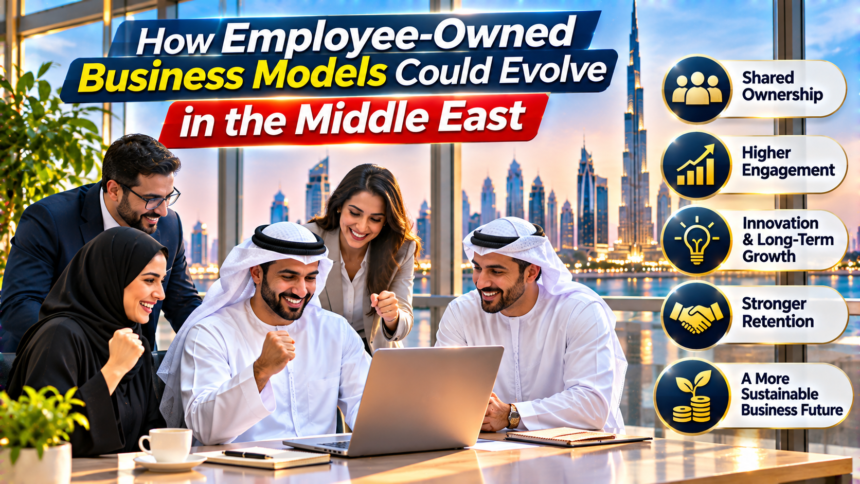
Employee ownership in the Middle East could evolve through share incentive programmes, employee stock options, collective ownership arrangements, and selected cooperative structures.
These models offer different ways for employees to participate in business value creation. In some arrangements, workers receive shares that may increase in value. In others, employees collectively own and influence the company through democratic governance or an ownership trust.
The distinction is important because holding a small number of company shares does not necessarily give employees control over business decisions.
Across the United Arab Emirates and Saudi Arabia, employee share schemes are already recognised within relevant corporate and securities frameworks. International businesses and Gulf startups may also use equity-based compensation to help attract and retain talent.
Meanwhile, worker cooperatives and employee ownership trusts provide alternative examples from other markets, showing how businesses can organise ownership beyond conventional founder-led or investor-controlled structures.
However, these models cannot be transferred automatically into every GCC jurisdiction. Company law, securities regulation, employment arrangements, tax treatment, and ownership rights differ between countries and legal entities.
Employee ownership also introduces financial risks, including the possibility that workers lose value if the company performs poorly.
Understanding the benefits, limitations, and regulatory considerations can help explain how employee-owned business models might develop as part of the region’s evolving economic landscape.
1. Why Employee Ownership Is Becoming Relevant to Middle Eastern Businesses
Traditional companies generally separate employees from owners.
Shareholders provide or hold capital and receive ownership rights, while employees provide labour in exchange for compensation.
Some executives may also receive bonuses or equity incentives.
Employee ownership introduces another possibility by allowing workers to share directly in the company’s ownership or financial performance.
Understanding Employee Ownership
Employee ownership can take several forms.
A company may grant employees options to acquire shares at a defined price. It might award actual shares after employees meet certain conditions, or allow workers to purchase shares through a structured programme.
More extensive arrangements may involve employees collectively holding a controlling interest.
However, these models produce different legal and economic outcomes.
Why Businesses Consider Shared Ownership
Companies may introduce equity incentives to encourage employees to remain with the organisation and contribute to its long-term development.
For a growing startup, offering future equity may also supplement cash compensation when the business cannot match the salaries offered by larger competitors.
Established businesses might consider employee ownership when planning leadership transitions or ownership succession.
Nevertheless, employee ownership is not suitable for every company.
The benefits depend on the design of the scheme, business performance, and the rights employees actually receive.
Ownership, Profit Sharing and Bonuses Are Different

A cash bonus rewards employees without giving them shares.
Profit sharing distributes a portion of business earnings according to defined arrangements.
Employee share ownership gives workers an actual equity interest, subject to the relevant legal structure.
Stock options may provide a future opportunity to acquire shares, but do not necessarily confer immediate ownership rights.
Common Business Models Compared
| Model | Employee Financial Interest | Employee Control |
|---|---|---|
| Salary and Bonus | Employment compensation | No ownership rights |
| Profit Sharing | Share of defined profits | Usually no ownership rights |
| Phantom Shares | Contractual payment linked to value | No actual shares |
| Stock Options | Right to acquire shares under conditions | Usually none until exercise |
| Direct Share Ownership | Actual equity interest | Depends on voting rights |
| Employee Ownership Trust | Indirect collective ownership | Exercised through trust governance |
| Worker Cooperative | Member-worker ownership | Generally democratic member governance |
Why Clear Definitions Matter
A company describing itself as employee-owned should explain whether employees hold real shares, receive contractual financial benefits, or control the business collectively.
These arrangements should not be presented as equivalent.
2. How Employee Stock Ownership Plans Could Support GCC Startups
Startup businesses often operate with limited resources while competing for professionals with specialised technical and commercial skills.
Equity incentives can provide one method of linking employee compensation to long-term company development.
Understanding Employee Stock Options
A stock option gives an employee the right, but generally not the obligation, to purchase shares under conditions specified in an agreement.
For example, a startup may grant options that become exercisable after a defined period of employment.
This process is commonly called vesting.
The employee’s eventual financial outcome depends on factors such as the exercise price, company valuation, liquidity, and applicable costs.
Receiving options does not guarantee a future profit.
Why Startups May Use Equity Incentives
Young technology companies may wish to recruit software engineers, product specialists, or experienced managers.
Offering equity can create an opportunity for employees to benefit financially if the business becomes more valuable.
However, employees should understand that private-company shares may be difficult to sell.
A valuation increase on paper does not necessarily provide immediate cash.
The UAE Startup Environment
Legal and investment practitioners report that employee share options are a commonly used incentive instrument for startups in the UAE and wider GCC.
Some founders use holding-company arrangements in the Dubai International Financial Centre or Abu Dhabi Global Market to support equity incentive structures.
However, these arrangements involve jurisdiction-specific legal and contractual considerations.
They should not be treated as a universal solution for every mainland or free-zone company.
Alternative Incentive Structures
Companies that do not wish to issue actual equity may consider contractual arrangements such as phantom shares.
A phantom-share programme generally provides a cash benefit linked to the value of the company or another agreed measure.
This can reward employees without transferring legal share ownership.
However, it also creates possible future payment obligations for the employer.
Employee Equity Instruments
| Instrument | Potential Advantage | Main Consideration |
|---|---|---|
| Share Options | Participation in future value growth | Exercise conditions and liquidity |
| Restricted Shares | Potential ownership after conditions are met | Vesting and forfeiture |
| Direct Share Grants | Immediate or conditional equity | Governance and dilution |
| Phantom Shares | Value-linked cash incentives | No real ownership |
| Profit-Sharing Plan | Rewards linked to business performance | Does not provide equity |
Why Transparent Communication Is Essential
Employees should receive understandable information about what they are being offered.
Important details include vesting schedules, termination provisions, dilution, voting rights, tax implications, and the circumstances under which shares can be sold.
Complex equity arrangements should not be presented as guaranteed compensation.
3. What UAE and Saudi Regulations Reveal About Employee Ownership
Corporate law has a significant influence on how employee ownership programmes can operate.
The UAE and Saudi Arabia provide examples of legal frameworks recognising selected employee share arrangements.
However, recognition of an incentive programme does not mean every business can implement it through the same procedure.
The UAE Commercial Companies Law
Article 228 of the UAE Federal Decree-Law No. 32 of 2021 concerning Commercial Companies provides for a company to increase its capital through a special resolution to implement an employee share incentive scheme.
The relevant provisions address the role of company governance in approving such arrangements.
This establishes a legal basis for specified employee share programmes.
However, eligibility and implementation depend on the legal form of the company and other applicable requirements.
UAE Private Joint Stock Company Rules
Ministerial Decision No. 137 of 2024 contains governance provisions for private joint stock companies, including rules concerning employee incentive programmes.
The framework addresses matters such as the conditions of the programme and the transfer of shares to employees.
This illustrates how employee incentives may require formal corporate governance procedures rather than informal agreements.
Saudi Arabia’s Capital Market Authority
Saudi Arabia’s Capital Market Authority recognises employee share schemes within its rules concerning securities offerings.
Its regulatory guidance explains that certain offers of securities to employees of an issuer or its affiliates may qualify for exemptions, subject to defined conditions.
The treatment depends on the securities involved and whether the relevant shares are already listed.
Consequently, a company considering an employee share scheme should review the applicable regulatory requirements.
Saudi Employee Share Arrangements in Practice
Saudi corporate prospectuses have disclosed employee share programmes.
For example, Amlak International’s published prospectus includes information about an employee share scheme linked to performance-based rewards.
Such disclosures demonstrate that employee share arrangements exist in the Saudi corporate sector.
However, the existence of these schemes does not establish that the participating employees control the company.
Regional Legal Considerations
| Jurisdiction or Framework | Relevant Feature | Important Qualification |
|---|---|---|
| UAE Commercial Companies Law | Employee share incentive provisions | Depends on company structure |
| UAE Private Joint Stock Rules | Governance of employee incentive programmes | Specific approval and documentation |
| DIFC or ADGM Structures | Share and contractual arrangements | Separate jurisdictional rules |
| Saudi CMA Framework | Regulation of employee securities offers | Exemptions are conditional |
| Other GCC Countries | Potential company-specific equity arrangements | Require separate legal assessment |
Why Legal Advice Matters
Employers must understand applicable company, securities, employment, and tax rules before establishing an ownership scheme.
This becomes particularly important for businesses with employees residing in several countries.
An arrangement legally valid for one group of employees may require additional compliance steps elsewhere.
4. Could Worker Cooperatives and Collective Ownership Models Develop in the Gulf?
Employee ownership can extend beyond incentive programmes.
Worker cooperatives are businesses collectively owned and governed by their worker-members.
They provide a different approach from conventional companies where investors generally exercise control according to their shareholding rights.
Understanding Worker Cooperatives
The International Labour Organization describes worker cooperatives as enterprises owned and controlled by the people who work in them.
Their governance is based on cooperative principles, including democratic member participation.
Workers may contribute capital, participate in decisions, and receive economic benefits according to the cooperative’s rules.
However, membership rights and obligations depend on the applicable legal framework.
The UAE’s Cooperative Legislation
The UAE has a federal legal framework governing cooperative associations.
Federal Decree-Law No. 6 of 2022 and Cabinet Resolution No. 55 of 2024 address the organisation and regulation of cooperatives.
The executive regulations distinguish different cooperative categories and expressly recognise cooperatives involving employees and professionals.
This provides a potentially relevant legal context for collective enterprise models.
However, the existence of a cooperative framework should not be interpreted as permission to establish any proposed worker-owned structure without meeting legal requirements.
Potential Business Applications
In principle, cooperative approaches could be explored in professional services, selected creative industries, agricultural activities, or local service businesses.
For example, a group of qualified professionals might consider collectively organising a service enterprise.
However, actual feasibility would depend on licensing, capital requirements, professional regulation, and cooperative eligibility.
International Lessons From Worker Cooperatives
The ILO identifies worker cooperatives as one response to changes in employment and the organisation of work.
Its research highlights applications involving worker buyouts, freelance cooperation, and platform-based services.
However, experiences from other countries cannot be assumed to produce identical results in Gulf labour markets.
Ownership Structures Compared
| Structure | Ownership Basis | Governance Consideration |
|---|---|---|
| Investor-Owned Company | Private shareholders | Voting linked to share rights |
| Minority Employee Share Scheme | Workers own selected shares | Founders or investors may retain control |
| Worker Cooperative | Worker-members | Democratic participation |
| Employee Ownership Trust | Trust holds shares for workers | Trustees exercise defined rights |
| Founder-Led Startup With Options | Founders and investors retain primary ownership | Options may create future minority interests |
Why Collective Ownership Requires Strong Governance
Democratic participation can create opportunities for members to influence company decisions.
However, collective governance also requires clear procedures for resolving disagreements, allocating profits, admitting members, and managing financial responsibilities.
Without these systems, shared ownership can become difficult to operate.
5. How Employee Ownership Could Influence Succession and Long-Term Business Growth
Business succession is another possible application of employee ownership.
When founders or long-term shareholders wish to reduce their involvement, transferring ownership to employees may provide an alternative to selling the company to outside investors.
However, financing such a transition can be complicated.
The Succession Challenge
An established business may depend heavily on its founder’s personal relationships and strategic leadership.
When the founder retires or changes responsibilities, the company needs a credible continuity plan.
Selling to employees could preserve existing management expertise and institutional knowledge in some circumstances.
However, employees must have an appropriate governance structure and a realistic financing arrangement.
The United Kingdom’s Employee Ownership Trust Model
The United Kingdom provides an example of indirect employee ownership through Employee Ownership Trusts, commonly called EOTs.
Under this model, trustees hold a controlling interest in a company for the benefit of eligible employees, subject to applicable legal conditions.
The trust structure allows a business to be collectively owned without requiring every employee to purchase individual shares.
However, UK tax reliefs and trust rules are country-specific.
They should not be presented as existing automatically in GCC countries.
What International Evidence Suggests
A UK government evaluation published in 2025 examined the experiences of businesses adopting employee ownership trusts.
The findings describe motivations including business succession, maintaining organisational culture, and employee engagement.
However, qualitative observations do not establish that employee-owned companies always outperform comparable businesses.
Possible Benefits for Middle Eastern Businesses
| Business Objective | Possible Role of Employee Ownership |
|---|---|
| Founder Succession | Alternative ownership transition |
| Employee Retention | Long-term financial incentives |
| Leadership Development | Greater participation in business decisions |
| Knowledge Continuity | Retaining experienced employees |
| Organisational Culture | Shared interest in company performance |
| Wealth Participation | Potential employee financial returns |
Why Ownership Alone Is Not Enough
A successful succession plan also requires management development, financial planning, clear decision-making authority, and communication.
Employees may receive an ownership stake while professional managers continue handling daily operations.
The division between ownership and management should be clearly documented.
6. The Financial and Governance Risks of Employee-Owned Businesses
Employee ownership can create valuable opportunities, but it also introduces risks.
These may affect employees, founders, investors, and the organisation itself.
Employees May Face Concentrated Financial Risk
Employees already depend on their employer for wages.
If a substantial part of their personal wealth is also invested in that employer, they become exposed to the company’s performance in multiple ways.
A serious business downturn could threaten both employment income and the value of their shares.
Financial education and appropriate safeguards are therefore important.
Private Shares May Be Difficult to Sell
Shares in private businesses may lack an accessible market.
An employee might own valuable shares on paper but have limited opportunities to convert them into cash.
Shareholder agreements may restrict transfers.
Workers should understand how they can exit the arrangement and how their interests will be valued.
Ownership Dilution
Companies may issue additional shares when raising capital.
If employee shareholders do not participate in new issuances, their percentage ownership may decrease.
This is known as dilution.
A properly designed programme should explain how future financing may affect employee interests.
Governance and Voting Rights
Employees who own shares do not necessarily have equal control over business decisions.
Voting rights may depend on share classes and ownership percentages.
Similarly, an employee trust may hold company shares while trustees exercise formal control.
The distinction between economic benefits and governance rights should be transparent.
Potential Challenges and Safeguards
| Risk | Possible Consequence | Practical Safeguard |
|---|---|---|
| Concentrated Wealth | Exposure to employer failure | Financial education |
| Limited Liquidity | Difficulty selling shares | Clear exit arrangements |
| Ownership Dilution | Reduced percentage interest | Transparent disclosure |
| Complex Valuation | Disputes over share value | Independent valuation |
| Weak Governance | Conflicts and unclear responsibilities | Formal governance rules |
| Tax and Legal Complexity | Compliance problems | Qualified professional advice |
| Unequal Participation | Workplace resentment | Fair eligibility criteria |
| Unrealistic Expectations | Employee dissatisfaction | Clear risk communication |
Why Fairness Matters
Companies should consider how ownership opportunities are distributed.
A scheme available only to selected senior executives may be a valid compensation arrangement, but it is different from broad-based employee ownership.
Businesses should explain eligibility criteria and avoid misleading claims about collective participation.
7. The Future of Employee Ownership in Middle Eastern Business Models
Employee ownership could evolve as Gulf businesses continue expanding into technology, professional services, manufacturing, and other knowledge-intensive industries.
However, adoption will depend on corporate structures, investor expectations, employee preferences, and the availability of suitable legal and financial arrangements.
The Role of Startup Ecosystems
Startups may continue using options and equity-linked rewards to attract specialist employees.
For these businesses, the immediate opportunity may involve improving the transparency and administration of incentive programmes rather than moving toward full employee control.
Digital cap-table management and professional equity administration could support this process.
However, technology cannot eliminate legal or financial risks.
Professional Services and Knowledge Businesses
Some consulting, engineering, and creative businesses depend heavily on the expertise of their employees.
Shared ownership may be attractive when the value of the organisation is closely linked to the knowledge and relationships of its workforce.
However, governance and professional licensing requirements must be assessed.
A Practical Employee Ownership Planning Checklist
- Define whether the objective is retention, succession, or collective control.
- Choose between actual equity, options, profit sharing, and other incentives.
- Review applicable company and securities regulations.
- Clarify eligibility and participation criteria.
- Establish appropriate share valuation procedures.
- Explain vesting, voting rights, dividends, and dilution.
- Develop fair exit and termination arrangements.
- Evaluate employee financial risks.
- Obtain appropriate legal, accounting, and tax advice.
- Establish transparent governance and reporting.
- Review the programme as the business develops.
How Businesses Should Measure Outcomes
Introducing employee ownership does not automatically demonstrate success.
Companies should evaluate whether the arrangement contributes to the objectives for which it was introduced.
Key Performance Indicators
| Indicator | What It Measures |
|---|---|
| Employee Participation | Breadth of ownership |
| Retention | Continued employment |
| Ownership Distribution | Concentration of employee stakes |
| Financial Understanding | Employee knowledge of plan terms |
| Liquidity Opportunities | Ability to realise share value |
| Governance Participation | Actual influence on decisions |
| Business Continuity | Stability through ownership changes |
| Employee Satisfaction | Experience of the programme |
Opportunities for Financial and Professional Services
Growth in equity incentives could create demand for legal advisers, corporate governance specialists, valuation professionals, accountants, and financial technology providers.
Companies may also need better systems for maintaining shareholder records and managing employee grants.
However, these opportunities should not be confused with evidence that a large employee-owned corporate sector already exists across the GCC.
The Importance of Gradual Development
Businesses considering employee ownership may begin with carefully designed incentive programmes.
Others may explore wider participation through direct share ownership or legally suitable cooperative arrangements.
More ambitious transitions, such as collective control or employee trust ownership, require additional preparation.
A gradual approach allows companies to evaluate financial, legal, and organisational consequences before making major ownership changes.
Conclusion
Employee-owned business models could become a more visible part of the Middle East’s evolving business landscape as companies explore alternatives to conventional compensation and ownership structures.
Equity incentives may help startups attract employees, while broader ownership arrangements could support selected business succession strategies.
The UAE and Saudi Arabia already recognise employee share programmes within relevant legal frameworks, and the UAE’s cooperative legislation provides another form of collective enterprise organisation.
However, these structures should not be treated as identical.
Stock options, profit sharing, minority share ownership, employee ownership trusts, and worker cooperatives provide different combinations of financial benefits and decision-making rights.
For employers, the opportunity lies in creating arrangements that are commercially sustainable and clearly understood.
For employees, participation should involve an informed understanding of potential rewards, financial risks, and ownership rights.
For policymakers and professional advisers, the challenge is to support appropriate legal structures and transparent governance.
Ultimately, employee ownership could help some Middle Eastern businesses connect financial participation with long-term organisational development.
Its success will depend not on the label of being employee-owned, but on whether ownership arrangements create meaningful, fair, and sustainable value for both the people working in a business and the enterprise itself.
Do follow us on Instagram
Read More – Why B2B Marketplaces Could Transform Procurement in the GCC