Why Emirates Airline Helped Transform Dubai Into a Global Hub
Every day, thousands of travellers arrive at Dubai International Airport to begin holidays, attend business meetings, visit family or catch connecting flights to destinations across the world. For many passengers, Dubai is their final destination. For others, it is an important stop on a much longer international journey.
- 1. How Dubai International Airport Grew From a Small Runway Into a Global Aviation Hub
- 2. Dubai’s Strategic Location Makes It an Important Connection Between Continents
- 3. Emirates Airline Played a Major Role in the Airport’s Global Success
- 4. Continuous Airport Expansion Made It Possible to Handle Millions of Passengers
- 5. Dubai’s Tourism, Shopping and Business Economy Increased Passenger Demand
- 6. Dubai International Built One of the World’s Largest Global Flight Networks
- 7. International Passenger Rankings Show Why DXB Became a Global Leader
- 8. What the Future Holds for Dubai International and Al Maktoum International Airport
This combination of tourism, business travel and global flight connections has helped transform a relatively small airport into one of the most important aviation centres in the world.
Known internationally by its airport code DXB, Dubai International Airport has developed into a major gateway connecting Europe, Asia, Africa and the Middle East.
Its success is the result of several factors, including Dubai’s geographical location, long-term infrastructure investment, the expansion of Emirates airline, an extensive international route network and the emirate’s growth as a tourism and business destination.
The latest complete annual figures highlight the scale of that achievement.
In 2025, Dubai International welcomed a record 95.2 million passengers, an increase of 3.1% from the previous year. According to Airports Council International (ACI), it ranked first globally for international passenger traffic and second for total passenger traffic, behind Hartsfield-Jackson Atlanta International Airport in the United States.
This distinction is important. Dubai is the world’s busiest airport for international passengers, but it is not the busiest airport overall when domestic and international passengers are combined.
By the end of 2025, the airport connected travellers to 291 destinations across 110 countries through 108 international airlines.
These figures are impressive for a facility that began operating in 1960 with a compacted-sand runway and limited infrastructure.
Over the following decades, aviation became central to Dubai’s development strategy. The airport expanded alongside airlines, hotels, commercial districts, tourism attractions and international business activity.
Today, understanding why Dubai International Airport became one of the world’s busiest airports reveals how geography, investment and economic planning can transform a city’s global connections.
1. How Dubai International Airport Grew From a Small Runway Into a Global Aviation Hub
The history of Dubai International Airport began long before the emirate became famous for its skyscrapers, luxury hotels and major shopping centres.
During the middle of the twentieth century, Dubai was already an established trading centre. Its economy depended heavily on commercial activity associated with Dubai Creek, maritime transportation and regional trade.
As international aviation developed, air connections offered new opportunities to expand commerce and travel beyond traditional sea routes.
Work on a new airport began in 1959, several kilometres from the edge of the city at that time.
The facility officially opened on September 30, 1960.
According to Dubai Aviation Engineering Projects, the original airport featured a single runway made of compacted sand, approximately 1,800 metres long. It was designed to accommodate relatively small aircraft compared with modern international passenger jets.
This modest beginning reflected the scale of Dubai at the time.
However, the airport’s development accelerated as the emirate expanded its commercial relationships and invested in aviation infrastructure.
During the following decades, new runways, terminals and supporting facilities were constructed.
The opening of a second runway in 1984 increased the airport’s operational capabilities.
Another major turning point came in 1985, when Emirates airline began operations from Dubai.
As the airline expanded, the airport required additional facilities to handle increasing passenger numbers and international flights.
In 2000, the opening of Sheikh Rashid Terminal, also known as Concourse 1, significantly expanded capacity.
A much larger development followed in October 2008 with the opening of Terminal 3.
Designed primarily to support Emirates operations, the new terminal became one of the world’s largest airport facilities.
Further expansion included Concourse A, which opened in January 2013 and was designed to accommodate Airbus A380 operations.
These projects allowed Dubai to handle more aircraft, passengers and connecting journeys.
The airport’s growth illustrates how infrastructure development can support economic ambitions over several decades.
| Year | Major milestone |
|---|---|
| 1960 | Dubai International Airport officially opens |
| 1984 | Second runway opens |
| 1985 | Emirates airline begins operations |
| 2000 | Sheikh Rashid Terminal opens |
| 2008 | Terminal 3 begins operations |
| 2013 | Concourse A opens |
| 2014 | DXB becomes the world’s busiest airport for international passengers |
| 2025 | Annual passenger traffic reaches a record 95.2 million |
The transformation was gradual rather than immediate.
Each major expansion helped accommodate increasing demand and strengthened Dubai’s ability to compete as an international aviation centre.
2. Dubai’s Strategic Location Makes It an Important Connection Between Continents
One of Dubai’s greatest advantages is its geographical position.
The emirate is located near important travel routes connecting Europe, Asia, Africa and the wider Middle East.
This creates opportunities for airlines to connect cities through a central hub rather than operating direct flights between every possible pair of destinations.
For example, passengers travelling from parts of Europe to South Asia, or from Africa to East Asia, may find suitable connections through Dubai.
The airport also serves travellers moving between the Gulf and destinations across the world.
However, geography alone does not make an airport successful.
Other cities also occupy favourable positions between major regions.
Dubai’s advantage developed because its location was combined with airline investment, extensive route networks and airport infrastructure.
The importance of connecting flights
Modern international airlines often operate through a hub-and-spoke system.
Under this arrangement, passengers from several departure cities fly into a central airport before connecting to other destinations.
Instead of requiring a separate nonstop flight between every city pair, the airline can combine passengers from multiple routes.
This can improve the commercial viability of flights and increase the number of destinations available through a single connection.
Dubai International became an important example of this model.
Travellers arriving from different regions can transfer to other flights, helping create a steady flow of international passengers.
Flight schedules are an essential part of this process.
Airlines may arrange groups of arrivals and departures so passengers can connect within suitable time windows.
However, the practical convenience of a connection depends on flight schedules, immigration requirements where applicable, baggage arrangements and the time available between flights.
Why international connections matter
The airport’s role is particularly significant because Dubai does not rely on a large domestic aviation market.
The UAE is geographically much smaller than countries such as the United States or China.
Consequently, the airport’s passenger traffic is overwhelmingly international.
This helps explain why it leads global rankings for international travel while another airport may handle more passengers overall.
| Geographic advantage | Contribution to aviation |
|---|---|
| Location between major regions | Supports intercontinental connections |
| Access to Asian markets | Encourages travel to and from South and East Asia |
| Connections with Europe | Supports tourism and business travel |
| Proximity to Africa | Provides additional international routing options |
| Links with Gulf countries | Facilitates regional travel |
| Hub-based scheduling | Allows passengers to connect between multiple routes |
Dubai’s position helped create the opportunity for an aviation hub, but the city’s airlines and infrastructure turned that opportunity into a large international network.
3. Emirates Airline Played a Major Role in the Airport’s Global Success
The development of Emirates airline is one of the most important factors behind Dubai International Airport’s expansion.
Before Emirates began operations, Dubai already had regional aviation connections.
However, the establishment of a Dubai-based international airline created new opportunities to build a coordinated global route network around the airport.
Emirates operated its first flights on October 25, 1985.
Its initial services connected Dubai with Karachi and Mumbai using two leased aircraft, according to the airline’s official historical timeline. Emirates
From those early routes, the airline expanded into a major international carrier.
During the following decades, Emirates added services to destinations in Europe, Asia, Africa, the Americas and Oceania.
The airline’s growth increased demand for airport infrastructure and created more opportunities for travellers to connect through Dubai.
A major feature of this expansion was the use of widebody aircraft designed for long-distance passenger transportation.
Aircraft such as the Boeing 777 and Airbus A380 became important components of Emirates’ fleet and network.
The airline’s investment in long-haul aviation helped make Dubai a connection point for travellers flying between distant regions.
How airline and airport growth reinforced each other
The relationship between Emirates and Dubai International developed through several connected processes.
As Emirates added routes, more passengers travelled through the airport.
Higher traffic created demand for additional terminal capacity, aircraft stands, baggage systems and ground services.
Expanded airport infrastructure then made it possible for airlines to operate more flights and handle larger passenger volumes.
This relationship supported long-term growth.
Terminal 3, which opened in 2008, was developed primarily for Emirates operations.
Its associated concourses were designed to accommodate large numbers of international travellers and widebody aircraft.
Dubai Aviation Engineering Projects states that the Terminal 3 project increased the airport’s overall capacity significantly and provided dedicated infrastructure for Airbus A380 operations. Dubai Aviation Engineering Projects
The contribution of other airlines
Although Emirates played a central role, Dubai International’s success cannot be attributed to one carrier alone.
Flydubai has developed an extensive network of regional and international destinations, including cities not served by all long-haul airline operations.
Other international airlines also contribute to the airport’s passenger traffic.
The presence of multiple carriers provides travellers with a wider choice of destinations, schedules and ticket options.
At the end of 2025, the airport was served by 108 international airlines, highlighting the breadth of its aviation connections.
This network has helped strengthen Dubai’s role as a destination and transfer point for travellers from many countries.
4. Continuous Airport Expansion Made It Possible to Handle Millions of Passengers
A successful airline network requires airport facilities capable of managing large numbers of flights and travellers.
Dubai International’s growth was supported by decades of investment in runways, terminals, concourses, baggage handling and ground transportation.
These facilities became increasingly important as passenger volumes expanded.
One of the airport’s major challenges has been accommodating rapid growth within a developed urban environment.
Unlike a completely new airport built on a large undeveloped site, DXB must operate within physical boundaries shaped by surrounding roads, residential areas and commercial development.
This makes efficient use of existing infrastructure particularly important.
Terminal development and passenger capacity
Dubai International has three passenger terminals.
Terminal 1 serves numerous international airlines, while Terminal 2 accommodates several operators, including flydubai services.
Terminal 3 is closely associated with Emirates, although some other airlines also operate from it.
The terminals work with associated concourses, aircraft stands and ground-handling systems.
One of the most significant projects was the opening of Terminal 3 in 2008.
Its development added substantial capacity and supported the growth of Emirates’ international operations.
Concourse A followed in 2013, creating additional facilities for large aircraft.
Dubai Airports reports that the combined expansions helped increase annual passenger-handling capacity from approximately 60 million to 75 million at that stage.
Subsequent upgrades improved the use of airport space and supporting systems.
Why operational efficiency matters
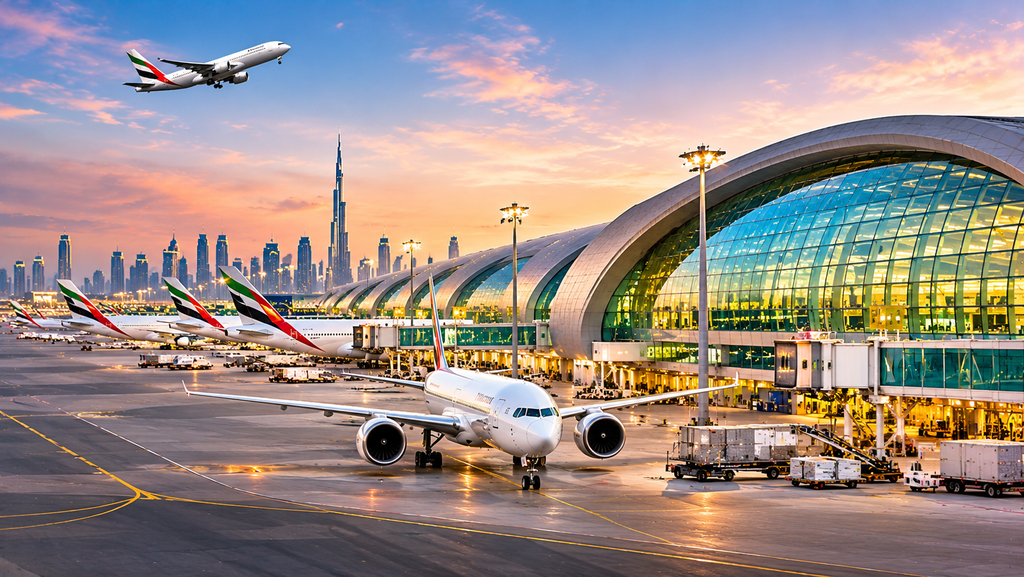
Airport capacity is not determined only by the size of a terminal.Several activities must operate together for passengers and aircraft to move efficiently.Aircraft require suitable arrival and departure slots.Baggage must be transferred between terminals, aircraft and collection areas.
Passengers need access to security, passport control where applicable, departure gates and transportation links. Delays in one part of the operation can affect other activities. For this reason, airports invest in technology, operational coordination and staff training to manage growing traffic.
The importance of baggage handling
Baggage management is particularly demanding at a major international connecting airport. Some passengers arrive in Dubai and collect their luggage, while others transfer to onward flights. This requires coordination between airlines, baggage systems and ground-handling teams.
In 2025, Dubai International processed approximately 86.75 million bags, according to Dubai Airports. Managing this volume illustrates the importance of reliable operational infrastructure.
Infrastructure supporting airport growth
| Facility or system | Main contribution |
|---|---|
| Passenger terminals | Handle check-in, arrivals and departures |
| Concourses | Connect passengers with aircraft gates |
| Runways and taxiways | Support aircraft movements |
| Baggage systems | Process arriving, departing and connecting luggage |
| Security and immigration facilities | Support passenger processing |
| Ground-handling services | Prepare aircraft and manage baggage |
| Airport technology | Improve coordination and passenger services |
| Ground transportation | Connect travellers with the city |
Dubai International’s expansion shows that airport success requires continuous investment in both visible facilities and the systems operating behind the scenes.
5. Dubai’s Tourism, Shopping and Business Economy Increased Passenger Demand
The airport’s success is closely connected to Dubai’s development as an international destination. While connecting passengers are important, many people travel specifically to visit the emirate.
Dubai attracts tourists interested in leisure activities, shopping, entertainment, hotels, beaches and cultural attractions. It also welcomes business travellers attending conferences, exhibitions, meetings and other professional events. These visitors create demand for direct flights to the city.
The growth of international tourism
Dubai has developed a tourism industry supported by hotels, attractions, entertainment venues and international marketing. The city’s major attractions include the Burj Khalifa, Dubai Mall, Palm Jumeirah and historical districts surrounding Dubai Creek.
Events and exhibitions also encourage travel at different times of the year.
According to the Dubai Department of Economy and Tourism, the emirate welcomed 19.59 million international overnight visitors in 2025, a 5% increase from 2024. December 2025
These tourists are not the same as the airport’s total passenger count. An airport may count both arriving and departing passengers, as well as connecting travellers, while tourism statistics measure visitors according to different definitions.
Therefore, the 95.2 million passengers handled by DXB in 2025 should not be interpreted as 95.2 million people visiting Dubai as tourists.
Business travel and international events
Dubai’s commercial economy creates another important source of aviation demand. The city is home to international businesses, financial institutions, trading companies and regional offices.
It hosts conferences, exhibitions and professional events attended by visitors from different countries.
Business travel can support demand for flights throughout the year.
Dubai also provides access to commercial markets across the Gulf and wider Middle East.
This can make the city a convenient meeting location for organisations operating across several regions.
Shopping and hospitality
Retail and hospitality are important components of Dubai’s visitor economy.
International shopping centres, restaurants and hotels help attract leisure travellers.
However, tourism demand is not driven by luxury experiences alone.
The city also receives visitors travelling for family reasons, budget holidays, business appointments and other purposes.
Its broad range of accommodation and transport options contributes to its appeal to different types of travellers.
The relationship between tourism and aviation
The airport and tourism industries benefit from each other’s growth.
More flight connections can make a destination easier to reach.
At the same time, an attractive destination gives airlines additional reasons to operate flights.
This relationship creates a cycle in which improved accessibility supports visitor growth, and stronger demand encourages additional aviation services.
| Source of travel demand | Contribution to airport activity |
|---|---|
| International tourism | Visitors arriving for holidays |
| Business travel | Flights for meetings and professional activity |
| Conferences and exhibitions | Event-related passenger demand |
| Shopping and entertainment | Leisure travel |
| Visiting friends and relatives | Travel involving residents and their families |
| Connecting passengers | Travellers changing flights in Dubai |
This combination helps explain why Dubai International attracts substantial passenger traffic even though the UAE has a relatively small domestic travel market.
6. Dubai International Built One of the World’s Largest Global Flight Networks
A major airport’s importance depends not only on how many travellers it serves but also on how many destinations it connects.
Dubai International has developed an extensive network through Emirates, flydubai and other international airlines.
This allows travellers to reach cities across Europe, Africa, Asia, the Americas and Oceania.
Some passengers travel directly between Dubai and another city.
Others use the airport as a transfer point between two international flights.
Both types of journeys contribute to its global role.
The scale of its international network
At the end of 2025, Dubai International had connections to:
291
Destinations
110
Countries
108
AirlinesSource: Dubai Airports, full-year 2025 operational reporting. Emirates News Agency
These connections allow the airport to serve passengers from a wide range of national and regional markets.
They also reduce dependence on a single country or type of traveller.
India’s importance to Dubai aviation
India has consistently been one of Dubai International’s most significant passenger markets.
The countries maintain strong travel connections involving tourism, business, employment and family visits.
In 2025, India was the airport’s largest country market, accounting for approximately 11.9 million passengers.
Saudi Arabia followed with 7.5 million, while the United Kingdom accounted for 6.3 million.
These figures demonstrate how aviation connects Dubai with both neighbouring Gulf countries and major international markets.
Dubai’s top five country markets in 2025
0 million3 million6 million9 million12 millionIndiaSaudi ArabiaUnited KingdomPakistanUnited States
Source: Dubai Airports, 2025 annual traffic report.
Why destination variety matters
Different regions have different travel seasons and economic conditions.
A network spread across many markets can create multiple sources of passenger demand.
For example, leisure travel may be especially important on certain routes, while others depend more heavily on business travel or family connections.
However, a diversified network does not eliminate risk.
International aviation remains vulnerable to changing economic conditions, airspace restrictions, geopolitical events, disease outbreaks and airline capacity constraints.
The disruptions experienced during the COVID-19 pandemic demonstrated how quickly passenger numbers could decline when international travel was restricted.
Dubai International subsequently recovered strongly, but its experience illustrates that high traffic levels require both long-term connectivity and the ability to respond to changing conditions.
7. International Passenger Rankings Show Why DXB Became a Global Leader
Dubai International’s position among the world’s busiest airports is an important part of its international reputation.
However, airport rankings can be confusing because different organisations measure different types of activity.
Some rankings compare total passenger traffic.
Others focus on international travellers, cargo volumes or aircraft movements.
The distinction helps explain why Dubai can be number one in one category and number two in another.
The difference between international and total passenger traffic
Total passenger traffic includes domestic and international travellers.
International passenger traffic focuses on passengers travelling across national borders.
Large countries such as the United States, China and Japan have substantial domestic aviation networks.
Their airports may therefore record enormous overall passenger volumes even if international traffic represents a smaller share.
Dubai has a different aviation structure.
The UAE’s domestic market is relatively small, and Dubai International functions primarily as an international airport.
This gives the facility an especially strong position in rankings focused on international travellers.
The historic rise to first place
In 2014, Dubai International became the world’s busiest airport for international passengers, handling approximately 70.4 million passengers.
It overtook London Heathrow in the international passenger category.
Dubai Airports’ official historical records identify 2014 as the year the airport reached that milestone.
The achievement reflected the cumulative effect of more than five decades of aviation development.
By that stage, Emirates had established an extensive global route network, major terminal expansions had been completed and Dubai’s tourism industry was continuing to grow.
The latest completed annual rankings
According to ACI World’s 2025 airport traffic rankings, published in 2026, Dubai International ranked:
- First globally for international passenger traffic.
- Second globally for total passenger traffic.
- Behind Atlanta for overall passenger numbers.
Atlanta handled approximately 106.3 million passengers in 2025, compared with Dubai’s 95.2 million.
These figures establish Dubai’s position without incorrectly suggesting that it leads every aviation category.
Passenger growth over time
| Year | Approximate passenger traffic | Significance |
|---|---|---|
| 2014 | 70.4 million | First place globally for international passengers |
| 2019 | 86.4 million | Major pre-pandemic international hub |
| 2023 | 86.9 million | Strong recovery after pandemic disruptions |
| 2024 | 92.3 million | New annual traffic record |
| 2025 | 95.2 million | Highest annual passenger volume in DXB history |
Historical traffic figures reported by Dubai Airports and official aviation publications. The figures also demonstrate that passenger growth has not been uninterrupted.
Global travel restrictions in 2020 significantly affected international aviation. Subsequent recovery depended on the reopening of markets, airline capacity and returning travel demand.
As of November 2026, the 2025 figures remain the latest complete annual results. The airport has also published partial 2026 traffic updates, but these do not yet establish a full-year ranking.
Therefore, 2026 performance should not be compared directly with complete annual totals from previous years.
8. What the Future Holds for Dubai International and Al Maktoum International Airport
Dubai International’s success has created a new challenge: how to manage future aviation demand within an airport surrounded by an established city.
Expanding passenger traffic requires additional capacity, efficient operations and long-term infrastructure planning.
Although Dubai International remains the emirate’s principal passenger airport, its physical location limits the scale of future development.
This has contributed to the long-term importance of Al Maktoum International Airport, also known as Dubai World Central or DWC.
The development of Dubai’s second airport
Al Maktoum International Airport began cargo operations in 2010 and later introduced passenger services.
It is located in Dubai South, away from the older urban districts surrounding DXB.
The location provides opportunities for larger infrastructure development and closer integration with logistics and commercial projects.
In April 2024, Dubai approved a major expansion programme for Al Maktoum International Airport.
The project includes a new passenger terminal and long-term plans for extensive aviation infrastructure.
The announced investment was approximately AED128 billion, or US$35 billion.
According to the Government of Dubai, the airport is ultimately planned to accommodate up to 260 million passengers annually.
This is a proposed future capacity, not the number of passengers currently travelling through DWC.
The airport does not yet operate at anything close to that scale.
Why a larger airport is being developed
Future aviation demand may require additional runways, terminals, aircraft stands and support facilities.
A larger site can provide opportunities for airport infrastructure to develop in stages.
Dubai’s aviation strategy also considers connections between airports, public transport, logistics areas and the wider economy.
However, large infrastructure projects involve substantial financial and operational challenges.
Construction schedules, airline needs and future passenger demand can change over time.
Will Al Maktoum replace Dubai International?
Dubai’s announced long-term strategy envisages transferring major aviation activity from DXB to the expanded DWC.
However, the transition is not an immediate event.
Dubai International remains an active global airport, and its future operations will depend on implementation decisions, infrastructure readiness and the development of the second airport.
It would therefore be inaccurate to say that DXB has already been replaced.
The role of technology
Technology is expected to influence the future of both airports.
Automated passenger processing, improved baggage systems and digital tools may help reduce congestion and support operational efficiency.
However, the benefits of these systems depend on implementation, accessibility, cybersecurity and reliability.
Airports must balance new technology with the practical needs of travellers.
Environmental considerations
Aviation also faces growing pressure to reduce its environmental impact.
Airports and airlines are exploring energy efficiency, alternative aviation fuels and operational improvements.
Future airport expansion will need to consider environmental responsibilities alongside passenger demand and economic development.
Long-term aviation priorities
| Priority | Importance |
|---|---|
| Additional airport capacity | Supports potential long-term passenger demand |
| Ground transport connections | Improves access between airports and the city |
| Operational technology | Supports efficiency and passenger services |
| Airline network development | Maintains international connectivity |
| Logistics integration | Strengthens trade-related activities |
| Environmental planning | Addresses energy use and other impacts |
| Workforce development | Supports skilled aviation employment |
The next stage of Dubai’s aviation development will depend on how successfully it balances growth, infrastructure investment and operational resilience.
Conclusion: Dubai’s Aviation Success Was Built Over Generations
Dubai International Airport did not become one of the world’s busiest airports simply because of its geographical location.
Its success emerged from decades of aviation investment, airline expansion and economic development.
The airport began in 1960 with a modest runway and limited facilities.
Over time, it developed new terminals, expanded its runway infrastructure and built an international network connecting hundreds of destinations.
The launch and subsequent growth of Emirates airline played a central role in this transformation.
Dubai’s position between major world regions helped create opportunities for connecting flights, while the city’s tourism and business economy increased demand from travellers visiting the emirate itself.
Terminal expansions, baggage systems and operational improvements supported increasingly high passenger volumes.
By 2014, DXB had become the world’s busiest airport for international passengers.
In 2025, it handled a record 95.2 million passengers and ranked second globally for total traffic.
These achievements illustrate the importance of long-term planning and the relationship between aviation and economic development.
The next major chapter will involve managing demand at Dubai International while developing the expanded Al Maktoum International Airport.
Ultimately, Dubai International became a global aviation leader because it combined a strategic location with powerful airline networks, sustained infrastructure investment and a city that attracted travellers from around the world.
Do follow us on Instagram
Read More – 10 Traditional Arabian Desserts Everyone Should Try