


Family Sponsorship Guide Gulf for Expats and Dependents in 2026
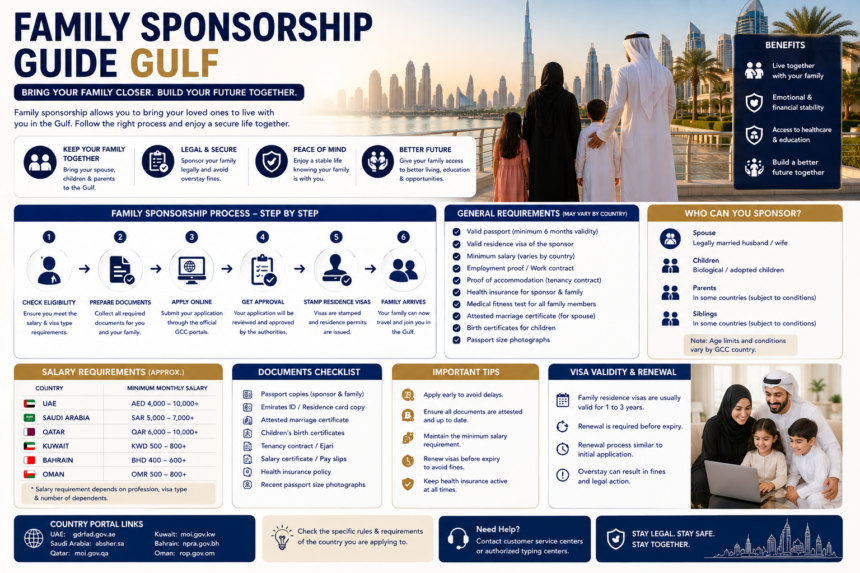
The Family Sponsorship Guide Gulf is essential for expatriates who want to build a life in the GCC while living with their spouse, children or other eligible dependants. The Gulf Cooperation Council consists of the UAE, Saudi Arabia, Qatar, Bahrain, Kuwait and Oman, and each country has its own family residence rules.
- 1. Family Sponsorship in the UAE
- 2. Family Sponsorship in Saudi Arabia
- 3. Family Sponsorship in Qatar
- 4. Family Sponsorship in Kuwait
- 5. Family Sponsorship in Bahrain
- 6. Family Sponsorship in Oman
- Family Sponsorship Guide Gulf Salary Requirements
- Marriage Certificate Requirements
- Birth Certificates for Children
- Medical Tests for Family Members
- Health Insurance for Dependants
- Family Residence Versus Family Visit Visa
- Can Parents Be Sponsored in the Gulf
- Can Women Sponsor Their Families
- Family Sponsorship and Changing Jobs
- Family Sponsorship and Children Turning Adults
- Cost of Sponsoring a Family in the Gulf
- Family Sponsorship Guide Gulf Application Process
- Common Family Sponsorship Mistakes
- Choosing a Gulf Job When You Have a Family
- Frequently Asked Questions
- Conclusion
Getting a job and receiving a residence permit does not automatically give every family member residence rights. In most cases, the expatriate must first establish valid residency and then apply separately to sponsor eligible dependants.
Requirements can include minimum salary levels, suitable accommodation, valid health insurance, authenticated marriage and birth certificates, medical examinations and proof of employment.
The rules also differ significantly between countries. In the UAE, for example, expatriate residents can currently sponsor eligible family members when earning at least AED 4,000 per month or AED 3,000 plus accommodation. The employee’s profession is no longer the deciding factor under the general rule.
Qatar takes a different approach. Its Ministry of Interior currently applies salary, housing and profession conditions for family residence, particularly for private sector employees.
Understanding these differences before accepting a Gulf job can prevent major problems later.
1. Family Sponsorship in the UAE
The UAE provides one of the Gulf’s most established family residence systems.
Both employers and employees holding valid UAE residence visas can sponsor qualifying family members.
Current UAE government rules state that an expatriate employee can sponsor family members regardless of job title when earning at least:
AED 4,000 per month
or
AED 3,000 per month plus accommodation
This is particularly useful because family eligibility is no longer restricted to a narrow list of professions.
Who Can Be Sponsored in the UAE
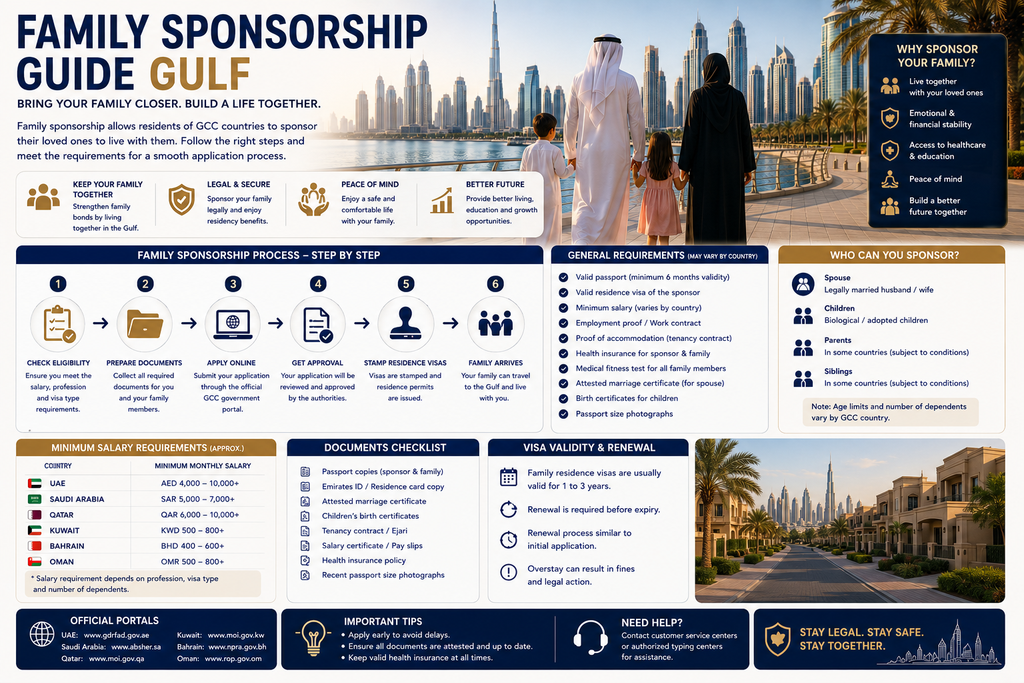
Under current general UAE rules, expatriate residents can sponsor:
Spouse
Unmarried daughters
Sons under 25
Children with special needs regardless of age
Green Visa holders can also sponsor first degree relatives under applicable conditions.
Family members aged 18 or older generally need to pass an approved medical fitness examination.
UAE Family Sponsorship Documents
Applicants commonly need documents such as:
Sponsor passport
Sponsor Emirates ID
Valid residence details
Passport copies of dependants
Marriage certificate
Birth certificates
Salary certificate or employment contract
Accommodation evidence
Medical fitness documents
Health insurance where applicable
Documents issued outside the UAE may need authentication or attestation.
What Happens if the UAE Sponsor Loses Residence
Family residence is linked to the sponsoring resident.
If the sponsor’s residence is cancelled, dependent residence permits also need to be dealt with.
The UAE government currently provides dependants a six month grace period from the expiry or cancellation of their residence permits to obtain another residence permit.
This can provide families with valuable time when a sponsor changes employment or immigration status.
2. Family Sponsorship in Saudi Arabia
Saudi Arabia has a large expatriate workforce, making family residence an important consideration for professionals relocating to the Kingdom.
Saudi Arabia provides a residence visa service that allows qualifying residents and citizens to bring first degree relatives.
For foreign residents, the family’s residence is generally connected to the duration of the sponsoring resident’s permit.
The Saudi Ministry of Interior also provides a process through which residents can book an appointment with the Istiqdam office to request sponsorship for their wife and children.
Saudi Family Residence Documents
Current official Saudi residence visa information identifies documents including:
Valid passport
Personal photograph
Medical insurance
The applicant completes the electronic visa process and, after approval, finishes the required procedures through the Saudi embassy or consulate before travelling to the Kingdom.
Additional requirements can apply depending on the sponsor, relationship and immigration category.
Family Residence and Iqama
For an expatriate worker, maintaining valid Saudi residence is extremely important.
The family’s immigration status can be connected with the sponsor’s legal status.
If the sponsor changes employer, leaves Saudi Arabia permanently or loses valid residence, the family’s immigration arrangements may also need to be updated.
Families should therefore monitor both the sponsor’s Iqama and the dependants’ documentation.
3. Family Sponsorship in Qatar
Qatar allows expatriate residents to sponsor immediate family members when they meet the applicable conditions.
Every family member, including infants, needs an individual Family Residence Visa.
Official Qatar guidance says Family Residence Visas can be issued for periods ranging from one to five years.
Qatar Family Sponsorship Salary Requirements
Salary is particularly important in Qatar.
Current Ministry of Interior guidance states that private sector employees seeking family residence should generally have a technical or specialised non-labour profession.
MOI information has published salary conditions around QAR 10,000 monthly, with lower thresholds possible when qualifying family accommodation is provided. Because official Qatar pages currently display different historical thresholds depending on the page, applicants should verify the exact figure applicable to their employment contract directly through MOI before applying.
Government and semi-government employees are also subject to accommodation and employment documentation requirements.
Qatar Family Sponsorship Documents
Documents can include:
Valid Qatar residence permit
Authenticated marriage certificate
Authenticated birth certificates
Salary certificate
Employment contract
Housing evidence
Six month bank statement for relevant private sector applicants
Educational certificate to establish profession
Good conduct certificate for adults where required
Medical examination documents
The Qatar MOI currently lists a QAR 200 fee for the family sponsorship residence visa service.
4. Family Sponsorship in Kuwait
Kuwait uses specific residence categories for expatriates and their dependants.
Family residence is commonly associated with Article 22.
An expatriate who wants to bring a spouse or children to live in Kuwait should first confirm that their own residence category, salary and employment circumstances allow family sponsorship.
Requirements can change depending on:
Sponsor’s profession
Salary
Relationship
Residence status
Dependent’s age
Applicants commonly need authenticated documents proving the family relationship.
These may include marriage certificates for spouses and birth certificates for children.
Family residence should not be confused with a family visit visa. A visit visa provides temporary entry, while family residence is designed for dependants who will actually live in Kuwait.
5. Family Sponsorship in Bahrain
Bahrain also allows qualifying expatriate workers to bring eligible dependants.
Family residence is connected with the sponsor’s valid immigration and employment status.
Applications may require:
Valid sponsor work permit
Passport copies
Marriage certificate
Birth certificates
Salary or employment evidence
Dependent photographs
Health or medical documentation where applicable
Bahrain’s labour and immigration systems are closely connected, so expatriates should ensure that their own LMRA employment status is valid before beginning the family process.
If the sponsor changes employers, family residence records may also need to be reviewed.
6. Family Sponsorship in Oman
Oman provides family joining options for qualifying expatriate workers.
Eligibility can depend on employment level, salary, accommodation and relationship to the dependants.
Applicants generally need to prove that they have suitable legal residence and sufficient financial capacity to support the family.
Common documentation can include:
Sponsor passport
Residence card
Employment details
Salary evidence
Rental agreement
Marriage certificate
Birth certificates
Passports of family members
Medical documents where applicable
Foreign issued marriage and birth certificates may need authentication before they are accepted.
Family Sponsorship Guide Gulf Salary Requirements
One of the biggest mistakes expatriates make is assuming there is a single minimum salary across the GCC.
There is not.
The salary threshold depends on the country and sometimes the sponsor’s employment category, housing arrangements and profession.
For example, the UAE currently uses AED 4,000 or AED 3,000 plus accommodation under its general expatriate family sponsorship rule.
Qatar applies a different structure and considers salary, profession and family housing for certain employees.
Someone considering two Gulf job offers should therefore compare family eligibility as well as salary.
A slightly higher salary in one country may still not provide the family sponsorship conditions the worker needs.
Marriage Certificate Requirements
A marriage certificate is one of the most important documents for spouse sponsorship.
The certificate may need to be:
Officially issued
Authenticated in the country of origin
Attested by relevant authorities
Translated into Arabic where required
Accepted by the destination country’s authorities
Qatar, for example, specifically requires an attested marriage certificate when applying to bring a spouse under family residence.
Preparing this document before moving can save significant time.
Birth Certificates for Children
Children generally require proof of their relationship with the sponsor.
A birth certificate may need the same authentication process as a marriage certificate.
Parents should make sure that names appear consistently across:
Passports
Birth certificates
Marriage certificate
Residence documents
Even small spelling differences can complicate immigration applications.
Medical Tests for Family Members
Medical fitness requirements are common across Gulf residence systems.
In the UAE, sponsored family members aged 18 or older generally need to pass medical fitness examinations at approved centres.
Qatar also requires medical testing under applicable family residence procedures.
Medical rules can differ according to age, nationality and residence category.
Do not arrange medical testing at an unofficial clinic unless the immigration authority accepts results from that facility.
Health Insurance for Dependants
Health insurance is another expense families should include in their relocation budget.
Saudi Arabia’s current residence visa service lists medical insurance among the required documents.
Other GCC countries and individual emirates may have their own health coverage requirements.
Insurance costs can increase significantly when sponsoring a spouse and several children.
The real cost of family relocation is therefore much higher than the visa application fee alone.
Family Residence Versus Family Visit Visa
These two categories should never be confused.
A family residence visa allows eligible family members to live in the country for an extended period under the sponsor.
A family visit visa normally allows relatives to enter temporarily.
Visit visas can be useful when:
Parents are visiting
A spouse is coming temporarily
Relatives are attending a family event
A family has not yet completed residence formalities
However, repeatedly using temporary visitor status is not a substitute for proper family residence when the dependant actually intends to live in the country.
Can Parents Be Sponsored in the Gulf
Parent sponsorship rules are often more restrictive than spouse and child sponsorship.
Some Gulf residence categories allow parents when additional conditions are satisfied.
The requirements can involve:
Higher income
Suitable accommodation
Medical insurance
Proof of dependency
Relationship documents
Sponsoring both parents together in some circumstances
Special humanitarian exceptions
Do not assume that being eligible to sponsor your spouse automatically means you can sponsor your parents under identical conditions.
Can Women Sponsor Their Families
Family sponsorship rules across the Gulf have evolved considerably.
In the UAE, both employers and employees holding valid residence can sponsor families when they satisfy the applicable requirements, and the current general sponsorship rule focuses on income rather than job title.
Other Gulf countries may apply different rules according to employment, relationship and immigration status.
Female expatriate professionals should therefore check the exact country specific requirements rather than relying on old assumptions about sponsorship.
Family Sponsorship and Changing Jobs
Changing employers can affect the entire family’s immigration position.
This is particularly important when the sponsor’s residence is linked to employment.
Before changing jobs, check:
When the old residence will be cancelled
When the new residence will be issued
Whether dependent visas must be cancelled
Whether dependants can remain during the transition
Whether new insurance is needed
Whether family residence must be reissued
Planning this process before resigning can prevent unnecessary immigration complications.
Family Sponsorship and Children Turning Adults
Parents should monitor age limits carefully.
Some Gulf countries apply different rules once sons reach a particular age.
The UAE currently allows expatriate residents to sponsor sons under 25, while unmarried daughters can generally remain sponsored without the same age limit.
Students and children with special needs may have different provisions.
Families with teenagers should check these rules well before the child’s existing residence expires.
Cost of Sponsoring a Family in the Gulf
The total cost can include much more than immigration fees.
Families should budget for:
Entry visa
Residence issuance
Identity card
Medical testing
Health insurance
Document attestation
Translation
Courier services
Housing
Security deposits
School fees
Residence renewal
The difference between moving alone and relocating with three or four dependants can be substantial.
Calculate the full annual cost before accepting an overseas job.
Family Sponsorship Guide Gulf Application Process
Although every GCC country has its own system, the general process often looks like this:
- Sponsor obtains valid residence.
- Sponsor confirms salary and profession eligibility.
- Marriage and birth certificates are authenticated.
- Family entry or residence application is submitted.
- Dependants enter the country where necessary.
- Medical testing is completed where required.
- Health insurance is arranged.
- Identity registration is completed.
- Residence permits are issued.
- Residence is renewed before expiry.
The order can differ by country.
Always follow the immigration authority’s official process.
Common Family Sponsorship Mistakes
Several problems appear repeatedly in Gulf family applications.
These include:
Using unattested marriage certificates
Submitting birth certificates with inconsistent names
Applying before the sponsor receives residence
Ignoring salary requirements
Confusing family visit and residence visas
Missing medical examinations
Allowing passports to approach expiry
Forgetting dependent health insurance
Not updating family visas after changing jobs
Missing residence renewal deadlines
Good preparation can prevent most of these issues.
Choosing a Gulf Job When You Have a Family
Professionals relocating with children should look beyond the headline salary.
Consider:
Family sponsorship eligibility
Housing allowance
School allowance
Health insurance
Annual flight benefits
Maternity coverage
Dependent visa fees
School availability
Childcare costs
Length of residence permit
Job stability
A salary that looks attractive for one person can become difficult once family housing, schooling and insurance are included.
Frequently Asked Questions
What is Family Sponsorship Guide Gulf?
Family Sponsorship Guide Gulf explains how expatriate residents can bring eligible spouses, children and other dependants to live with them in the UAE, Saudi Arabia, Qatar, Kuwait, Bahrain and Oman.
Can I sponsor my family in the UAE?
Yes, qualifying expatriate residents can sponsor eligible family members. The current general income requirement is AED 4,000 monthly or AED 3,000 plus accommodation.
Can Saudi residents sponsor their families?
Yes. Saudi Arabia provides family residence services for qualifying first degree relatives, with the family’s residence for expatriate sponsors generally linked to the duration of the sponsor’s residence.
Can expatriates sponsor family in Qatar?
Yes, provided they satisfy the relevant residence, salary, profession, housing and documentation requirements.
Does every child need a separate residence visa in Qatar?
Yes. Qatar’s official guidance states that every family member, including infants, requires an individual Family Residence Visa.
Can I use a family visit visa instead of residence?
A visit visa is intended for temporary stays. Family residence is the appropriate category when eligible dependants intend to live in the country on a longer term basis.
Do marriage certificates need attestation?
Often, yes. Qatar explicitly requires an attested marriage certificate, and authenticated relationship documents are common across GCC family residence processes.
Conclusion
The Family Sponsorship Guide Gulf becomes much easier to understand when expatriates recognise one basic principle: there is no single GCC family visa.
Every country has its own system.
The UAE currently provides a relatively straightforward income based route, allowing qualifying residents earning at least AED 4,000 or AED 3,000 plus accommodation to sponsor eligible family members.
Saudi Arabia provides residence services for the first degree relatives of qualifying residents, with the family’s residence generally connected to the expatriate sponsor’s own permit.
Qatar considers residence status, salary, profession, housing and authenticated relationship documentation when evaluating family sponsorship.
Kuwait, Bahrain and Oman also provide family residence routes, but applicants must satisfy their respective employment, salary, relationship and immigration requirements.
For expatriates, family sponsorship should therefore be researched before accepting a Gulf job, not after arriving.
Check whether your salary qualifies.
Confirm which relatives can be sponsored.
Prepare marriage and birth certificates early.
Understand medical and insurance requirements.
Calculate housing and schooling costs.
And make sure your own residence remains valid.
A successful Gulf relocation is not simply about finding the right job. For professionals moving with their loved ones, it is about choosing a residence structure that allows the entire family to build a stable life together.
follow us on Instagram
Read More – Residence Visa Guide Gulf: 6 Essential Routes for 2026