


How Banking Works for Expats in the Gulf: 2026 Overview
How Banking Works for Expats in the Gulf is an important part of everyday life for anyone moving to the UAE, Saudi Arabia, Qatar, Bahrain, Oman or Kuwait. A local bank account may be needed to receive a salary, pay rent, manage bills, send money home and access services such as debit cards, credit cards and personal finance.
- How Banking Works for Expats in the Gulf: 2026 Overview
- 1. Opening a Bank Account as an Expat
- 2. Documents Required for Bank Account Opening
- 3. Current Accounts and Savings Accounts
- 4. Salary Accounts and Employer Transfers
- 5. Debit Cards, Credit Cards and Digital Payments
- 6. International Money Transfers and Remittances
- 7. Bank Fees and Minimum Balance Requirements
- 8. Personal Loans, Car Finance and Credit Facilities
- 9. Islamic Banking and Conventional Banking
- 10. Digital Banking and Mobile Banking
- 11. Banking Security and Fraud Prevention
- 12. Banking When Changing Jobs or Leaving the Gulf
- Banking for Expats in the UAE
- Banking for Expats in Saudi Arabia
- Banking for Expats in Qatar
- Banking for Expats in Bahrain
- Banking for Expats in Oman
- Banking for Expats in Kuwait
- Choosing the Right Bank as an Expat
- Managing Credit and Debt in the Gulf
- Banking Complaints and Consumer Protection
- Common Banking Mistakes Gulf Expats Should Avoid
- Practical Expat Banking Checklist
- Final Thoughts on Banking for Gulf Expats
Fortunately, the Gulf has a highly developed banking sector. Major cities provide access to local banks, Islamic banks, international banks, digital banking applications, exchange houses and electronic payment services.
However, banking rules are not identical across all six GCC countries.
Residency status, local identification, salary, employment, source of funds and individual bank policies can all affect whether an account is approved and which products are available.
New expatriates should therefore avoid assuming that a bank account which worked one way in Dubai will operate exactly the same way after moving to Riyadh, Doha or Kuwait City.
Understanding the basics before relocating can make managing money significantly easier.
How Banking Works for Expats in the Gulf: 2026 Overview
Banking systems across the GCC generally operate around regulated financial institutions supervised by national central banks.
These include:
| Country | Main banking regulator |
|---|---|
| UAE | Central Bank of the UAE |
| Saudi Arabia | Saudi Central Bank |
| Qatar | Qatar Central Bank |
| Bahrain | Central Bank of Bahrain |
| Oman | Central Bank of Oman |
| Kuwait | Central Bank of Kuwait |
Banks must follow customer identification and anti-money laundering requirements. For expatriates, that means opening an account usually involves proving identity, residency and, in many cases, employment or source of income.
The exact process can vary by bank.
The UAE Government, for example, states that expatriate residents commonly need a passport, valid residence visa, Emirates ID and a salary certificate or employer letter. Some banks may also request proof of address.
Saudi Arabia’s banking rules similarly require expatriate residents to hold valid residency documentation. SAMA’s current rules state that an expatriate with a valid Iqama may open an account after the bank obtains the required identification and address information.
These rules reflect a basic principle across Gulf banking: banks need to know who the customer is, where the money comes from and how the account is expected to be used.
1. Opening a Bank Account as an Expat
Opening an account is often one of the first financial tasks after receiving residency documentation.
Some banks allow customers to complete much of the process through mobile applications. Others may require a branch visit depending on the customer’s nationality, employment situation or requested banking product.
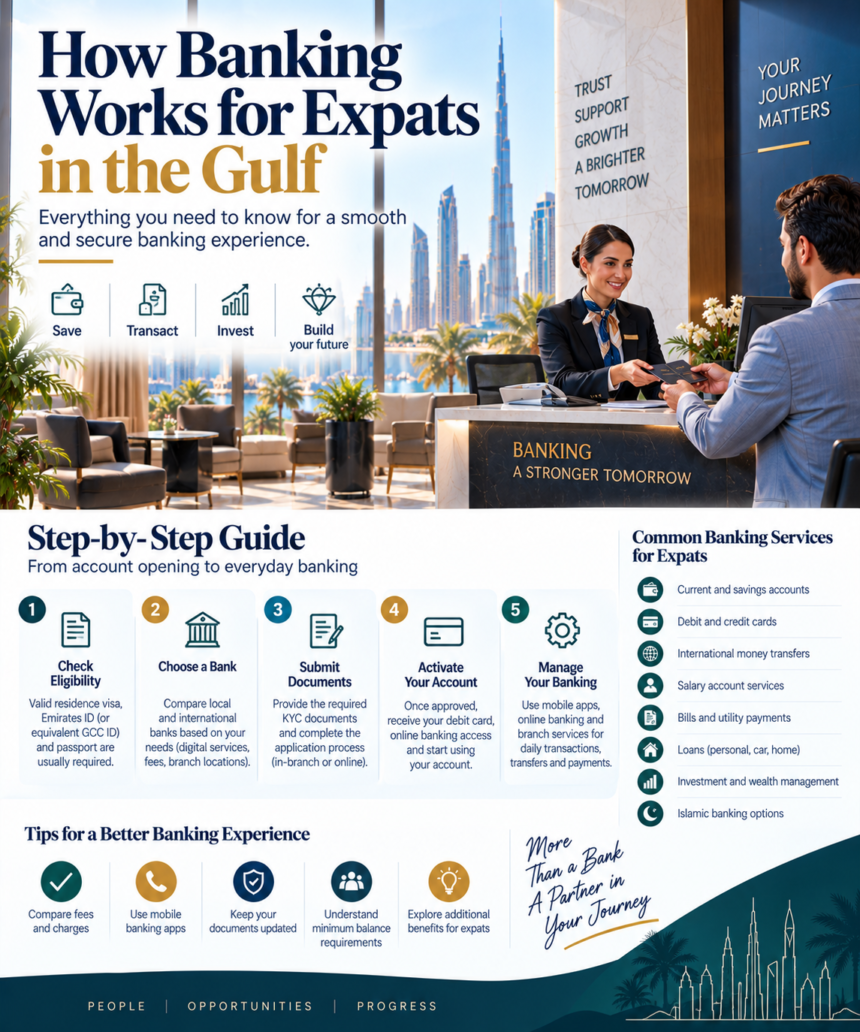
A typical process involves:
- Selecting a bank
- Completing an application
- Providing identification
- Providing residency information
- Declaring employment and income
- Completing Know Your Customer checks
- Receiving an account number or IBAN
- Activating mobile banking
- Receiving a debit card
The UAE’s official government platform notes that many banks offer online or app-based applications and digital identity verification. It also states that account approval can take from several hours to a few days depending on the institution.
Approval is not automatic.
Banks can decline applications because of incomplete information, financial-crime controls, compliance issues or their own risk policies.
The Central Bank of the UAE’s Consumer Protection Standards, for example, allow financial institutions to refuse an account for reasonable and justifiable grounds, including concerns relating to suspicious transactions.
New residents should therefore provide accurate information rather than trying to simplify or hide their employment or source of funds.
2. Documents Required for Bank Account Opening
Requirements vary, but expat residents commonly need some combination of:
- Passport
- Residence permit or visa
- National resident ID
- Local mobile number
- Local address
- Employment letter
- Salary certificate
- Source-of-income information
- Tax residency information
Self-employed individuals may need additional documents such as a trade licence, company registration information and evidence showing the nature of their business.
In the UAE, the official banking guidance specifically identifies Emirates ID, a valid UAE residence visa, passport, salary or employment documentation and, in some situations, proof of address. Self-employed customers may need company documents and a trade licence.
Saudi banking regulations require identification as well as customer information including nationality, occupation, contact details, source of income, expected account activity and the purpose for opening the account.
Banks may ask additional questions when large international transfers, investment income or business activity is expected.
This should not automatically be viewed as a problem.
Modern financial institutions are required to understand unusual or significant financial activity and may ask customers to provide supporting documents.
Keeping employment contracts, salary certificates and proof of major financial transactions can therefore be useful.
3. Current Accounts and Savings Accounts
The two most common personal bank accounts are current and savings accounts.
Current accounts are generally designed for everyday banking. They may include a debit card, salary deposits, transfers, bill payments and other transactional services.
Some banks may also offer cheque-book facilities, although eligibility can vary.
Savings accounts are generally intended for holding money and may offer returns or profit arrangements depending on whether the bank is conventional or Islamic.
Before selecting an account, check:
- Minimum salary requirement
- Minimum balance
- Monthly fees
- Debit card availability
- ATM fees
- International transfer fees
- Interest or profit arrangements
- Currency options
Do not automatically choose the account advertised as “premium.”
Premium accounts can provide advantages such as airport benefits, relationship managers or better banking services, but they can also require significantly higher salary transfers or account balances.
For many expats, a straightforward everyday account is sufficient.
4. Salary Accounts and Employer Transfers
Salary transfer is a major part of Gulf banking.
Many employers pay workers directly into local bank accounts.
In countries with formal wage-protection systems, salary payments may also be processed through regulated financial channels designed to provide greater transparency around wage payment.
A salary relationship can affect the banking products an expat receives.
Banks may provide additional benefits to customers who transfer their monthly salary, including:
- Reduced minimum-balance requirements
- Credit cards
- Personal finance
- Preferential account packages
- Higher transaction limits
This does not mean a customer should select a bank only because their employer uses it.
Compare the account carefully.
If your employer asks for an IBAN, ensure you provide the correct account information.
The UAE has required IBAN for electronic payments and receipts since 2012, apart from certain card transactions.
Kuwait also uses IBAN, with its system active since January 2011 to support more reliable domestic and cross-border transfers.
5. Debit Cards, Credit Cards and Digital Payments
Once an account is active, most expats receive a debit card.
Debit cards use money already available in the bank account. They are useful for everyday purchases, ATM withdrawals and online transactions.
Credit cards operate differently.
The bank provides a credit limit, and the customer later repays the amount used according to the card agreement.
Credit cards may offer:
- Cashback
- Airline miles
- Hotel benefits
- Lounge access
- Reward points
- Retail discounts
These benefits can be useful, but only if the card is managed responsibly.
Pay particular attention to:
- Annual fee
- Interest or profit charges
- Cash-advance fees
- Foreign currency fees
- Late-payment fees
- Minimum monthly payment
- Eligibility requirements
A card offering attractive airline miles can become expensive if the balance is carried for long periods.
Expats should also understand that a credit card is a borrowing product, not additional salary.
6. International Money Transfers and Remittances

Sending money internationally is an important part of financial life for millions of Gulf expatriates.
Workers may regularly transfer funds to India, Pakistan, Bangladesh, the Philippines, Egypt, Nepal, Europe, Africa or other destinations.
There are several ways to transfer money:
- Bank international transfers
- Licensed exchange houses
- Remittance companies
- Digital transfer platforms
- Banking apps
Do not compare only the advertised transfer fee.
The exchange rate can be equally important.
A transfer advertised as “zero fee” may still be more expensive if the currency conversion rate is less favourable.
Before sending significant amounts, compare:
Transfer fee + exchange rate + receiving-bank charges + delivery time.
Use only regulated providers.
The UAE’s official banking guidance confirms that licensed exchange houses may conduct domestic and international remittance operations under Central Bank regulation.
For large transfers, banks or exchange providers may ask about the source and purpose of funds.
Keeping documents for property sales, investments, bonuses or other large financial events can make this process easier.
7. Bank Fees and Minimum Balance Requirements
Bank accounts are not always free.
Common charges can include:
- Minimum balance fees
- International transfer charges
- Foreign ATM fees
- Card replacement charges
- Foreign currency conversion fees
- Cheque-related fees
- Early loan settlement charges
- Credit-card annual fees
The UAE Government specifically notes that many banks require customers to maintain a minimum monthly balance and that falling below the requirement can lead to a monthly fee.
The most important document is therefore not the advertisement. It is the bank’s current schedule of fees and terms.
Before opening an account, ask:
“What will this account cost me if my salary or balance changes?”
That question is particularly important for expats whose employment could change unexpectedly.
An account that is free while a large monthly salary is being transferred may become more expensive after the salary stops.
8. Personal Loans, Car Finance and Credit Facilities
Gulf banks offer various forms of consumer finance, including personal loans, vehicle finance and credit cards.
Eligibility generally depends on factors such as:
- Salary
- Employment
- Employer category
- Credit history
- Existing debts
- Residency
- Age
- Bank policy
Borrowing should be approached conservatively.
An expat may earn a strong salary but still face uncertainty if an employment contract ends or relocation becomes necessary.
Before borrowing, calculate the repayment under a difficult scenario.
Could you still meet the instalment if income stopped temporarily?
Also ask about:
- Early settlement
- Loan insurance
- Total financing cost
- Variable or fixed pricing
- Late-payment consequences
- Salary transfer requirements
Never sign a financing agreement based only on the monthly instalment shown by a salesperson.
The total cost matters.
9. Islamic Banking and Conventional Banking
The Gulf gives consumers access to both conventional and Islamic banking.
Islamic banking products are structured according to Sharia principles and avoid conventional interest-based structures.
Depending on the product, Islamic banks may use arrangements such as financing through sale, lease or profit-based structures.
Customers can find Islamic alternatives for:
- Current accounts
- Savings
- Credit cards
- Home finance
- Vehicle finance
- Personal finance
The practical user experience can look similar in some everyday areas, such as using a debit card or mobile banking, but the contractual structure differs.
Neither option should be chosen purely because of marketing.
Compare:
- Total financing cost
- Fees
- Account conditions
- Accessibility
- Digital banking
- Customer service
Customers specifically seeking Sharia-compliant finance should review the product documentation and the bank’s applicable Sharia governance information.
10. Digital Banking and Mobile Banking
Banking in the Gulf has become increasingly digital.
Many routine activities can now be completed from a phone, including:
- Opening certain accounts
- Transfers
- Bill payments
- Card management
- Updating information
- Freezing cards
- Viewing statements
- Sending international transfers
This is especially useful for expats who travel frequently.
When comparing banks, the quality of the mobile application deserves serious consideration.
A bank with an attractive branch network but a weak digital platform can become frustrating when most daily banking is performed online.
Check whether the app offers:
- Biometric login
- Instant card freezing
- International transfers
- Beneficiary management
- Digital statements
- Spending notifications
- Card controls
- Secure authentication
Keep your registered mobile number and email address updated because banks frequently use them for authentication and fraud alerts.
11. Banking Security and Fraud Prevention
Digital banking has improved convenience, but it also creates opportunities for fraud.
Never share:
- Online banking password
- Card PIN
- One-time password
- CVV security code
- Authentication codes
Be cautious when someone calls claiming to represent a bank and creates urgency around account suspension, identity verification or a supposed prize.
Use the bank’s official application or published telephone number to verify the request.
Do not click banking links sent through unexpected SMS, WhatsApp or email messages.
Another common risk involves allowing another person to use your bank account to receive or move money.
Even when the person is a friend, you may become responsible for explaining transactions passing through an account registered in your name.
Banks monitor financial activity under anti-money laundering rules, so unexplained transfers can create serious problems.
12. Banking When Changing Jobs or Leaving the Gulf
This is one of the most important financial issues for expatriates.
A bank account is often connected to residency and employment information.
When you change employers, update the bank if required.
Saudi banking rules provide a particularly clear example of the connection between residency and banking. SAMA’s current rules state that non-Saudi accounts can face restrictions after residency documentation expires, and expatriate accounts are to be closed upon final exit under the applicable rules.
Before permanently leaving any GCC country:
- Repay or settle loans
- Clear credit cards
- Cancel unnecessary standing orders
- Download bank statements
- Update contact details
- Transfer remaining money safely
- Ask whether the account can remain open
- Obtain clearance where appropriate
Do not simply leave the country and ignore outstanding banking obligations.
A small unpaid card balance or fee can become a much bigger problem later.
Banking for Expats in the UAE
The UAE has one of the region’s largest and most internationally oriented banking markets.
Residents can choose between local, international, conventional and Islamic banks.
The official UAE Government banking guide states that common documents for expatriate account opening include Emirates ID, a valid residence visa, passport, salary or employment documentation and sometimes proof of address.
Many accounts can now be opened partly or entirely through digital channels.
Customers should compare minimum-balance rules carefully because account charges can apply when balances fall below requirements.
The UAE also has a formal consumer-protection framework.
The Central Bank’s Consumer Protection Standards require institutions to explain account-opening requirements and disclose applicable fees.
For unresolved financial complaints, the UAE operates Sanadak, an independent banking and insurance ombudsman established under the Central Bank framework. The Central Bank directs consumers with complaints against licensed financial institutions or insurance companies to Sanadak.
Banking for Expats in Saudi Arabia
Saudi Arabia’s banking system is highly regulated through the Saudi Central Bank.
For most working expatriates, a valid Iqama is central to the banking relationship.
SAMA’s rules state that an expatriate holding a residence permit may open a bank account after the bank obtains the required Iqama and address information.
Banks also collect information about income, occupation, expected financial activity and the purpose of the account.
Keeping residency information current is particularly important because banking restrictions can apply when identity documents expire.
Saudi Arabia also provides an official SAMA complaint service through which individuals can file complaints against supervised banks, finance companies, payment companies and money changers.
For new expats, one of the simplest rules is to complete the Iqama process promptly and make sure the bank always has updated residency information.
Banking for Expats in Qatar
Qatar has a well-developed banking system regulated by Qatar Central Bank.
Expats can access conventional and Islamic banking products, with account eligibility depending on the institution’s identification, residency, employment and KYC requirements.
When comparing accounts, residents should examine salary requirements, transfer charges and access to international banking services.
Consumer protection is formally overseen by Qatar Central Bank.
QCB’s Customer Protection Department states that it is responsible for protecting financial customers’ rights, promoting transparent treatment and receiving complaints and feedback relating to financial institutions.
Qatari law also requires financial institutions to provide customers with clear information about financial services and prohibits misleading promotion of financial products.
This makes the written terms particularly important when taking credit cards, loans or other financial products.
Banking for Expats in Bahrain
Bahrain is one of the Gulf’s long-established financial centres and offers both conventional and Islamic banking.
The Central Bank of Bahrain’s rules recognise that some foreign workers may need to open accounts while their formal Bahraini residency documents are still being processed. Under specified circumstances, financial institutions are expected to allow account opening for a non-resident who intends to take employment or conduct business in Bahrain unless there are serious reasons for refusing, such as identification or compliance concerns.
The exact account requirements still depend on the bank and customer.
Bahrain also provides a formal financial consumer complaint system.
The Central Bank of Bahrain advises customers to complain first to the financial institution. Banks or financial institutions are expected to acknowledge the complaint and provide a written response within the regulatory process, after which unresolved matters can be escalated to the CBB.
Banking for Expats in Oman
Oman offers local, Islamic and international banking services under the supervision of the Central Bank of Oman.
As elsewhere in the GCC, expatriate customers should expect identity verification and KYC checks when establishing a banking relationship.
Account options can include salary accounts, savings accounts, cards and different forms of personal finance.
New residents should compare digital banking carefully, particularly if they expect to send frequent international remittances.
The Central Bank of Oman also provides an official channel for complaints relating to banking and financial institutions. Customers are generally expected to approach their financial institution first and can escalate unresolved matters through CBO’s customer complaint process.
Banking for Expats in Kuwait
Kuwait has an established conventional and Islamic banking sector regulated by the Central Bank of Kuwait.
Banks are required to identify customers and actual beneficiaries before establishing banking relationships, reflecting standard KYC and financial-crime controls.
Kuwait also uses IBAN for bank transfers, with the national IBAN system operating since January 2011.
Consumers have access to a formal complaints framework. Current Central Bank guidance states that customers should first raise a complaint with their bank, with further complaint or appeal channels available through CBK’s Consumer Protection system when relevant conditions are met.
Expats should keep residency and contact details current with their bank, particularly when changing employment or preparing to leave Kuwait.
Choosing the Right Bank as an Expat
The best bank is not necessarily the largest bank or the one offering the biggest welcome bonus.
Compare what you will actually use.
| Priority | Feature to compare |
|---|---|
| Salary banking | Minimum salary and account fees |
| Sending money home | Exchange rate and transfer fees |
| Frequent travel | International card charges |
| Digital banking | App quality and security |
| Cash use | ATM network |
| Borrowing | Total finance cost |
| Saving | Interest or profit arrangements |
| Islamic banking | Sharia-compliant product structure |
| Family banking | Additional accounts and cards |
| International mobility | Overseas support and transfer services |
A professional transferring money abroad every month may prioritise remittance pricing.
Someone who travels constantly may care more about foreign transaction fees.
A family planning to buy a car or home may place greater value on financing options.
Choose according to your actual financial behaviour.
Managing Credit and Debt in the Gulf
Easy access to credit can create problems if spending grows along with salary.
New expats sometimes increase their lifestyle quickly because they receive a higher salary than in their home country.
Rent, cars, travel, dining and credit cards can then consume much of that income.
A safer approach is to establish an emergency fund before taking on major debt.
Try to maintain enough accessible savings to cover an unexpected period without income.
Before borrowing, understand:
- Monthly repayment
- Total amount repayable
- Early-settlement rules
- Insurance
- Late charges
- What happens if employment ends
Do not treat your expected end-of-service payment as a guaranteed future debt repayment strategy.
Employment circumstances and personal plans can change.
Banking Complaints and Consumer Protection
Each GCC country has its own banking regulator and consumer complaint structure.
The typical process is to first contact the bank directly.
If the issue cannot be resolved, customers may have an escalation route through the relevant regulator or dispute-resolution body.
Examples include Sanadak in the UAE, SAMA’s financial institution complaint service in Saudi Arabia, Qatar Central Bank’s Customer Protection Department, the Central Bank of Bahrain’s consumer complaint procedure, the Central Bank of Oman’s complaints service and the Central Bank of Kuwait’s Consumer Protection system.
Keep copies of:
- Statements
- Emails
- Contracts
- Complaint reference numbers
- Transaction records
- Bank responses
Clear documentation makes complaints considerably easier to investigate.
Common Banking Mistakes Gulf Expats Should Avoid
Choosing a bank only because the employer recommended it
Compare other options as well.
Ignoring account fees
Minimum-balance charges can become expensive over time.
Using a credit card as additional income
Credit must eventually be repaid.
Sending money without comparing exchange rates
A poor currency rate can cost more than the transfer fee.
Sharing authentication codes
Banks should not need you to reveal confidential one-time passwords to an unexpected caller.
Ignoring residency expiry
Keep identification current with your financial institution.
Taking a large loan immediately after relocating
Understand your real monthly expenses first.
Leaving the Gulf without settling banking obligations
Clear accounts, cards and financing before permanent departure.
Failing to update phone numbers
Old contact information can create security and authentication problems.
Practical Expat Banking Checklist
After relocating to the Gulf:
- Obtain local residency identification
- Compare several regulated banks
- Check account fees and minimum balances
- Open an appropriate current or salary account
- Activate digital banking securely
- Confirm the correct IBAN or account information
- Compare remittance costs
- Keep your salary and employment details updated
- Build emergency savings
- Use credit conservatively
- Review bank statements regularly
- Keep your phone number and address updated
- Store banking documents securely
- Know the official complaint channel
- Settle debts before permanent relocation
Final Thoughts on Banking for Gulf Expats
Understanding banking in the GCC becomes much easier once you recognise that most everyday services follow the same basic principles.
You establish legal residency, prove your identity, explain your employment and source of income, open an appropriate account and then use that relationship to manage salary, payments, savings and transfers.
The differences appear in the details.
The UAE offers extensive digital and international banking options, with official government guidance identifying Emirates ID, residency and employment documentation among common requirements.
Saudi Arabia places strong emphasis on the Iqama and updated residency information for expatriate banking relationships.
Qatar, Bahrain, Oman and Kuwait each maintain their own central-bank regulation and financial consumer protection systems, meaning banking conditions should always be checked locally rather than assuming GCC-wide rules are identical.
For expats, the smartest banking strategy is usually simple.
Choose an account with realistic fees. Keep identification current. Compare exchange rates before sending money overseas. Borrow conservatively. Protect online banking information and maintain enough emergency savings to deal with a change in employment.
Most importantly, read the product terms before signing.
A Gulf banking relationship can remain straightforward for many years when the account matches your income and lifestyle. Problems are more likely when customers misunderstand fees, rely excessively on debt or fail to update the bank when their residency or employment changes.
Learning How Banking Works for Expats in the Gulf before opening accounts or accepting credit can therefore save money, reduce financial stress and make everyday life across the GCC considerably easier.
Do follow us on Instagram
Read More – 6 Best Gulf Countries for International Students in 2026: Essential Study Guide