


What Eid Means Across the Arabian Gulf
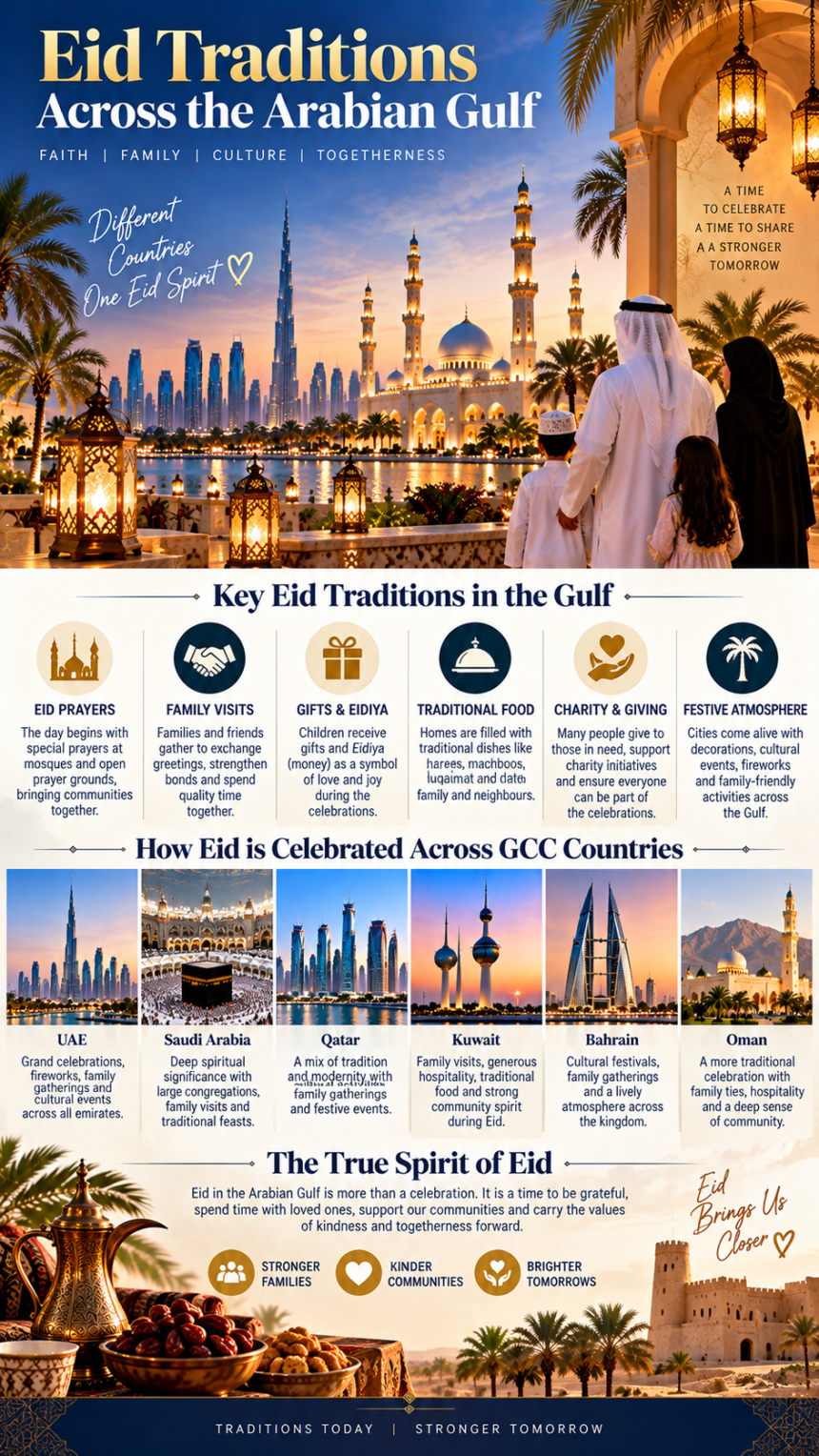
Eid is one of the most important times of the year across the UAE, Saudi Arabia, Qatar, Bahrain, Oman and Kuwait. Cities may look more modern than ever, but many of the customs surrounding Eid remain centred on traditions that have passed between generations.
- What Eid Means Across the Arabian Gulf
- Eid Al-Fitr and Eid Al-Adha: What Is the Difference?
- Eid Morning Begins With Prayer
- Wearing New and Traditional Clothes for Eid
- Family Visits Are at the Heart of Eid
- Why Children Look Forward to Eidiya
- Food and Hospitality During Gulf Eid Celebrations
- Arabic Coffee, Dates, Oud and Bukhoor
- Eid Traditions in the UAE
- Eid Traditions in Saudi Arabia
- Eid Traditions in Qatar
- Eid Traditions in Bahrain
- Eid Traditions in Oman
- Eid Traditions in Kuwait
- How Eid Al-Adha Traditions Differ
- Traditional Music and Public Celebrations
- How Modern Gulf Cities Celebrate Eid Today
- What Visitors Should Know During Eid
- Common Eid Greetings Across the Gulf
- Eid Traditions Across the Arabian Gulf at a Glance
- Final Thoughts on Eid Traditions Across the Arabian Gulf
Eid Traditions Across the Arabian Gulf bring together religion, family, hospitality, traditional clothing, special meals and generosity. The first morning often begins with Eid prayer before families visit parents, grandparents and relatives. Homes fill with Arabic coffee, dates, incense and food, while children wait excitedly for Eidiya, the money or gifts traditionally given to them during the celebration.
Although the six GCC countries share many customs, each has its own character. Qatar emphasises majlis gatherings and Eidiya, Bahrain preserves children’s traditions such as Heya Beya around Eid Al-Adha, Oman combines family greetings with distinctive food and community festivities, and Saudi Arabia celebrates through regional dishes and traditions that vary across the Kingdom.
The result is a celebration that feels recognisably Gulf-wide while remaining deeply local.
What Eid Means Across the Arabian Gulf
Muslims celebrate two main Eids each year: Eid Al-Fitr and Eid Al-Adha.
Both are religious occasions, but they are also among the Gulf’s biggest periods for family reunions. People travel between cities, relatives open their homes to visitors, children receive gifts and communities gather for prayer, meals and celebrations.
The majlis plays an important role in this social culture. In Gulf homes, a majlis provides a space where relatives, neighbours and guests can sit together, exchange greetings and share refreshments. Qatar Tourism describes the majlis as a traditional gathering place built around hospitality and social connection, while Abu Dhabi’s cultural guide highlights gahwa, or Arabic coffee, as a central part of welcoming guests.
Modern Eid celebrations may include fireworks, concerts and shopping events, but family connection remains at the centre.
Eid Al-Fitr and Eid Al-Adha: What Is the Difference?
Eid Al-Fitr arrives immediately after Ramadan and celebrates the completion of the month of fasting. It begins on the first day of Shawwal in the Islamic lunar calendar.
The day combines prayer, gratitude, charity and celebration. In Saudi Arabia, official tourism guidance highlights Zakat Al-Fitr, Eid prayer, family meals, children’s Eidiya, new clothing and sweets among the traditions associated with the occasion.
Eid Al-Adha takes place later in the Islamic year during the Hajj period. It is associated with the story of Prophet Ibrahim and the values of faith, sacrifice and generosity. Those performing the sacrifice distribute meat among family members, friends and people in need.
Qatar Tourism describes Eid Al-Adha as a time when families gather for prayer and a shared feast while extending generosity to neighbours, friends and those in need.
Many social traditions, including visiting family and giving Eidiya, appear during both celebrations.
Eid Morning Begins With Prayer
Eid morning starts early.
People bathe, dress carefully and prepare for the special Eid prayer, which is performed in mosques or designated prayer grounds. Afterwards, worshippers exchange congratulations before returning home or beginning visits to relatives.
Qatar Tourism describes early-morning Eid prayers as the traditional start of the celebration, followed by family greetings, breakfast and visits.
Oman follows the same broad rhythm. Oman News Agency records communities gathering for Eid prayers before exchanging congratulations and visiting relatives, reflecting the importance of family connections during the holiday.
This early start gives Eid mornings a distinctive atmosphere. Streets around mosques fill with people wearing their best clothes, while families begin preparing to welcome guests.
Wearing New and Traditional Clothes for Eid
Clothing is an important part of Eid throughout the Gulf.
Many people prepare new outfits before the holiday. Men may wear freshly tailored thobes, kanduras or dishdashas, depending on the country, while women often choose elegant dresses, abayas or traditional garments.
Qatar Tourism notes that men commonly prepare new thobes and women wear beautiful dresses and kaftans for Eid.
Henna is another festive tradition in parts of the Gulf. Abu Dhabi’s cultural guide describes henna as a centuries-old practice commonly used by women before Eid, weddings and other major occasions.
Perfumes, oud and bukhoor also become part of preparing for the day. Dressing well is not simply about fashion. It reflects the idea of making Eid feel different from an ordinary day.
Family Visits Are at the Heart of Eid
After prayer, many families begin visiting relatives.
Older family members often receive some of the earliest visits, reinforcing respect for parents and grandparents. Brothers, sisters, cousins, neighbours and close friends may then visit throughout the following days.
In Kuwait, official cultural information describes strong ties between family members, neighbours and friends as a defining feature of local social life and notes that religious holidays are shared collectively.
In Qatar, Eid is similarly described as a time for meeting family and friends, sharing food and strengthening community relationships.
A single family may therefore move between several homes in one day, or remain at a senior relative’s home while a continuous stream of visitors arrives.
Why Children Look Forward to Eidiya
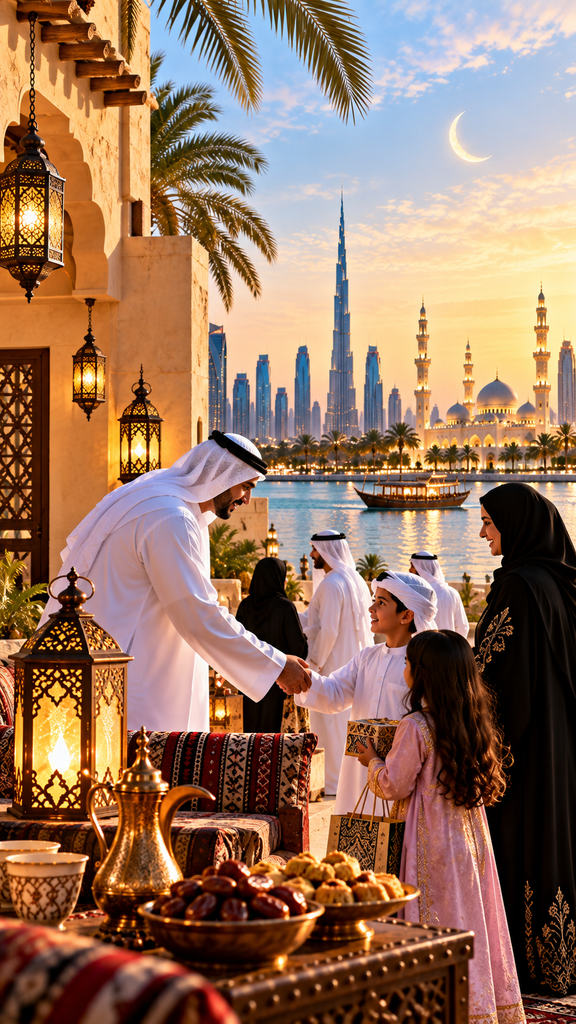
For many Gulf children, one tradition stands above almost everything else: Eidiya.
Eidiya is money given to children by parents, grandparents and other relatives during Eid. Some families place the cash in decorated envelopes or combine it with small gifts.
The custom remains widespread across the GCC. Qatar’s official cultural guide specifically identifies Eidiya as one of its core Eid traditions, while Saudi Arabia’s tourism authority notes that children may receive money, clothing or toys.
In Emirati culture, Eidiya is associated with generosity, joy and family togetherness, and modern celebrations increasingly feature decorative Eidiya packaging alongside the traditional cash gift.
Children may spend the day moving between relatives knowing that every visit could bring another envelope.
Food and Hospitality During Gulf Eid Celebrations
Food gives every Gulf Eid its own regional character.
Large family meals are common, but the dishes on the table can vary substantially between Riyadh, Jeddah, Doha, Muscat, Manama, Kuwait City and the different emirates of the UAE.
Saudi Arabia’s tourism authority highlights dishes such as mugalgal and jareesh alongside Eid sweets as part of Saudi celebrations.
Oman’s culinary heritage includes shuwa, meat slow-roasted with spices, as well as qabooli, harees and other substantial family dishes. Omani hospitality traditionally combines these meals with coffee, dates and halwa.
Food also functions as hospitality. Visitors may be offered refreshments almost immediately after entering a home, even when they are only making a short Eid greeting visit.
Arabic Coffee, Dates, Oud and Bukhoor
Some of the most memorable Eid traditions are experienced through scent and taste.
Arabic coffee is served from a dallah into small cups and frequently accompanied by dates or sweets. Abu Dhabi’s cultural authority describes gahwa and the majlis as deeply established parts of Emirati hospitality.
Oman has its own distinctive hospitality tradition combining cardamom-flavoured coffee with Omani halwa, a sweet prepared with ingredients including sugar, saffron, nuts and rosewater.
Fragrance is equally important. Qatar Tourism describes bukhoor as particularly significant during Eid Al-Fitr and Eid Al-Adha, when fragrant wood or incense is burned in homes and offered to guests so they can scent their clothing and hair.
These small rituals help give Gulf homes their distinctive Eid atmosphere.
Eid Traditions in the UAE
Eid in the UAE mixes family traditions with large-scale modern celebrations.
Morning prayer comes first, followed by visits, meals and gatherings. The majlis becomes an important space for receiving guests, with gahwa and dates commonly offered as part of Emirati hospitality.
Children receive Eidiya, while women may prepare henna and families wear new or carefully selected clothing. Heritage performances also become more visible during public Eid events. Experience Abu Dhabi notes that traditional Al-Ayyala troupes frequently perform around the city during Eid celebrations.
Outside the home, major destinations organise fireworks, family entertainment, cultural programmes and special dining experiences. The UAE government describes both Eid Al-Fitr and Eid Al-Adha as occasions celebrated enthusiastically, with decorated public areas and special events.
The public holiday provides time for both traditional family visits and modern staycations or entertainment.
Eid Traditions in Saudi Arabia
Saudi Arabia’s regional diversity gives Eid celebrations considerable variety.
The broad pattern begins with prayer, charity and family gatherings. People wear their finest clothes, children receive Eidiya and households prepare large meals and sweets.
Visit Saudi notes that Eid Al-Fitr begins with special prayers and Zakat Al-Fitr before families celebrate with dishes including regional foods and sweets. Women may decorate their hands with henna, while children receive gifts, clothes or money.
Cities such as Riyadh and Jeddah now add street markets, lights and public events to the holiday atmosphere. Historic Jeddah provides a particularly strong cultural setting where modern Eid activity meets the architecture and traditions of Al Balad.
Yet Eid remains strongly family-oriented even as the public entertainment programme expands.
Eid Traditions in Qatar
Qatar has one of the clearest documented sets of Gulf Eid customs.
The morning begins with prayer before families return home for breakfast and begin visiting relatives. Everyone wears special clothing and exchanges greetings such as “Eid Mubarak.”
Children move between relatives and neighbours collecting Eidiya, while meals and gifts are shared throughout the celebration.
Traditional hospitality adds Arabic coffee, dates, oud and bukhoor to household gatherings. Bukhoor takes on particular importance during major celebrations, including both Eids.
Modern Qatar adds another layer through cultural programmes, markets and family entertainment. Visit Qatar’s 2026 Eid Al-Fitr programme, for example, combined festive markets, cultural showcases and live family entertainment with traditional gatherings.
This combination of home-based traditions and public celebrations is increasingly typical across the Gulf.
Eid Traditions in Bahrain
Bahrain preserves several distinctive customs alongside the wider Gulf traditions of prayer, family and hospitality.
One unusual element appears just before Eid Al-Adha. The traditional children’s celebration known as Heya Beya takes place around Arafah Day. Children nurture small plants before wearing traditional clothes, carrying the plants towards the shore and singing traditional verses before placing them into the sea. Bahrain’s Culture Authority identifies Heya Beya as an old tradition passed between generations and closely connected with Eid Al-Adha.
The custom continues to be revived through modern cultural programmes. Bahrain Tourism included Heya Beya activities in its 2026 Eid Al-Adha programme at Marassi.
Bahrain also preserves its ceremonial cannon tradition. Once the Eid crescent confirming the end of Ramadan is sighted, cannon shots help mark the transition from Ramadan into Eid Al-Fitr.
Family meals, greetings and public cultural performances then continue throughout the holiday.
Eid Traditions in Oman
Eid in Oman retains a particularly strong connection to village and family traditions.
Prayer begins the first day before people exchange congratulations and visit relatives. Community ties remain highly visible, and public festivities frequently include traditional arts, children’s competitions, horseback riding and family activities. Oman News Agency recorded such Eid events continuing across several North Al Batinah wilayats in 2025.
Traditional markets also form part of preparations in various regions. Pre-Eid gatherings known as Habta or Habtan have historically brought communities together to buy food, livestock and other supplies for the holiday.
At home, hospitality may involve Omani coffee, dates and halwa, while larger family meals can include some of the country’s best-known dishes such as shuwa. Experience Oman describes coffee and halwa as central symbols of Omani hospitality.
The result is an Eid atmosphere where household traditions and community celebration remain closely linked.
Eid Traditions in Kuwait
Family connection is equally important in Kuwait.
Official cultural information describes Kuwaiti society as one where relatives, friends and neighbours maintain close ties and celebrate important occasions together. Eid Al-Fitr is traditionally celebrated over several days, while Eid Al-Adha extends the festive period further.
On Eid morning, prayer is followed by visits and congratulations. Homes receive guests throughout the day, and younger relatives commonly receive Eidiya.
Food, sweets, coffee and perfumes contribute to the festive atmosphere, while modern Kuwait adds shopping, dining and public entertainment to the holiday period.
The strong culture of visiting matters particularly because Eid creates an opportunity to reconnect with relatives people may not see regularly throughout the year.
How Eid Al-Adha Traditions Differ
Eid Al-Fitr and Eid Al-Adha share prayer, family visits, clothing, meals and gifts, but Eid Al-Adha has an additional focus on sacrifice and distribution.
For Muslims performing the sacrifice, meat is shared with family, friends and people in need. Qatar Tourism highlights generosity and shared feasts as central features of Eid Al-Adha.
The festival also comes during Hajj, making Saudi Arabia particularly important at this time.
Bahrain’s Heya Beya provides one of the Gulf’s most visually distinctive pre-Eid Al-Adha customs, while in Oman larger family meals and traditional dishes can take on a particularly prominent role.
The principle connecting these customs is generosity. Celebration is intended to extend beyond the immediate household.
Traditional Music and Public Celebrations
Eid does not remain entirely inside homes.
Traditional music and performances continue to play a visible role in public celebrations. Abu Dhabi frequently stages Al-Ayyala, where rows of performers move rhythmically to drums and chanted poetry.
Bahrain’s modern Eid programmes combine traditional Bahraini performances with contemporary family entertainment. During Eid Al-Adha 2026, tourism programmes included cultural performances, traditional hospitality and children’s activities.
Oman similarly organises public Eid events featuring folk arts, competitions and family programmes.
These events give visitors a way to encounter local traditions even when they are not celebrating inside a private family home.
How Modern Gulf Cities Celebrate Eid Today
Eid traditions are not disappearing as Gulf cities modernise. Instead, many have been incorporated into new forms of celebration.
Shopping centres may host traditional performers beside international entertainment. Hotels serve elaborate Eid brunches while families continue visiting grandparents at home. Children may receive Eidiya through beautifully designed envelopes while the basic idea remains unchanged.
Qatar’s current tourism programming combines cultural celebrations with live entertainment and family events, while Abu Dhabi promotes Eid around both traditional togetherness and contemporary attractions.
The same pattern appears across the GCC: tradition remains the foundation, while the setting evolves.
What Visitors Should Know During Eid
Travelling during Eid can be rewarding, but visitors should expect a different rhythm.
The first morning can be quiet commercially because families attend prayers and spend time together. Later, malls, entertainment districts and restaurants may become extremely busy.
Public holidays also create heavy regional travel. Airports and highways can be crowded as residents visit family or take short holidays.
Islamic holiday dates depend on the Hijri calendar and official moon sightings. The UAE government, for example, confirms that dates for Eid Al-Fitr and Eid Al-Adha are determined according to the Islamic calendar and moon sighting.
Book popular restaurants and hotels ahead, particularly if Eid falls around a weekend.
Visitors should dress respectfully around religious spaces, avoid interrupting prayer gatherings and remember that a family celebration can be culturally significant even when the surrounding city feels like a large entertainment festival.
Common Eid Greetings Across the Gulf
The easiest greeting for visitors is Eid Mubarak, meaning “Blessed Eid” or commonly understood as “Happy Eid.”
Another phrase heard around the Gulf is Eid Saeed, meaning “Happy Eid.”
People may also say Kul ‘am wa enta bi-khair, expressing a wish for continued wellbeing each year, or Taqabbala Allahu minna wa minkum, a religious greeting asking that good deeds and worship be accepted.
Visit Qatar lists all of these among commonly used Eid greetings.
Visitors do not need to memorise several phrases. A warm “Eid Mubarak” is appropriate in almost any social setting.
Eid Traditions Across the Arabian Gulf at a Glance
| Tradition | Where It Is Common |
|---|---|
| Morning Eid prayer | All GCC countries |
| Family and elder visits | All GCC countries |
| Eidiya for children | UAE, Saudi Arabia, Qatar, Bahrain, Oman, Kuwait |
| New traditional clothing | Throughout the Gulf |
| Arabic coffee and dates | Throughout the Gulf |
| Oud and bukhoor | Especially visible in home hospitality |
| Henna before Eid | UAE, Saudi Arabia and elsewhere |
| Large family feasts | All GCC countries |
| Al-Ayyala performances | UAE |
| Heya Beya | Bahrain |
| Habta markets | Oman |
| Regional Saudi Eid dishes | Saudi Arabia |
| Public cultural events | All major GCC cities |
The details differ between families, regions and generations. There is no single household routine that represents every Gulf resident, but the broader themes of faith, generosity and family are remarkably consistent.
Final Thoughts on Eid Traditions Across the Arabian Gulf
Eid Traditions Across the Arabian Gulf show how strongly family and hospitality continue to shape Gulf culture.
In the UAE, Eid combines morning prayer, Eidiya, majlis hospitality and heritage performances with modern city celebrations. Saudi Arabia brings regional food, henna, family feasts and children’s gifts together with the religious significance of a country that is home to Makkah and Madinah.
Qatar preserves a particularly recognisable combination of Eid prayer, traditional clothing, family visits, Eidiya, bukhoor and generous hospitality. Bahrain adds distinctive heritage customs such as Heya Beya before Eid Al-Adha.
In Oman, Eid remains closely connected to community gatherings, traditional hospitality and public folk celebrations, while Kuwait places strong emphasis on visits between families, friends and neighbours.
Some customs have changed in appearance. Eidiya may come in elaborate modern packaging, traditional performances may happen inside shopping centres and families may spend part of the holiday at resorts rather than remaining home for several days.
Yet the purpose has changed far less.
Across the Gulf, Eid remains a time to pray together, dress for the occasion, visit loved ones, welcome guests, give generously and make children feel that these are some of the most special days of the year.
Do follow us on Instagram
Read More – Ramadan in GCC Countries: 15 Essential Daily Life Changes