


Common Wedding Traditions Shared Across the GCC
Weddings across the Arabian Gulf can bring together hundreds of guests, beautifully embroidered clothing, henna, Arabic coffee, traditional music, large family meals and ceremonies that continue late into the night. Behind the scale and glamour, however, the most important element is usually much simpler: the joining of two families.
- What Makes Gulf Weddings Unique?
- Wedding Traditions Across GCC Countries at a Glance
- Family Plays a Central Role in Gulf Weddings
- The Marriage Proposal and Engagement
- Mahr, Gifts and Bridal Preparations
- Why Henna Night Is So Important
- Traditional Gulf Wedding Clothing
- Music, Dance and Wedding Processions
- Food and Hospitality at Gulf Weddings
- Wedding Traditions in the UAE
- Wedding Traditions in Saudi Arabia
- Wedding Traditions in Qatar
- Wedding Traditions in Bahrain
- Wedding Traditions in Oman
- Wedding Traditions in Kuwait
- Men’s and Women’s Wedding Celebrations
- How Modern Gulf Weddings Are Changing
- What Guests Should Know Before Attending a Gulf Wedding
- Common Wedding Traditions Shared Across the GCC
- Final Thoughts on Wedding Traditions Across GCC Countries
Wedding Traditions Across GCC Countries share many similarities across the UAE, Saudi Arabia, Qatar, Bahrain, Oman and Kuwait. Family approval, the marriage contract, mahr, gifts, henna celebrations and generous hospitality remain important in many communities, even as modern couples increasingly choose hotels, purpose-built wedding halls and contemporary bridal fashion.
Traditional practices have also evolved rather than disappearing. The UAE’s official cultural information notes that weddings once relied heavily on neighbourhood participation and folk celebrations but today commonly take place in hotels and specialised halls. Kuwait’s government similarly describes modern wedding traditions as a combination of older customs and contemporary lifestyles.
There is no single “Gulf wedding.” Customs differ between regions, tribes, families, religious communities and generations. A wedding in Dhofar may look very different from one in Muscat, while traditions in Jeddah may differ from Riyadh or other parts of Saudi Arabia. The customs below should therefore be understood as commonly documented traditions rather than rules followed by every couple.
What Makes Gulf Weddings Unique?
A Gulf wedding is often much bigger than the bride and groom.
Parents, grandparents, siblings, aunts, uncles and extended relatives can play important roles throughout the process. Traditionally, neighbours also helped with preparations, cooking, furniture, jewellery and entertainment.
Kuwait’s official heritage information offers a particularly clear example. It records how relatives and neighbours historically helped prepare weddings by lending jewellery, providing carpets or household items, preparing food and even helping pay musicians.
Similar ideas of community support appear elsewhere in the region. A 2026 recreation of a traditional Omani wedding at Suhar Festival highlighted how older weddings could unfold over several days and depended heavily on cooperation between relatives and the wider community.
Modern weddings may use professional planners rather than neighbours, but family involvement remains central.
Wedding Traditions Across GCC Countries at a Glance
| Tradition | Common Role in Gulf Weddings |
|---|---|
| Family proposal | Formalises the relationship between families |
| Mahr | Financial gift or agreed marriage payment for the bride |
| Engagement gathering | Celebrates agreement between families |
| Henna night | Pre-wedding women’s celebration |
| Traditional clothing | Connects the wedding with national or regional heritage |
| Gold and jewellery | Common bridal gift or adornment |
| Arabic coffee | Symbol of hospitality |
| Bukhoor and perfume | Used to fragrance homes, clothing and celebrations |
| Traditional music | Celebrates the couple and community |
| Wedding feast | Welcomes extended family and guests |
| Men’s gathering | Common in many traditional families |
| Women’s celebration | Often includes music, dancing and bridal entrance |
| Wedding procession | Appears in several historic Gulf traditions |
| Bridal gifts | Clothing, perfume, jewellery and household items |
| Family visits | Continue before and after the main wedding |
The details and names change from one country to another, but family honour, generosity and hospitality repeatedly appear at the centre.
Family Plays a Central Role in Gulf Weddings
Marriage has traditionally connected families as well as individuals.
In older Gulf communities, parents and senior relatives frequently participated directly in identifying suitable partners and discussing arrangements. Modern couples generally have much more personal involvement in choosing partners, but formal family meetings remain significant in many households.
Kuwait’s official history notes that family selection and matchmakers once played major roles, whereas social changes, university education and workplaces later created more opportunities for couples to meet independently. Family approval and formal proposal customs nevertheless remain important.
Traditional Omani accounts show a similar family structure. The groom’s family may formally visit the bride’s household, after which issues including the marriage arrangements and mahr are discussed.
The process is therefore often designed to build trust between two households before the large public celebration begins.
The Marriage Proposal and Engagement
The proposal is often more formal than the private proposal style common in some other parts of the world.
A groom or his family may approach the bride’s father or senior family members. Once both sides agree, families discuss the next steps, which can include the marriage contract, mahr, gifts and wedding timing.
In older Kuwaiti custom, a matchmaker could connect families before formal meetings took place. Today, the government describes the process as blending old and new practices, with the prospective groom formally requesting the woman’s hand from her father or another senior guardian before financial arrangements are discussed.
Omani traditions likewise place importance on a formal family visit. Accounts from Dhofar describe the groom arriving with his father and relatives before discussions begin about the marriage and its arrangements.
Engagement gatherings can then become the first major celebration before the wedding itself.
Mahr, Gifts and Bridal Preparations
Mahr is an important element in Muslim marriage. It is an agreed gift or financial obligation given to the bride as part of the marriage.
Beyond mahr, Gulf traditions may include additional gifts such as jewellery, clothing, perfume, textiles or household items.
Qatari heritage records distinguish between mahr and Al-Dazza, a traditional collection of wedding items sent by the groom’s side to the bride’s family. The Qatar Ministry of Culture’s research describes Al-Dazza as historically including clothing, gold, perfume and household provisions, although some older forms of the custom have become less common.
Kuwait also preserves the term Daza in its historical wedding record. Government heritage information describes traditional Daza gifts as including valuable garments, cloth, bedding and other items presented before marriage.
In modern weddings, the form may be different, but bridal jewellery, perfumes and carefully prepared gifts remain prominent in many families.
Why Henna Night Is So Important
Henna is one of the most recognisable wedding traditions across the Gulf.
The celebration usually takes place before the main wedding and centres on the bride, female relatives and friends. Her hands and sometimes feet are decorated with intricate designs while women gather for music, food and celebration.
In the UAE, Experience Abu Dhabi describes the bride’s henna night as one of the major evenings associated with an Emirati wedding. Henna remains strongly connected with weddings, Eid and other celebrations.
Saudi Arabia has a closely documented tradition known as Henna Night or Al-Ghamrah in some regions. Saudipedia says women from the bride and groom’s families traditionally gather while a specialist henna artist decorates the bride, accompanied by songs and celebratory chants.
Omani henna also remains strongly connected with marriage. A 2025 account notes that henna night continues to be one of the country’s important pre-wedding traditions and that close relatives may join the bride in applying henna.
The tradition is therefore not simply decorative. It marks the transition into the wedding celebration itself.
Traditional Gulf Wedding Clothing
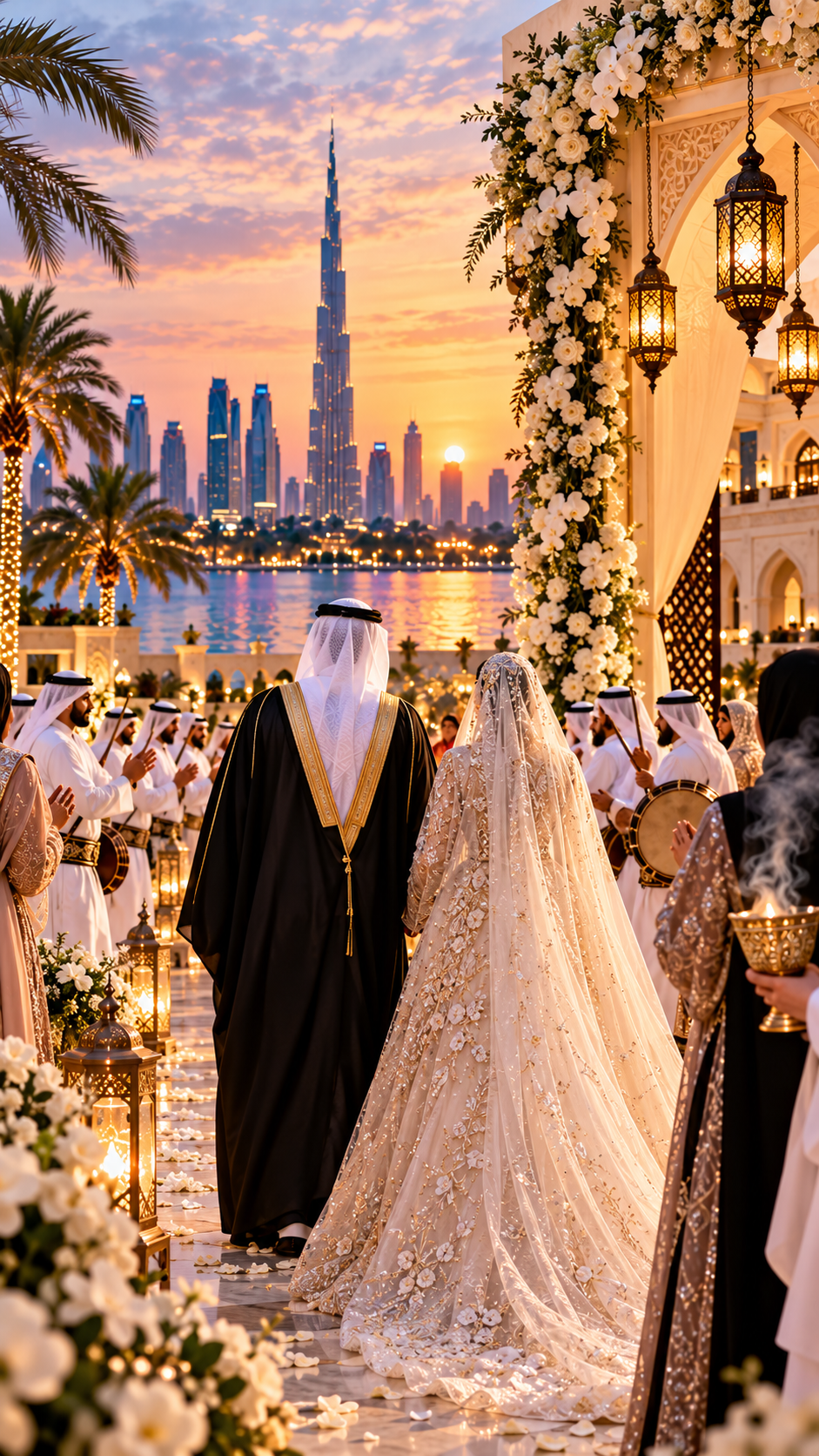
Modern white bridal gowns are common throughout the GCC, particularly at large hotel weddings, but traditional clothing continues to play an important role during henna nights, family ceremonies or heritage-focused celebrations.
Qatar’s Ministry of Culture documents the Thobe Al-Nashil, a wide silk garment decorated with gold or silver thread that women wear on important occasions including weddings and henna nights.
In Oman, regional wedding clothing varies considerably. Omani heritage dress can feature elaborate embroidery, jewellery and distinctive garments associated with individual regions. The Ministry of Information notes that traditional silver and jewellery crafts have long been closely connected with weddings and women’s ceremonial adornment.
Grooms across the Gulf commonly wear national dress, sometimes adding a bisht, the formal cloak worn over a thobe, kandura or dishdasha for important occasions.
Modern weddings frequently move between both worlds: traditional clothing at one celebration and international-style formalwear at another.
Music, Dance and Wedding Processions
Music makes Gulf wedding traditions especially distinctive because individual countries retain their own performance styles.
In the UAE, Al-Ayyala is performed at weddings, festivals and national celebrations. Two rows of men move in rhythm while holding bamboo canes as drums and poetry accompany the performance. Al-Razfa is another festive form associated with weddings.
Qatar preserves Al-Ashouri, an older celebratory art historically associated with wedding processions. The Ministry of Culture describes women performing it as the bride moved slowly towards the groom’s house, accompanied by poetry, tambourines and drums.
Bahraini heritage includes Al-Dazza, described by the Bahrain Authority for Culture and Antiquities as a ceremonial procession involving the groom and his family travelling towards the bride’s home. Other wedding-related performances include Al-Khemari and post-wedding Al-Basta.
In Oman, Al-Razha, Al-Azi and other regional forms can accompany traditional wedding celebrations.
Food and Hospitality at Gulf Weddings
Wedding hospitality can be as important as the ceremony.
Large meals allow families to honour guests, relatives and community members. Rice, meat, sweets, dates and Arabic coffee commonly appear, although exact dishes depend heavily on country and region.
The serving of Arabic coffee is particularly significant throughout Gulf society because it signals welcome and generosity. In Emirati culture, coffee prepared with cardamom and sometimes saffron or rosewater is offered to guests as part of a wider hospitality tradition.
Omani weddings may also include Omani halwa, coffee and larger communal meals. Historical accounts describe community participation in food preparation as an important part of weddings before professional catering became standard.
Today’s luxury wedding banquet may be far more elaborate, but the underlying principle is the same: guests should be generously welcomed.
Wedding Traditions in the UAE
Traditional Emirati wedding customs historically began with family arrangements, the milcha or marriage contract, bridal preparation and communal celebrations.
The UAE government’s cultural history notes that the bride’s preparation included henna on the hands and feet and a bridal trousseau known as Al-Zahba. Neighbourhood women traditionally helped prepare and decorate the bride. Folk groups were then invited to perform Al-Ayyala and Al-Razfa during the wedding.
Economic and social development changed the scale and setting of weddings. The same official source notes that weddings increasingly moved into hotels and specialised halls, while white bridal gowns became common alongside older traditional garments.
Many Emirati weddings today can therefore look highly contemporary while preserving henna, family gatherings, traditional music, Arabic coffee and national dress.
Wedding Traditions in Saudi Arabia
Saudi wedding customs vary significantly between regions, making it especially difficult to describe one universal Saudi ceremony.
Henna remains one of the clearest shared traditions in some areas. Saudipedia explains that the pre-wedding Ghamrah or Henna Night brings women from both families together while the bride is decorated with elaborate henna. Traditional songs and chants accompany the celebration.
Clothing, food and music may differ between Najd, Hijaz, the south and other regions. Modern urban weddings can be enormous hotel or wedding-hall events, while regional families continue to preserve older artistic forms, jewellery and bridal customs.
Family involvement and hospitality remain important across these different styles.
The most useful approach when discussing Saudi wedding culture is therefore to ask which region the family comes from rather than assuming traditions in Riyadh represent the entire Kingdom.
Wedding Traditions in Qatar
Qatar’s wedding heritage contains several distinctive traditions that continue to influence modern celebrations.
Henna, embroidered clothing and folk arts are particularly visible. The Ministry of Culture records the Thobe Al-Nashil as a ceremonial women’s garment worn at weddings and henna nights, while Al-Ashouri was historically associated with the bride’s wedding procession.
Traditional women’s performance also includes Al-Muradah, a form in which groups of women or girls sing and move in facing lines during weddings and other celebrations.
Al-Ardha can appear at Qatari weddings as well, with poetry, drums and coordinated sword movements forming part of the wider celebration.
Modern Qatari weddings often take place in luxury hotels or purpose-built halls, but traditional clothing, perfumes, henna, jewellery and family celebrations continue to connect the occasion with the country’s heritage.
Wedding Traditions in Bahrain
Bahraini wedding heritage reflects the island’s long maritime history and its position within wider Gulf culture.
The Bahrain National Museum maintains an entire customs and traditions exhibition that includes recreations of traditional weddings, showing how important marriage ceremonies are to understanding older Bahraini social life.
Traditional performance is one of the strongest surviving elements. Bahrain’s Culture Authority identifies Al-Dazza as the groom and his family’s ceremonial procession towards the bride’s home. Al-Khemari and Al-Basta were also connected with wedding celebrations and the period after the marriage.
Al-Ardha is another form performed by men at occasions including weddings. Dancers form two facing rows while swords, drums and poetry create the rhythm of the performance.
Modern Bahraini weddings may take place in luxury hotels and halls, but these traditional musical forms remain an important link with older celebrations.
Wedding Traditions in Oman
Oman has some of the GCC’s most regionally diverse wedding customs.
A traditional wedding could once unfold over several days, with engagement arrangements, marriage contracts, henna, community meals and music each forming separate stages. A 2026 traditional-wedding recreation at Suhar Festival highlighted values of family cooperation, community participation and shared celebration.
Henna remains an important part of bridal preparation. Omani women continue to associate it strongly with weddings, beauty and celebration.
Dhofar has particularly distinctive customs. Documented traditions include family negotiations, gifts known locally as Al-Manani, public marriage-contract gatherings, performances such as Al-Haboot and Al-Bara, women’s celebrations and ceremonies surrounding the bride’s move to her new household.
This diversity makes Oman a good example of why GCC wedding traditions should always be understood regionally as well as nationally.
Wedding Traditions in Kuwait
Kuwait has one of the most detailed government records of historic wedding customs in the Gulf.
Traditional marriage preparation involved not only the couple’s immediate families but relatives and neighbours. Gifts known as Daza were carried to the bride’s home, and acceptance represented the family’s blessing of the marriage.
One older bridal celebration was known as Jalwa. The bride wore green and sat beneath a green silk covering while women and musicians performed around her before she was taken to meet the groom.
Traditional Kuwaiti weddings also included musical forms such as Al-Samari, which government cultural information describes as a song and dance commonly performed at weddings.
Today, weddings are commonly held in large public halls or hotels. Kuwait’s official heritage guide notes that separate men’s and women’s celebrations remain common in many families, combining older customs with modern wedding formats.
Men’s and Women’s Wedding Celebrations
Gender-separated celebrations have historically been common across parts of the Gulf, although modern practices vary widely.
In traditional formats, male guests may gather separately to congratulate the groom, eat together and watch performances such as Al-Ayyala or Al-Ardha. Women’s gatherings may focus more heavily on the bride, fashion, music, dancing, henna and the bridal entrance.
Kuwait’s government still describes weddings with separate men’s and women’s parties as a common modern format.
This separation can also affect photography rules. At women-only celebrations, guests may remove abayas or head coverings in a private environment, so photographing or posting other attendees without clear permission can be particularly inappropriate.
Visitors attending a Gulf wedding should therefore ask their host about seating, photography and dress expectations instead of assuming the event follows one standard format.
How Modern Gulf Weddings Are Changing
The most visible change is scale.
Neighbourhood homes and courtyards have increasingly been replaced by hotels, wedding halls and specialised event spaces. Professional planners now handle decorations, catering, lighting, photography and entertainment that relatives and neighbours once organised themselves.
Fashion has changed as well. White bridal gowns are widespread, international floral and stage designs influence reception styling and couples increasingly personalise ceremonies.
Yet many older elements remain remarkably resilient.
Henna nights are still popular. Traditional clothing continues to appear. Al-Ayyala, Al-Ardha and other folk arts remain associated with weddings, while Arabic coffee, perfume, family gifts and large communal meals continue to express hospitality.
Modernisation has therefore changed how Gulf weddings look without necessarily removing the values underneath them.
What Guests Should Know Before Attending a Gulf Wedding
Wedding invitations should be taken seriously because guest expectations can differ from those at a Western-style reception.
Dress elegantly but respectfully, and ask your host whether the event is gender-separated. Arrive according to the family’s timing rather than assuming the printed starting time means the bride will immediately enter.
Photography is one of the most important areas to clarify. Never photograph the bride, women guests or private areas without permission, particularly during a women-only event.
Guests may be offered Arabic coffee repeatedly. In Gulf hospitality, accepting at least a small serving is normally appreciated. In Emirati custom, gently shaking the small coffee cup when returning it signals that you have finished.
Most importantly, follow the host family’s lead. A wedding that appears highly formal may still operate according to family traditions that are not obvious to an outside visitor.
Common Wedding Traditions Shared Across the GCC
Despite national differences, several themes repeatedly appear across Gulf weddings.
Family involvement remains strong. Henna continues to mark celebration and bridal preparation. Jewellery, perfume and clothing are important gifts, while music and poetry express community joy.
Traditional performances vary, but the underlying purpose is similar: publicly celebrate the joining of two families.
Food also remains fundamental. Whether the reception takes place in a family courtyard or a five-star ballroom, generous hospitality communicates respect for the guests.
Perhaps most importantly, traditions are rarely preserved exactly as they existed a century ago. Families select, adapt and reinterpret customs according to their own identity.
That flexibility is one reason Gulf wedding heritage has remained visible even as the societies around it have changed dramatically.
Final Thoughts on Wedding Traditions Across GCC Countries
Wedding Traditions Across GCC Countries reveal both the similarities and extraordinary diversity of Gulf culture.
In the UAE, henna, Al-Zahba, Al-Ayyala and family hospitality connect modern hotel weddings with older Emirati customs.
In Saudi Arabia, traditions such as Ghamrah or Henna Night continue in some regions, while the size of the Kingdom means wedding clothing, music and food can change dramatically between communities.
Qatar preserves ceremonial clothing such as the Thobe Al-Nashil alongside wedding arts including Al-Ashouri, Al-Muradah and Al-Ardha.
Bahrain maintains traditions connected with wedding processions and folk performances, including Al-Dazza and Al-Ardha.
In Oman, regional traditions range from henna and community preparation in northern areas to highly distinctive Dhofari wedding stages, music and family customs.
And in Kuwait, historical customs such as Daza, Jalwa and Al-Samari continue to form part of the country’s cultural memory even as contemporary weddings increasingly take place in hotels and dedicated halls.
The dresses, venues and decorations may change with each generation, but one idea remains consistent across the Gulf: a wedding is rarely treated as the celebration of only two people. It is an occasion where families meet, communities gather and cultural identity is passed from one generation to the next.
Do follow us on Instagram
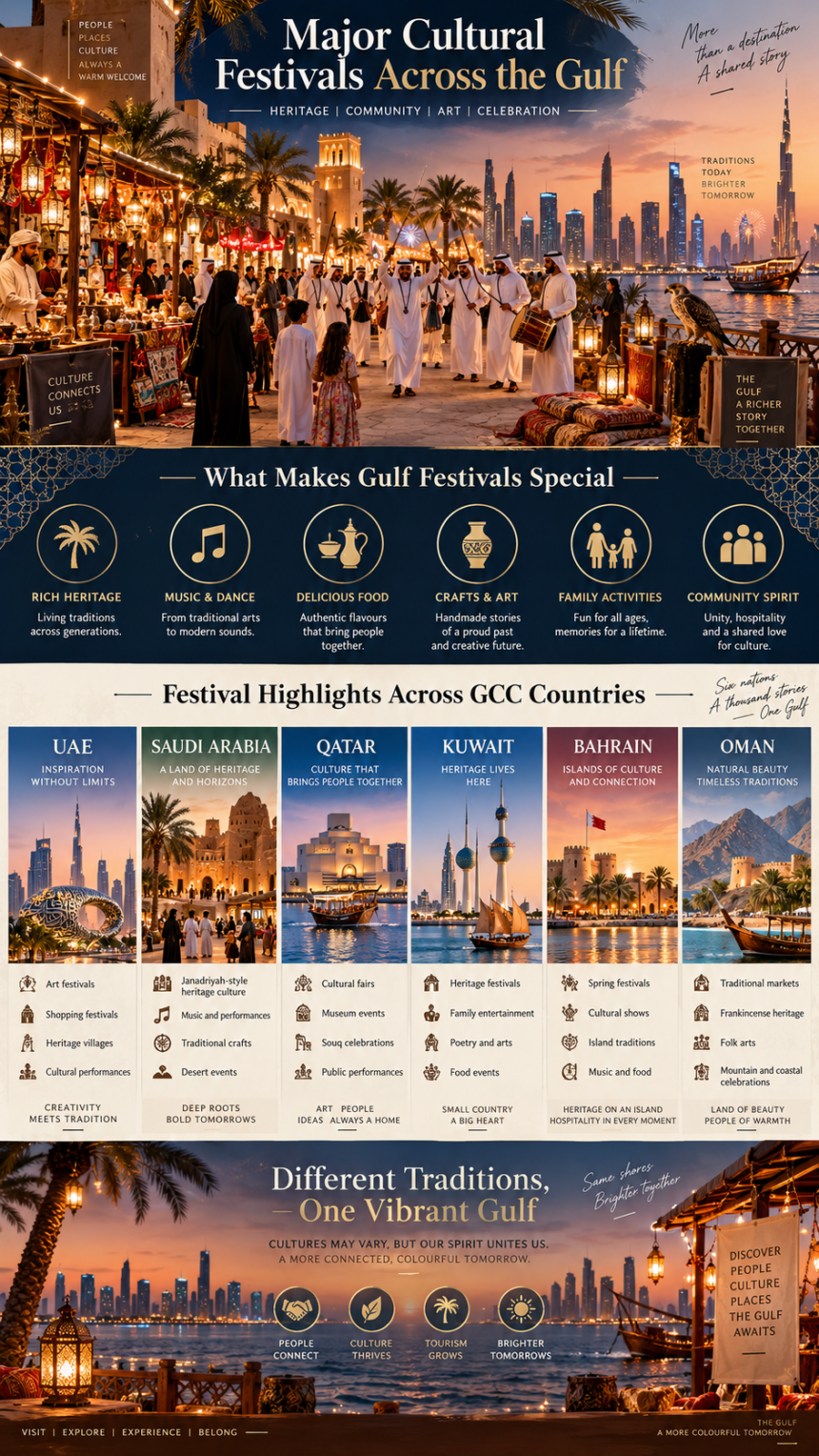
Read More – Major Cultural Festivals Across the Gulf: 12 Amazing Events