

Why Tourism Matters More to Gulf Countries
The Future of Gulf Tourism is becoming closely connected with one of the biggest economic transformations taking place across the Arabian Gulf. The UAE, Saudi Arabia, Qatar, Bahrain, Oman and Kuwait are all looking beyond traditional energy-driven growth and developing tourism as part of broader plans to create diversified and internationally connected economies.
- Future of Gulf Tourism and the Changing GCC Economy
- Why Tourism Matters More to Gulf Countries
- GCC Tourism Targets at a Glance
- 1. Tourism Will Become a Bigger Part of Economic Diversification
- 2. Luxury Tourism Will Become More Experience Focused
- 3. Artificial Intelligence Will Change the Visitor Journey
- 4. Sustainable Tourism Will Become More Important
- 5. Cultural and Heritage Tourism Will Grow
- 6. Sports and Entertainment Will Drive Travel Demand
- 7. Aviation Will Remain Central to Gulf Tourism
- 8. Stopover Tourism Will Become More Competitive
- 9. Adventure and Nature Tourism Will Expand
- 10. Wellness Tourism Will Create New Opportunities
- 11. Business and Events Tourism Will Keep Growing
- 12. GCC Countries May Become Easier to Explore Together
- Future of Tourism in the UAE
- Future of Tourism in Saudi Arabia
- Future of Tourism in Qatar
- Future of Tourism in Bahrain
- Future of Tourism in Oman
- Future of Tourism in Kuwait
- How Will Technology Change Gulf Travel
- What Will Future Gulf Travellers Expect
- Which Tourism Careers Could Grow
- What Challenges Could Affect Gulf Tourism
- GCC Tourism Opportunities for Businesses
- Future of Gulf Tourism Quick Checklist
- Final Thoughts on the Future of Gulf Tourism
The region already has many advantages. Major global airlines connect Gulf cities with Europe, Asia, Africa and the Americas. Luxury hotels have established international reputations, while new cultural attractions, resorts, sporting events, entertainment districts and natural tourism experiences are expanding what visitors can do beyond traditional shopping and city breaks.
Government strategies show how ambitious this transformation has become. The UAE Tourism Strategy 2031 targets 40 million hotel guests, AED 100 billion in additional tourism investment and a tourism contribution of AED 450 billion to GDP. Saudi Arabia has increased its 2030 tourism goal to 150 million visitors after surpassing its earlier 100 million target ahead of schedule. Qatar is targeting six million visitors annually by 2030, while Oman aims to reach 12 million visitors by 2040.
The next stage of Gulf tourism, however, will not be about visitor numbers alone. Competition will increasingly focus on the quality of experiences, sustainability, technology, cultural authenticity and the amount visitors spend inside each destination.
Future of Gulf Tourism and the Changing GCC Economy
Tourism is becoming a strategic economic sector rather than only a hospitality business.
A tourist arriving in a Gulf country spends money across several industries at the same time.
That spending may support:
- Hotels
- Airlines
- Restaurants
- Retail
- Transportation
- Entertainment
- Museums
- Tour operators
- Events
- Local businesses
This creates what economists often describe as a multiplier effect. A successful tourism sector can support employment and investment far beyond hotel rooms.
Qatar, for example, officially identifies tourism as one of five priority sectors supporting economic diversification and greater private-sector participation. Its national development plans also position tourism alongside manufacturing and logistics as an important non-oil growth cluster.
The UAE’s Tourism Strategy 2031 similarly includes specialised tourism products, workforce development and additional investment among its main priorities.
For the Gulf, tourism therefore serves two goals.
It creates economic activity today while also helping countries build economies that depend less heavily on hydrocarbons over time.
Why Tourism Matters More to Gulf Countries
Tourism creates something particularly valuable for economies trying to diversify: demand for many different skills and businesses.
A large tourism ecosystem requires chefs, marketers, tour guides, hotel managers, event specialists, transport workers, architects, technology professionals and entrepreneurs.
It can also generate opportunities for smaller businesses.
A large resort may employ hundreds of people directly, but visitors staying there can also spend money at local restaurants, activity providers, shops and cultural attractions.
Tourism can support four major economic goals:
| Goal | Tourism Contribution |
|---|---|
| Diversification | Expands non-oil economic activity |
| Employment | Creates service and specialist careers |
| Investment | Attracts hotel, entertainment and infrastructure capital |
| Global branding | Raises international visibility |
This explains why tourism plans across the GCC often connect directly with national economic visions.
The future competition will therefore not simply be about which country attracts the most visitors.
It will also involve who can keep visitors longer, encourage them to explore more locations and create experiences they are willing to return for.
GCC Tourism Targets at a Glance
Current government strategies provide a useful picture of where the region is heading.
| Country | Important Tourism Direction |
|---|---|
| UAE | 40 million hotel guests by 2031 |
| Saudi Arabia | 150 million visitors by 2030 |
| Qatar | 6 million visitors annually by 2030 |
| Bahrain | Tourism diversification through its strategic tourism pillars |
| Oman | 12 million visitors by 2040 |
| Kuwait | Tourism and entertainment linked with Vision 2035 diversification |
The UAE also aims for AED 450 billion in tourism GDP contribution by 2031 and AED 100 billion in additional tourism investment.
Saudi Arabia raised its target to 150 million visitors after exceeding the original 100 million visitor ambition ahead of schedule.
Qatar’s strategy combines its six million visitor target with MICE tourism, major events, family travel and improved visitor experiences.
Oman’s Vision 2040 tourism strategy places sustainability alongside its 12 million visitor ambition.
These targets demonstrate something important.
Every GCC country wants tourism growth, but each is trying to build a slightly different tourism identity.
1. Tourism Will Become a Bigger Part of Economic Diversification
Tourism will increasingly be treated as economic infrastructure.
This means governments will invest not only in hotels but also in airports, roads, entertainment, cultural attractions and digital visitor services.
The UAE is already using tourism as part of its wider 2031 economic vision, while Saudi Arabia’s tourism development sits directly within Vision 2030.
Oman identifies tourism as a key economic pillar under Vision 2040, and Kuwait’s Vision 2035 focuses on building a more diversified private-sector-led economy.
This creates opportunities beyond traditional travel companies.
Future tourism growth could benefit:
- Construction companies
- Technology providers
- Event businesses
- Food companies
- Transport operators
- Creative industries
- Retailers
The line between tourism and other industries will become increasingly difficult to separate.
2. Luxury Tourism Will Become More Experience Focused
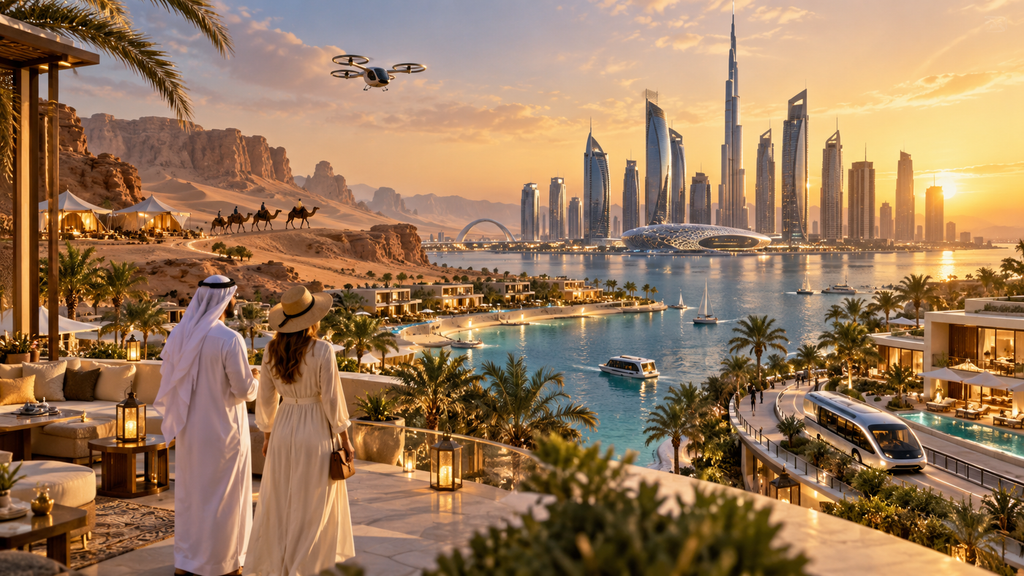
The Gulf is already strongly associated with luxury tourism.
Five-star hotels, private beaches, premium shopping and high-end restaurants have helped establish Dubai, Abu Dhabi, Doha and other Gulf cities internationally.
Future luxury tourism, however, will likely become less focused on simply providing expensive surroundings.
Travellers increasingly want memorable experiences.
Luxury could increasingly mean:
- Private desert experiences
- Boutique heritage hotels
- Exclusive wellness retreats
- Personalised cultural tours
- Luxury eco-resorts
- Private island experiences
- High-end adventure travel
Saudi Arabia’s Red Sea tourism development and Oman’s focus on luxury hospitality and specialised tourism demonstrate this shift toward experience-led premium travel. Oman is specifically developing integrated tourism complexes and niche experiences alongside traditional luxury hospitality.
Future luxury travellers may ask less about how large a hotel lobby is and more about what experience they cannot have anywhere else.
3. Artificial Intelligence Will Change the Visitor Journey
Artificial intelligence will increasingly influence how people plan and experience Gulf travel.
A future traveller may interact with AI before even booking a flight.
AI could recommend destinations based on interests, create personalised itineraries and adjust plans according to weather, traffic or opening hours.
Saudi Arabia has already piloted a smart digital tourism guide called Sarah as part of its tourism development.
Qatar has also invested in personalised digital visitor tools, interactive websites and mobile experiences as part of its tourism strategy.
Possible future AI uses include:
| Travel Stage | Possible AI Role |
|---|---|
| Inspiration | Destination recommendations |
| Booking | Personalised packages |
| Arrival | Digital travel assistance |
| Hotels | Automated guest preferences |
| Attractions | Smart itinerary suggestions |
| Translation | Real-time language support |
| Customer service | 24-hour virtual assistance |
Technology will make travel easier, but human hospitality will remain important.
The most successful destinations may use AI to remove friction while still keeping the personal service visitors associate with Gulf hospitality.
4. Sustainable Tourism Will Become More Important
Tourism development creates economic benefits, but it can also place pressure on water, energy and natural environments.
This makes sustainable tourism increasingly important.
Oman provides one of the clearest examples. Its Ministry of Heritage and Tourism says sustainability is central to tourism development under Vision 2040, while projects include a carbon-neutral tourism development at Yiti. Tourism initiatives are expected to incorporate sustainability principles.
Future sustainable tourism could include:
- Energy-efficient hotels
- Reduced plastic use
- Water conservation
- Protected natural areas
- Sustainable transport
- Local sourcing
- Eco-friendly construction
The challenge will be balancing visitor growth with environmental protection.
A destination can attract millions of visitors, but if tourism damages the landscape people came to see, that growth becomes difficult to sustain.
5. Cultural and Heritage Tourism Will Grow
Gulf tourism was once marketed internationally mainly through modern skylines, shopping and luxury.
That image is expanding.
Visitors are increasingly being introduced to archaeology, traditional markets, museums, forts, pearl-diving history and local food.
Qatar’s tourism strategy highlights cultural destinations such as the National Museum of Qatar, Museum of Islamic Art and traditional souqs as important visitor assets.
Oman has an especially strong heritage tourism proposition combining forts, traditional villages and historic landscapes.
Saudi Arabia is developing destinations such as AlUla around archaeology, culture and heritage.
The UAE is also increasing attention on heritage and domestic tourism alongside its modern attractions.
Why cultural tourism matters
It gives each destination something competitors cannot simply copy.
Another country can build a luxury hotel.
It cannot recreate your history.
That makes authentic cultural experiences increasingly valuable in a region where tourism infrastructure is becoming more competitive.
6. Sports and Entertainment Will Drive Travel Demand
Major events can bring visitors who might never have considered a destination otherwise.
Qatar demonstrated this dramatically through the FIFA World Cup and continues building a sports calendar including major international competitions. It will also host the Asian Games in 2030.
Saudi Arabia is developing major entertainment, sports and festival programmes.
The UAE already hosts Formula 1, international golf, tennis and major cultural events.
Bahrain also has established sports tourism through Formula 1 and other events.
This creates what can be called event-led tourism.
A visitor comes for a race, football competition or concert but also spends money on hotels, restaurants and attractions.
Destinations will increasingly design event calendars to reduce seasonal tourism gaps and encourage repeat visits.
7. Aviation Will Remain Central to Gulf Tourism
Few regions are as closely connected to international aviation as the Gulf.
Dubai, Doha and Abu Dhabi have developed major global aviation hubs, while Saudi Arabia is also expanding airline and airport capacity.
The importance of connectivity became especially clear during recent regional disruptions. Middle Eastern airline traffic declined sharply during parts of 2026 because of geopolitical and airspace disruptions, but IATA reported that Gulf hub traffic was on a recovery trajectory by July.
Before those disruptions, Middle Eastern airlines recorded 6.7 percent international traffic growth in 2025.
The long-term lesson is that aviation will remain a major advantage, but tourism strategies also need resilience.
Future priorities may include:
- More direct international routes
- Larger airport capacity
- Better regional connectivity
- Easier stopovers
- Faster immigration
- Stronger disruption planning
Airlines are not simply transporting tourists to the Gulf.
They are part of the tourism product itself.
8. Stopover Tourism Will Become More Competitive
Gulf airlines connect many travellers between continents.
That creates a valuable question.
Why should a passenger spend three hours at the airport when they could spend two or three days exploring the destination?
Qatar’s tourism strategy specifically identifies stopover travellers as an important market segment.
The UAE has also benefited strongly from the combination of international aviation and tourism infrastructure.
Future stopover programmes may combine:
- Short visas
- Hotel packages
- Airport transfers
- City tours
- Attraction tickets
- Airline promotions
The easier destinations make these short visits, the more transit passengers can become actual tourists.
Saudi Arabia is also developing its connectivity and tourism visa framework, creating another competitor in the stopover market.
9. Adventure and Nature Tourism Will Expand
Not every Gulf traveller wants shopping malls and skyscrapers.
Nature tourism is becoming one of the region’s strongest opportunities.
Oman is already positioning adventure and specialised experiences as important parts of its future tourism strategy, including adventure and astral tourism.
Across the GCC, possible experiences include:
- Mountain hiking
- Desert camping
- Diving
- Sailing
- Wildlife experiences
- Stargazing
- Wadi exploration
- Cycling
Saudi Arabia’s varied geography also creates opportunities ranging from Red Sea coastlines to mountains and desert heritage destinations.
The UAE is promoting natural and heritage attractions across all seven emirates through its domestic tourism strategy.
Nature tourism could help distribute visitors beyond major capital cities.
That is important because future tourism growth will increasingly need to benefit smaller communities and regional destinations as well as famous city centres.
10. Wellness Tourism Will Create New Opportunities
Wellness tourism sits between hospitality and healthcare.
Travellers may choose destinations based on:
- Spas
- Fitness
- Healthy food
- Medical services
- Recovery programmes
- Mental wellbeing
- Nature retreats
The Gulf already has a strong luxury hospitality industry, making wellness a natural extension.
Future resorts could combine premium accommodation with personalised fitness programmes, nutrition, rehabilitation or longevity services.
This creates opportunities for hotels but also for:
- Fitness professionals
- Nutritionists
- Wellness consultants
- Therapists
- Healthcare providers
- Technology companies
Wellness could become particularly valuable because it encourages longer stays and higher visitor spending.
11. Business and Events Tourism Will Keep Growing
Tourism is not only about holidays.
Business travellers can be extremely valuable because they attend conferences, exhibitions and corporate events while also using hotels, restaurants and transport.
Qatar has made the MICE sector, meaning meetings, incentives, conferences and exhibitions, an explicit part of its tourism development strategy.
Bahrain’s 2022 to 2026 tourism strategy also identifies MICE and business travel as one of its key pillars alongside marine, leisure, medical, cultural, sports and media tourism.
Dubai and Abu Dhabi already have major exhibition and conference ecosystems.
Riyadh is also rapidly expanding its international business events calendar.
Future competition could therefore be based not only on leisure attractions but also on which Gulf city becomes the preferred location for global conferences and corporate gatherings.
12. GCC Countries May Become Easier to Explore Together
One of the biggest future opportunities is regional travel.
Instead of visiting one Gulf country per trip, international tourists could increasingly combine several.
Qatar’s Government Communications Office notes that GCC tourism ministers endorsed a unified tourist visa initiative during a meeting in Doha in 2024.
If regional travel becomes easier, tourists could eventually build itineraries such as:
Dubai plus Muscat
City luxury combined with Omani nature.
Riyadh plus Bahrain
Business or entertainment combined with a short island break.
Doha plus UAE
Museums, events and shopping across two major aviation hubs.
A regional tourism model could make the GCC more competitive against destinations where travellers already move easily between neighbouring countries.
Future of Tourism in the UAE
The UAE is likely to remain one of the region’s most established tourism markets.
Its Tourism Strategy 2031 targets:
- 40 million hotel guests
- AED 450 billion tourism contribution to GDP
- AED 100 billion in additional tourism investment
- Greater development of specialised tourism products
Dubai will remain an important global city tourism destination, but future growth is likely to be increasingly spread across the federation.
Abu Dhabi offers culture, entertainment and luxury.
Ras Al Khaimah continues developing resorts and adventure tourism.
Sharjah has a strong cultural identity.
Fujairah offers mountains and coastal tourism.
The UAE’s domestic tourism strategy specifically aims to highlight the different natural, heritage and cultural attractions of all seven emirates.
Future UAE advantage
Its strength may increasingly come from variety.
A visitor could experience futuristic city tourism, beaches, desert resorts, museums and mountain adventures within one relatively compact country.
Future of Tourism in Saudi Arabia
Saudi Arabia is pursuing one of the world’s most ambitious tourism transformations.
The Kingdom exceeded its original target of 100 million annual tourists ahead of 2030 and raised its goal to 150 million visitors by the end of the decade.
Development extends across:
- Riyadh
- Jeddah
- AlUla
- Red Sea destinations
- Heritage sites
- Entertainment developments
- Religious tourism
Saudi tourism also benefits from enormous domestic travel demand.
Future growth is likely to combine international tourism with domestic visitors and religious travel.
The challenge will be scaling hospitality, aviation, workforce skills and visitor services quickly enough to match the expansion.
If successful, Saudi Arabia could significantly change the competitive balance of Gulf tourism.
Future of Tourism in Qatar
Qatar’s tourism development is closely connected with the infrastructure created before and after the FIFA World Cup.
The country aims to attract six million visitors annually by 2030.
Its future strategy includes:
- Major international events
- Family tourism
- MICE tourism
- Stopover travel
- Culture
- Luxury hospitality
- Digital visitor services
Qatar also wants tourism to contribute around 12 percent of GDP by 2030 and increase visitor spending significantly from earlier levels.
The country’s compact geography can be an advantage.
Visitors can move quickly between museums, markets, beaches and major event venues without long domestic journeys.
Doha may increasingly position itself as a short-break and stopover destination in addition to an events hub.
Future of Tourism in Bahrain
Bahrain has a different opportunity.
Rather than competing only through scale, it can focus on specialised tourism experiences.
Its 2022 to 2026 Tourism Strategy is built around areas including:
- Marine tourism
- MICE and business travel
- Sports
- Leisure
- Medical tourism
- Cultural tourism
- Media and entertainment
Bahrain’s relatively compact size allows tourists to combine cultural sites, restaurants, waterfront attractions and events within short distances.
The next phase of development can build on the kingdom’s position as a regional weekend destination, particularly for GCC residents.
Future tourism success may therefore depend on giving visitors strong reasons to return several times rather than treating Bahrain only as a one-time destination.
Future of Tourism in Oman
Oman may have one of the Gulf’s strongest opportunities in sustainable and nature-based tourism.
Its Ministry of Heritage and Tourism says Oman aims to attract 12 million visitors by 2040.
Instead of attempting to become another Dubai, Oman can build around its own strengths.
These include:
- Mountains
- Coastlines
- Wadis
- Deserts
- Heritage villages
- Adventure
- Stargazing
- Luxury nature resorts
Sustainability has also been integrated directly into tourism development.
The Yiti sustainable city is being developed as Oman’s first carbon-neutral tourism development, while wider tourism initiatives are expected to incorporate sustainability principles.
This gives Oman a distinctive future tourism identity based on premium experiences without losing its landscapes and cultural character.
Future of Tourism in Kuwait
Kuwait currently has a smaller international leisure tourism profile than some neighbouring GCC markets.
That also means it has room to grow.
Kuwait Vision 2035 aims to develop a more diversified economy led increasingly by private-sector activity and stronger infrastructure.
Tourism, hotels and entertainment have been identified as investment opportunities, with government investment material highlighting resorts, sports activities and commercial entertainment developments.
Future tourism opportunities could include:
- Waterfront development
- Cultural tourism
- Entertainment
- Sports
- Shopping
- Business travel
- Regional weekend tourism
Kuwait’s tourism challenge will be creating a clear destination identity strong enough to encourage visitors to choose it alongside more established Gulf tourism markets.
How Will Technology Change Gulf Travel
Future tourism technology will not simply mean mobile tickets.
The entire journey could become more connected.
Before arrival
AI systems could recommend destinations, flights and personalised packages.
At the airport
Biometric processing could reduce immigration and security waiting times.
Inside hotels
Guest preferences could automatically control rooms, dining recommendations and services.
Around the destination
Apps could combine transport, attractions, maps, payments and event information.
After travel
Destinations could use visitor data to understand why people return and what experiences need improvement.
The biggest opportunity is convenience.
However, tourism authorities and businesses will also need to balance personalisation with privacy and responsible data use.
What Will Future Gulf Travellers Expect
Future travellers are unlikely to choose destinations using only hotel quality.
They will compare the entire experience.
Visitors may increasingly expect:
| Expectation | What Destinations Need |
|---|---|
| Easy entry | Simple visa processes |
| Connectivity | Direct flights and transport |
| Digital convenience | Apps and contactless services |
| Authenticity | Local culture and food |
| Sustainability | Responsible tourism options |
| Personalisation | Experiences matching interests |
| Value | Clear quality for the price |
| Flexibility | Easy booking and cancellation |
Social media will also shape expectations.
Travellers can compare destinations immediately through reviews, videos and creator content.
A disappointing experience can become public within minutes.
Service quality will therefore become increasingly important as GCC tourism markets compete with one another.
Which Tourism Careers Could Grow
Tourism expansion creates careers well beyond hotel reception.
Future opportunities may include:
- Hospitality management
- Revenue management
- Tourism marketing
- Destination management
- Event management
- Adventure tourism
- Sustainability
- Travel technology
- Data analytics
- Wellness
- Culinary careers
- Aviation
Professionals who combine traditional hospitality knowledge with technology or data may become especially valuable.
For example, a hotel manager who understands revenue analytics can make better commercial decisions.
A destination marketer who understands digital behaviour can target visitors more effectively.
Tourism careers will increasingly require both human service skills and digital knowledge.
What Challenges Could Affect Gulf Tourism
The future is promising, but tourism growth is not guaranteed.
The sector faces several challenges.
Regional instability
Air travel disruptions during 2026 showed how quickly geopolitical events can affect aviation and traveller confidence. Middle Eastern airline demand fell sharply during parts of the year before gradually recovering.
Climate
Extreme summer temperatures can make outdoor tourism difficult.
Competition
Every Gulf country is investing in tourism, meaning new attractions alone may not guarantee success.
Sustainability
Rapid development can place pressure on water and natural environments.
Workforce skills
Millions of additional visitors require trained employees capable of delivering consistent service.
Future success will therefore depend on resilience as much as expansion.
GCC Tourism Opportunities for Businesses
Tourism growth can create space for businesses of many sizes.
Large investors may develop hotels and entertainment destinations, while smaller entrepreneurs can build specialised services.
Possible opportunities include:
- Guided experiences
- Food tours
- Adventure companies
- Travel technology
- Cultural experiences
- Luxury transport
- Wellness services
- Event production
- Destination content
- Sustainable tourism solutions
The strongest businesses may be those that solve specific visitor problems.
Instead of asking, “How can I start a tourism company?” entrepreneurs can ask:
What does the visitor currently struggle to find?
That could be authentic local food experiences, convenient regional travel planning or premium outdoor adventures.
Future of Gulf Tourism Quick Checklist
The future tourism market can be understood through a few major shifts.
Expect more
- Visitors
- Airline connectivity
- Tourism investment
- Major events
- Digital services
- Cultural experiences
- Nature tourism
Expect stronger competition around
- Service quality
- Luxury experiences
- Stopover tourism
- Entertainment
- Family travel
- International events
Expect increasing importance of
- Sustainability
- AI
- Personalisation
- Visitor data
- Workforce training
- Regional cooperation
Watch carefully
- Climate challenges
- Geopolitical disruption
- Infrastructure capacity
- Environmental impact
- Changing traveller expectations
The next decade will reward destinations that balance ambitious growth with visitor experience and long-term sustainability.
Final Thoughts on the Future of Gulf Tourism
The Future of Gulf Tourism is moving far beyond the image of skyscrapers, luxury hotels and shopping malls.
The UAE aims to welcome 40 million hotel guests by 2031 while raising tourism’s GDP contribution to AED 450 billion and attracting AED 100 billion in additional tourism investment.
Saudi Arabia has already exceeded its original 100 million visitor ambition and now targets 150 million visitors by 2030.
Qatar wants six million annual visitors by 2030 while strengthening events, business tourism, family travel and stopover experiences.
Bahrain continues building tourism around business events, marine attractions, culture, entertainment and regional travel.
Oman is targeting 12 million visitors by 2040 while putting sustainability, nature and specialised tourism experiences at the centre of development.
Kuwait is linking future tourism and entertainment development with its wider Vision 2035 economic diversification and private-sector agenda.
Together, these strategies could reshape how international travellers view the Gulf.
The region may increasingly become a collection of complementary destinations rather than six separate tourism markets.
One traveller could visit Dubai for city experiences, Oman for nature, Saudi Arabia for heritage, Qatar for events, Bahrain for a short cultural break and Kuwait for business or entertainment.
Technology will make journeys easier.
Better aviation will connect more markets.
New attractions will give visitors more reasons to travel.
But the strongest future tourism experiences may still depend on something less technical.
Authenticity.
Travellers increasingly want to understand the place behind the hotel.
They want local food, history, landscapes and stories that feel different from what they can find somewhere else.
That creates the biggest opportunity for the Gulf.
The region does not need to copy one successful tourism model six times.
Each country can build around its own strengths while improved regional cooperation makes the entire GCC easier to explore.
If Gulf countries can combine infrastructure, technology and investment with authentic culture and responsible growth, tourism could become one of the most important pillars of the region’s post-oil economy.
The future will therefore not simply be about bringing more people to the Gulf.
It will be about giving them stronger reasons to stay longer, explore further and return again.
Do follow us on Instagram
Read More – How the GCC Is Preparing for a Post-Oil Economy