


GCC Countries Are Increasing Regional Water Cooperation
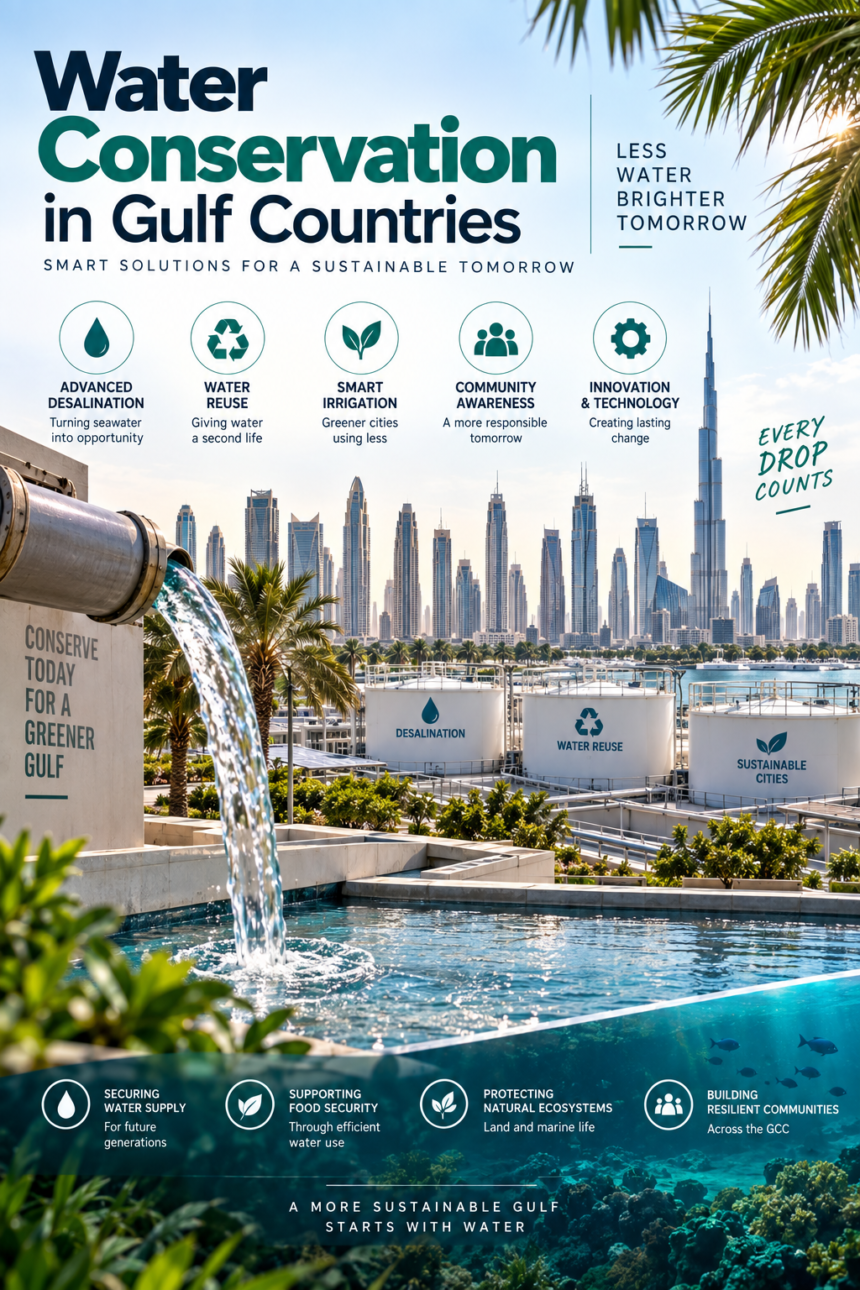
Water conservation in Gulf countries has become one of the region’s most important sustainability priorities. The GCC has built some of the world’s most advanced cities in an environment where rainfall is limited, temperatures are high and natural freshwater resources are scarce.
- Why Water Conservation in Gulf Countries Is So Important
- Desalination Remains Essential Across the Gulf
- The UAE Is Targeting Lower Water Demand
- Treated Wastewater Is Becoming a Valuable Resource
- Qatar Is Expanding Water Conservation Regulation
- Qatar Is Replacing Freshwater in Cooling Systems
- Smart Water Networks Can Find Waste Before People See It
- Saudi Arabia Is Reducing Water Use in Agriculture
- Drip Irrigation Can Reduce Agricultural Water Waste
- Oman Is Combining Conservation With Water Storage
- Rainwater Harvesting Still Matters in an Arid Region
- Bahrain Is Strengthening National Water Management
- Kuwait Is Using Public Conservation Campaigns
- Buildings Can Become Major Water-Saving Tools
- Businesses Have a Bigger Role Than Many People Realise
- Desalination Must Become More Energy Efficient
- GCC Countries Are Increasing Regional Water Cooperation
- Small Everyday Changes Still Matter
- How Gulf Water Conservation Strategies Compare
- What Challenges Still Limit Water Conservation?
- What the Future of Gulf Water Management Could Look Like
- Water Conservation in Gulf Countries Is Becoming a Long-Term Priority
Saudi Arabia, the UAE, Qatar, Kuwait, Bahrain and Oman have responded to these conditions by developing large desalination systems. These facilities have made modern urban growth possible, but producing freshwater from the sea requires infrastructure, energy and significant investment.
The next stage of Gulf water policy is therefore not simply about producing more water. Governments are increasingly trying to reduce unnecessary consumption, reuse treated wastewater, protect groundwater, modernise irrigation and use digital technology to identify leaks and improve efficiency.
Water conservation is also becoming closely connected with food security, energy policy, urban planning and climate resilience. The GCC Secretariat continues to coordinate regional water-security planning and in 2026 was studying possible water interconnection projects between member states to strengthen supplies during emergencies.
The future of water in the Gulf will depend on managing every litre more carefully.
Why Water Conservation in Gulf Countries Is So Important
The Gulf’s natural environment creates a difficult water equation.
Rainfall is generally limited and highly variable. Rivers that provide large renewable freshwater supplies in many other regions do not exist across most of the Arabian Peninsula, while groundwater reserves can take extremely long periods to replenish.
At the same time, cities have expanded rapidly.
Millions of residents need water for homes, businesses, hotels, hospitals, schools, landscaping and industry. Agriculture also creates significant demand in several GCC countries.
Desalination has solved much of the supply problem, but it does not remove the need for conservation.
Saudi Arabia’s National Water Strategy, for example, identifies limited renewable water, depletion of non-renewable groundwater and high agricultural demand as major national challenges.
The UAE similarly describes water security as a national priority because of its arid environment, limited natural resources and high demand associated with economic and population growth.
This makes conservation essential not because the Gulf cannot produce water, but because producing, transporting and storing that water requires significant resources.
Desalination Remains Essential Across the Gulf
Desalination is one of the foundations of modern life across the GCC.
Seawater is processed to remove salt and other impurities before entering drinking-water networks. Gulf countries have invested heavily in this technology because naturally available freshwater cannot satisfy urban demand.
Qatar’s water sector, for example, produced 538 million imperial gallons per day of potable desalinated water in 2024 following expansion at the Umm Al Houl plant.
Saudi Arabia is also one of the world’s largest producers of desalinated water. In 2026, the Ministry of Environment, Water and Agriculture said daily water distribution had reached 11.4 million cubic metres, supported by production capacity of 12.8 million cubic metres per day.
Kuwait’s water system similarly depends heavily on desalination, with the Ministry of Electricity, Water and Renewable Energy responsible for planning desalination facilities, strategic storage and distribution infrastructure.
However, desalination has traditionally required considerable energy.
Modern Gulf water strategies are therefore increasingly focused on more efficient technologies such as reverse osmosis and greater use of renewable energy.
The goal is not to eliminate desalination but to produce the water the region needs with lower environmental and energy costs.
The UAE Is Targeting Lower Water Demand
The UAE has established one of the clearest long-term water conservation frameworks in the Gulf.
The UAE Water Security Strategy 2036 aims to reduce total demand for water resources by 21 percent and increase the reuse of treated water to 95 percent.
This approach is important because water security is being addressed from both sides.
The country is investing in supply technologies such as efficient desalination, but it is also trying to reduce the amount of water that needs to be produced in the first place.
The UAE is increasingly using membrane-based desalination, renewable energy, smart water networks, rainwater harvesting and wastewater reuse.
Water conservation therefore becomes part of a complete system.
A litre saved inside a home or commercial building is a litre that does not need to be desalinated, pumped through networks and eventually treated as wastewater.
Treated Wastewater Is Becoming a Valuable Resource
One of the biggest opportunities for Gulf water conservation is using the same water more than once.
Wastewater from homes and businesses can be treated to high standards and reused for applications where drinking-quality water is unnecessary.
The UAE already relies heavily on this approach.
In 2025, the Ministry of Energy and Infrastructure said the country had more than 160 wastewater treatment plants with combined capacity exceeding 3 million cubic metres per day. Around 73 percent of treated wastewater was being reused, mainly for irrigation of urban landscapes.
The long-term UAE target is to increase treated-water reuse to 95 percent.
Saudi Arabia is also expanding wastewater reuse. Its water policy prioritises treated water for irrigation, agriculture, industrial applications and urban landscaping to reduce pressure on groundwater and freshwater supplies.
By 2050, Saudi water-security plans aim to recycle and reuse more than 70 percent of treated wastewater.
This shift effectively changes wastewater from something that must simply be disposed of into a second water resource.
Qatar Is Expanding Water Conservation Regulation
Qatar has strengthened the legal and technical framework surrounding water use.
Law No. 23 of 2025 established a comprehensive framework covering desalinated water, groundwater and treated wastewater. It places greater emphasis on preventing overuse, protecting resources and improving efficiency.
Another major step took effect in 2026.
Qatar introduced the GCC technical regulation for water-conservation devices, covering products including taps, showerheads, mixers, toilets and flow regulators. Compliance became mandatory for covered products from February 24, 2026.
This is a good example of how water conservation can move beyond awareness campaigns.
Instead of depending only on people remembering to close taps, governments can improve the efficiency of the equipment installed in millions of homes and businesses.
A low-flow fixture saves water every time it is used.
Across thousands of buildings and many years, relatively small improvements can produce substantial savings.
Qatar Is Replacing Freshwater in Cooling Systems
Air-conditioning is essential in Gulf cities, and large developments increasingly use district cooling systems.
Cooling can also create water demand.
Qatar has addressed this by prohibiting the use of desalinated drinking water for district cooling and requiring alternatives such as treated sewage effluent or seawater.
This principle is important for future GCC water management.
Not every activity requires drinking-quality freshwater.
Landscaping, industrial processes, cooling and certain agricultural uses can often use treated water instead.
Separating water supplies according to the quality actually required can significantly reduce pressure on desalinated potable water.
Future cities could increasingly operate different water systems for different purposes rather than treating every litre as if it were intended for drinking.
Smart Water Networks Can Find Waste Before People See It
A large amount of water can be wasted without ever reaching the customer.
Leaks in underground pipelines may continue for long periods before becoming visible. Incorrect pressure can also increase network losses.
This is why digital water infrastructure is becoming an important conservation tool.
Smart meters allow utilities and customers to track consumption more closely. Sudden increases can indicate leaks, while automated systems can analyse unusual patterns.
Qatar’s Kahramaa is upgrading its distribution system and installing smart water meters as part of efforts to reduce network losses. Its water network extends for more than 11,000 kilometres.
Bahrain is also modernising its network monitoring. Its Electricity and Water Networks Control Centre uses advanced systems to monitor water desalination facilities, transmission networks and distribution infrastructure.
Over time, artificial intelligence could make these systems even more powerful by predicting where leaks are most likely to occur before major water loss happens.
Saudi Arabia Is Reducing Water Use in Agriculture
Agriculture represents one of the biggest water-management challenges in arid countries.
Saudi Arabia’s National Water Strategy identifies agricultural water demand as a major pressure on limited resources.
The Kingdom has therefore introduced measures designed to reduce inefficient groundwater use and improve agricultural productivity per unit of water.
In June 2026, the Ministry of Environment, Water and Agriculture said national conservation initiatives had reduced agricultural water consumption by more than 8 billion cubic metres annually.
This demonstrates why Gulf water conservation cannot focus only on households.
A household saving a few litres is useful, but large-scale agricultural improvements can potentially conserve vastly greater quantities.
Efficient irrigation, better crop selection, treated wastewater reuse and improved monitoring of groundwater extraction can all play important roles.
Drip Irrigation Can Reduce Agricultural Water Waste
Traditional irrigation methods can lose significant amounts of water through evaporation, runoff and overwatering.
Modern irrigation systems deliver water more precisely.
Drip irrigation places small quantities directly near plant roots. Sensors can measure soil moisture and allow irrigation systems to operate only when required.
Smart systems can also adjust watering according to weather conditions.
This is particularly valuable in the Gulf, where watering during the hottest part of the day can increase evaporation.
Bahrain’s national water planning includes promoting water-saving technologies at farms, while government sustainability programmes also encourage modern irrigation systems.
Oman similarly combines water security with groundwater monitoring, reuse and rainwater-management programmes under its Vision 2040 framework.
Agriculture is therefore becoming increasingly data-driven rather than simply using more water to produce more food.
Oman Is Combining Conservation With Water Storage
Oman’s geography gives it a somewhat different water environment from several neighbouring GCC countries.
The country receives seasonal rainfall in some regions and has a long tradition of managing groundwater and surface water through systems such as aflaj.
Modern water planning is adding new technologies to this history.
The Oman Vision 2040 2024-2025 report highlighted the operation of 4,353 water-monitoring stations, construction of groundwater-recharge and surface-storage dams, expansion of desalination and operation of wastewater-treatment facilities.
The report also said Oman was reusing more than half of treated water across agricultural, industrial and service sectors.
Water conservation in Oman therefore includes several different approaches at once: preserving groundwater, storing rainfall, treating wastewater, expanding efficient desalination and monitoring resources more carefully.
This diversified approach can increase resilience because the country is not dependent on a single solution.
Rainwater Harvesting Still Matters in an Arid Region
Rainfall may be limited in the Gulf, but that does not mean it has no value.
When intense rainfall occurs, large volumes of water can arrive within a short period. Without suitable infrastructure, much of it may flow toward the sea or cause flooding rather than becoming a usable resource.
Rainwater harvesting and groundwater recharge provide another opportunity.
The UAE has highlighted rainwater harvesting as part of its water-security strategy, while Oman operates extensive dam infrastructure to capture water and support groundwater recharge.
Qatar has also rehabilitated and developed water-harvesting wells as part of efforts to protect groundwater resources.
Rainwater harvesting will never replace desalination across the GCC.
However, in a water-scarce environment, conservation is about using every available source more intelligently.
Bahrain Is Strengthening National Water Management
Bahrain’s National Water Strategy 2030 was approved in 2018 and aligns with the GCC’s wider regional water strategy. It focuses on coordination between authorities, implementation monitoring and public awareness.
The country has also been working on climate resilience in the water sector.
Initiatives include household and farm conservation, rainwater-harvesting guidance, greywater recycling and stronger integrated water-resource management.
Bahrain has another useful conservation advantage: digital consumption monitoring.
Government information says water accounts are monitored for unusual increases that may indicate excessive consumption or leaks.
This turns the utility provider into part of the conservation process.
Instead of discovering a leak only after receiving a very large bill, customers can potentially be alerted earlier.
Kuwait Is Using Public Conservation Campaigns
Kuwait remains highly dependent on desalinated water and continues investing in desalination, storage and distribution capacity.
At the same time, public conservation campaigns show that behaviour still matters.
During summer 2025, Kuwait’s Ministry of Electricity, Water and Renewable Energy promoted its Waffer conservation campaign. Government reporting said peak water demand reached 533 million imperial gallons on June 4, before falling to 504 million imperial gallons approximately one month after the campaign began.
Many different factors can influence short-term demand, so the change should not be attributed entirely to one campaign.
However, the example demonstrates why public participation remains part of water security.
Technology can reduce leakage and improve desalination efficiency, but residents and businesses still determine a significant share of everyday demand.
Kuwait is also participating in GCC discussions about greater regional coordination of desalination and water infrastructure.
Buildings Can Become Major Water-Saving Tools
Future water conservation will increasingly begin when buildings are designed.
Homes, offices, hotels and shopping centres can be equipped with efficient taps, dual-flush toilets, smart meters and leak-detection systems.
Landscape design matters too.
Large lawns and water-intensive plants can create unnecessary demand in desert climates. Native and drought-resistant landscaping can significantly reduce irrigation requirements.
Greywater systems provide another opportunity.
Water from showers or washbasins can potentially be treated and reused for suitable non-drinking applications rather than immediately entering the wastewater network.
In large developments, these savings can become substantial.
A hotel that improves shower efficiency, detects leaks faster, reuses treated water and installs efficient landscaping can reduce demand in several parts of its operations simultaneously.
The most water-efficient Gulf buildings will therefore treat conservation as an integrated design requirement rather than an optional environmental feature.
Businesses Have a Bigger Role Than Many People Realise
Water conservation is often presented as something residents should practise at home.
Commercial and industrial users can have an equally important role.
Hotels use water in guest rooms, kitchens, laundries, swimming pools and landscaping. Shopping centres require water for restrooms, cleaning and cooling. Food companies and manufacturers may consume water directly in production.
Smart meters can identify which processes use the most water.
Businesses can then establish efficiency targets, replace outdated fixtures, reuse water where appropriate and include water performance in environmental reporting.
There is also a financial incentive.
Reducing consumption can lower utility and wastewater-treatment costs while helping companies meet sustainability requirements from investors and customers.
As environmental reporting becomes more detailed, water performance could become an increasingly visible corporate metric across the GCC.
Desalination Must Become More Energy Efficient
Producing more water cannot be separated from the question of how much energy is required to produce it.
Traditional thermal desalination technologies can be energy intensive. Reverse osmosis uses membranes to separate salt from water and can offer improved efficiency in suitable applications.
The UAE is increasingly expanding membrane-based desalination and integrating renewable energy into water production as part of its water-sector strategy.
Saudi Arabia is also focusing on innovation and efficiency within desalination as part of its broader water strategy.
The relationship between water and energy is particularly important in the Gulf.
Saving water can indirectly save energy because less water needs to be produced, treated and pumped.
Similarly, cleaner electricity can reduce the environmental impact of every litre produced by desalination.
Water conservation and energy transition therefore reinforce each other.
GCC Countries Are Increasing Regional Water Cooperation
Water security is not only a national issue.
The GCC has worked for years on regional cooperation, including a unified water strategy developed in 2016. Member states have continued discussions about updating common planning and strengthening the sustainability of water resources.
During 2026, regional cooperation became even more practical.
The GCC began detailed work examining potential water interconnections between member states. Studies include possible bilateral links involving Saudi Arabia, Kuwait, Bahrain, Qatar, Oman and the UAE.
The idea is similar in principle to connected energy infrastructure.
If one country’s system faces disruption, another network could potentially provide emergency support where suitable infrastructure exists.
The studies are considering risks including desalination-plant outages, pollution, natural disasters, cyberattacks and energy interruptions.
This demonstrates how water conservation is evolving into a broader discussion about regional resilience.
Small Everyday Changes Still Matter
National infrastructure delivers the biggest structural improvements, but households still have an important role.
A leaking tap or toilet can waste significant quantities over weeks or months. Running taps unnecessarily, overwatering gardens and using open hoses for cleaning can also increase demand.
Bahrain’s Electricity and Water Authority, for example, recommends repairing leaks, using water-saving fixtures, irrigating during cooler hours, choosing drought-resistant plants and using efficient irrigation systems.
Qatar’s Tarsheed programme similarly promotes changes in consumer behaviour alongside technical regulations and infrastructure improvements.
The lesson is not that individual behaviour can solve the Gulf’s water challenge alone.
Rather, conservation works best when efficient behaviour and efficient infrastructure support each other.
How Gulf Water Conservation Strategies Compare
| Country | Major Water Conservation Direction |
|---|---|
| UAE | Demand reduction, treated-water reuse, efficient desalination and smart management |
| Saudi Arabia | Agricultural efficiency, wastewater reuse, groundwater protection and desalination |
| Qatar | Conservation regulation, smart meters, treated water and efficient fixtures |
| Oman | Groundwater monitoring, dams, wastewater reuse, desalination and rainwater management |
| Bahrain | National water strategy, leak monitoring, conservation technology and greywater planning |
| Kuwait | Demand awareness, desalination efficiency, strategic storage and regional cooperation |
The methods vary because each country has different geography, infrastructure and demand patterns.
However, the overall direction is increasingly similar.
Fresh drinking water should be reserved for uses that actually require it. Wastewater should be treated and reused. Networks should identify losses quickly. Agriculture should use water more precisely, while desalination should become more energy efficient.
What Challenges Still Limit Water Conservation?
The Gulf has made significant progress, but reducing demand remains difficult.
Population growth creates new water requirements even when individual buildings become more efficient. Expanding tourism, industry and urban development can produce additional pressure.
Low water prices or heavily subsidised services can also reduce the financial incentive for some users to conserve.
Older buildings may have inefficient plumbing and limited monitoring technology.
Agriculture remains particularly challenging because some crops require large quantities of water, while excessive groundwater extraction can threaten long-term reserves.
Wastewater reuse can also face public perception challenges even when treatment meets high technical standards.
Finally, climate change could increase temperatures and make rainfall less predictable, adding another layer of uncertainty to future planning.
These challenges explain why there is no single solution.
What the Future of Gulf Water Management Could Look Like
Future GCC water systems are likely to become much more digital.
Smart meters will provide customers with real-time consumption information. Artificial intelligence could identify abnormal demand across entire neighbourhoods and automatically alert utilities to possible leaks.
Advanced irrigation systems could combine soil sensors with weather forecasts to determine exactly when plants need water.
More buildings may recycle greywater.
Wastewater treatment could provide larger volumes for landscaping, agriculture and industry.
Desalination facilities will increasingly use efficient membrane technologies and cleaner energy, while strategic reserves and potential GCC interconnection projects could strengthen emergency preparedness.
Water networks may eventually operate much like modern digital energy systems, constantly monitoring production, storage, demand and losses.
The objective will not simply be to produce enough water.
It will be to use the right type of water, in the right place, at the right time.
Water Conservation in Gulf Countries Is Becoming a Long-Term Priority
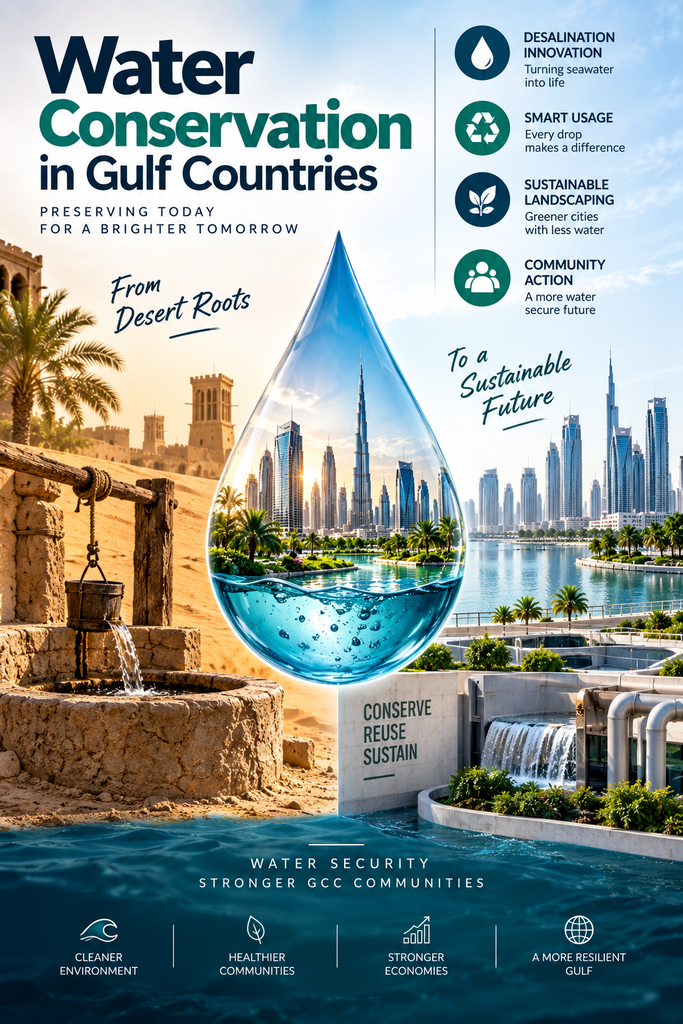
Water conservation in Gulf countries is moving from awareness campaigns into the design of national infrastructure, regulations and cities.
The UAE wants to cut overall water demand and dramatically increase treated-water reuse. Saudi Arabia is reducing agricultural consumption and protecting groundwater. Qatar is regulating water-efficient fixtures and replacing desalinated water in uses such as district cooling.
Oman is combining dams, wastewater reuse, groundwater monitoring and desalination. Bahrain is strengthening integrated water management and conservation technology, while Kuwait continues to focus on efficient supply, public awareness and stronger regional cooperation.
At the same time, GCC countries are examining whether their water infrastructure can become more interconnected in the future.
The Gulf will continue to need desalination because of its climate and limited natural freshwater resources. However, producing more water cannot be the only answer.
The more sustainable model is to conserve freshwater, reuse water whenever possible, protect groundwater, reduce network losses and make every stage of the water system more efficient.
For one of the world’s most water-scarce regions, that transition is not simply an environmental goal.
It is a long-term requirement for cities, economies and future generations.
Do follow us on Instagram
Read More – Sustainable Architecture in GCC Cities: How Gulf Buildings Are Becoming Greener