



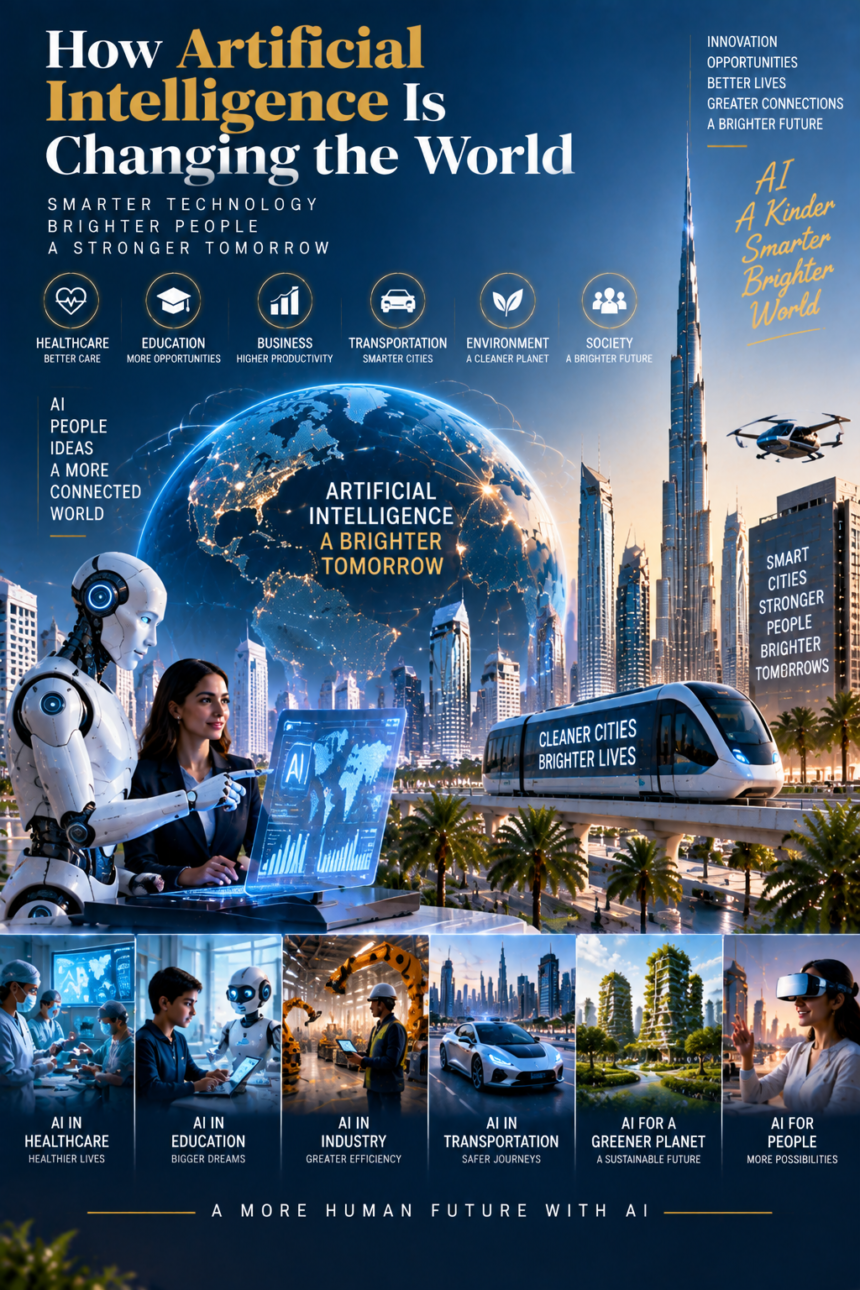
Artificial Intelligence Transforming Businesses and Industries
Artificial Intelligence is becoming one of the most influential technologies shaping the modern world. From smartphones and online services to healthcare systems, businesses and scientific research, AI is changing how people work, communicate and solve problems.
- How AI Has Evolved From Research to Everyday Life
- Artificial Intelligence Transforming Businesses and Industries
- AI Revolutionising Healthcare and Medical Research
- The Impact of Artificial Intelligence on Education
- How AI Is Changing Transportation and Smart Cities
- Artificial Intelligence in Finance, Security and Global Services
- The Role of AI in Creativity and Entertainment
- Artificial Intelligence and Scientific Research
- Challenges and Ethical Questions Around Artificial Intelligence
- Data Privacy and Security
- Impact on Jobs and Skills
- Accuracy and Bias
- Responsible AI Development
- How Businesses Can Prepare for an AI-Powered Future
- The Future of Artificial Intelligence
- Artificial Intelligence Changing the World: A Technology Defining the Future
- Quick Takeaways
What was once considered a technology limited to research laboratories is now becoming part of everyday life. Artificial Intelligence systems can analyse large amounts of data, recognise patterns, understand human language and assist with complex decision-making.
The rapid growth of AI is creating opportunities across almost every industry. Companies are using AI to improve efficiency, governments are exploring smart services, and researchers are developing solutions for challenges that were previously difficult to solve.
The impact of Artificial Intelligence can be seen across multiple areas:
| Industry | AI Impact |
|---|---|
| Healthcare | Faster diagnosis and medical research |
| Business | Automation and better decision-making |
| Education | Personalised learning experiences |
| Transportation | Smart vehicles and traffic management |
| Finance | Fraud detection and digital services |
| Entertainment | Content creation and recommendations |
| Science | Faster research and discoveries |
Artificial Intelligence is not simply replacing existing technologies. It is creating new possibilities by allowing machines to support human creativity, analysis and innovation.
The global AI revolution is also changing the skills people need. As technology develops, knowledge of digital tools, data analysis and creative problem-solving is becoming increasingly valuable.
The future will likely be shaped by collaboration between humans and intelligent systems, where AI helps people achieve more while humans continue providing creativity, judgement and emotional understanding.
How AI Has Evolved From Research to Everyday Life
The journey of Artificial Intelligence began decades ago with the goal of creating machines capable of performing tasks that normally require human intelligence.
Early AI research focused on basic problem-solving and computer reasoning. Over time, advances in computing power, data availability and algorithms allowed AI systems to become more capable.
Today, AI is present in many everyday activities.
People interact with AI through:
| Daily Activity | AI Application |
|---|---|
| Searching online | Understanding user queries |
| Watching videos | Personalised recommendations |
| Using smartphones | Voice assistants and smart features |
| Shopping online | Product suggestions |
| Using maps | Route optimisation |
| Banking digitally | Security and fraud detection |
Machine learning has been one of the biggest developments behind modern AI. Instead of being programmed for every possible situation, AI systems can learn from data and improve their performance over time.
Another major development has been generative AI. These systems can create text, images, audio and other forms of content based on user instructions.
Generative AI is changing how people approach:
- Writing
- Design
- Research
- Programming
- Marketing
- Communication
Businesses are increasingly adopting AI because it can help employees complete tasks faster and make better use of information.
Artificial Intelligence Transforming Businesses and Industries
Businesses across the world are adopting Artificial Intelligence to improve productivity, customer experiences and decision-making.
AI is helping companies analyse markets, automate repetitive tasks and develop new products.
Major business applications include:
| Business Area | How AI Helps |
|---|---|
| Customer service | AI chatbots and virtual assistants |
| Marketing | Personalised campaigns |
| Operations | Process automation |
| Sales | Customer behaviour analysis |
| Human resources | Recruitment support |
| Supply chains | Better forecasting |
One of the biggest advantages of AI is its ability to process large amounts of information quickly.
For example, businesses can use AI to understand customer preferences, predict market trends and identify opportunities.
Small businesses are also benefiting from AI tools. Many affordable platforms now allow smaller companies to use technology previously available mainly to large organisations.
Entrepreneurs are using AI for:
- Content creation
- Business planning
- Customer communication
- Data analysis
- Online marketing
Artificial Intelligence is also changing workplace productivity. Employees can use AI assistants to organise information, generate ideas and automate routine tasks.
However, successful AI adoption requires businesses to combine technology with human expertise. AI can provide insights and support decisions, but human judgement remains important.
AI Revolutionising Healthcare and Medical Research
Healthcare is one of the fields where Artificial Intelligence is creating some of the most significant changes.
Doctors and researchers are using AI to improve diagnosis, develop treatments and analyse medical information.
Important healthcare applications include:
| Healthcare Area | AI Contribution |
|---|---|
| Diagnosis | Identifying patterns in medical images |
| Drug research | Speeding up development processes |
| Patient monitoring | Tracking health conditions |
| Medical records | Organising healthcare information |
| Personalised medicine | Creating targeted treatments |
AI systems can analyse medical images such as scans and help doctors identify possible health concerns more efficiently.
Researchers are also using AI to study large amounts of medical data. This can help identify patterns that may lead to better understanding of diseases.
Another important area is personalised healthcare. AI can analyse individual health information and support treatment approaches based on specific patient needs.
Hospitals are also using AI-powered systems to improve operations, including:
- Appointment management
- Resource planning
- Patient communication
- Administrative tasks
While AI offers major benefits, healthcare professionals continue to play the central role in making medical decisions.
The future of healthcare will likely involve stronger collaboration between doctors and AI systems, combining human expertise with advanced data analysis.
The Impact of Artificial Intelligence on Education
Education is another sector experiencing major changes because of Artificial Intelligence.
AI is creating new ways for students to learn and helping teachers provide more personalised support.
Traditional education often follows the same learning approach for all students. AI can help create learning experiences based on individual needs.
AI applications in education include:
| Area | AI Impact |
|---|---|
| Learning platforms | Personalised lessons |
| Language learning | Interactive practice tools |
| Assessment | Faster feedback |
| Research | Information assistance |
| Accessibility | Support for different learning needs |
Students can use AI tools to understand difficult topics, practise skills and receive additional learning support.
Teachers can also use AI to:
- Prepare educational materials
- Analyse student progress
- Automate administrative tasks
- Develop personalised activities
AI is particularly valuable for improving access to education. Digital learning platforms can help students in different locations access educational resources.
However, education experts emphasise the importance of using AI responsibly. Technology should support learning rather than replace critical thinking, creativity and human interaction.
The future classroom will likely combine traditional teaching methods with AI-powered tools to create more flexible and personalised learning environments.
How AI Is Changing Transportation and Smart Cities
Artificial Intelligence is transforming transportation by making movement safer, more efficient and more connected.
Cities around the world are using AI to improve traffic management, public transport and urban planning.
AI applications in transportation include:
| Transportation Area | AI Role |
|---|---|
| Traffic management | Predicting and reducing congestion |
| Navigation | Optimising routes |
| Vehicles | Supporting autonomous driving |
| Public transport | Improving efficiency |
| Logistics | Managing deliveries |
Smart cities are using AI systems to analyse data from roads, sensors and public services.
This helps cities improve:
- Traffic flow
- Energy use
- Public safety
- Infrastructure planning
Self-driving vehicle technology is another major area of AI development. While fully autonomous transportation is still evolving, AI-powered systems are already helping vehicles improve safety through features such as driver assistance.
Logistics companies are also using AI to improve delivery networks by predicting demand and optimising routes.
As cities become more connected, Artificial Intelligence will continue playing an important role in creating smarter and more efficient urban environments.
Artificial Intelligence in Finance, Security and Global Services
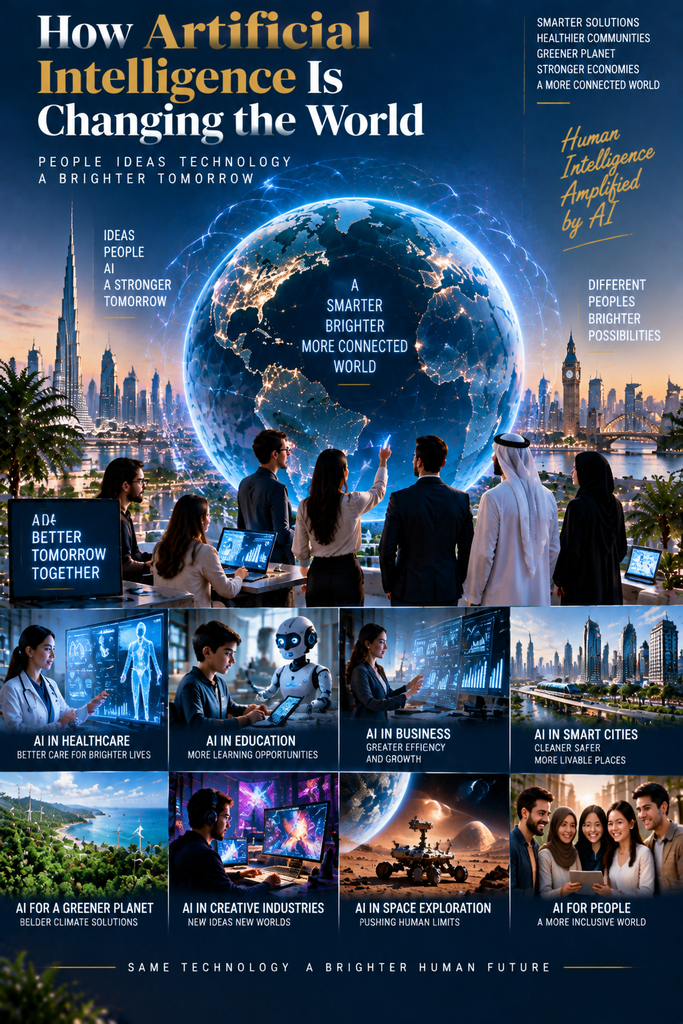
Artificial Intelligence is transforming the financial sector by improving decision-making, strengthening security and creating faster digital services. Banks, investment firms and financial technology companies are using AI to analyse information, detect risks and provide more personalised experiences.
One of the biggest advantages of AI in finance is its ability to process large amounts of financial data quickly. This helps organisations identify patterns, predict market behaviour and improve customer services.
Key applications include:
| Finance Area | Artificial Intelligence Application |
|---|---|
| Fraud detection | Identifying unusual transactions |
| Customer service | AI-powered virtual assistants |
| Investment analysis | Market data evaluation |
| Risk management | Predicting financial risks |
| Digital banking | Faster personalised services |
AI-powered systems can monitor transactions in real time and identify suspicious activities. This helps financial institutions improve security and protect customers.
Banks are also using AI chatbots to answer common questions, assist customers and provide basic financial guidance.
In investment and business decision-making, AI can analyse large amounts of market information and help professionals understand trends. However, human expertise remains essential because financial decisions often require judgement and strategic thinking.
Beyond finance, AI is also becoming important in global security systems. Organisations are using AI for:
- Cybersecurity monitoring
- Threat detection
- Data protection
- Network analysis
As cyber threats become more advanced, AI helps security teams identify unusual activity and respond faster.
Governments and organisations are also exploring AI-powered systems to improve public services. These include digital government platforms, smart city solutions and automated administrative processes.
The combination of AI and digital transformation is creating more efficient services for citizens and businesses around the world.
The Role of AI in Creativity and Entertainment
Artificial Intelligence is changing the creative industries by providing new tools for artists, designers, filmmakers, musicians and content creators.
For many years, creativity was considered a uniquely human ability. Today, AI is becoming a powerful tool that helps creators develop ideas, experiment with new formats and improve production processes.
AI applications in creative industries include:
| Industry | AI Contribution |
|---|---|
| Film | Visual effects and production support |
| Music | Sound creation and editing assistance |
| Design | Image generation and creative tools |
| Writing | Content assistance and idea development |
| Gaming | Character design and interactive experiences |
Content creators are using AI tools to speed up workflows and explore new creative possibilities.
For example, designers can use AI to generate concepts, filmmakers can improve visual effects, and writers can use AI for research and brainstorming.
The entertainment industry is also using AI to personalise experiences. Streaming platforms use AI algorithms to recommend content based on user preferences.
Gaming companies are using AI to create:
- More realistic characters
- Smarter game environments
- Personalised experiences
- Advanced storytelling
AI is also contributing to the growth of virtual experiences, including augmented reality and immersive digital environments.
However, creativity still depends heavily on human imagination. AI can support the creative process, but human vision, emotions and storytelling remain essential.
Artificial Intelligence and Scientific Research
Scientific research is another area where Artificial Intelligence is creating major opportunities.
Researchers are using AI to analyse complex data, discover patterns and accelerate innovation.
Important applications include:
| Research Field | AI Impact |
|---|---|
| Climate science | Analysing environmental data |
| Space research | Processing scientific information |
| Biology | Understanding complex systems |
| Chemistry | Supporting drug discovery |
| Physics | Analysing experimental data |
Traditional research methods can require years of analysis. AI can help researchers process information faster and identify connections that may not be immediately visible.
In medicine, AI is helping scientists study diseases and develop potential treatments.
In environmental research, AI models can analyse climate patterns and support efforts to understand environmental changes.
Space agencies and researchers are also using AI to analyse large amounts of data collected from missions and scientific instruments.
The relationship between AI and science demonstrates how technology can expand human knowledge and support discoveries.
Challenges and Ethical Questions Around Artificial Intelligence
Although Artificial Intelligence provides many opportunities, its rapid development also creates important challenges.
As AI becomes more powerful, societies must address questions related to privacy, security, employment and responsible use.
Data Privacy and Security
AI systems require large amounts of data to operate effectively. This creates concerns about how information is collected, stored and used.
Important considerations include:
- Protecting personal information
- Ensuring secure data management
- Creating transparent systems
Companies and governments are developing regulations and guidelines to encourage responsible AI development.
Impact on Jobs and Skills
One of the biggest discussions around AI is its impact on employment.
AI can automate certain repetitive tasks, which may change how some jobs are performed. However, it is also creating new roles related to technology, data analysis and AI management.
Future workplaces will likely require a combination of:
- Digital skills
- Creative thinking
- Problem-solving abilities
- Human communication skills
Instead of simply replacing workers, AI is expected to transform many professions by changing how tasks are completed.
Accuracy and Bias
AI systems learn from data, which means the quality of their results depends on the information they receive.
Challenges include:
- Incorrect information
- Unfair outcomes
- Lack of transparency
Developers are working to create AI systems that are more accurate, fair and understandable.
Responsible AI Development
The future of AI depends on responsible innovation.
Organisations need to focus on:
| Priority | Importance |
|---|---|
| Transparency | Understanding how AI makes decisions |
| Security | Protecting systems and data |
| Human oversight | Maintaining responsible control |
| Fairness | Reducing bias |
| Education | Helping people use AI effectively |
Responsible development will help ensure that AI benefits society while reducing potential risks.
How Businesses Can Prepare for an AI-Powered Future
As Artificial Intelligence becomes more common, businesses need strategies to successfully integrate AI into their operations.
Successful AI adoption requires more than purchasing technology. Companies need to understand their goals and train employees to work effectively with AI tools.
Important steps include:
Identifying business opportunities:
Companies should determine where AI can improve efficiency, customer experience or decision-making.
Training employees:
Workers need skills to use AI tools effectively and understand their limitations.
Maintaining human involvement:
AI should support employees rather than remove the importance of human judgement.
Protecting information:
Strong security systems are necessary when using AI technologies.
Businesses that combine AI capabilities with human creativity will likely be better prepared for future competition.
The Future of Artificial Intelligence
The future of Artificial Intelligence will influence almost every part of human life. As technology continues developing, AI systems are expected to become more advanced, accessible and integrated into everyday activities.
Future AI developments may include:
| Area | Expected Growth |
|---|---|
| Healthcare | More personalised treatments |
| Education | Advanced learning assistants |
| Business | Smarter automation |
| Transportation | Improved autonomous systems |
| Science | Faster discoveries |
| Entertainment | More immersive experiences |
AI will continue changing how people work, learn and interact with technology.
However, the most successful future will likely come from cooperation between humans and machines. Artificial Intelligence can provide speed, analysis and automation, while humans provide creativity, ethics and emotional understanding.
The goal is not simply to create more powerful machines but to use technology to improve human experiences and solve global challenges.
Artificial Intelligence Changing the World: A Technology Defining the Future
Artificial Intelligence is no longer a future concept. It is already influencing industries, communities and everyday activities around the world.
From healthcare breakthroughs and smarter cities to business innovation and creative tools, AI is creating possibilities that were once difficult to imagine.
The coming years will bring further developments as researchers, businesses and governments continue exploring new applications.
The impact of Artificial Intelligence will depend on how responsibly society chooses to develop and use it.
When combined with human creativity, knowledge and decision-making, AI has the potential to become one of the most important technologies shaping the future of the world.
Quick Takeaways
- Artificial Intelligence is transforming industries including healthcare, business, education and transportation.
- AI helps organisations analyse data, automate tasks and improve decision-making.
- Healthcare and scientific research are benefiting from faster analysis and innovation.
- Businesses are using AI to improve customer experiences and operational efficiency.
- Technology is creating new opportunities while also raising questions about privacy, security and employment.
- The future of AI depends on responsible development and collaboration between humans and machines.
- Artificial Intelligence will continue shaping the way people live, work and interact with technology.
Do follow us on Instagram
Read More – Best Cities to Live in the World in 2026: 10 Amazing Global Destinations for Modern Living