
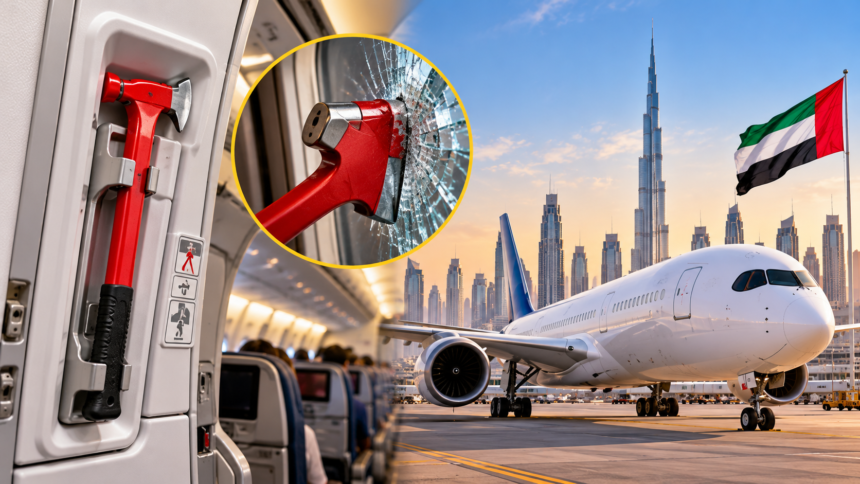
Why Crash Axes Are Kept Hidden From Passengers on UAE Flights
A crash axe is one of those pieces of aircraft emergency equipment that most passengers will never see, yet it can play an important role during a serious emergency.
- What UAE Law Says About Crash Axes on Aircraft
- Are Crash Axes Required on Every Flight?
- Why Large Aircraft Need an Additional Crash Axe or Crowbar
- Why Passengers Normally Cannot See the Crash Axe
- What Is a Crash Axe Actually Used For?
- Do Private Aircraft Follow the Same UAE Rule?
- How UAE Crash Axe Rules Compare With Other Emergency Equipment Requirements
- Are Cabin Crew Trained to Use Crash Axes?
- Does UAE Law Apply to Foreign Airlines Flying Into the Country?
- Crash Axe Requirements in the UAE at a Glance
- Common Misconceptions About Crash Axes on Aircraft
But are crash axes required on every flight?
Under current UAE civil aviation rules, the answer is no.
The requirement depends on the aircraft.
For commercial air transport, the UAE General Civil Aviation Authority says an aeroplane must carry at least one crash axe or crowbar if:
- Its maximum certificated take-off mass is more than 5,700 kg, or
- Its maximum operational passenger seating configuration is more than nine seats
The equipment must be located in the flight crew compartment.
Larger passenger aircraft face an additional requirement.
If an aeroplane has a maximum operational passenger seating configuration of more than 200, an additional crash axe or crowbar must be installed in or near the rearmost galley area.
The rule also says that any crash axe or crowbar located in the passenger compartment must not be visible to passengers.
So while passengers travelling on large commercial aircraft in the UAE may be flying on an aircraft that carries crash axes, those tools are deliberately stored out of sight.
The rules are part of the UAE’s wider emergency equipment requirements designed to ensure flight and cabin crews have appropriate tools available if an unusual situation develops.
This guide explains what UAE law requires, which aircraft must carry crash axes, where the equipment is kept, why passengers normally cannot see it and what role the tools could play during an emergency.
What UAE Law Says About Crash Axes on Aircraft
The current rule appears in the UAE General Civil Aviation Authority’s CAR-AIR OPS Part-CAT, which governs commercial air transport operations.
The relevant provision is:
CAT.IDE.A.255 Crash axe and crowbar.
It requires an aeroplane to carry at least one crash axe or crowbar when either of two thresholds is exceeded:
Maximum certificated take-off mass above 5,700 kg
or
Maximum operational passenger seating configuration above nine seats.
This means the regulation is based on the characteristics of the aircraft rather than the number of passengers actually travelling on a particular flight.
For example, imagine an aircraft approved for 180 passenger seats but carrying only 40 passengers on a particular service.
The aircraft would still fall within the requirement.
That is because the rule looks at the approved aircraft configuration, not how many passengers happen to be on board that day.
The requirement is for a crash axe or crowbar
Another important detail is that UAE rules do not always require the equipment to specifically be an axe.
The wording is:
Crash axe or crowbar.
An operator can therefore meet the relevant requirement using the approved emergency equipment permitted under the regulation.
The primary tool is located with the pilots
For qualifying aircraft, at least one crash axe or crowbar must be located in the flight crew compartment.
That keeps it immediately accessible to trained crew members if needed during an emergency.
Are Crash Axes Required on Every Flight?
No.
It is more accurate to say that certain aircraft are required to be equipped with them.
The requirement is not simply:
“Every flight must have a crash axe.”
A small aeroplane below the applicable weight and passenger-capacity thresholds does not automatically fall under the commercial-air-transport crash axe rule.
The threshold is:
- More than 5,700 kg maximum certificated take-off mass
or
- More than nine approved passenger seats
If either condition applies, the commercial aeroplane must carry at least one crash axe or crowbar in the flight crew compartment.
Most normal airline jets easily exceed the threshold
Aircraft commonly used by major airlines generally exceed 5,700 kg and carry far more than nine passengers.
That means the requirement will apply to conventional passenger airliners.
Examples would include aircraft in categories such as:
- Narrow-body passenger jets
- Wide-body passenger jets
- Larger regional aircraft
Smaller general aviation aeroplanes may fall outside the requirement depending on their certified weight and seating capacity.
It is an aircraft-equipment rule
This distinction is important.
The aircraft is certified and operated with required emergency equipment.
The operator is not deciding before every individual flight whether to put an axe onboard depending on the passenger count.
Emergency equipment forms part of the aircraft’s required operational configuration.
Why Large Aircraft Need an Additional Crash Axe or Crowbar
UAE rules become stricter when passenger capacity becomes very large.
For aeroplanes with a maximum operational passenger seating configuration above 200, an additional crash axe or crowbar must be installed:
In or near the rearmost galley area.
This means very large aircraft can have more than one emergency cutting or prying tool.
Why place one toward the rear?
Large aircraft cabins can be long.
If the only emergency tool were stored on the flight deck, crew members at the back of the aircraft might not be able to access it quickly during certain emergencies.
Providing another tool near the rear gives trained cabin crew additional access.
Possible emergency situations could involve:
- Fire
- Smoke
- Damaged interior panels
- Obstructed access
- Emergency equipment access
The exact use would depend on the situation and operator procedures.
This does not mean cabin crew use axes routinely
Crash axes and crowbars are emergency equipment.
They are not normal operational tools.
Cabin crew are trained in emergency equipment and procedures, but the equipment would only be used when appropriate.
The UAE’s organisation requirements for air operators specifically include crash axes or crowbars among the safety and emergency equipment that cabin crew may need training on, along with fire extinguishers, oxygen equipment, torches and other emergency items.
Why Passengers Normally Cannot See the Crash Axe
One of the most interesting parts of the UAE regulation is the visibility rule.
GCAA regulations state that crash axes and crowbars located in the passenger compartment shall not be visible to passengers.
The associated guidance reinforces this by saying such equipment should be stored in a position that passengers cannot see.
This explains why even frequent flyers may never notice one.
The equipment may be nearby
On a large aircraft with more than 200 approved passenger seats, an additional axe or crowbar can be stored near the rearmost galley.
Passengers sitting nearby may therefore be physically close to the equipment without knowing exactly where it is.
That is intentional.
Emergency equipment is controlled by crew
Many types of aircraft safety equipment are positioned so trained crew can access them quickly.
Some items are visible.
Others are stored inside designated compartments.
The location and accessibility depend on their purpose.
Security is an obvious consideration
A crash axe is a potentially dangerous tool.
Keeping it out of passenger view and under crew control reduces unnecessary access while ensuring trained personnel can still use it if required.
The exact storage design varies by aircraft type and operator.
What Is a Crash Axe Actually Used For?

A crash axe is designed as an emergency tool rather than a conventional household axe.
Its potential purpose is to help crew gain access through aircraft materials during unusual situations.
Depending on the aircraft and emergency, such a tool may assist with:
- Removing interior panels
- Accessing areas behind cabin structures
- Reaching concealed fire sources
- Breaking through certain lightweight materials
- Creating access during an emergency
A crowbar can provide a similar emergency function through prying or forced access.
Fire is one possible scenario
Aircraft fires can develop behind:
- Panels
- Ceiling areas
- Galleys
- Electrical compartments
Crew may sometimes need to access the area where smoke or heat is coming from.
Simply spraying a fire extinguisher toward a closed panel may not reach the source.
Emergency cutting or prying equipment can potentially help trained crew reach concealed areas.
It is part of a larger emergency system
A crash axe is only one tool.
Aircraft emergency equipment can also include:
- Fire extinguishers
- Protective breathing equipment
- Emergency oxygen
- Torches
- Life jackets
- Megaphones
- Evacuation equipment
The GCAA’s training rules specifically include crash axes or crowbars in the list of emergency equipment cabin crew may receive training on.
Do Private Aircraft Follow the Same UAE Rule?
The UAE also has similar requirements for certain non-commercial aircraft.
Under Part-NCC, which covers non-commercial operations with complex motor-powered aircraft, the GCAA uses essentially the same threshold.
An aeroplane with:
- Maximum certificated take-off mass above 5,700 kg
or
- Maximum operational passenger seating configuration above nine
must carry at least one crash axe or crowbar in the flight crew compartment.
If the aeroplane is configured for more than 200 passengers, an additional axe or crowbar must be installed in or near the rearmost galley.
Again, any such equipment in the passenger compartment must not be visible to passengers.
So the rule is not only about airlines
A large privately operated aeroplane could also fall within the requirement.
The relevant question becomes:
What category of operation applies?
and
What are the aircraft’s certified weight and seating characteristics?
Small private aircraft can be different
A small light aircraft that remains below the applicable thresholds may not be required under this specific provision to carry a crash axe or crowbar.
Other safety-equipment requirements can still apply.
How UAE Crash Axe Rules Compare With Other Emergency Equipment Requirements
A crash axe sits within a much larger framework governing aircraft equipment.
The GCAA requires different emergency items depending on factors including:
- Aircraft size
- Passenger seating
- Operation type
- Route
- Aircraft configuration
For example, commercial aircraft also have requirements covering hand fire extinguishers.
The number and positioning of extinguishers increase with passenger capacity.
GCAA guidance says the number and location should ensure they are readily available while considering cabin size, galleys, lavatories and other risk areas.
At least one suitable hand fire extinguisher should also be installed in the flight crew compartment under the associated guidance.
This illustrates how aviation safety works.
There is rarely one identical equipment list for every aircraft.
Requirements become more demanding as:
- Aircraft become larger
- More passengers are carried
- Operational complexity increases
The same logic applies to other systems.
The UAE’s current Aeronautical Information Publication, for example, requires certain turbine aircraft above specified weight or passenger thresholds to carry airborne collision avoidance equipment.
Safety regulation is therefore based on the risk and operating characteristics of the aircraft.
Are Cabin Crew Trained to Use Crash Axes?
Cabin crew emergency training under UAE aviation rules includes familiarisation with the safety and emergency equipment carried by the operator.
The GCAA’s current organisation requirements state that cabin crew members should receive realistic training and demonstrations covering equipment including:
- Fire extinguishers
- Protective breathing equipment
- Crash axe or crowbar
- Emergency lights
- Communication equipment
- Life-saving equipment
where applicable.
This means the equipment is not simply carried without anyone knowing how it works.
Training is aircraft-specific
Cabin configurations vary significantly.
A crew member working on a wide-body aircraft may deal with different:
- Equipment locations
- Galleys
- Doors
- Emergency systems
than someone working on a smaller aircraft.
Crew training therefore includes information relevant to the operator’s specific aircraft configuration.
Fire and smoke training is particularly important
Aircraft fires can develop quickly.
Crew members must understand:
- Fire extinguisher use
- Protective breathing equipment
- Communication with pilots
- Passenger management
Emergency tools such as a crash axe may become relevant depending on where a fire or obstruction develops.
Passengers should never attempt to access such equipment
Emergency equipment stored for crew use should only be handled as directed by trained personnel.
During an emergency, passengers should follow crew instructions rather than trying to locate or use specialised equipment themselves.
Does UAE Law Apply to Foreign Airlines Flying Into the Country?
This requires an important distinction.
UAE-registered operators and aircraft are subject to the country’s civil aviation regulatory framework.
The UAE Civil Aviation Law applies to civil aviation within the state and to UAE-registered civil aircraft, subject to applicable foreign law when they operate abroad.
Foreign operators entering UAE airspace are also subject to applicable UAE operational requirements and authorisations.
The GCAA has a dedicated Foreign Operators Affairs function responsible for rules, approvals and oversight relating to foreign commercial and non-commercial operators in the UAE.
However, aircraft may also be subject to:
- State-of-registry requirements
- ICAO standards
- Operator-specific approvals
This means an aircraft operated by a foreign airline is not necessarily governed only by the exact same certification framework as a UAE-registered aircraft.
International aviation safety rules are built around overlapping responsibilities between:
- State of registry
- State of operator
- State being flown into
For passengers, the practical point is that major commercial aircraft generally operate under detailed emergency-equipment requirements regardless of the airline’s nationality.
Crash Axe Requirements in the UAE at a Glance
The rules can be summarised simply.
| Aircraft Situation | UAE Requirement |
|---|---|
| MCTOM above 5,700 kg | At least one crash axe or crowbar |
| More than 9 approved passenger seats | At least one crash axe or crowbar |
| More than 200 approved passenger seats | Additional crash axe or crowbar near rearmost galley |
| Tool in passenger compartment | Must not be visible to passengers |
| Smaller aircraft below thresholds | Not automatically covered by this specific requirement |
For commercial air transport, these rules appear under CAT.IDE.A.255 in the current GCAA Part-CAT Issue 03.
Similar requirements appear for qualifying non-commercial complex aeroplanes under Part-NCC.
Important terminology
MCTOM means:
Maximum Certificated Take-Off Mass
MOPSC means:
Maximum Operational Passenger Seating Configuration
This is why the actual number of passengers travelling on one flight does not determine whether the aircraft needs the equipment.
The aircraft’s approved characteristics do.
Common Misconceptions About Crash Axes on Aircraft
Crash axes can sound dramatic, which leads to several misunderstandings.
Myth: Every aircraft must carry one
Not under this UAE rule.
The requirement begins when the aircraft exceeds the specified weight or seating threshold.
Myth: Every passenger aircraft has an axe in the cabin
Not necessarily.
The basic requirement is for at least one crash axe or crowbar in the flight crew compartment.
An additional tool near the rear becomes mandatory when the aircraft has more than 200 approved passenger seats.
Myth: Passengers can see where it is stored
UAE rules specifically say crash axes and crowbars in passenger compartments must not be visible to passengers.
Myth: It is mainly for evacuations
Its potential emergency role is broader than that.
It can be useful for gaining access to areas behind panels or structures, including during fire-related emergencies.
Myth: Cabin crew are unfamiliar with the tool
GCAA cabin-crew training guidance specifically includes crash axes and crowbars among relevant emergency equipment.
So, are crash axes required on every flight in the UAE?
No.
Under current GCAA commercial-air-transport rules, the requirement applies to aeroplanes with a maximum certificated take-off mass above 5,700 kg or more than nine approved passenger seats.
Those aeroplanes must carry at least one crash axe or crowbar in the flight crew compartment.
Aircraft configured for more than 200 passengers must carry another crash axe or crowbar in or near the rearmost galley.
And if the equipment is stored within the passenger compartment, passengers should not be able to see it.
Similar requirements also apply to qualifying non-commercial complex aeroplanes.
For passengers, that explains why the equipment can exist onboard without being obvious.
Crash axes and crowbars are part of a wider aircraft emergency system designed around crew access, training and safety.
They are not routinely used, and most passengers will never see one.
But on the aircraft covered by UAE regulations, they remain available for the rare situation in which trained crew may need them.
Do follow us on Instagram
Read More – Sheikh Hamdan Stresses Need to Innovate Education as Dubai Explores New School Models