


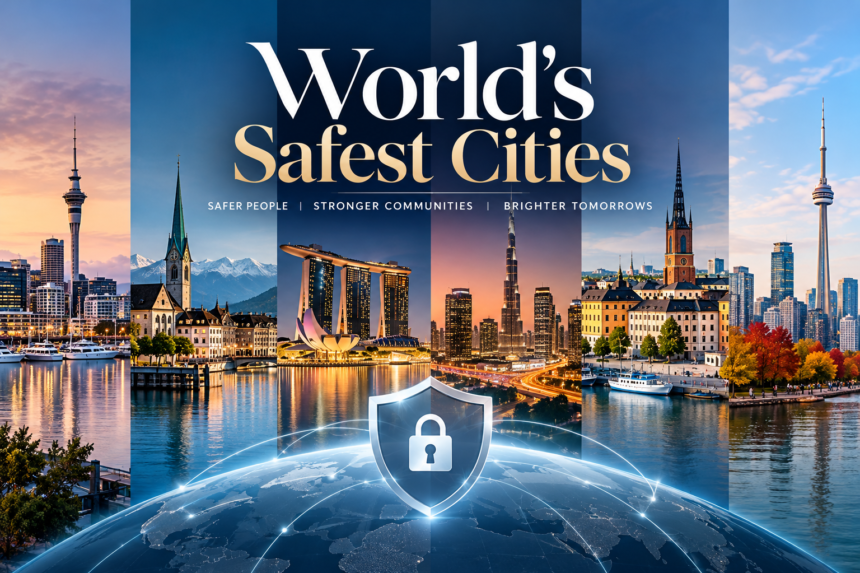
World’s Safest Cities: What the 2026 Rankings Really Tell Us
The world’s safest cities are increasingly important to travellers, expatriates, families and professionals choosing where to live, work or visit. Safety affects almost every part of urban life, from walking alone at night and using public transport to raising children and exploring unfamiliar neighbourhoods.
- World’s Safest Cities in 2026 at a Glance
- Abu Dhabi Remains One of the World’s Safest Cities
- Ajman, Ras Al Khaimah and Sharjah Strengthen the UAE’s Safety Ranking
- Dubai Combines Global Tourism With High Perceived Safety
- Doha and Muscat Show Why Gulf Cities Rank Highly for Safety
- Taipei, Singapore and East Asian Cities Remain Strong Safety Performers
- European Cities Continue to Perform Well on Safety
- What Does a Safety Index Actually Measure?
- Crime Is Only One Part of What Makes a City Safe
- Are the World’s Safest Cities Automatically the Best Places to Live?
- How Travellers Should Use World’s Safest Cities Rankings
- Common Mistakes People Make When Comparing the World’s Safest Cities
- World’s Safest Cities: What the 2026 Rankings Really Tell Us
In 2026, cities in the UAE and wider Gulf continue to perform particularly strongly in global safety rankings. Abu Dhabi retained its position as one of the strongest-performing cities in Numbeo’s 2026 safety data, while Ajman, Ras Al Khaimah, Sharjah, Doha and Dubai also recorded very high scores.
Abu Dhabi was also officially recognised by the emirate’s Media Office as the world’s safest city for the tenth consecutive year in the Numbeo ranking announced in January 2026. The announcement highlighted advanced policing, digital transformation, AI and predictive analytics as part of the emirate’s approach to public security.
However, safety rankings require careful interpretation.
Numbeo’s Safety Index is based largely on perceptions reported by contributors rather than being a single global database of verified police crime statistics. Its country-level methodology states clearly that the data reflects perceptions from visitors to the website over recent years.
That means a high score is useful as one indicator of how safe people feel, but it should not be treated as the only measure of urban safety.
Factors such as emergency response, road safety, political stability, healthcare, public transport, disaster risk and local laws can also shape how secure a city feels in everyday life.
This article looks at some of the strongest-performing cities in 2026, explains why Gulf cities are ranking so highly and shows what travellers should consider beyond a simple ranking.
World’s Safest Cities in 2026 at a Glance
Numbeo publishes both annual and continuously updated safety rankings. The exact order can therefore shift during the year as new data is added.
In its current 2026 Safety Index, Abu Dhabi is listed first with a score of 88.6, followed by Ajman, Ras Al Khaimah, Sharjah, Doha, Dubai, Taipei and Muscat among the strongest-performing cities.
| City | Country | Current Safety Index |
|---|---|---|
| Abu Dhabi | UAE | 88.6 |
| Ajman | UAE | 88.0 |
| Ras Al Khaimah | UAE | 85.7 |
| Sharjah | UAE | 84.7 |
| Doha | Qatar | 84.6 |
| Dubai | UAE | 83.8 |
| Taipei | Taiwan | 83.4 |
| Muscat | Oman | 81.4 |
| The Hague | Netherlands | 79.0 |
| Trondheim | Norway | 78.5 |
The table reflects Numbeo’s current city ranking and should be understood as a snapshot rather than a permanent global order.
The 2026 mid-year dataset produced a slightly different ordering, with Ajman marginally ahead of Abu Dhabi at that specific point in time.
This illustrates an important point: when a source is crowdsourced and continuously updated, rankings can move even when the overall safety picture remains broadly stable.
Abu Dhabi Remains One of the World’s Safest Cities
Abu Dhabi has built one of the strongest international reputations for urban safety.
In January 2026, the Abu Dhabi Media Office announced that the emirate had been ranked the world’s safest city for the tenth consecutive year in Numbeo’s annual ranking.
The city’s current Numbeo Safety Index stands at 88.6, placing it at the top of the continuously updated table.
Why Abu Dhabi scores highly
The emirate’s public-safety strategy combines traditional policing with technology.
The official Abu Dhabi announcement pointed to:
- Proactive policing
- Advanced operational readiness
- Digital transformation
- Artificial intelligence
- Predictive analytics
as factors supporting its security environment.
Residents also report a strong sense of personal safety
Abu Dhabi’s Department of Community Development reported that 93.6% of residents in its fifth Quality of Life Survey said they felt safe walking alone at night.
This is particularly important because feelings of safety influence how people experience a city after dark, use public spaces and participate in community life.
Why the city appeals to families and expatriates
Safety can influence decisions about:
- Choosing residential areas
- Raising children
- Travelling alone
- Working late
- Using public spaces
Abu Dhabi’s combination of low perceived crime, modern infrastructure and strong institutional security contributes to its international reputation.
Ajman, Ras Al Khaimah and Sharjah Strengthen the UAE’s Safety Ranking
One of the most notable features of the 2026 data is that Abu Dhabi is not the only UAE city near the top.
Ajman, Ras Al Khaimah and Sharjah also record very high safety scores.
The current Numbeo ranking lists Ajman at 88.0, Ras Al Khaimah at 85.7 and Sharjah at 84.7.
Ajman
Ajman performed particularly strongly in the 2026 mid-year ranking, briefly taking the number-one position with a safety score of 88.8.
Later current data again placed Abu Dhabi first, which demonstrates how the exact ordering can shift as perceptions are updated.
Ras Al Khaimah
Ras Al Khaimah also ranks among the strongest-performing cities.
Its relatively smaller urban scale, community environment and established policing structure contribute to its reputation as a secure place for residents and tourists.
Sharjah
Sharjah records a current Safety Index of 84.7, placing it among the highest-ranked cities globally.
The city has a large family population and is closely integrated with the wider Dubai-Sharjah metropolitan area.
The broader UAE picture
At country level, Numbeo reported a UAE Safety Index of 86.16 in June 2026. Its perception data also showed very high scores for feeling safe while walking alone during both the day and night.
This consistency across several emirates is one reason the UAE appears so prominently in global safety comparisons.
Dubai Combines Global Tourism With High Perceived Safety
Dubai is one of the world’s busiest international tourism and business cities, yet it continues to maintain a high safety score.
Numbeo’s current 2026 ranking gives Dubai a Safety Index of 83.8.
Visit Dubai also highlights the city’s safety record and notes that Numbeo’s 2025 data placed Dubai among the world’s safest cities, with particularly high perceptions of safety when walking alone.
Strong daytime safety perception
Dubai Media Office reported in July 2026 that Dubai Police achieved a 99.9% score in the perception of daytime safety in a national quality-of-life security survey.
The same report stated that confidence in police stations reached 96.2%.
These indicators help explain why Dubai remains attractive to:
- Solo travellers
- Families
- International workers
- Business visitors
- Long-term residents
Safety does not mean zero risk
Visitors should still take normal precautions.
Dubai’s tourism authority advises travellers to follow guidance around road safety, beaches, hiking, desert activities and emergencies.
The city’s low perceived crime level does not remove risks related to traffic, weather or outdoor activities.
Regional context also matters
Dubai issued a travel advisory in June 2026 noting that the emirate remained stable while authorities continued monitoring wider regional developments. Travellers were advised to check flight status and rely on official information channels.
This shows why a city’s crime ranking should never be the only factor considered when evaluating travel safety.
Doha and Muscat Show Why Gulf Cities Rank Highly for Safety
The UAE is not the only Gulf country performing strongly.
Doha in Qatar and Muscat in Oman also sit near the top of Numbeo’s 2026 rankings.
Doha currently has a Safety Index of 84.6, while Muscat records 81.4.
Doha
Qatar’s capital has developed quickly over the past two decades, combining new infrastructure with extensive public-space development.
Its high safety score contributes to its appeal for:
- Families
- Business travellers
- International residents
- Stopover tourists
Doha’s position also demonstrates how strongly Gulf capitals perform when respondents are asked about crime and personal security.
Muscat
Muscat offers a different urban environment.
The Omani capital is less densely built than Dubai or Doha, but it continues to receive strong safety scores.
Its current Safety Index of 81.4 places it among the world’s strongest-performing major cities.
Why Gulf cities perform well
Common factors can include:
- Visible policing
- Strict enforcement
- Extensive surveillance
- Modern urban infrastructure
- Low perceptions of street crime
- Strong emergency response systems
However, visitors should also understand local laws and cultural rules, which may be stricter than those in their home countries.
A city can feel physically safe while still requiring travellers to pay close attention to legal and social expectations.
Taipei, Singapore and East Asian Cities Remain Strong Safety Performers
The Gulf dominates the top of the 2026 Numbeo table, but several East Asian cities also perform strongly.
Taipei records a current Safety Index of 83.4. Singapore is lower on the same ranking but still records a high score of 77.7.
Taipei
Taipei consistently performs well on measures related to personal security.
For travellers, a strong safety environment can make activities such as public transport use, evening dining and solo exploration feel more comfortable.
Its score places it alongside leading Gulf cities.
Singapore
Singapore has a long-established reputation for public order, strong enforcement and well-developed infrastructure.
Its current score remains high even though it does not appear at the very top of Numbeo’s 2026 ranking.
This is another reminder that different safety indexes can produce different orders depending on methodology.
Why methodology matters
One index may emphasise:
- Personal crime perception
while another may include:
- Digital security
- Healthcare resilience
- Infrastructure
- Environmental risk
- Emergency readiness
That means a city can perform extremely well overall while appearing lower in a specific crime-perception ranking.
European Cities Continue to Perform Well on Safety
Several European cities also appear high in Numbeo’s 2026 data.
The Hague records a current Safety Index of 79.0, while Trondheim, Zagreb, Tallinn, Munich and Ljubljana all perform strongly.
The Hague
The Hague combines a high safety score with a strong overall quality-of-life performance.
In Numbeo’s 2026 mid-year Quality of Life Index, the city recorded a safety score of 78.9 alongside high healthcare and purchasing-power indicators.
This highlights the difference between evaluating a city purely by crime perception and looking at broader quality of life.
Nordic and Central European cities
Cities such as Trondheim, Munich and Ljubljana also benefit from:
- Reliable public services
- Strong urban infrastructure
- Public transport
- Stable institutions
These factors contribute to how safe residents and visitors feel.
European cities may offer a different safety profile
Some Gulf cities score exceptionally highly for low crime perception, while European cities may combine moderate-to-high safety scores with particularly strong healthcare, transport and social infrastructure.
For long-term residents, both aspects matter.
What Does a Safety Index Actually Measure?
Safety rankings can be useful, but readers should understand what sits behind the number.
Numbeo’s Crime and Safety Index is not a police crime database.
The platform states that its data is based on perceptions submitted by users and visitors to its website.
Respondents evaluate concerns such as:
- Crime levels
- Theft
- Robbery
- Assault
- Car theft
- Drug-related problems
- Corruption
- Safety walking alone during the day
- Safety walking alone at night
These responses are then converted into index scores.
High score means higher perceived safety
A higher Safety Index indicates that respondents generally feel safer.
A lower Crime Index indicates lower perceived crime.
The two are closely related.
Why perception matters
Perception is not meaningless.
If large numbers of residents consistently report that they feel comfortable walking alone at night, that tells us something important about daily urban life.
However, perception can be influenced by:
- Sample size
- Media coverage
- Local expectations
- Neighbourhood differences
- Respondent demographics
That is why it should not replace official crime statistics.
Different rankings may disagree
A city can rank first in one index and lower in another.
This does not necessarily mean one is wrong.
It may simply mean the indexes measure different aspects of safety.
Crime Is Only One Part of What Makes a City Safe
A truly safe city must do more than record low levels of street crime.
Travellers and residents should consider a wider range of risks.
Road safety
Traffic accidents can be a greater everyday risk than crime in some cities.
Visitors should understand:
- Pedestrian rules
- Driving culture
- Speed limits
- Public transport options
Healthcare access
A safe city should also provide access to emergency medical care.
This becomes especially important for:
- Families
- Elderly travellers
- Pregnant visitors
- People with chronic conditions
Natural and climate risks
Extreme heat, flooding, earthquakes or severe weather can affect city safety.
For Gulf cities, heat management is particularly important.
A low crime ranking does not mean visitors should spend hours outdoors during extreme summer temperatures without preparation.
Digital and financial scams
Modern urban safety also includes protection against:
- Online scams
- Fraud
- Identity theft
- Payment scams
These risks may not appear clearly in traditional street-crime rankings.
Regional stability
Travel conditions can change because of geopolitical events or transport disruptions.
Official travel advisories should therefore be checked even when the destination itself has a strong crime-safety score.
Are the World’s Safest Cities Automatically the Best Places to Live?
Not necessarily.
Safety is extremely important, but it is only one part of urban quality of life.
A city can be very safe but expensive.
Another may have excellent safety but limited employment opportunities for a particular industry.
Other factors include:
- Housing costs
- Salaries
- Healthcare
- Education
- Pollution
- Transport
- Climate
- Work opportunities
Numbeo’s Quality of Life Index demonstrates this clearly by combining safety with purchasing power, healthcare, commute times, pollution, housing affordability and climate.
Abu Dhabi
Abu Dhabi combines very high safety with a 2026 mid-year Quality of Life Index of 169.0.
Dubai
Dubai records a similarly strong overall quality-of-life score of 168.7 in the same dataset, alongside a Safety Index of 83.8.
Doha
Doha records a Quality of Life Index of 169.2 and a Safety Index of 84.6.
These examples show that strong safety can form part of a broader package rather than functioning alone.
How Travellers Should Use World’s Safest Cities Rankings
Safety rankings are most useful as a starting point.
They can help travellers compare broad perceptions, but they should not replace destination-specific research.
Check neighbourhoods
Safety can differ within the same city.
Research the specific area where your hotel is located.
Check transport
Understand:
- Metro operating hours
- Taxi systems
- Airport transfers
- Late-night transport
A city may be safe but difficult to navigate if you do not understand its transport network.
Know local laws
This is particularly important in Gulf cities.
Visitors should familiarise themselves with laws covering:
- Alcohol
- Photography
- Drugs
- Public behaviour
- Road rules
The safest city can still become complicated for a visitor who ignores local law.
Save emergency numbers
In Dubai, the official tourism safety guide lists 999 for police emergencies.
Travellers should also know local medical and fire numbers for the destination they are visiting.
Continue using normal precautions
Even in cities with very high safety scores:
- Protect passports
- Use official taxis
- Keep valuables secure
- Avoid sharing sensitive banking information
- Stay alert in crowded tourist areas
High safety does not mean zero risk.
Common Mistakes People Make When Comparing the World’s Safest Cities
One common mistake is treating every ranking as though it measures exactly the same thing.
Numbeo measures user perceptions of crime and safety. Other indexes may focus on infrastructure, healthcare, digital security or environmental risk.
Another mistake is presenting a continuously changing ranking as permanent. Numbeo’s annual, mid-year and current tables can show slightly different orders because the underlying data changes over time.
Visitors should also avoid assuming that a high citywide score means every neighbourhood has identical conditions.
Another common mistake is confusing “safe” with “risk-free.” Road accidents, extreme weather, medical emergencies and scams can still occur in cities with very low levels of perceived street crime.
Finally, safety should not be used in isolation when choosing where to live. Housing costs, healthcare, jobs and quality of life matter just as much for long-term decisions.
World’s Safest Cities: What the 2026 Rankings Really Tell Us
The world’s safest cities in 2026 are dominated by the UAE and wider Gulf in Numbeo’s current safety data.
Abu Dhabi currently holds the highest Safety Index at 88.6, followed by Ajman, Ras Al Khaimah, Sharjah, Doha and Dubai. Taipei and Muscat also perform extremely strongly.
Abu Dhabi’s performance is particularly notable because the emirate was officially recognised in January 2026 for topping the Numbeo ranking for a tenth consecutive year.
Dubai also continues to combine a high safety score with a large international tourism and expatriate population. Dubai Police reported a 99.9% daytime safety-perception result in 2025 performance data released in 2026.
However, the rankings should be read carefully.
Numbeo is primarily a perception-based platform, so its safety index tells us how secure respondents feel rather than providing a complete record of official crime statistics.
That makes the data useful, but not complete.
The best way to evaluate urban safety is to combine perception surveys with official crime information, local laws, healthcare access, road safety, emergency response and current travel conditions.
For travellers, one conclusion remains clear: cities such as Abu Dhabi, Dubai, Doha, Muscat and Taipei continue to offer environments where residents and visitors report very high levels of personal security.
But even in the world’s safest cities, sensible planning remains part of travelling well.
Do follow us on Instagram
Read More – Traditional Saudi Dishes Every Visitor Should Try