Future of Sustainable Food Production in Gulf Cities
Food is an essential part of everyday life, but producing enough fresh and healthy food is becoming a major challenge for many cities around the world. In the Gulf region, this challenge is especially important because of high temperatures, limited rainfall, water shortages, and a shortage of fertile agricultural land.
- 1. Why Sustainable Food Production Matters in Gulf Cities
- 2. Vertical Farming Will Change Urban Agriculture
- 3. Hydroponics Will Help Save Water
- 4. Smart Greenhouses Can Support Farming in Hot Weather
- 5. Artificial Intelligence Will Make Farming Smarter
- 6. Urban Farming Will Bring Food Production Closer to People
- 7. Aquaculture Will Support Sustainable Seafood Production
- 8. Renewable Energy Can Make Food Production More Sustainable
- 9. Sustainable Food Production Across the Six GCC Countries
- 10. Reducing Food Waste Will Be Just as Important as Growing More Food
- 11. Better Food Storage and Supply Chains Will Strengthen Cities
- 12. Challenges Facing Sustainable Food Production in the Gulf
- 13. The Role of Consumers in Building Sustainable Food Systems
- 14. What Will the Future of Sustainable Food Production Look Like?
- Conclusion: Building a Sustainable Food Future for Gulf Cities
- Frequently Asked Questions (FAQs)
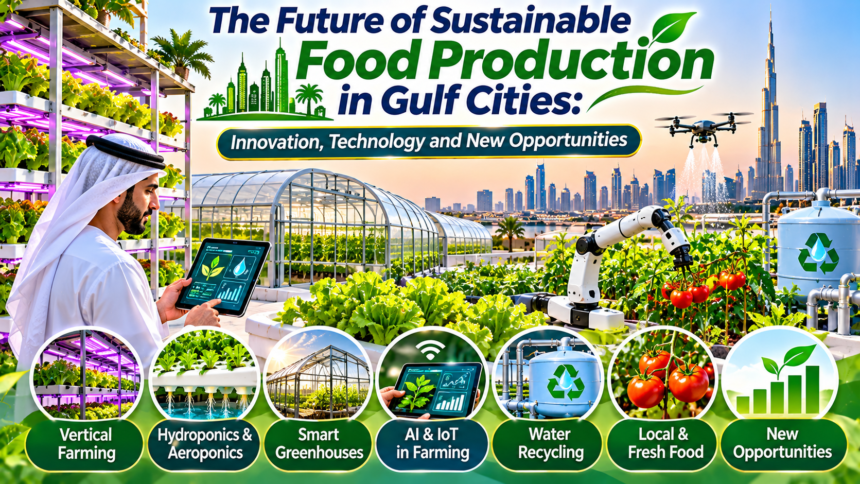
Food production in Gulf cities is changing as countries move away from traditional farming methods and adopt modern techniques such as indoor farming, smart greenhouses, and AI-based technology.
Since GCC countries import more than 80% of their food and have very little land suitable for farming, they are focusing on new ways to grow food locally and reduce their dependence on imports.
Cities such as Dubai, Riyadh, Doha, Muscat, Kuwait City, and Manama depend heavily on food supplies from other countries. Although international trade helps keep shops and supermarkets supplied, it can also make the region more exposed to transport problems, rising food prices, and changes in global markets.
To address these challenges, Gulf countries are exploring new ways to grow, produce, store, and distribute food. Hydroponic farms, vertical farming, smart irrigation, greenhouse agriculture, aquaculture, and food-waste reduction programmes are becoming important parts of this change.
The aim is not to produce everything locally. Instead, Gulf cities want to build stronger food systems that combine local production, responsible water use, modern technology, reliable imports, and better food management.
In this article, we explore the future of sustainable food production in Gulf cities, including the technologies, opportunities, challenges, and country-level initiatives that could shape the region’s food supply in the coming years.
1. Why Sustainable Food Production Matters in Gulf Cities
Sustainable food production is important for Gulf cities because they depend heavily on imported food, face serious water shortages, and have growing populations. Finding better ways to grow food locally is not just about protecting the environment; it is also important for ensuring people have a reliable food supply in the future.
Gulf cities are growing rapidly. More people are moving to urban areas, tourism is expanding, and demand for fresh food is increasing. Supermarkets, restaurants, hotels, and food businesses need reliable supplies throughout the year.
However, the natural environment creates several difficulties for traditional farming. High temperatures, limited rainfall, water scarcity, and sandy soil make large-scale agriculture difficult in many areas.
The Gulf Cooperation Council (GCC) includes Saudi Arabia, the United Arab Emirates, Qatar, Oman, Kuwait, and Bahrain. These countries have invested in food security, but they continue to depend heavily on international food markets.
The United Nations’ Arab Sustainable Development Report 2024 estimates that GCC countries import around 85% of their food. This figure highlights why local production and reliable international supply chains are both important.
Sustainable food production can help Gulf cities:
- Improve access to fresh food.
- Reduce pressure on limited natural resources.
- Support farmers and local food businesses.
- Strengthen food supply during emergencies.
- Create new employment opportunities.
- Reduce food loss and waste.
- Encourage better use of land and water.
The future of food production in the Gulf will depend on finding a balance between local farming and responsible international trade.
2. Vertical Farming Will Change Urban Agriculture
Vertical farming is one of the most interesting developments in modern agriculture. Instead of growing crops across large fields, farmers use vertically arranged shelves or growing systems inside buildings.
Vertical farms grow crops in multiple layers, allowing them to produce 10 to 20 times more food in the same space compared to traditional farms. Empty warehouses, rooftops, and shipping containers can also be turned into places for growing fresh food.
Plants receive carefully controlled amounts of light, water, and nutrients. Many vertical farms use hydroponics, which allows plants to grow without traditional soil.
This method can be useful in Gulf cities because it allows food to be produced in warehouses or other controlled indoor spaces.
Dubai provides a strong example through Bustanica, an indoor vertical farm near Al Maktoum International Airport. The facility covers approximately 330,000 square feet and is designed to produce more than one million kilograms of leafy greens annually. Its operators report that it uses up to 95% less water than conventional outdoor farming.
The farm grows products such as lettuce, spinach, kale, parsley, and other leafy greens. Its controlled environment also allows production throughout the year.
Vertical farming offers several possible benefits:
- Uses less land than many traditional farming systems.
- Can reduce water consumption through recycling.
- Allows year-round production.
- Provides fresh produce close to urban customers.
- Reduces some weather-related risks.
- Allows close monitoring of plant growth.
However, vertical farming is not suitable for every crop. It is particularly useful for selected leafy vegetables and herbs. Growing wheat, rice, or other staple crops indoors on a large scale may be too expensive and energy-intensive.
3. Hydroponics Will Help Save Water
Water is one of the most valuable resources in Gulf cities. Traditional farming can require large amounts of water, especially in hot and dry climates. This makes water-efficient agricultural methods important for the region’s future.
Hydroponic and aeroponic farming systems reuse water instead of wasting it. They can use 90% to 95% less water than traditional farming, making them a good option for growing food in cities where water is limited.
Hydroponics is a farming method in which plants grow using water containing the nutrients they need. The plants are supported by materials or structures rather than ordinary soil.
In many systems, water is circulated and reused instead of being lost through traditional field irrigation.
This approach can help farmers grow vegetables in greenhouses, indoor farms, and other controlled environments.
Some advantages of hydroponic farming include:
- More controlled water use.
- Efficient delivery of nutrients to plants.
- Production in areas with limited fertile soil.
- Better control over growing conditions.
- Potential for year-round harvesting.
- Reduced dependence on some traditional pesticides.
The UAE has encouraged the adoption of hydroponics through its agricultural development programmes. Its official government agriculture information reports that the country has 87 commercial farms using hydroponic technology and states that the method can save up to 70% of water in the relevant farming context.
The actual amount saved depends on the crop, farm design, and comparison method. Hydroponics still needs careful management, clean water, electricity, and suitable technical knowledge.
4. Smart Greenhouses Can Support Farming in Hot Weather
Greenhouses are another important part of sustainable food production in Gulf cities. They allow farmers to grow vegetables and other crops in a more controlled environment.
A greenhouse protects plants from some external conditions, including strong winds, excessive sunlight, and certain pests. Modern greenhouses can also use cooling systems, sensors, automatic irrigation, and climate controls.
Smart greenhouses are designed to monitor conditions such as:
- Temperature.
- Humidity.
- Soil or growing-medium moisture.
- Light levels.
- Nutrient levels.
- Water availability.
When sensors detect a change, automated systems can adjust irrigation, ventilation, or other growing conditions.
For example, a greenhouse in the UAE may use controlled cooling and shade systems to protect vegetables during hot weather. In Riyadh or Doha, similar systems can support the production of tomatoes, cucumbers, peppers, and leafy vegetables.
However, cooling greenhouses can require significant energy. Farmers need to select designs that suit local conditions and use efficient cooling, shading, and ventilation to manage operating costs.
5. Artificial Intelligence Will Make Farming Smarter
Artificial intelligence (AI) is creating new opportunities for agriculture. Smart farming systems can collect information from sensors, cameras, weather services, and irrigation equipment.
AI tools can help farmers understand this information and make better decisions.
For example, a smart system may identify areas where plants need more water or detect early signs of disease. It may also help predict harvest times and monitor crop growth.
Some possible uses of AI in Gulf agriculture include:
- Detecting plant diseases at an early stage.
- Monitoring crop health through cameras.
- Predicting irrigation requirements.
- Managing greenhouse temperatures.
- Tracking crop growth.
- Forecasting production levels.
- Reducing unnecessary use of fertilisers and water.
Saudi Arabia has already introduced technology-based urban farming projects. In April 2024, the Ministry of Environment, Water and Agriculture launched a vertical farm inside a Danube supermarket in Riyadh. The project used artificial intelligence and the Internet of Things to grow products such as lettuce, coriander, parsley, and broccoli.
Such projects show how food production may become more closely connected with the daily life of urban consumers.
6. Urban Farming Will Bring Food Production Closer to People
Urban farming means growing food within or close to cities. It can take place on rooftops, inside buildings, in community gardens, or on unused urban land.
The idea is simple: instead of producing all food far away and transporting it into cities, some products can be grown closer to where people live.
Urban farming can be useful for Gulf cities because it may reduce the distance between farms, shops, restaurants, and consumers.
Examples include:
- Rooftop vegetable gardens.
- Indoor vertical farms.
- Small hydroponic systems.
- Community gardens.
- Farms inside supermarkets.
- Greenhouses near residential areas.
The Riyadh supermarket farm is an example of bringing growing systems directly into a retail environment. Customers can see selected plants being grown close to the point of sale.
Urban farming cannot replace large agricultural operations or international food supplies. However, it can provide fresh vegetables and herbs, support local businesses, and introduce more people to how food is produced.
7. Aquaculture Will Support Sustainable Seafood Production
The Gulf has a long connection with fishing and seafood. Fish is an important part of the food culture in countries such as Oman, Bahrain, Qatar, Kuwait, Saudi Arabia, and the UAE.
However, growing demand for seafood can place pressure on wild fish populations. Sustainable aquaculture offers another way to produce fish and other aquatic food.
Aquaculture means farming fish, shellfish, and other aquatic organisms under managed conditions. It can take place in sea cages, coastal facilities, ponds, or land-based systems.
Oman is developing its aquaculture sector as part of its food security and economic diversification plans. According to an Oman government report published in May 2026, aquaculture production reached 9,240 tonnes by the end of 2025. The report also describes investments in shrimp, marine fish, oysters, abalone, and other products.
Aquaculture may support Gulf food systems by:
- Increasing the supply of locally produced seafood.
- Creating jobs in coastal communities.
- Supporting seafood processing businesses.
- Reducing some pressure on wild fish stocks.
- Creating new opportunities for investment and research.
However, aquaculture must be managed responsibly. Poorly managed fish farms can affect water quality, spread disease, and create waste. Sustainable production requires suitable locations, careful feeding, monitoring, and environmental protection.
8. Renewable Energy Can Make Food Production More Sustainable
Modern agricultural systems often use electricity for lighting, cooling, water pumps, sensors, and refrigeration. In the hot Gulf climate, energy demand can be especially important.
If food production relies on electricity from fossil fuels, some environmental benefits of efficient farming may be reduced.
Solar power offers an opportunity because Gulf countries receive strong sunlight throughout much of the year.
Solar energy can support:
- Greenhouse cooling systems.
- Water pumps.
- Indoor farm lighting.
- Refrigerated storage.
- Food processing facilities.
- Farm monitoring equipment.
For example, a greenhouse could use solar panels to supply part of the electricity required for irrigation and other operations.
Some farms may also combine solar power with battery storage or the electricity grid to maintain a reliable supply.
The future challenge will be to make modern farms efficient in both water and energy. A farming method that saves water but consumes excessive electricity may not always provide the best environmental result.
9. Sustainable Food Production Across the Six GCC Countries
Each Gulf country has different agricultural conditions, available resources, and development priorities. Their approaches to sustainable food production therefore vary.
United Arab Emirates
The UAE has invested in vertical farming, hydroponics, greenhouse agriculture, and food technology.
Its National Food Security Strategy 2051 aims to strengthen local production, diversify food imports, improve food supply chains, and reduce waste.
Dubai’s Food Tech Valley is planned as an ecosystem connecting food production, research, logistics, and innovation. Its focus areas include vertical farming, hydroponics, fish farming, and other modern agricultural methods.
Saudi Arabia
Saudi Arabia is developing modern agriculture under Vision 2030. Its efforts include water-efficient irrigation, protected farming, aquaculture, and support for local producers.
The 2024 urban farm project in Riyadh is one example of bringing technology-based agriculture into the city.
In May 2026, the Saudi Press Agency reported that the country’s agricultural and food production exceeded 16 million tonnes in 2024. The same report highlighted improvements in modern irrigation and the development of local food production.
Qatar
Qatar’s National Food Security Strategy 2030 was launched in December 2024. It focuses on sustainable food security, healthy consumption, food safety, climate adaptation, and effective partnerships.
Hydroponics, smart irrigation, and aquaponics are among the technologies being used to improve production while managing limited land and water resources.
Oman
Oman has opportunities in agriculture, fisheries, and aquaculture. Its coastline supports seafood production, while agricultural development programmes aim to improve local production and rural livelihoods.
The country is also investing in shrimp and marine fish farming to diversify its food supply.
Bahrain
Bahrain is working to strengthen local food production and support agricultural projects. Its efforts include developing farming methods that make better use of limited land and water resources.
Kuwait
Kuwait is supporting agricultural production, food reserves, and technology-based farming. Greenhouses and other controlled growing systems can help produce selected vegetables in a challenging climate.
The GCC Secretariat’s September 2026 update describes the different food security initiatives across all six countries, including technology adoption, strategic reserves, sustainable production, and reduced food waste.
10. Reducing Food Waste Will Be Just as Important as Growing More Food
Producing more food is only one part of a sustainable food system. Cities also need to prevent food from being lost or wasted during storage, transport, shopping, cooking, and serving.
Food waste uses resources unnecessarily. When food is thrown away, the water, energy, land, labour, and transport used to produce it are also wasted.
Restaurants, hotels, supermarkets, and households all have a role to play.
Some practical ways to reduce food waste include:
- Planning food purchases carefully.
- Improving storage and refrigeration.
- Donating safe surplus food.
- Managing restaurant portion sizes.
- Using more of each ingredient.
- Turning suitable food waste into compost.
- Improving transport and packaging systems.
The UAE’s National Food Loss and Waste Initiative, ne’ma, aims to reduce food loss and waste by 50% by 2030. It works with government organisations, businesses, food retailers, hospitality companies, and communities.
Reducing food waste can improve the efficiency of the entire food system without requiring more farmland or water.
11. Better Food Storage and Supply Chains Will Strengthen Cities
Even when food is grown locally, it must be stored, transported, and delivered properly. Poor storage conditions can cause fresh products to spoil before they reach shops or customers.
This is especially important in Gulf cities, where high outdoor temperatures can affect food quality.
Cold storage, refrigerated transport, improved packaging, and digital supply-chain management can help keep food fresh for longer.
Modern logistics systems can help businesses:
- Monitor storage temperatures.
- Track food during transport.
- Manage stock levels.
- Predict demand.
- Reduce unnecessary deliveries.
- Identify products that need to be sold sooner.
Dubai’s position as an international logistics centre gives it an advantage in food distribution. Other Gulf cities can also strengthen local transport and storage systems to improve access to fresh products.
A strong food supply system needs both efficient production and reliable distribution.
12. Challenges Facing Sustainable Food Production in the Gulf
Although modern farming offers many opportunities, Gulf cities still face important challenges.
Water scarcity: Farming requires water, and freshwater resources are limited. Even water-efficient systems must have a reliable water source.
High temperatures: Extreme heat can damage crops and increase the need for cooling and shade.
Energy consumption: Indoor farms and climate-controlled greenhouses can require significant electricity.
High operating costs: Advanced equipment, skilled workers, maintenance, and cooling systems can make modern farms expensive.
Limited crop variety: Vertical farms are suitable for some vegetables but cannot easily replace large outdoor farms for every type of food.
Dependence on technology: Sensors, automated systems, and specialised equipment need maintenance and trained staff.
Market competition: Locally grown products must compete with imported food on price, quality, and availability.
The future success of sustainable farming will depend on choosing the right technology for each crop and location rather than using one solution everywhere.
13. The Role of Consumers in Building Sustainable Food Systems
Governments, farmers, and food companies have important responsibilities, but consumers can also influence the future of food production.
People make choices every day about what they buy, how much they cook, and how they store food. These habits can affect demand, food waste, and the success of local producers.
Consumers can support sustainable food systems by:
- Buying seasonal products when available.
- Choosing locally produced food where practical.
- Avoiding unnecessary food purchases.
- Storing food correctly.
- Using leftovers safely.
- Supporting responsible food businesses.
- Learning about where food comes from.
Restaurants can also offer suitable portion sizes and reduce food waste through better menu planning.
When consumers value quality, responsible production, and reduced waste, businesses have stronger reasons to improve their practices.
14. What Will the Future of Sustainable Food Production Look Like?
The future of food production in Gulf cities will probably involve several methods working together.
Vertical farms may produce selected leafy greens close to consumers. Greenhouses may grow tomatoes, cucumbers, peppers, and other vegetables. Aquaculture may provide more locally produced seafood, while smart irrigation can help existing farms use water more efficiently.
Technology will also connect different parts of the food system. AI tools may help predict crop needs, digital systems may improve delivery planning, and better cold storage may reduce spoilage.
Some important developments to watch include:
- Expansion of indoor and vertical farms.
- More efficient hydroponic systems.
- Better use of solar energy in agriculture.
- Growth in responsible fish and seafood farming.
- Improved food storage and delivery.
- More research into crops suited to hot climates.
- Stronger cooperation between Gulf countries.
- Wider public awareness of food waste.
The region will still need international food trade. Sustainable local production is not about stopping imports; it is about creating more reliable and balanced food systems.
Conclusion: Building a Sustainable Food Future for Gulf Cities
The future of sustainable food production in Gulf cities will be shaped by technology, responsible resource use, investment, and cooperation. Water-efficient farming, vertical agriculture, smart greenhouses, aquaculture, renewable energy, and improved food storage can all help strengthen the region’s food systems.
Dubai, Riyadh, Doha, Muscat, Kuwait City, and Manama are exploring different ways to improve local production and reduce pressure on natural resources. Their efforts show that agriculture can develop even in challenging environments when suitable technology and careful planning are used.
However, modern farming alone cannot solve every food security problem. Gulf cities must also maintain reliable international trade, protect water resources, reduce food waste, support farmers, and make sustainable food more accessible to consumers.
The future of food in the Gulf is not simply about growing more. It is about producing food wisely, using fewer resources, reducing waste, and building a supply system that can support future generations.
Frequently Asked Questions (FAQs)
1. What is sustainable food production?
Sustainable food production means growing, raising, processing, and distributing food in ways that protect natural resources, reduce waste, and support long-term food availability.
2. Why is sustainable food production important in Gulf cities?
It is important because Gulf countries face water scarcity, limited farmland, high temperatures, and heavy dependence on food imports. Sustainable methods can improve local production and strengthen food security.
3. What is vertical farming?
Vertical farming is a method of growing crops in stacked layers, usually inside a controlled building. It often uses artificial lighting and systems such as hydroponics to grow plants efficiently.
4. How does hydroponics help save water?
Hydroponics delivers nutrients to plants through water rather than traditional soil. Many systems circulate and reuse water, which can reduce water loss compared with conventional farming.
5. Which Gulf cities are investing in sustainable agriculture?
Dubai, Riyadh, Doha, Muscat, Kuwait City, and Manama are among the cities connected with national or local initiatives supporting food security, modern farming, or agricultural development.
6. What is the role of technology in future food production?
Technology can help farmers monitor crops, manage water, control greenhouse conditions, detect plant diseases, predict harvests, and improve food storage and distribution.
7. Can vertical farming produce all types of food?
No. Vertical farming is especially useful for selected leafy vegetables and herbs. Growing staple crops such as wheat and rice indoors is generally more challenging and costly.
8. How can aquaculture support Gulf food security?
Aquaculture can increase the local supply of fish and other seafood, create jobs, and support coastal businesses. It must be managed responsibly to protect marine environments.
9. How can Gulf cities reduce food waste?
Cities can improve food storage, donate safe surplus food, plan restaurant portions, educate consumers, improve supply chains, and encourage households to buy and prepare only what they need.
10. Will Gulf countries become fully self-sufficient in food?
Complete food self-sufficiency is difficult because of limited water and farmland. A more practical goal is to increase suitable local production while maintaining diverse and reliable international food supplies.
Do follow us on Instagram
Read More – Dubai International Airport (DXB)