Why Cool Roofs and Reflective Surfaces Matter in Middle Eastern Cities
Across the Middle East, rising temperatures, expanding urban populations, and increasing demand for air conditioning are creating new challenges for building design and energy management. From Dubai and Abu Dhabi to Riyadh, Doha, Muscat, Manama, and Kuwait City, residential towers, commercial buildings, shopping centres, and public infrastructure must provide comfortable indoor environments despite prolonged periods of intense heat.
- 1. Why Reflective Building Materials Matter in Hot Middle Eastern Cities
- 2. How Cool Roofs Could Reduce Air-Conditioning Demand
- 3. What Dubai and Riyadh Reveal About Reflective Building Materials
- 4. How Reflective Walls, Pavements, and Façades Could Improve Urban Design
- 5. The Environmental and Economic Benefits of Reflective Construction Materials
- 6. Challenges of Reflective Materials in Desert Environments
- 7. The Future of Reflective Building Materials in Middle Eastern Cities
As cities continue expanding, reflective building materials in Middle Eastern cities could become an important part of reducing energy consumption and improving urban resilience.
Unlike conventional dark-coloured surfaces that absorb substantial amounts of sunlight, reflective materials are designed to redirect a greater proportion of incoming solar radiation away from buildings. This can help keep roofs and selected exterior surfaces cooler, reducing the amount of heat entering indoor spaces.
Reflective roofing membranes, specialised paints, exterior coatings, and certain construction materials are already being studied or incorporated into energy-efficient buildings.
In the Gulf, where cooling can represent a major part of building electricity demand, even modest improvements in thermal performance may create meaningful benefits when applied across large numbers of properties.
Research from Saudi Arabia and the UAE has demonstrated the potential of reflective surfaces to reduce cooling loads under particular conditions. Dubai’s green building framework also recognises the role of solar reflectance in limiting urban heat accumulation.
However, reflective materials are not a universal solution. Their effectiveness depends on roof insulation, building orientation, surface cleanliness, surrounding structures, climate, and maintenance.
Reflective walls and pavements also require careful design because redirected sunlight can sometimes increase glare or heat exposure elsewhere.
Understanding these opportunities and limitations reveals how reflective building technologies could contribute to more energy-efficient Middle Eastern cities.
1. Why Reflective Building Materials Matter in Hot Middle Eastern Cities
Buildings absorb heat from several sources, including sunlight, outdoor air, internal equipment, and occupants.
During hot weather, air-conditioning systems remove unwanted heat to maintain comfortable indoor temperatures.
Reducing the amount of heat entering a building can therefore reduce some of the work required from cooling equipment.
Understanding Solar Heat Absorption
Sunlight contains energy across visible, ultraviolet, and infrared wavelengths.
When sunlight reaches a building surface, part of the energy is reflected and part is absorbed.
Absorbed energy increases the surface temperature and may contribute to heat transfer into the building.
A dark rooftop exposed to strong sunlight can therefore become considerably hotter than a more reflective surface.
However, colour alone does not fully describe material performance.
Some specially engineered darker coatings can reflect more near-infrared solar radiation than conventional products with similar visible colours.
Solar Reflectance and Thermal Emittance
Two important properties influence the performance of cool roofing materials.
Solar reflectance describes the proportion of incoming solar energy reflected by a surface.
Thermal emittance describes how effectively that surface releases heat through thermal radiation.
A material combining high solar reflectance with suitable thermal emittance can remain cooler under sunlight.
The US Department of Energy identifies both characteristics as important when evaluating cool roofs.
Why Urban Heat Islands Matter
Cities often contain large areas of asphalt, concrete, rooftops, and other surfaces that absorb solar energy.
Buildings and roads can store heat during the day and release it later.
This contributes to the urban heat island effect, where developed areas may experience higher temperatures than surrounding less-developed locations.
Reflective materials can reduce heat absorption by selected surfaces.
However, citywide temperature changes depend on the scale of installation, local geography, vegetation, and urban design.
Conventional and Reflective Materials Compared
| Property | Conventional Dark Surface | High-Reflectance Surface |
|---|---|---|
| Solar Reflection | Generally lower | Generally higher |
| Solar Heat Absorption | Generally higher | Generally lower |
| Surface Temperature | Often hotter in direct sunlight | May remain cooler |
| Heat Entering Building | Can be greater | May be reduced |
| Cooling Demand | Depends on insulation and design | Potentially lower |
| Maintenance | Material-dependent | Reflectance may require cleaning |
| Suitability | Depends on application | Requires climate and building assessment |
Reflective materials can help reduce unwanted heat, but they work most effectively as part of an integrated building design.
2. How Cool Roofs Could Reduce Air-Conditioning Demand
Roofs are among the most promising surfaces for reflective building materials because they are frequently exposed to direct sunlight.
A cool roof uses materials or coatings designed to reflect more solar radiation than conventional alternatives.
Why Roof Temperature Matters
When a roof absorbs sunlight, its temperature increases.
Some heat may then pass through the roof assembly into the building.
The quantity transferred depends on insulation, construction materials, ventilation, and the temperature difference between indoor and outdoor environments.
A reflective roof can reduce the solar heat absorbed by the outer surface.
This may lower cooling requirements, particularly in buildings with high roof exposure.
Evidence From Energy Research
The US Environmental Protection Agency reports that cool roofs can reduce peak cooling demand in air-conditioned residential buildings by approximately 11% to 27% under the conditions examined in cited studies.
These values are not guaranteed savings for every building.
They depend on insulation, equipment efficiency, climate, and roof characteristics.
Research From Dubai
A 2024 study published in the journal Solar Energy examined cool roof performance in Dubai.
The researchers assessed reflective materials and their effects on building cooling demand.
The study reported average cooling-load reductions of approximately 32.16% for non-insulated buildings and 24.3% for insulated buildings in its modelled scenarios.
These findings show why insulation levels matter.
They should not be interpreted as measured electricity-bill reductions for all Dubai properties.
Different Cool Roof Technologies
Reflective roofs can be created through several approaches.
| Cool Roof Type | Potential Advantage | Important Consideration |
|---|---|---|
| Reflective Coating | Can be applied to suitable existing roofs | Surface preparation and maintenance |
| Reflective Membrane | Integrated roofing solution | Waterproofing and installation quality |
| Reflective Roof Tiles | Suitable for selected roof designs | Weight and compatibility |
| Cool Metal Roofing | Durable material options | Thermal emittance and glare |
| Specialised Roof Paint | Relatively accessible retrofit option | Coating lifespan and cleaning |
| Engineered Reflective Materials | Targeted solar-reflection properties | Cost and verified performance |
Retrofitting Existing Buildings
Some existing roofs can be upgraded with suitable reflective coatings.
This may offer an opportunity to improve thermal performance without replacing the entire roofing system.
However, the existing roof must be inspected first.
A reflective coating should not be used to conceal damaged waterproofing, structural defects, or moisture problems.
Professional assessment is essential before application.
3. What Dubai and Riyadh Reveal About Reflective Building Materials
The UAE and Saudi Arabia provide useful examples of how reflective building technologies are being incorporated into regulation and scientific research.
Their experiences demonstrate both the potential of reflective materials and the importance of applying them under suitable conditions.
Dubai’s Al Sa’fat Green Building Framework
Dubai’s Al Sa’fat green building requirements address the urban heat island effect.
The framework specifies minimum Solar Reflectance Index, or SRI, values for relevant roofing surfaces.
For flat and low-sloped roofs, the listed minimum SRI is 78, while steep-sloped roofs have a minimum value of 29.
The requirements apply to the specified proportion of qualifying roof surfaces and must be interpreted alongside the full building regulations.
Dubai Municipality also provides conformity certification procedures for roofing materials assessed against relevant solar-reflectance requirements.
These provisions demonstrate that reflective materials are already part of the city’s building-efficiency framework.
Understanding the Solar Reflectance Index
SRI combines solar reflectance and thermal emittance into a calculated indicator describing how hot a surface is expected to become under defined conditions.
A higher SRI generally indicates better resistance to solar heat accumulation.
However, SRI is not the same as a measured percentage of electricity savings.
Two buildings using materials with the same SRI can experience different energy outcomes.
Riyadh’s Urban Cooling Research
A study published in Nature Cities in January 2024 examined heat-mitigation strategies across 3,323 buildings in Riyadh.
The researchers considered combinations of advanced cool materials, greenery, and building energy adaptations.
Their modelled scenarios found that selected urban strategies could reduce peak ambient temperature by up to 4.5°C.
Cooling energy conservation reached up to 16% under certain heat-mitigation scenarios, while combined approaches incorporating energy adaptation measures produced reductions of up to 35%.
These represent results under the study’s modelling assumptions rather than measured citywide outcomes.
Why Combined Strategies Perform Differently
Reflective materials may reduce solar heat absorption.
Insulation slows heat transfer.
Shading limits direct sunlight reaching selected surfaces.
Vegetation can modify local microclimates when suitable water resources and maintenance are available.
Combining these measures may provide greater benefits than relying on a single intervention.
However, combined strategies also introduce additional costs and environmental considerations.
Regional Lessons
| Regional Evidence | What It Demonstrates |
|---|---|
| Dubai Al Sa’fat Requirements | Reflective roofing is recognised in building standards |
| Dubai Cool Roof Research | Savings depend on insulation and material properties |
| Riyadh Urban Heat Research | Reflective materials can contribute to wider heat mitigation |
| Saudi Climate Studies | Regional climate differences affect performance |
| GCC Material Testing | Long-term ageing and maintenance influence results |
The main lesson is that reflective materials should be evaluated within the wider building and urban environment.
4. How Reflective Walls, Pavements, and Façades Could Improve Urban Design
Roofs are important, but they are not the only surfaces exposed to sunlight.
Building façades, walkways, parking areas, and paved public spaces can also absorb heat.
Reflective materials may help reduce temperatures across these surfaces.
However, their benefits and risks can differ from those of roofs.
Reflective Exterior Walls
Exterior walls receive varying amounts of sunlight depending on orientation and surrounding buildings.
Reflective coatings may reduce solar absorption, particularly on heavily exposed façades.
However, the resulting cooling savings depend on insulation, wall construction, window area, and shading.
Highly reflective walls can also redirect sunlight toward nearby buildings or public areas.
Cool Pavements
Cool pavements use materials or surface treatments intended to reduce pavement temperatures.
Possible approaches include lighter-coloured materials and specially engineered coatings.
These may reduce heat storage compared with darker conventional surfaces.
However, lower pavement surface temperatures do not automatically translate into improved pedestrian comfort.
Reflected solar radiation may increase exposure for people walking nearby.
The Challenge of Glare
Excessive visible reflection can create glare.
This can affect pedestrians, drivers, and neighbouring buildings.
Architects should therefore consider the direction and intensity of reflected sunlight.
Materials designed to reflect more near-infrared energy while limiting unwanted visible glare may offer advantages in selected applications.
Reflective Façades and Glazing
Highly reflective exterior finishes should not be confused with high-performance glazing.
Windows involve additional considerations such as solar heat gain coefficient, visible-light transmission, insulation, and occupant comfort.
A reflective coating on an opaque wall works differently from a solar-control coating applied to glass.
Both require appropriate design assessment.
Urban Surfaces Compared
| Surface | Potential Benefit | Main Trade-Off |
|---|---|---|
| Rooftops | Reduced solar heat gain | Maintenance and insulation interaction |
| Exterior Walls | Lower heat absorption | Glare and reflected radiation |
| Pavements | Reduced surface temperature | Pedestrian radiant exposure |
| Parking Areas | Lower absorbed solar heat | Durability and visibility |
| Building Façades | Potential energy improvements | Architectural and neighbouring impacts |
| Solar-Control Glazing | Reduced window heat gain | Daylight and visual comfort considerations |
Why Urban Design Must Consider People
The objective of reflective urban materials should not simply be to produce cooler surface-temperature readings.
Cities also need to assess pedestrian comfort, accessibility, outdoor shade, and local environmental conditions.
Shading structures, well-designed walkways, and suitable landscaping may be more effective than reflective pavement alone in some locations.
5. The Environmental and Economic Benefits of Reflective Construction Materials
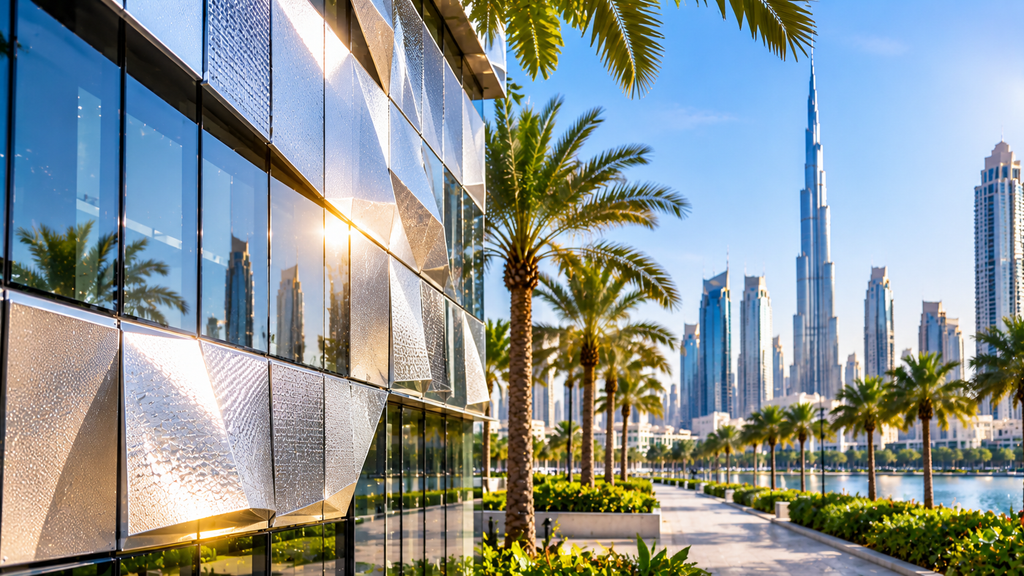
Reflective building materials could help reduce energy consumption, operating costs, and some environmental impacts associated with cooling.
However, their value depends on how much energy they save relative to the costs and impacts of manufacturing, installation, and maintenance.
Reducing Electricity Consumption
When a reflective surface reduces heat entering a building, air-conditioning equipment may require less electricity.
The extent of savings depends on the building’s cooling system and thermal characteristics.
A highly insulated building may experience smaller incremental savings than a poorly insulated property.
However, lower roof temperatures may still offer other benefits.
Lower Peak Cooling Demand
Reflective roofs may help reduce cooling demand during hot, sunny periods.
This can be relevant to electricity networks because air-conditioning often contributes to peak demand in hot climates.
However, roof reflectance is only one factor affecting electricity demand.
Equipment efficiency, occupancy, temperature settings, and building operation also matter.
Potential Emissions Reductions
If reflective materials reduce electricity consumption, they may also reduce greenhouse gas emissions associated with electricity generation.
However, emissions benefits depend on the electricity supply.
The same electricity saving can have different carbon implications in locations with different generation mixes.
Financial Considerations
Reflective products may involve higher initial costs than conventional alternatives.
Building owners should consider material prices, installation, maintenance, durability, and expected energy savings.
For example, applying a suitable reflective coating during planned roof maintenance may be more economical than undertaking a separate project solely for that purpose.
However, actual financial returns require building-specific assessment.
Benefits and Their Conditions
| Potential Benefit | Conditions That Influence Results |
|---|---|
| Lower Cooling Energy | Roof exposure, insulation and HVAC efficiency |
| Reduced Peak Demand | Time of day and cooling operation |
| Lower Surface Temperatures | Reflectance, emittance and cleanliness |
| Reduced Emissions | Electricity generation mix |
| Better Indoor Comfort | Building envelope and ventilation |
| Lower Operating Costs | Energy prices and maintenance |
| Longer Material Life | Product quality and environmental exposure |
The Role of Lifecycle Assessment
Manufacturing reflective coatings, membranes, and construction materials requires energy and resources.
Projects should therefore consider the environmental impacts associated with production, transport, installation, maintenance, and eventual disposal.
A material that saves electricity over a long period may deliver a positive lifecycle outcome.
However, the result depends on its durability and actual performance.
6. Challenges of Reflective Materials in Desert Environments
Despite their potential, reflective materials face particular challenges in Middle Eastern cities.
Dust accumulation, sand exposure, strong sunlight, temperature fluctuations, and maintenance conditions can influence performance.
Dust and Surface Soiling
Desert environments can experience frequent dust accumulation.
When reflective surfaces become dirty, their ability to reflect sunlight may decrease.
This can reduce the cooling benefits achieved immediately after installation.
Research published in Buildings in 2023 investigated the ageing and energy performance of high-SRI paints in GCC residential conditions.
The findings highlight the importance of considering material performance over time rather than relying only on initial laboratory ratings.
Maintenance and Cleaning
Reflective coatings may require inspections and periodic cleaning.
However, cleaning introduces additional costs and may consume water.
In water-stressed environments, maintenance strategies should balance reflectance performance with responsible resource use.
Manufacturers’ recommended methods should be followed to avoid damaging coatings or waterproofing systems.
Durability Under Extreme Weather
Prolonged solar exposure and environmental conditions can affect some roofing materials.
Product selection should therefore consider ultraviolet resistance, thermal expansion, mechanical durability, and compatibility with the underlying structure.
A material that performs well in initial testing may deteriorate if it is unsuitable for local conditions.
The Importance of Insulation
Reflective materials reduce solar heat absorption at the surface.
Insulation reduces heat transfer through the building envelope.
These functions complement one another but are not interchangeable.
An uninsulated roof may benefit substantially from reflectance improvements, but insulation may still be required to meet building standards and comfort requirements.
Potential Heating Penalties
Reflective roofs can reduce beneficial solar heat gain during cooler periods.
In some climates, this may increase heating requirements.
For many hot Gulf locations, cooling benefits may outweigh heating penalties.
However, mountainous and seasonally cooler areas require different assessment.
Common Challenges and Practical Responses
| Challenge | Potential Impact | Possible Response |
|---|---|---|
| Dust Accumulation | Lower reflectance | Appropriate cleaning and aged-performance testing |
| Intense UV Exposure | Material deterioration | Suitable certified products |
| Poor Installation | Reduced lifespan | Qualified installers |
| Glare | Outdoor discomfort | Appropriate surface selection |
| Inadequate Insulation | Continued heat transfer | Integrated envelope design |
| Maintenance Costs | Reduced financial savings | Lifecycle cost analysis |
| Water Use for Cleaning | Additional resource demand | Efficient maintenance methods |
| Seasonal Climate Variation | Different annual energy results | Climate-specific modelling |
Why Certification Matters
Building owners should look for independently verified product performance rather than relying only on advertising claims.
Relevant indicators may include solar reflectance, thermal emittance, SRI, and aged reflectance values.
The Cool Roof Rating Council provides guidance and rated-product information that can support material comparisons.
However, local building codes and certification requirements should take priority where applicable.
7. The Future of Reflective Building Materials in Middle Eastern Cities
Reflective construction materials could become a more important part of sustainable urban development as Middle Eastern cities seek to manage rising cooling demand.
Their future may involve improved material technologies, stronger performance testing, and closer integration with building design and urban planning.
Advanced Cool Coatings
Researchers are exploring coatings designed to reflect more solar radiation while releasing heat efficiently.
Some advanced materials are engineered to achieve cooling effects through radiative heat transfer.
However, laboratory performance does not guarantee identical results on occupied buildings.
Durability, cost, installation conditions, and long-term environmental exposure remain important.
Combining Reflective Materials With Passive Cooling
Reflective surfaces may perform best when used alongside other building-efficiency measures.
These can include roof insulation, external shading, appropriate glazing, ventilation strategies, and efficient cooling systems.
Building orientation and neighbouring structures also influence heat exposure.
The Role of Smart Building Technology
Digital monitoring systems may help facility managers evaluate energy consumption and indoor temperatures before and after reflective upgrades.
Building energy simulations can estimate possible outcomes.
However, measured energy performance is influenced by weather, occupancy, equipment operation, and other variables.
Evaluations should account for these differences when attributing savings to reflective materials.
A Practical Reflective Building Materials Checklist
- Assess existing roof and wall conditions.
- Review relevant local building requirements.
- Identify surfaces receiving significant solar exposure.
- Compare verified solar reflectance and thermal emittance ratings.
- Consider aged performance, not only initial ratings.
- Review insulation and waterproofing conditions.
- Evaluate glare and effects on neighbouring areas.
- Estimate cooling-energy savings using suitable models.
- Assess installation, cleaning, and maintenance costs.
- Monitor actual performance after installation.
How Should Performance Be Measured?
Building owners and city planners should use consistent indicators to evaluate reflective materials.
These may include surface temperature, cooling electricity consumption, indoor thermal conditions, and maintenance requirements.
However, lower surface temperature does not automatically translate into equivalent electricity savings.
Key Performance Indicators
| Indicator | What It Measures |
|---|---|
| Solar Reflectance | Fraction of solar energy reflected |
| Thermal Emittance | Ability to release absorbed heat |
| Solar Reflectance Index | Calculated surface temperature performance |
| Roof Surface Temperature | Thermal response under sunlight |
| Cooling Electricity Use | Energy consumed by cooling equipment |
| Peak Cooling Demand | Maximum cooling-related load |
| Indoor Comfort | Temperature and occupant conditions |
| Aged Reflectance | Performance after exposure and weathering |
| Lifecycle Cost | Total financial performance over time |
Opportunities for Gulf Construction Businesses
Reflective materials could create opportunities for building-material manufacturers, roofing contractors, energy consultants, architects, and property-maintenance businesses.
Existing buildings may offer retrofit opportunities, while new developments can integrate suitable materials during design.
However, businesses should avoid promising fixed energy-savings percentages without evaluating the property.
The Importance of Climate-Specific Design
The Arabian Peninsula contains different climatic conditions.
Coastal cities may experience high humidity, while inland areas may have hotter and drier conditions.
Some locations also experience cooler winters.
Material performance should therefore be evaluated against local climate and building requirements rather than applying one specification universally.
Conclusion
Reflective building materials could play an important role in reducing cooling demand across Middle Eastern cities.
By reflecting more solar radiation and limiting heat absorption, suitable roofs and exterior surfaces may help reduce indoor heat gain and lower the energy required for air conditioning.
Research from Dubai and Riyadh demonstrates the potential benefits of cool materials under specific building and urban conditions.
Dubai’s green building regulations also show that reflective surfaces are already recognised within regional construction standards.
However, reflective technology is not a replacement for insulation, effective shading, efficient air-conditioning systems, or careful urban planning.
Dust accumulation, maintenance requirements, glare, and material ageing can affect long-term performance.
For developers and building owners, the strongest approach is to combine verified reflective products with suitable building-envelope design and realistic energy assessments.
For city planners, reflective materials may contribute to wider strategies addressing urban heat accumulation and cooling-related electricity demand.
As Middle Eastern cities continue expanding, technologies that reduce unnecessary solar heat absorption could become increasingly valuable.
Ultimately, the future of energy-efficient architecture will depend not on using a single innovative material, but on combining proven design principles, appropriate technologies, and long-term maintenance to create buildings that remain comfortable while consuming fewer resources.
Do follow us on Instagram
Read More – Why Underground Infrastructure Deserves More Attention in Gulf Urban Planning