




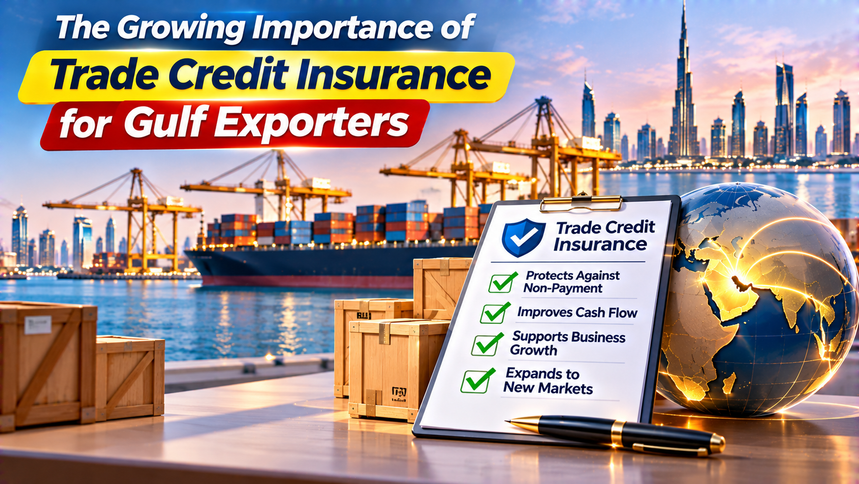
Why Export Credit Insurance Matters for Gulf Businesses
Across the Gulf Cooperation Council, companies are exploring new international markets as governments seek to expand non-oil exports, strengthen manufacturing, and support economic diversification. From food products and construction materials to chemicals, machinery, packaging, and professional services, Gulf businesses are developing commercial relationships with buyers across Asia, Africa, Europe, and other international markets.
- 1. Why Trade Credit Insurance for Gulf Exporters Is Becoming More Relevant
- 2. How Trade Credit Insurance Could Protect Cash Flow and Business Stability
- 3. What UAE and Saudi Arabia Reveal About Export Credit Insurance
- 4. How Oman, Qatar, and Bahrain Are Supporting Export Insurance
- 5. How Credit Insurance Could Support Export Financing and Market Expansion
- 6. The Costs, Exclusions, and Claims Challenges Exporters Must Understand
- 7. The Future of Trade Credit Insurance for Gulf Exporters
- Conclusion
However, exporting creates financial risks that do not always exist in the same form when selling to familiar domestic customers.
A business may manufacture and deliver products successfully but still experience difficulties receiving payment from an overseas buyer. Financial problems, unexpected insolvency, foreign exchange restrictions, or political disruptions can affect international transactions.
For exporters operating with limited cash reserves, one unpaid invoice may create problems extending beyond the original sale.
This is why trade credit insurance for Gulf exporters is becoming an important consideration within international trade and financial risk management.
Trade credit insurance provides protection against specified risks of non-payment by commercial customers. Depending on the policy, this may include buyer insolvency, prolonged payment default, and certain political events.
By reducing exposure to eligible losses, insurance can help companies manage receivables and consider expansion into unfamiliar markets.
Across the UAE, Saudi Arabia, Oman, Qatar, and Bahrain, export credit institutions provide insurance or related financial solutions intended to support international trade.
Etihad Credit Insurance operates as the UAE’s federal export credit company. Saudi EXIM Bank provides export financing and insurance products, while Credit Oman offers protection for eligible receivables.
Qatar Development Bank and Export Bahrain also support exporters through credit insurance programmes.
However, credit insurance is not a guarantee that every invoice will be paid. Policies include eligibility rules, credit limits, exclusions, notification requirements, and claims procedures.
Understanding how these arrangements operate can help Gulf businesses decide whether trade credit insurance belongs in their export development strategies.
1. Why Trade Credit Insurance for Gulf Exporters Is Becoming More Relevant
International trade often involves a delay between delivering goods and receiving payment.
An exporter may agree to supply products on credit, allowing the overseas buyer to pay after an agreed period.
These arrangements can make commercial relationships more attractive, but they also expose the seller to payment uncertainty.
Understanding Trade Credit Risk
Trade credit arises when a supplier delivers goods or services before collecting payment.
For example, a UAE manufacturer might sell packaging materials to an overseas distributor with payment due 60 days after invoicing.
During that period, the manufacturer has a receivable rather than cash.
If the buyer fails to pay, the exporter may still owe money to employees, transport companies, raw-material suppliers, and lenders.
The financial consequences can therefore extend beyond the unpaid amount.
What Trade Credit Insurance Covers
Trade credit insurance generally protects eligible accounts receivable against specified buyer non-payment events.
Commercial risks commonly include insolvency or prolonged default.
Some export credit policies also cover defined political risks that prevent payment, such as certain government restrictions or disruptions.
However, political-risk coverage must be specifically included in the policy.
Why Expanding Internationally Creates Additional Risk
A company selling to familiar local customers may have an established understanding of their payment history.
Entering an unfamiliar foreign market can make it more difficult to evaluate a buyer’s financial position or pursue unpaid invoices.
Different legal systems, banking arrangements, and commercial practices can add complexity.
Insurance does not eliminate these differences, but it may transfer part of an eligible financial loss to an insurer.
Common Export Payment Risks
| Risk | What May Happen | Possible Insurance Relevance |
|---|---|---|
| Buyer Insolvency | Customer cannot pay debts | Often covered subject to terms |
| Prolonged Default | Payment remains overdue | May be covered after a waiting period |
| Political Restrictions | Government action prevents payment | Covered only under appropriate policies |
| Currency Transfer Restrictions | Funds cannot be transferred internationally | Depends on political-risk wording |
| Commercial Dispute | Buyer challenges product or contract | Commonly restricted or excluded |
| Exchange-Rate Movement | Currency value changes | Generally requires separate risk management |
Why Policy Wording Matters
Two policies described as export credit insurance may provide different coverage.
Businesses should examine the exact insured risks, countries, buyer limits, exclusions, and claims requirements.
Marketing descriptions alone are insufficient for determining whether a particular transaction is protected.
2. How Trade Credit Insurance Could Protect Cash Flow and Business Stability
Cash flow is one of the most important concerns for exporters.
Even profitable companies can experience financial difficulties when payments arrive later than expected.
Trade credit insurance may help manage the consequences of certain defaults, although it does not provide immediate payment in every circumstance.
The Financial Impact of an Unpaid Invoice
Consider a hypothetical Gulf manufacturer delivering goods worth AED 500,000 to an international customer.
If the buyer fails to pay, the business may experience a substantial reduction in available working capital.
It must still cover costs associated with producing and shipping the goods.
The company may also need to finance new orders while attempting to recover the outstanding amount.
How an Insurance Claim Might Work
Suppose the exporter has eligible coverage for 90% of an approved AED 500,000 receivable.
If the insurer accepts a qualifying claim for the full unpaid amount, the indicated compensation would be AED 450,000 before any other applicable conditions or adjustments.
The remaining AED 50,000 would be outside that illustrative coverage percentage.
However, this example assumes that the invoice, buyer, credit limit, reporting, and default event all satisfy the policy.
It is not a quotation or promise of settlement.
Illustrative Compensation Example
| Item | Amount |
|---|---|
| Insured eligible invoice | AED 500,000 |
| Hypothetical coverage rate | 90% |
| Potential compensation if fully accepted | AED 450,000 |
| Uninsured share | AED 50,000 |
Why Claims Are Not Immediate Cash
Credit insurance normally requires the exporter to establish that a covered event has occurred.
The insurer may impose a waiting period, request supporting documents, or require debt-recovery steps.
Consequently, businesses must continue managing liquidity while claims are assessed.
Credit insurance should not replace adequate cash reserves or financial planning.
Reducing Concentration Risk
An exporter may depend heavily on a small number of overseas customers.
If one large buyer defaults, the financial impact may be substantial.
Insurance may reduce some of this exposure, but the company should also consider diversifying customers and monitoring its receivables.
Business Stability Beyond Compensation
Trade credit insurance can encourage more structured credit management.
Insurers may assess buyers before approving coverage limits.
This creates an additional opportunity to consider whether proposed payment terms are appropriate.
However, an insurer’s approval does not mean the buyer is risk-free.
3. What UAE and Saudi Arabia Reveal About Export Credit Insurance
The UAE and Saudi Arabia provide established examples of government-supported export credit insurance.
Their institutions aim to support international trade and provide exporters with mechanisms for managing eligible financial risks.
Etihad Credit Insurance in the UAE
Etihad Credit Insurance, or ECI, was established in 2018 as the UAE’s federal export credit company.
It provides trade credit insurance, political risk protection, and export financing-related solutions.
ECI’s products are intended to help qualifying exporters reduce exposure to buyer non-payment and consider opportunities in foreign markets.
Its services include short-term export credit protection and other specialised products.
Supporting UAE Exporters Through Partnerships
In November 2024, ECI announced a partnership with the Free Zones Authority of Ajman.
The agreement included cooperation on insurance, finance, and awareness programmes for exporters.
In September 2025, ECI also signed a memorandum of understanding with Al Masraf concerning export finance and risk protection.
These collaborations demonstrate institutional efforts to improve access to trade-related financial services.
However, partnership announcements should not be confused with proof that every participating business has obtained insurance or financing.
Saudi Export-Import Bank
Saudi EXIM Bank supports the development of Saudi non-oil exports through financing, guarantees, and export credit insurance.
Its offerings include policies covering eligible export receivables and certain risks involving financial institutions.
These products are designed to help Saudi exporters reach international markets while managing specified payment risks.
Saudi EXIM and SABIC
In 2024, Saudi EXIM Bank announced a Letter of Credit Insurance Policy agreement with SABIC.
The arrangement was intended to support export transactions involving letters of credit and banking-related payment risks.
This is different from an ordinary policy covering a distributor’s open-account invoice.
The distinction illustrates how export credit insurance can operate across different trade-financing arrangements.
Saudi EXIM’s 2026 Activity
The Saudi Press Agency reported that Saudi EXIM provided SAR 13.23 billion in credit facilities during the first quarter of 2026.
The total included financing and export credit insurance products.
It should not be presented as SAR 13.23 billion of insurance claims or premium revenue.
UAE and Saudi Support Compared
| Institution | Main Role | Relevant Services |
|---|---|---|
| Etihad Credit Insurance | UAE federal export credit company | Credit insurance and political risk protection |
| Saudi EXIM Bank | Saudi export credit institution | Export insurance, financing and guarantees |
| UAE Free Zone Partnerships | Exporter outreach and cooperation | Access and awareness initiatives |
| Saudi EXIM Banking Partnerships | Trade-finance risk management | Selected bank-related insurance solutions |
The availability of public export credit institutions does not replace individual business assessments or applicable policy requirements.
4. How Oman, Qatar, and Bahrain Are Supporting Export Insurance
Export credit protection is not limited to the UAE and Saudi Arabia.
Oman, Qatar, and Bahrain also operate programmes intended to reduce international trade payment risks.
Their approaches reflect different institutional arrangements and eligibility requirements.
Credit Oman’s Insurance Solutions
Credit Oman is the country’s official export credit agency.
It provides insurance products for eligible domestic and international trade receivables.
Its short-term trade credit policy supports companies registered in Oman that sell to local or overseas buyers.
The agency also identifies extended short-term insurance for qualifying instalment transactions payable over periods of up to 36 months.
However, an exporter should not assume every sale with a 36-month payment period is automatically eligible.
Actual coverage depends on the specific product and approved terms.
Credit Oman and Exporter Awareness
In 2025, Oman’s Ministry of Commerce, Industry and Investment Promotion organised an awareness programme in cooperation with Credit Oman.
The programme addressed international trade assurance, export credit insurance, and letters of credit.
This demonstrates efforts to explain trade risk management to Omani businesses.
However, awareness initiatives do not establish the number of businesses that subsequently purchased coverage.
Qatar Development Bank’s Export Insurance
Qatar Development Bank offers export trade financing and credit insurance through its export support activities.
Its products include pre-shipment and post-shipment protection for qualifying businesses.
One available product covers a portfolio of export receivables involving multiple buyers and countries.
Eligibility may involve the business’s activities and the extent of Qatari value addition.
Exporters should review specific product criteria rather than assume all international sales qualify.
Export Bahrain’s Support Programme
Export Bahrain provides export credit insurance support designed to protect qualifying businesses against international buyer default.
Its public programme information describes subsidies covering 80% of specified insurance premiums and transaction fees, subject to approved rates and eligibility conditions.
It also describes compensation arrangements of at least 90% in the case of covered default.
However, neither the subsidy nor compensation figure should be treated as universally applicable without reviewing the current programme rules and policy terms.
Regional Programmes Compared
| Institution | Country | Main Focus |
|---|---|---|
| Credit Oman | Oman | Domestic and export receivables insurance |
| Qatar Development Bank | Qatar | Export credit and trade financing |
| Export Bahrain | Bahrain | Export credit insurance support |
| Etihad Credit Insurance | UAE | Commercial and political export risks |
| Saudi EXIM Bank | Saudi Arabia | Non-oil export insurance and financing |
Why Regional Access Matters
Smaller exporters may lack specialist risk-management teams.
Public export credit programmes and awareness initiatives can help businesses understand available options.
Nevertheless, obtaining suitable protection still requires accurate documentation, qualified buyers, and careful assessment of costs.
5. How Credit Insurance Could Support Export Financing and Market Expansion
Trade credit insurance can provide benefits beyond claims protection.
Insured receivables may be useful in certain financing arrangements, while more structured credit evaluation can help exporters assess opportunities in unfamiliar markets.
However, financing advantages are not automatic.
The Relationship Between Insurance and Banks
Banks assess the risks associated with lending to businesses.
An exporter may request working-capital financing based partly on outstanding invoices.
If those receivables are insured under acceptable terms, a lender may consider the insurance when evaluating the transaction.
However, the bank must review the policy, borrower, buyer, and other relevant conditions.
Credit insurance does not guarantee loan approval or a lower interest rate.
Trade Credit Insurance Versus Letters of Credit
A letter of credit is a banking instrument under which a bank undertakes payment when specified documentary conditions are met.
Trade credit insurance instead protects against defined non-payment risks.
These are different mechanisms.
An exporter may use one, both, or other arrangements depending on the transaction.
Common Export Risk-Management Instruments
| Instrument | Main Purpose | Important Limitation |
|---|---|---|
| Trade Credit Insurance | Protect eligible receivables | Coverage limits and exclusions |
| Letter of Credit | Bank payment undertaking under specified terms | Documentary compliance |
| Bank Guarantee | Protect against a defined contractual obligation | Limited to guarantee conditions |
| Factoring | Sell or finance receivables | Cost and recourse conditions |
| Advance Payment | Receive funds before delivery | Buyer may resist terms |
| Currency Hedging | Manage exchange-rate exposure | Does not insure buyer default |
Expanding Into New Export Markets
A company considering sales to an unfamiliar overseas distributor may face uncertainty about the buyer’s reliability.
Credit insurance providers may assess the buyer and determine whether a suitable credit limit is available.
This can help an exporter evaluate its risk.
However, insurance availability alone should not determine whether entering a market is commercially sensible.
Businesses also need to assess demand, product compliance, logistics, import regulations, and competitive conditions.
Supporting Smaller Manufacturers
Small manufacturers may find it difficult to absorb a large unpaid export invoice.
Suitable insurance can reduce exposure to specified losses.
However, premiums, deductibles, and administrative requirements must remain affordable relative to the expected benefit.
6. The Costs, Exclusions, and Claims Challenges Exporters Must Understand
Trade credit insurance can be valuable, but policyholders must understand its limitations.
A business that assumes every unpaid invoice is covered may make dangerous financial decisions.
How Premiums Are Determined
Pricing may depend on factors such as export turnover, buyer creditworthiness, destination markets, sector risk, payment terms, and the level of cover.
Different insurers use different underwriting methods.
Businesses should obtain quotations based on their actual trading circumstances.
A low premium does not automatically make one policy more suitable than another.
Credit Limits
An insurer may approve a maximum amount of exposure for a specific buyer.
For example, an exporter might have coverage for only part of the total outstanding balance owed by that customer.
If the business exceeds its approved limit, the additional exposure may be uninsured.
Credit limits should therefore be monitored before accepting further orders.
Commercial Disputes
A buyer may refuse payment because goods allegedly fail to meet the agreed specifications.
Such disputes can complicate insurance claims.
Many policies exclude disputed debts until the underlying contractual disagreement is resolved.
Exporters should maintain clear contracts, delivery evidence, inspection records, and customer communications.
Pre-Shipment Versus Post-Shipment Protection
Some risks arise before goods are delivered.
For example, a buyer may cancel an order after a manufacturer has incurred production costs.
Specialised pre-shipment insurance may cover certain events, subject to conditions.
Ordinary post-shipment receivables insurance should not be assumed to provide identical protection.
Common Exclusions and Operational Requirements
| Issue | Why It Matters |
|---|---|
| Unapproved Buyer | May fall outside insured coverage |
| Exceeded Credit Limit | Excess exposure may be uninsured |
| Late Notification | May affect claim eligibility |
| Commercial Dispute | Payment may be suspended or excluded |
| Incorrect Documentation | Can delay or undermine a claim |
| Uninsured Political Event | May fall outside policy wording |
| Overdue Accounts | May trigger restrictions on future shipments |
| Policy Deductible | Exporter retains part of the loss |
Why Claims Management Begins Before Default
An exporter should maintain accurate records from the beginning of the sales relationship.
These may include purchase orders, contracts, shipping documentation, invoices, correspondence, and evidence of payment arrangements.
When difficulties arise, prompt communication with the insurer is important.
However, exporters should follow their specific policy rather than relying on a generic claims timeline.
The Importance of Cost-Benefit Analysis
Not every company needs the same level of cover.
A business with secure advance-payment arrangements may have different requirements from one offering lengthy payment terms to numerous foreign customers.
The decision should reflect exposure, financial resilience, transaction margins, and available alternatives.
7. The Future of Trade Credit Insurance for Gulf Exporters
As GCC economies develop additional manufacturing, service, and non-oil export capabilities, companies may seek more sophisticated tools for managing international payment risks.
Trade credit insurance could become more closely connected with digital trade finance, banking relationships, and export development programmes.
However, its future role will depend on affordability, awareness, reliable underwriting, and actual business needs.
Digitalising Export Credit Processes
Insurers may increasingly use digital platforms for applications, buyer-limit requests, policy management, and claims documentation.
This could reduce some administrative work and improve access to information.
However, digital submission does not eliminate underwriting requirements or guarantee immediate approval.
The Role of Export Credit Agencies
Public export credit agencies can support international business by providing eligible insurance and financing tools.
The Berne Union’s State of the Industry 2025 report documents the continued importance of export credit and investment insurance across international markets.
Its findings illustrate the scale of risk-protection activities globally.
However, international industry totals should not be presented as figures exclusively representing GCC exporters.
A Practical Export Credit Insurance Checklist
- Identify which customers purchase goods on credit.
- Calculate the maximum outstanding exposure to each buyer.
- Assess buyer and destination-country risks.
- Determine whether commercial and political risks need cover.
- Compare available insurer and export credit agency products.
- Review coverage percentages, deductibles, and exclusions.
- Obtain appropriate buyer credit limits.
- Maintain accurate export and delivery documentation.
- Understand overdue-payment notification requirements.
- Review claims waiting periods and recovery procedures.
- Evaluate whether insured receivables could support financing.
- Monitor policies and buyer exposures regularly.
How Exporters Should Measure Insurance Value
The value of an insurance programme should be assessed through more than the amount of coverage purchased.
Companies can examine its financial cost, protected exposure, payment performance, claims outcomes, and contribution to risk-management objectives.
Key Performance Indicators
| Indicator | What It Measures |
|---|---|
| Insured Export Turnover | Sales covered by approved policies |
| Buyer Credit Exposure | Outstanding amounts by customer |
| Overdue Receivables | Delayed payments |
| Coverage Ratio | Proportion of eligible exposure insured |
| Premium Cost | Insurance expenditure |
| Claim Acceptance | Outcomes under policy terms |
| Recovery Performance | Amounts recovered from defaulting buyers |
| Financing Access | Availability of suitable funding arrangements |
Opportunities for Banks and Export Support Institutions
Banks, insurers, export credit agencies, and business associations may collaborate on training, risk assessment, and trade-finance products.
For smaller companies, clearer information about insurance eligibility and documentation could improve their ability to use available services.
However, access programmes should not encourage exporters to accept unsuitable buyers or excessive credit exposure.
Building Responsible Export Strategies
Trade credit insurance should complement broader commercial risk management.
Exporters still need reliable contracts, product quality controls, suitable payment terms, and appropriate customer due diligence.
Insurance is most useful when integrated into these existing processes.
Conclusion
Trade credit insurance is becoming an increasingly important consideration for Gulf exporters seeking to expand international business while managing the financial risks associated with delayed or unpaid invoices.
As GCC countries develop non-oil industries and pursue opportunities across global markets, companies may encounter buyers operating under unfamiliar financial, legal, and commercial conditions.
Credit insurance can provide protection against eligible non-payment events and may support more structured credit management.
Regional institutions such as Etihad Credit Insurance, Saudi EXIM Bank, Credit Oman, Qatar Development Bank, and Export Bahrain demonstrate that insurance and related export support services are already available in several GCC markets.
However, these products are not interchangeable.
Coverage limits, qualifying risks, financing arrangements, premiums, and claims conditions vary according to the provider and policy.
For exporters, the strongest approach is to assess their actual exposure, understand contract terms, and select suitable financial protection rather than assuming insurance eliminates every export risk.
For governments and export support institutions, the opportunity lies in improving awareness, accessibility, and cooperation with commercial lenders.
Ultimately, successful international expansion depends on more than finding new customers.
It also requires managing the financial uncertainty that can arise after products are delivered.
By combining careful buyer assessment, clear commercial agreements, and appropriate trade credit insurance, Gulf exporters may be better equipped to protect cash flow, strengthen business continuity, and pursue international growth with greater financial discipline.
Do follow us on Instagram
Read More – How Employee Ownership Business Models Could Evolve in the Middle East