How Machine-Readable Regulations Could Transform GCC Businesses
Across the Gulf Cooperation Council, businesses operate in an increasingly sophisticated regulatory environment. Companies must manage tax obligations, licensing requirements, employment rules, financial reporting, data protection, cybersecurity standards, and industry-specific regulations.
- 1. Why Machine-Readable Regulations in the GCC Could Transform Compliance
- 2. How the UAE’s Rules as Code Initiative Could Change Regulatory Compliance
- 3. What Saudi Arabia’s Digital Tax and Regulatory Systems Reveal
- 4. How Machine-Readable Rules Could Support GCC Businesses Across Different Sectors
- 5. How Regulatory Technology and AI Could Work With Machine-Readable Laws
- 6. The Risks of Turning Regulations Into Computer Code
- 7. The Future of Machine-Readable Regulation and GCC Business Compliance
- Conclusion
As regional economies expand into technology, manufacturing, financial services, and international trade, keeping track of these requirements can become more complicated.
A company operating in the UAE may need to follow federal legislation alongside requirements issued by particular emirates or regulatory authorities. A business expanding into Saudi Arabia, Qatar, or Bahrain may encounter additional rules covering similar activities but with different definitions, procedures, and deadlines.
For smaller businesses, understanding these requirements can demand considerable time and professional resources.
However, advances in government digitalisation are creating opportunities to change how regulations are published, understood, and applied.
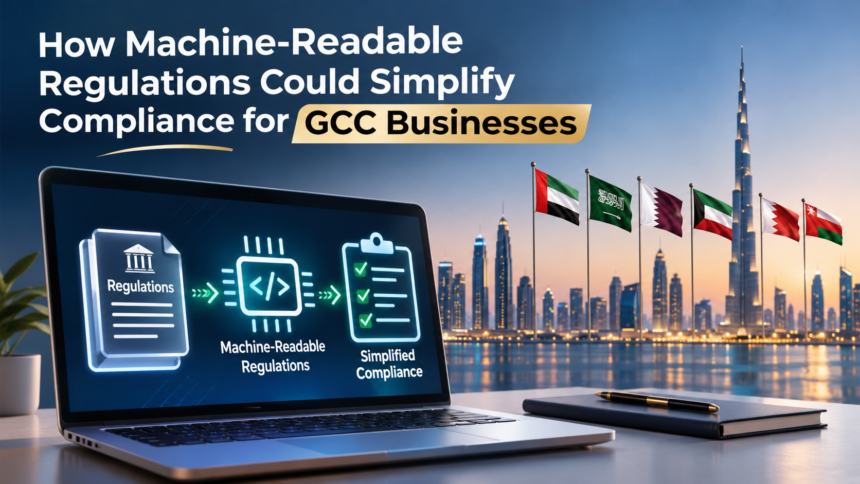
One important development involves machine-readable regulations in the GCC, which could allow computers to process selected legal requirements using structured information and formally defined rules.
Instead of relying entirely on employees to interpret documents and manually update compliance checklists, businesses could use approved digital systems to evaluate certain obligations, identify changes, and prepare regulatory submissions.
This approach is sometimes associated with Rules as Code, a method of translating selected legal or policy requirements into computer-readable or executable representations.
The UAE has already introduced a Rules as Code initiative designed to make legislative requirements easier to understand and apply through digital technology.
Meanwhile, Saudi Arabia’s electronic invoicing framework demonstrates how structured technical requirements can support automated interactions between business systems and a regulatory authority.
International organisations, including the OECD, are also examining how machine-readable legislation could reduce administrative burdens and improve the consistency of regulatory processes.
However, technology cannot eliminate legal uncertainty or replace professional judgement.
Many legal requirements depend on context, proportionality, interpretation, and facts that cannot be reduced to a simple calculation.
The opportunity therefore lies in using machine-readable rules for appropriate tasks while maintaining clear legal accountability.
1. Why Machine-Readable Regulations in the GCC Could Transform Compliance
Business compliance traditionally involves identifying relevant laws, interpreting their requirements, and translating them into internal policies and operational procedures.
Organisations may employ compliance officers, accountants, lawyers, and consultants to manage these responsibilities.
However, significant administrative work can arise from repeatedly checking requirements that follow relatively predictable rules.
Understanding Machine-Readable Regulations
Machine-readable regulations represent legal or regulatory information in a structured format that software can process.
A simple example might involve a requirement that applies when a business meets specified, objectively measurable conditions.
A computer system could compare those conditions with relevant company information and identify whether an obligation may apply.
However, the answer would only be reliable if the digital representation accurately reflected the applicable law.
Machine-Readable Versus Machine-Executable Rules
These terms are related but different.
A machine-readable regulation may use a structured format that allows software to identify sections, definitions, dates, or obligations.
A machine-executable rule goes further by expressing particular requirements as computational logic.
For example, a rule might calculate a deadline from a defined reporting date.
Not every legally significant requirement can be expressed accurately through executable logic.
Why Ordinary PDFs Are Not Enough
Publishing a law as a searchable PDF improves accessibility.
However, it does not necessarily allow software to determine automatically how that law applies to a specific business.
A searchable legal database may support research without providing a formally approved computational interpretation.
This distinction is essential when evaluating digital regulation initiatives.
Different Levels of Regulatory Digitalisation
| Level | Description | Potential Business Use |
|---|---|---|
| Online Legal Documents | Laws published digitally | Manual research |
| Searchable Legislation | Search and filter legal texts | Faster information retrieval |
| Structured Legal Data | Provisions published with consistent metadata | Automated monitoring |
| Machine-Readable Rules | Defined regulatory information processed by software | Compliance mapping |
| Machine-Executable Rules | Selected requirements expressed as computational logic | Automated checks |
| Integrated Regulatory Services | Approved systems exchange information | Submission and verification |
Why Businesses Could Benefit
The greatest potential benefit is reducing repetitive administrative work.
However, organisations should still verify that digital tools are based on current, authoritative legal materials.
2. How the UAE’s Rules as Code Initiative Could Change Regulatory Compliance
The UAE provides one of the most relevant regional examples of a government-backed initiative specifically focused on machine-readable legal requirements.
Its Rules as Code platform seeks to transform selected legislation into digital representations that are easier for people and software systems to use.
Understanding the UAE Initiative
According to the UAE Government, the Rules as Code platform uses digital technology and coding approaches to enhance the legislative ecosystem.
The initiative aims to make legislation accessible in digitally readable formats.
Its stated purpose includes improving how individuals and businesses understand and apply legal requirements.
This is more closely connected to machine-readable regulation than a conventional government website that merely publishes legislation.
The Role of OpenFisca
The Mohammed Bin Rashid Centre for Government Innovation describes the UAE initiative as using OpenFisca, an open-source rules calculation engine.
The programme was developed by the Ministry of Finance in collaboration with the UAE’s Office of Artificial Intelligence.
OpenFisca allows certain rules and eligibility conditions to be represented through structured computational models.
This can support applications that calculate or explain outcomes based on defined inputs.
However, the use of a particular rules engine does not establish that every UAE law has been translated into executable code.
The UAE Legislation Platform
The UAE Legislation platform is the official source for federal legislation, regulatory decisions, and relevant amendments.
It brings together legislative materials in an accessible digital environment.
The platform provides an important foundation for businesses seeking current legal information.
However, the existence of an official digital legislation database does not automatically mean every provision can be evaluated by software.
The UAE’s API-First Policy
The UAE Government’s API-First Policy aims to improve integration and data exchange across digital services.
Application programming interfaces, known as APIs, allow authorised software systems to exchange information through defined technical connections.
Such infrastructure could eventually support approved regulatory services that interact with business management systems.
However, an API for a government service is not necessarily an API delivering legally authoritative machine-executable rules.
UAE Digital Regulation Initiatives Compared
| Initiative | Main Function | Relationship to Compliance |
|---|---|---|
| Rules as Code | Transform selected legal rules into digital logic | Potential automated interpretation |
| UAE Legislation Platform | Publish authoritative federal legal information | Regulatory research |
| API-First Policy | Encourage digital service interoperability | System integration |
| UAE API Marketplace | Provide access to selected government APIs | Digital business services |
| EmaraTax | Support electronic tax administration | Tax registration and filing |
Why Authoritative Legal Sources Matter
Businesses should distinguish between a government-approved computational rule and a privately created interpretation.
If the applicable legislation changes, an automated compliance system must reflect the correct legal version.
3. What Saudi Arabia’s Digital Tax and Regulatory Systems Reveal
Saudi Arabia has developed digital systems that demonstrate how regulatory administration can become more structured and integrated with business technology.
Its electronic invoicing programme provides a useful example.
However, structured reporting and machine-readable legislation are not identical.
Saudi Arabia’s FATOORA Programme
The Zakat, Tax and Customs Authority introduced electronic invoicing requirements through its FATOORA programme.
The first phase began in December 2021, with subsequent integration requirements introduced in stages.
During the integration phase, eligible taxpayers must connect their electronic invoicing solutions with ZATCA’s platform and meet prescribed technical requirements.
These include structured invoice formats and specified data fields.
Why Structured Invoices Matter
Traditional invoices can vary considerably in layout and format.
Structured electronic invoices use defined data elements that software systems can validate and process more consistently.
For example, a system may check whether specified mandatory fields are present.
This can reduce some manual processing requirements.
However, validating the technical structure of an invoice does not automatically establish that every underlying tax treatment is correct.
Machine-Readable Reporting Versus Rules as Code

Saudi electronic invoicing demonstrates machine-readable regulatory reporting.
Rules as Code involves representing the substance of legal requirements as computational logic.
The two approaches may complement each other, but they should not be confused.
An invoice integration system can enforce technical submission requirements without necessarily publishing a complete machine-executable tax code.
SAMA’s Digital Regulatory Environment
The Saudi Central Bank maintains an online rulebook providing access to its regulatory requirements.
It also operates a Regulatory Sandbox through which eligible financial technology businesses can test innovative products and services under defined conditions.
In June 2026, SAMA announced enhancements to its online Regulatory Sandbox application service.
These developments support regulatory accessibility and supervised innovation.
However, they do not establish that SAMA’s entire regulatory framework is available as machine-executable legislation.
Saudi Digital Compliance Examples
| System | Main Function | Digital Capability |
|---|---|---|
| FATOORA | Electronic invoicing | Structured invoice data |
| ZATCA Developer Guidance | Technical implementation support | Validation specifications |
| SAMA Online Rulebook | Regulatory information | Searchable rules |
| SAMA Regulatory Sandbox | Supervised financial innovation | Digital application and testing processes |
Why These Systems Matter
They demonstrate the technical infrastructure through which businesses can interact with regulatory authorities.
Future machine-readable regulatory services could build on similar foundations, provided legal meaning and implementation responsibilities remain clear.
4. How Machine-Readable Rules Could Support GCC Businesses Across Different Sectors
The potential applications extend beyond finance and taxation.
Many business activities involve requirements that could be partially supported by structured regulatory information.
However, some obligations are easier to automate than others.
Tax Compliance
Businesses may need to determine whether registration thresholds, reporting dates, or invoice-format requirements apply.
For rules based on clear variables, properly maintained software could assist with calculations and alerts.
However, complex tax questions involving legal interpretation, exemptions, or the substance of transactions may still require professional advice.
Corporate Licensing
A new business must identify the licences and approvals relevant to its proposed activities.
A well-designed digital system could ask structured questions about location, activity, and company characteristics.
It could then identify possible licensing requirements.
However, the result must reflect the relevant jurisdiction and any activity-specific restrictions.
Employment Administration
Certain employment requirements involve defined dates, periods, or calculations.
Machine-executable rules could potentially support administrative checks.
However, employment disputes and legal classifications may involve facts that require human assessment.
Environmental and Industrial Compliance
Industrial companies often manage permits, inspections, monitoring requirements, and technical standards.
Structured regulatory information could help connect specified obligations with factory operations.
However, compliance with environmental standards cannot always be established through a simple digital declaration.
Physical inspections and laboratory measurements may still be necessary.
Financial Services
Banks and financial institutions maintain complex internal controls addressing licensing, risk, reporting, and customer protection.
Machine-readable regulations could help teams monitor particular changes and compare requirements with internal systems.
However, important judgements involving financial conduct, consumer outcomes, and governance cannot be entirely automated.
Potential Applications by Sector
| Sector | Possible Automated Support | Human Responsibility |
|---|---|---|
| Taxation | Deadline and format checks | Tax interpretation |
| Corporate Licensing | Eligibility screening | Approval and legal review |
| Employment | Defined administrative calculations | Dispute assessment |
| Manufacturing | Permit and reporting alerts | Technical compliance |
| Banking | Control mapping and regulatory monitoring | Risk and conduct judgements |
| Logistics | Document validation | Customs classification disputes |
| Healthcare | Selected documentation checks | Clinical and legal judgement |
Why SMEs Could Benefit
Small businesses may lack dedicated compliance departments.
A reliable, affordable regulatory information service could help them understand basic requirements more efficiently.
However, digital tools must be designed for users without specialised technical knowledge.
5. How Regulatory Technology and AI Could Work With Machine-Readable Laws
Regulatory technology, commonly called RegTech, refers to software and services that help organisations manage compliance requirements.
Machine-readable legal information could strengthen these tools by providing more structured and traceable regulatory inputs.
The Difference Between RegTech and Machine-Readable Regulation
RegTech is a broad category that may include compliance monitoring, reporting, identity verification, and risk management systems.
Machine-readable regulation refers specifically to how legal requirements are represented.
A RegTech product can operate without access to authoritative machine-executable rules.
For example, a compliance platform might analyse documents using artificial intelligence and generate suggested tasks.
However, the interpretation would still need verification.
Why AI Alone Is Not Sufficient
Large language models can summarise legal documents and answer questions.
However, they can also misunderstand provisions, overlook exceptions, or generate inaccurate legal references.
An AI-generated interpretation should not be treated as an official regulatory decision.
Where practical, formally defined computational rules may provide more predictable outcomes for requirements that are suitable for calculation.
Combining AI With Rules Engines
One possible system could use AI to help users find relevant legislation.
A verified rules engine could then evaluate selected conditions using structured information.
A compliance professional would review uncertain or high-impact results.
This could combine the accessibility of conversational systems with the consistency of formal rules.
However, the architecture must prevent unverified AI outputs from being mistaken for legally authoritative requirements.
An Illustrative Compliance Workflow
| Stage | Digital Function | Essential Safeguard |
|---|---|---|
| Identify Rule | Retrieve official regulation | Authoritative source |
| Determine Scope | Match business characteristics | Correct jurisdiction |
| Evaluate Condition | Apply verified computational logic | Testing and validation |
| Identify Exceptions | Review relevant exclusions | Legal oversight |
| Produce Alert | Notify relevant personnel | Clear explanation |
| Record Action | Maintain audit trail | Secure records |
| Review Updates | Monitor amendments | Version control |
Why Auditability Matters
Businesses should be able to understand why a software system identified a particular obligation.
An explanation might identify the relevant legal provision, applicable date, input data, and calculation method.
Without this information, errors may be difficult to investigate or challenge.
6. The Risks of Turning Regulations Into Computer Code
Although machine-readable regulations can improve efficiency, translating legal rules into software introduces risks.
Legislation often uses concepts that depend on interpretation.
A digital representation may fail if it simplifies these concepts excessively.
Legal Ambiguity
Terms such as reasonable, appropriate, substantial, or proportionate may require contextual assessment.
These concepts cannot always be reduced to a fixed calculation without changing their meaning.
A rules engine should therefore identify when human interpretation is necessary.
The Risk of Coding Errors
A small software error can lead to incorrect compliance results.
For example, applying an outdated threshold or missing an exemption might cause a business to misunderstand its obligations.
The impact could affect many users if the same erroneous rule is distributed widely.
Legal Text Must Remain Authoritative
The OECD has emphasised that Law as Code raises questions about accountability and the relationship between legal text and digital implementations.
Governments must establish how executable rules relate to legally authoritative legislation.
Businesses should not assume that privately developed code overrides statutory language or judicial interpretation.
Managing Amendments
Regulations change.
A computational model based on an old version of the law may generate incorrect outcomes.
Robust systems require version control, effective dates, change histories, and procedures for testing updates.
Privacy and Cybersecurity
Automated compliance checks may require information about business finances, workers, operations, or customers.
Sharing these details with external software providers can create privacy and confidentiality risks.
Organisations should apply suitable access controls, data minimisation, and security procedures.
Risks and Practical Responses
| Risk | Possible Consequence | Appropriate Response |
|---|---|---|
| Incorrect Legal Interpretation | Misleading compliance advice | Legal validation |
| Outdated Rules | Incorrect obligations | Version management |
| Software Defects | Systematic errors | Independent testing |
| Excessive Automation | Missed contextual issues | Human oversight |
| Cybersecurity Failures | Exposure of sensitive information | Security controls |
| Poor Data Quality | Inaccurate compliance outcomes | Input validation |
| Unclear Authority | Disputes over legal status | Official-source identification |
| Vendor Dependence | Operational disruption | Portability and contingency planning |
Why Regulatory Accountability Cannot Be Automated Away
Even when a digital tool performs calculations correctly, a business may remain legally responsible for complying with applicable requirements.
Software assistance should improve decision-making rather than create a false impression that responsibility has been transferred to the technology provider.
7. The Future of Machine-Readable Regulation and GCC Business Compliance
Machine-readable regulation could become part of a wider transition toward more connected government and business systems.
However, successful adoption requires reliable technical standards, legislative oversight, and practical support for businesses.
The OECD’s Law as Code Work
In July 2026, the OECD launched a consultation concerning a shared reference framework for the digital provision of law.
The consultation focused on how machine-executable legal logic could be developed and provided in ways that preserve government control, accountability, and legal transparency.
The initiative demonstrates increasing international attention to the governance of machine-readable rules.
However, a consultation does not establish a universally adopted technical or legal standard.
The New Gulf Legislation Platform
In June 2026, the GCC launched a Gulf Legislation Platform providing a unified electronic reference for relevant Gulf legislation.
The platform supports access to legislative information across member states.
This is relevant to cross-border businesses seeking to understand multiple legal systems.
However, the platform should not be described as a complete GCC-wide machine-executable compliance engine.
Qatar’s Digital Legal Information
In October 2026, Qatar’s Ministry of Justice announced a renewed Official Gazette website and Al Meezan Legal Portal.
The platform brings together legislation, judicial rulings, and other legal materials.
This supports easier access to legal information.
However, a digitally searchable legal portal is not automatically equivalent to an officially approved Rules as Code system.
Why Cross-Border Standards Could Help
Businesses operating in several GCC markets may face similar reporting questions but different legal definitions.
Structured regulatory information could help software identify the applicable jurisdiction and highlight variations.
However, regional digital interoperability does not require laws to become identical.
Each state retains authority over its own regulatory framework.
A Practical Machine-Readable Compliance Checklist
- Identify the business’s relevant regulatory obligations.
- Confirm which laws and authorities are applicable.
- Use official and current legal information.
- Distinguish searchable text from machine-executable rules.
- Verify the legal status of digital rule representations.
- Identify requirements suitable for reliable automation.
- Document exceptions and matters requiring interpretation.
- Validate software calculations against legal requirements.
- Establish controls for regulatory amendments.
- Maintain clear records of inputs and compliance decisions.
- Protect confidential company information.
- Train employees responsible for compliance.
- Review high-impact results with qualified professionals.
- Monitor system accuracy and operating costs.
How Should Governments and Businesses Measure Success?
A machine-readable regulation project should be evaluated according to whether it helps users understand and meet their obligations.
Publishing a large number of rules in digital form does not, by itself, establish success.
Suggested Performance Indicators
| Indicator | What It Measures |
|---|---|
| Rule Coverage | Regulations represented accurately |
| Update Timeliness | Speed of incorporating legal amendments |
| Automated Check Accuracy | Reliability of computational results |
| Compliance Processing Time | Administrative efficiency |
| Manual Review Requirements | Work still requiring human judgement |
| User Error Rates | Accuracy of business submissions |
| SME Accessibility | Ease of use for smaller companies |
| Data Security | Protection of business information |
| Auditability | Ability to explain system outputs |
| Regulatory Disputes | Problems arising from interpretations |
Opportunities for GCC Technology Businesses
Machine-readable regulation could create opportunities for software developers, compliance technology providers, legal technology businesses, cybersecurity specialists, and data integration companies.
Products may help businesses monitor regulatory changes, validate submissions, manage deadlines, or connect internal systems with approved government services.
However, commercial providers should clearly distinguish authoritative rules from their own interpretations.
Why Human-Centred Design Matters
Business owners should not need to understand computer programming to benefit from machine-readable regulations.
Effective services should explain obligations in clear language, disclose relevant conditions, and make it possible to request professional assistance when necessary.
Digital compliance tools should also support people with different levels of technological expertise.
Conclusion
Machine-readable regulations could simplify compliance for GCC businesses by making selected legal requirements easier to process, monitor, and apply through digital systems.
As companies expand across sectors and jurisdictions, regulatory responsibilities are becoming more complex.
Traditional legal research and compliance processes remain necessary, but some repetitive tasks could be supported by formally structured rules and automated checks.
The UAE’s Rules as Code initiative provides a regional example of legislation being translated into computational representations.
Saudi Arabia’s electronic invoicing programme illustrates how structured regulatory requirements can support automated business-to-government interactions.
Meanwhile, official legislation platforms in the UAE and Qatar, alongside the new Gulf Legislation Platform, demonstrate wider progress in making legal information more accessible.
However, these initiatives perform different functions and should not be described as equivalent technologies.
Machine-readable regulations also introduce challenges involving legal interpretation, software accuracy, version control, cybersecurity, and accountability.
For governments, the priority should be developing reliable digital representations while preserving legal authority and procedural fairness.
For businesses, the opportunity lies in reducing unnecessary administration without abandoning professional oversight.
For technology companies, successful products will depend on accuracy, transparency, security, and practical usefulness.
Ultimately, the future of regulatory compliance in the Gulf may involve a combination of human expertise and well-designed digital systems.
Machine-readable rules could become an important part of that transition, helping organisations understand their obligations more efficiently while supporting a more accessible and responsive regulatory environment.
Do follow us on Instagram
Read More – Why Semiconductor Packaging Could Become an Opportunity for Gulf Industrial Development