Why Shared Parenting Is Becoming Important for Gulf Families
Across the Middle East, conversations about family life are increasingly extending beyond traditional responsibilities associated with mothers and fathers. As societies experience changes in employment, education, urban living, and household arrangements, greater attention is being directed toward how parents share the everyday responsibilities of raising young children.
- 1. Why Men’s Participation in Early Childhood Care Matters for Child Development
- 2. How Shared Parenting Responsibilities Could Strengthen Family Relationships
- 3. How UAE Family Policies Are Encouraging Greater Father Involvement
- 4. What Saudi Arabia and Oman’s Parental Leave Policies Reveal
- 5. Why Cultural Expectations and Workplace Practices Influence Men’s Caregiving Roles
- 6. How Communities, Healthcare Providers and Educators Could Support Fathers
- 7. The Future of Shared Caregiving and Fatherhood in Gulf Societies
- Conclusion
One important part of this discussion concerns the involvement of men in early childhood care.
For many families, fathers have traditionally played important roles in financial provision, protection, guidance, and decision-making. However, modern discussions about parenting increasingly recognise that caregiving also involves daily emotional support, feeding, playing, comforting, learning activities, and attending to children’s developmental needs.
These responsibilities are not limited to one parent.
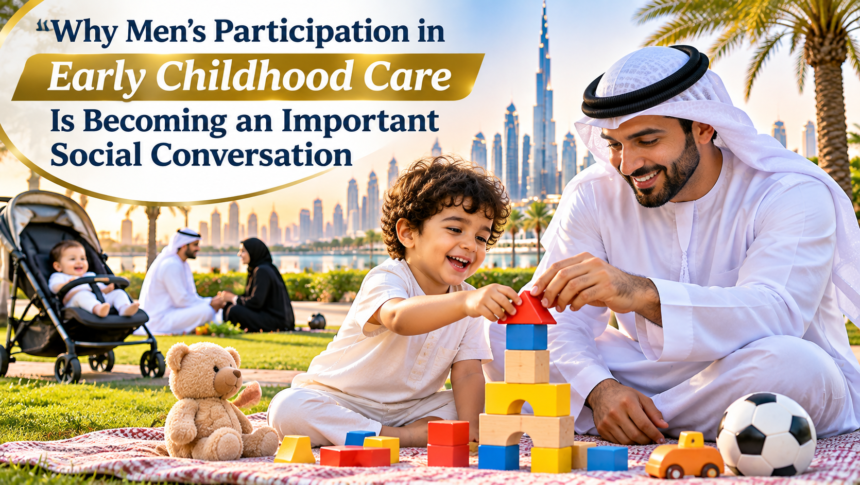
Men’s participation in early childhood care is becoming an important social conversation because it connects child development, family relationships, workplace policies, household responsibilities, and wider expectations about parenting.
Early childhood is a particularly significant period of development. During the first years of life, children develop foundational abilities involving communication, movement, emotional regulation, social interaction, and learning.
Supportive relationships with parents and other caregivers can contribute to this process.
The World Health Organization’s Nurturing Care Framework identifies responsive caregiving, health, nutrition, safety, and opportunities for early learning as important elements of healthy childhood development.
Research has also examined the relationship between fathers’ involvement and children’s social-emotional development.
Across the Gulf Cooperation Council, developments in parental leave and family-support initiatives are contributing to greater recognition of caregiving responsibilities.
The UAE provides paid parental leave for eligible working mothers and fathers. Oman has introduced paid paternity leave through social protection reforms, while Saudi Arabia’s labour framework includes leave following the birth of a child.
Abu Dhabi’s Early Childhood Authority has also promoted family-friendly workplaces and highlighted the importance of fathers’ involvement in children’s lives.
However, greater participation should not be understood as a criticism of traditional family structures or as a requirement that all households organise themselves identically.
Families differ in employment, income, health, cultural expectations, and available support.
The central question is how men can be supported in taking meaningful, responsible roles in early childhood care while respecting the diverse circumstances of families.
1. Why Men’s Participation in Early Childhood Care Matters for Child Development

The earliest years of life involve rapid physical, emotional, and cognitive development.
Children begin learning how to communicate, understand emotions, interact with others, and respond to their environment.
Parents and caregivers influence these experiences through everyday interactions.
Understanding Responsive Caregiving
Responsive caregiving involves recognising a child’s signals and responding appropriately.
For a baby, this might include recognising signs of hunger, discomfort, or tiredness.
For a toddler, it may involve listening, helping with unfamiliar situations, and providing reassurance during moments of frustration.
These interactions help create predictable and supportive relationships.
The WHO’s Nurturing Care Framework recognises responsive caregiving as a central component of early childhood development.
The Role of Fathers in Early Learning
Fathers can participate in early learning through conversation, reading, storytelling, music, play, and everyday activities.
These interactions create opportunities for children to develop language, curiosity, coordination, and social skills.
However, children’s development depends on the quality and consistency of care rather than the presence of a particular activity alone.
Reading a book occasionally is valuable, but it cannot replace broader responsibilities involving safety, emotional support, and everyday care.
What Research Suggests
A meta-analysis published in 2025 examined research on fathers’ involvement and children’s social-emotional competence.
The study identified associations between paternal involvement and aspects of early social-emotional development.
However, associations should not automatically be interpreted as evidence that one parenting behaviour directly causes a particular developmental outcome.
Family circumstances, parental wellbeing, and the wider environment can also influence results.
The Importance of Multiple Supportive Relationships
Children may benefit from positive relationships with mothers, fathers, grandparents, and other trusted caregivers.
This is especially relevant in households where one parent is absent or where relatives provide substantial caregiving support.
Encouraging fathers’ participation should not imply that children without an involved father are unable to thrive.
Everyday Caregiving Activities
| Activity | Possible Developmental Contribution |
|---|---|
| Reading Together | Language exposure and shared attention |
| Responsive Conversation | Communication and emotional connection |
| Physical Play | Movement and coordination |
| Feeding and Daily Care | Consistent caregiving relationships |
| Comforting a Distressed Child | Emotional reassurance |
| Outdoor Exploration | Curiosity and physical activity |
| Attending Health Appointments | Awareness of children’s wellbeing |
Why Quality Matters More Than Visibility
A father who participates regularly in routine caregiving may develop a deeper understanding of his child’s needs.
The objective should not simply be increasing the number of photographs or public examples of fathers spending time with children.
Meaningful participation involves sustained responsibility.
2. How Shared Parenting Responsibilities Could Strengthen Family Relationships
Early childhood care involves numerous tasks that may not always be visible.
Parents organise meals, washing, sleep routines, health appointments, nursery arrangements, and household schedules.
When these responsibilities are concentrated on one person, the demands can become difficult to manage.
Understanding the Unpaid Care Economy
Unpaid care work includes activities that support the daily wellbeing of household members without direct financial compensation.
It may involve caring for children, assisting older relatives, preparing meals, and managing household responsibilities.
UN Women has identified unequal distribution of unpaid care work as an important issue across the Arab region.
However, the amount and distribution of care vary by country, household, employment arrangement, and family circumstances.
Why Shared Responsibility Matters
When both parents participate in appropriate caregiving activities, the household may have greater flexibility.
For example, one parent may manage a child’s morning routine while the other prepares meals or handles nursery transportation.
The arrangement does not need to involve identical schedules.
What matters is that responsibilities are understood and agreed upon.
The Difference Between Helping and Taking Responsibility
A father may occasionally assist with childcare without managing any recurring responsibility.
Shared parenting goes further.
It can involve remembering appointments, preparing necessary supplies, responding to difficulties, and making decisions together.
This distinction is particularly relevant when discussing the mental and organisational demands of caregiving.
Why Communication Is Essential
Families may have different expectations about who should perform particular tasks.
Unspoken assumptions can create disagreements.
Discussing routines, workloads, and individual needs can help parents develop workable arrangements.
However, no single division of labour is suitable for every household.
Examples of Shared Caregiving
| Responsibility | Possible Shared Arrangement |
|---|---|
| Morning Routine | Parents alternate preparation tasks |
| Feeding | Responsibilities organised around work schedules |
| Health Appointments | Both parents remain informed |
| Bedtime | Caregivers coordinate routines |
| Nursery Communication | Both parents receive relevant updates |
| Household Supplies | Responsibilities are allocated clearly |
| Emergency Care | Backup arrangements are established |
The Wider Family Context
In many Gulf households, grandparents and extended relatives contribute to children’s care.
Professional caregivers may also provide support.
Recognising men’s involvement should complement these arrangements rather than dismiss the contribution of other family members.
3. How UAE Family Policies Are Encouraging Greater Father Involvement
The UAE provides useful examples of how family policy and early childhood initiatives can support the role of fathers.
These developments are part of wider efforts to strengthen family wellbeing and create supportive environments for working parents.
Paid Parental Leave in the UAE
Under the UAE’s federal private-sector labour framework, eligible employees are entitled to five working days of paid parental leave.
The entitlement applies to both mothers and fathers and can be used within six months of the child’s birth.
This gives eligible working fathers an opportunity to spend time supporting their families during early infancy.
However, five days of leave should not be confused with a complete childcare support system.
Parents may still face ongoing challenges involving work schedules and caregiving responsibilities.
Public-Sector Arrangements
The UAE federal government also provides paid parental leave of five working days for eligible employees following the birth of a child.
However, employment conditions can differ across federal, emirate-level, free-zone, and private-sector organisations.
Families should verify the rules relevant to their employer.
Abu Dhabi’s Early Childhood Authority
The Abu Dhabi Early Childhood Authority has highlighted the importance of fathers in children’s early learning, emotional wellbeing, and family relationships.
The authority also promotes initiatives addressing workplace practices and family-friendly environments.
Its Parent-Friendly Label encourages organisations to introduce policies that support working parents and their children.
This may include improvements in leave arrangements, workplace flexibility, and organisational culture.
Fatherhood and Workplace Expectations
In June 2026, reporting on the UAE’s parent-friendly workplace initiative highlighted concerns that some fathers may hesitate to use available benefits because of perceived career consequences.
This illustrates an important distinction between formal entitlements and actual workplace behaviour.
A policy may exist, but employees must also feel able to use it appropriately.
UAE Family-Support Measures
| Initiative | Main Purpose | Relevance to Fathers |
|---|---|---|
| Paid Parental Leave | Support eligible working parents after childbirth | Time for early caregiving |
| Parent-Friendly Label | Encourage supportive employment practices | Workplace participation |
| Early Childhood Authority Programmes | Promote early childhood wellbeing | Parenting knowledge |
| Family-Friendly Urban Planning | Improve environments for families | Easier access to services |
| Early Childhood Awareness Campaigns | Support informed parenting | Greater awareness of caregiving needs |
Why Policies Need Practical Implementation
Leave entitlements can provide valuable support, but participation also depends on management practices, workload planning, employee awareness, and financial circumstances.
The existence of a family-friendly policy does not necessarily prove that every employee experiences a supportive workplace.
4. What Saudi Arabia and Oman’s Parental Leave Policies Reveal
Saudi Arabia and Oman have introduced different legal provisions that recognise the responsibilities associated with childbirth and family care.
These frameworks demonstrate how parental involvement is becoming part of employment and social protection discussions.
Saudi Arabia’s Birth Leave
Saudi Arabia’s labour framework provides eligible workers with three days of paid leave following the birth of a child.
The Ministry of Human Resources and Social Development identifies this entitlement within the Labour Law’s provisions on leave.
The current wording specifies that the leave should be taken within seven days of the child’s birth.
These provisions provide a limited period for family support during the immediate postnatal stage.
However, they should not be interpreted as a broader parental leave entitlement lasting several weeks or months.
Oman’s Social Protection Reforms
Oman has introduced seven days of paid paternity leave for eligible employed fathers.
The International Labour Organization reports that the entitlement applies to Omani and non-Omani employed fathers covered by the relevant framework.
The leave is paid at the full salary rate and is available within the specified period following childbirth.
The reform forms part of Oman’s wider Social Protection Law introduced through Royal Decree No. 52 of 2023.
A Different Financing Approach
The ILO identifies Oman’s arrangement as significant because relevant maternity and paternity benefits are financed through a collective social insurance model.
This differs from systems where the employer directly bears the entire cost of the leave benefit.
The financing approach matters because it affects how social protection responsibilities are distributed.
However, its financial sustainability and coverage must be assessed through the actual operation of the scheme.
Selected GCC Leave Provisions
| Country | Relevant Provision | General Duration |
|---|---|---|
| UAE | Paid parental leave for eligible private-sector employees | 5 working days |
| Saudi Arabia | Paid leave following childbirth under the Labour Law | 3 days |
| Oman | Paid paternity leave under the social protection framework | 7 days |
<escape>These are selected statutory provisions, not a complete comparison of GCC family leave laws. Eligibility, employment sector, documentation, and timing conditions differ.</escape>
Why Leave Duration Is Only One Consideration
A short period of paid leave may help a father participate immediately after childbirth.
However, early childhood care continues for years.
Flexible schedules, childcare services, employer support, and family arrangements can also influence men’s participation.
5. Why Cultural Expectations and Workplace Practices Influence Men’s Caregiving Roles
Men’s participation in childcare is influenced by more than individual willingness.
Social expectations, family traditions, employment conditions, and access to parenting support can affect how caregiving responsibilities are organised.
Understanding Changing Expectations
In some households, fathers may primarily be associated with financial responsibility.
In others, men already perform substantial daily caregiving tasks.
It would be inaccurate to assume that all Gulf families follow one model.
The region includes diverse nationalities, household structures, professional circumstances, and cultural practices.
The Importance of Respectful Dialogue
Discussions about fatherhood can become unproductive when they portray traditional roles as inherently inadequate or assume that all families should make the same choices.
A more useful conversation focuses on children’s needs and the practical responsibilities of caregiving.
Families can consider how different members contribute while recognising individual circumstances.
UN Women’s Regional Work
UN Women’s Dare to Care programme operates across the Arab region and focuses on addressing inequalities in unpaid care responsibilities.
Its Hand in Hand campaign encourages discussions involving men, women, and younger generations.
The programme reflects growing international attention to men’s participation in household and childcare activities.
However, it is a regional initiative and should not be described as evidence that every GCC government operates the same programme.
The Challenge of Long Working Hours
Some fathers may work schedules that limit their availability during conventional childcare hours.
Others may undertake commuting, shift work, or travel.
This can make routine participation difficult even when they wish to be more involved.
Workplace flexibility may help some employees, but it depends on the demands of their jobs.
Creating More Supportive Workplaces
Employers can consider measures that help parents manage caregiving responsibilities.
These may include predictable schedules, appropriate use of leave, flexible work arrangements, and clear communication about employee entitlements.
However, workplace policies must remain consistent with operational needs and applicable employment law.
Common Barriers and Possible Responses
| Barrier | Possible Effect | Practical Response |
|---|---|---|
| Long Working Hours | Limited family time | More predictable scheduling |
| Unclear Leave Policies | Employees may not use benefits | Better information |
| Social Expectations | Unequal responsibilities | Respectful family dialogue |
| Limited Parenting Knowledge | Reduced confidence | Accessible education |
| Lack of Childcare Support | Increased household pressure | Suitable care services |
| Workplace Stigma | Hesitation to request leave | Supportive management |
| Financial Constraints | Reduced flexibility | Realistic household planning |
Why Men’s Participation Should Not Be Measured Only Through Employment
A father who provides financial support contributes to family wellbeing.
However, financial provision and direct caregiving are different forms of responsibility.
Families may benefit from considering how both can be addressed under their particular circumstances.
6. How Communities, Healthcare Providers and Educators Could Support Fathers
Early childhood care involves health, education, social relationships, and family wellbeing.
Healthcare professionals, childcare providers, employers, and community organisations can therefore influence how fathers understand and participate in caregiving.
Including Fathers in Healthcare Discussions
During pregnancy and after childbirth, healthcare services often provide guidance on infant feeding, safety, immunisation, sleep, and development.
Where appropriate, fathers can be included in these discussions.
This may help them understand their responsibilities and recognise when professional assistance is needed.
However, healthcare providers must respect patient consent, confidentiality, and family circumstances.
Parenting Education
Parenting programmes can offer practical information about childhood development and everyday care.
Topics may include communication, emotional responsiveness, age-appropriate play, and creating safe environments.
The objective should be to support caregivers rather than establish unrealistic standards of perfect parenting.
UNICEF’s Evidence Review
A UNICEF review covering evaluations from 2014 to 2024 concluded that parenting and caregiving programmes can be more effective when integrated into trusted public systems and community services.
The review also identified gaps in how programmes measure outcomes such as father engagement, caregiving quality, and family wellbeing.
This suggests that future programmes should focus on meaningful results rather than attendance alone.
The Role of Early Childhood Centres
Nurseries and early childhood education providers can encourage appropriate participation by both parents.
They may share developmental updates, invite caregivers to relevant activities, and provide accessible information.
However, they should also recognise that not every child has two available parents.
Communication should accommodate single-parent households and other caregiving arrangements.
Community Initiatives
Community organisations may organise parenting workshops, family events, or discussions about children’s developmental needs.
These activities could help men share experiences and learn practical caregiving skills.
However, programme effectiveness should be evaluated rather than assumed.
Potential Support Services
| Institution | Possible Contribution |
|---|---|
| Hospitals | Newborn care and family education |
| Paediatric Clinics | Developmental guidance |
| Nurseries | Parent communication and involvement |
| Employers | Family-friendly work arrangements |
| Community Organisations | Parenting discussions |
| Universities | Child development research |
| Public Agencies | Family and early childhood programmes |
Why Inclusion Matters
Parenting initiatives should welcome fathers with different levels of experience.
They should also avoid excluding adoptive parents, guardians, single parents, or families with different caregiving arrangements.
Supporting fathers is most effective when it strengthens the wider environment surrounding children.
7. The Future of Shared Caregiving and Fatherhood in Gulf Societies
As Gulf countries continue developing family policies, early childhood services, and modern workplaces, men’s participation in caregiving may become a more visible subject of public discussion.
However, meaningful progress requires evaluating what happens in everyday family life.
The number of awareness campaigns or leave policies does not automatically establish that caregiving responsibilities have changed.
The Potential of Family-Friendly Employment
Employers may increasingly examine how work arrangements affect parents’ ability to care for young children.
Family-friendly policies could support recruitment, employee wellbeing, and retention in certain workplaces.
However, benefits depend on implementation, affordability, and the nature of employment.
The Role of Public Awareness
Positive examples of involved fatherhood can make everyday caregiving responsibilities more visible.
Media, educational institutions, and community groups may contribute by presenting fathers as active participants in children’s lives.
However, awareness campaigns should avoid stereotypes or unrealistic portrayals.
Fatherhood involves ordinary daily responsibilities as well as memorable family experiences.
A Practical Shared-Caregiving Checklist
- Discuss childcare responsibilities before and after childbirth.
- Understand available parental or paternity leave entitlements.
- Identify opportunities for regular father-child interaction.
- Share age-appropriate feeding, hygiene, and bedtime tasks.
- Participate in health and developmental discussions.
- Make time for reading, conversation, and play.
- Establish realistic household routines.
- Recognise the mental and organisational demands of childcare.
- Discuss work schedules and caregiving difficulties openly.
- Support one another during illness, stress, or major changes.
- Seek professional guidance when developmental concerns arise.
- Include trusted extended-family support where appropriate.
- Review arrangements as children’s needs change.
How Should Men’s Caregiving Participation Be Evaluated?
Policies and community programmes should consider the quality of participation rather than simply counting the number of fathers attending events.
Research may examine actual responsibilities, workplace experiences, parent-child interaction, and family wellbeing.
Suggested Evaluation Indicators
| Indicator | What It Measures |
|---|---|
| Paternity Leave Uptake | Use of available entitlements |
| Regular Caregiving Time | Participation in everyday responsibilities |
| Parenting Confidence | Perceived ability to provide care |
| Family Satisfaction | Experiences of household members |
| Child Development Measures | Relevant developmental outcomes |
| Workplace Support | Accessibility of family-friendly arrangements |
| Parenting Programme Participation | Reach of educational services |
| Caregiving Distribution | Allocation of unpaid responsibilities |
| Employee Retention | Workforce outcomes where relevant |
| Caregiver Wellbeing | Support available to parents |
Why Research Must Reflect Gulf Families
More locally representative research could help policymakers understand how fathers participate in early childhood care across different communities.
However, evidence from one country or demographic group should not automatically be applied to every GCC household.
Research should consider employment, family structures, living arrangements, and access to services.
The Importance of Practical Flexibility
Some fathers may be able to care for children throughout the day, while others have limited time during working hours.
Meaningful involvement can take different forms.
The objective should be consistent, responsible participation that reflects children’s needs and the family’s circumstances.
A Broader Understanding of Parenting
Modern discussions about early childhood care increasingly recognise that parenting involves emotional, practical, and financial responsibilities.
Sharing care does not require parents to perform identical tasks.
It requires recognising the value of caregiving and making informed arrangements that support children and the people raising them.
Conclusion
Men’s participation in early childhood care is becoming an important social conversation because it connects children’s development with changing family expectations, employment practices, and public policy.
Research indicates that responsive caregiving and supportive relationships contribute to children’s early development.
Fathers can participate through everyday activities such as feeding, comforting, playing, communicating, and helping manage children’s routines.
Across the Gulf, developments in parental leave and family-support initiatives demonstrate increasing recognition of these responsibilities.
The UAE’s parental leave framework, Oman’s social protection reforms, Saudi Arabia’s childbirth leave provisions, and Abu Dhabi’s early childhood initiatives offer different examples of institutional attention.
However, legal entitlements alone cannot determine how families organise their responsibilities.
Work schedules, income, cultural expectations, family support, and individual circumstances also influence participation.
For policymakers, the opportunity lies in developing practical support for families.
For employers, it involves creating appropriate conditions for working parents.
For healthcare and education professionals, the priority is providing inclusive guidance that helps caregivers understand children’s needs.
For fathers, meaningful involvement can begin with ordinary, consistent acts of care.
Ultimately, the future of this conversation should not be about replacing one parenting model with another.
It should be about recognising that children benefit from safe, responsive, and committed caregiving, and that men can play an important role in providing it.
By supporting families rather than imposing one universal arrangement, Gulf societies can continue developing approaches to early childhood care that respect their diverse circumstances while prioritising children’s wellbeing.
Do follow us on Instagram
Read More – The Growing Demand for Inclusive Playground Design in Gulf Cities