



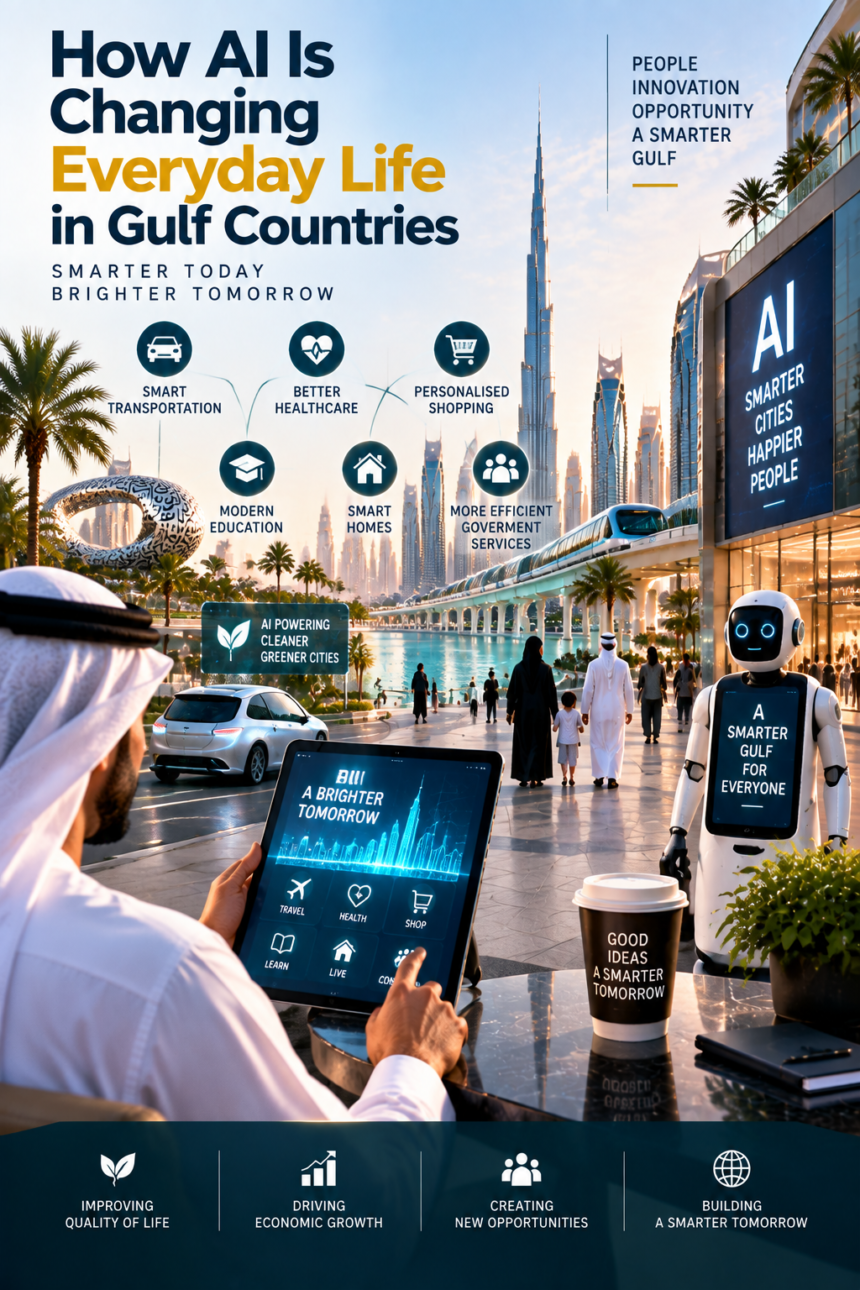
AI Is Helping Businesses Become More Efficient
AI in Gulf countries is becoming an important part of everyday life, transforming how people travel, access government services, manage finances, receive healthcare and interact with businesses.
- Why AI Adoption Is Growing So Quickly Across the Gulf
- AI Is Becoming Part of Everyday Activities
- The UAE Is Leading AI Adoption in the Gulf
- Dubai Is Becoming an AI-Powered Smart City
- Saudi Arabia Is Using AI to Support Vision 2030
- AI Is Supporting Smart Cities Across the GCC
- AI Is Transforming Healthcare in Gulf Countries
- AI Is Changing Banking and Financial Services
- AI Assistants Are Changing Customer Service
- AI Is Improving Transportation Across the Gulf
- AI Is Entering Education Systems
- AI Is Helping Businesses Become More Efficient
- AI and Cybersecurity Are Becoming Connected
- The Role of AI in Energy and Sustainability
- AI Is Creating New Career Opportunities
- Challenges of AI Adoption in the Gulf
- How GCC Countries Compare in AI Development
- What the Future of AI in Gulf Countries Could Look Like
- Quick Takeaway: How AI Is Changing Gulf Life
- AI in Gulf Countries Is Becoming Part of Everyday Life
Artificial intelligence is no longer limited to technology companies or research laboratories. Across the GCC, AI is becoming integrated into normal daily experiences, from smart traffic systems in Dubai to digital government assistants, personalised banking services and AI-powered healthcare solutions.
The Gulf region has positioned artificial intelligence as a major driver of future economic growth. Governments in the UAE, Saudi Arabia, Qatar, Bahrain, Oman and Kuwait are investing in AI infrastructure, talent development and digital transformation programmes.
The impact of AI is visible because Gulf cities already have strong digital foundations. High smartphone adoption, advanced infrastructure and connected government services allow new AI solutions to be introduced quickly.
The future of AI in the Gulf is not only about creating new technology. It is about making everyday services faster, more personalised and more efficient.
Why AI Adoption Is Growing So Quickly Across the Gulf
The GCC has several advantages that support rapid AI adoption.
Many Gulf countries have built advanced digital government systems, smart-city projects and technology-focused economic strategies. This creates an environment where artificial intelligence can be applied at a large scale.
AI adoption is also being driven by the need to improve efficiency.
Governments and businesses are using AI to reduce manual work, analyse large amounts of information and provide faster services to citizens, residents and customers.
Major Factors Supporting AI Growth
| Growth Factor | Impact |
|---|---|
| Digital government | Faster public services |
| Smart cities | Intelligent urban management |
| Cloud technology | Better AI infrastructure |
| Data availability | More accurate AI systems |
| Young population | Faster technology adoption |
| Business innovation | New AI-powered products |
| Government investment | Stronger AI ecosystems |
AI is becoming less about replacing existing systems and more about improving how those systems work.
AI Is Becoming Part of Everyday Activities
Many people interact with artificial intelligence without even realising it.
Everyday examples include:
| Daily Activity | AI Application |
|---|---|
| Navigation | Traffic prediction and route suggestions |
| Shopping | Personalised recommendations |
| Banking | Fraud detection and financial assistance |
| Healthcare | Medical analysis and diagnosis support |
| Translation | Real-time language tools |
| Customer service | AI chat assistants |
| Transportation | Smart mobility systems |
| Entertainment | Content recommendations |
| Security | Face recognition and monitoring |
| Education | Personalised learning tools |
As AI becomes embedded into existing services, it gradually becomes a normal part of daily routines.
The UAE Is Leading AI Adoption in the Gulf
The UAE has positioned artificial intelligence as a major national priority.
The country launched its UAE Artificial Intelligence Strategy 2031 to support AI adoption across sectors including government, healthcare, transport, education and energy. (u.ae)
The UAE has also created dedicated AI institutions and programmes focused on research, skills development and practical applications.
Dubai, in particular, has integrated AI into many public services and smart-city initiatives.
UAE AI Application Areas
| Sector | AI Use |
|---|---|
| Government | Digital assistants and automated services |
| Transport | Traffic management and smart mobility |
| Healthcare | Data analysis and medical support |
| Security | Threat detection |
| Business | Customer service automation |
| Education | Learning technologies |
The UAE’s approach focuses on making AI useful in real-world situations rather than keeping it only as an experimental technology.
Dubai Is Becoming an AI-Powered Smart City
Dubai’s smart-city development has created many opportunities for artificial intelligence.
The city uses technology to improve transport, government services, public safety and urban management.
AI helps analyse large amounts of information collected from connected systems.
Examples of AI in Dubai Life
Smart transportation:
AI systems analyse traffic patterns and help improve movement across the city.
Government services:
AI assistants can help residents find information and complete digital processes.
Public safety:
Advanced systems support monitoring and emergency response.
Customer services:
Businesses use AI chatbots to respond faster to customers.
The goal is not simply adding technology. It is creating a city where services respond more efficiently to people’s needs.
Saudi Arabia Is Using AI to Support Vision 2030
Saudi Arabia has identified artificial intelligence as an important technology for economic diversification.
The Kingdom established the Saudi Data and AI Authority (SDAIA) to lead national AI development and support data-driven transformation. (sdaia.gov.sa)
AI applications are expanding across government, healthcare, energy, finance and urban development.
Saudi Arabia AI Growth Areas
| Sector | AI Impact |
|---|---|
| Government | Automated digital services |
| Healthcare | Medical research and diagnosis support |
| Energy | Better efficiency and forecasting |
| Finance | Fraud prevention and analytics |
| Cities | Smart infrastructure |
| Industry | Automation and productivity |
Saudi Arabia is also investing in AI skills and research because future digital industries require specialised talent.
AI Is Supporting Smart Cities Across the GCC
Smart cities are among the biggest areas where people experience AI directly.
A smart city uses connected technology to improve how urban systems operate.
AI can analyse information from:
- Traffic sensors
- Public transport systems
- Energy networks
- Security systems
- Environmental monitoring tools
- Public-service platforms
How AI Improves Cities
| Challenge | AI Solution |
|---|---|
| Traffic congestion | Intelligent traffic management |
| Energy consumption | Smart energy optimisation |
| Public services | Faster automated responses |
| Waste management | Better collection planning |
| Emergency response | Faster decision-making |
Across the GCC, smart-city development is creating demand for AI solutions that make cities more efficient and sustainable.
AI Is Transforming Healthcare in Gulf Countries
Healthcare is one of the most important areas where artificial intelligence is making an impact.
Hospitals and medical organisations are using AI to support doctors, improve diagnosis and manage healthcare systems.
AI Healthcare Applications
| Application | Benefit |
|---|---|
| Medical imaging | Faster analysis of scans |
| Patient monitoring | Early identification of risks |
| Digital assistants | Better patient communication |
| Research | Faster data analysis |
| Hospital management | Improved efficiency |
AI does not replace medical professionals. Instead, it provides tools that can help doctors make better-informed decisions.
The Gulf’s investment in advanced healthcare infrastructure creates opportunities for wider AI adoption in the medical sector.
AI Is Changing Banking and Financial Services
Financial services are among the sectors experiencing rapid AI adoption.
Banks across the GCC are using artificial intelligence to improve security, customer experience and decision-making.
AI in Banking Includes
- Fraud detection
- Customer service chatbots
- Credit assessment
- Personalised financial recommendations
- Risk analysis
- Automated processes
The growth of digital payments and fintech across the Gulf has increased the need for intelligent financial systems.
AI helps banks handle large volumes of transactions while improving security.
AI Assistants Are Changing Customer Service
Many businesses are introducing AI-powered assistants to provide faster support.
Instead of waiting for a human representative, customers can receive immediate answers to common questions.
Businesses Use AI Assistants For
| Function | Example |
|---|---|
| Customer support | Answering common queries |
| Booking systems | Managing appointments |
| Sales | Product recommendations |
| Complaints | Faster response handling |
| Information services | Instant assistance |
The benefit is not only speed.
AI allows companies to provide support around the clock, which is increasingly important in a region with international customers and businesses operating across different time zones.
AI Is Improving Transportation Across the Gulf
Transportation is another area where AI is becoming highly visible.
Gulf cities are investing in smart mobility systems that use artificial intelligence to improve efficiency and safety.
AI Transportation Applications
| Technology | Purpose |
|---|---|
| Smart traffic systems | Reduce congestion |
| Predictive analysis | Improve transport planning |
| Autonomous vehicles | Future mobility solutions |
| Route optimisation | Faster travel |
| Public transport management | Better passenger experience |
Dubai, Abu Dhabi, Riyadh and other major cities are exploring how AI can support the next generation of transportation.
AI Is Entering Education Systems
Education is also changing through artificial intelligence.
AI-powered tools can provide personalised learning experiences by analysing student progress and adapting content.
AI Education Benefits
- Personalised lessons
- Automated assessments
- Learning recommendations
- Language support
- Administrative automation
Teachers remain central to education, but AI can provide additional tools to support different learning needs.
As Gulf countries focus on building knowledge economies, AI skills are also becoming increasingly important for students.
AI Is Helping Businesses Become More Efficient
Companies across the GCC are adopting AI to improve operations.
From large corporations to small businesses, artificial intelligence can help reduce repetitive tasks and improve decision-making.
Business AI Applications
| Business Area | AI Use |
|---|---|
| Marketing | Customer behaviour analysis |
| Sales | Lead prediction |
| Operations | Process automation |
| Human resources | Recruitment support |
| Finance | Forecasting and analysis |
| Logistics | Route optimisation |
For businesses, AI is becoming a competitive advantage.
Companies that use AI effectively can improve productivity while creating better customer experiences.
AI and Cybersecurity Are Becoming Connected
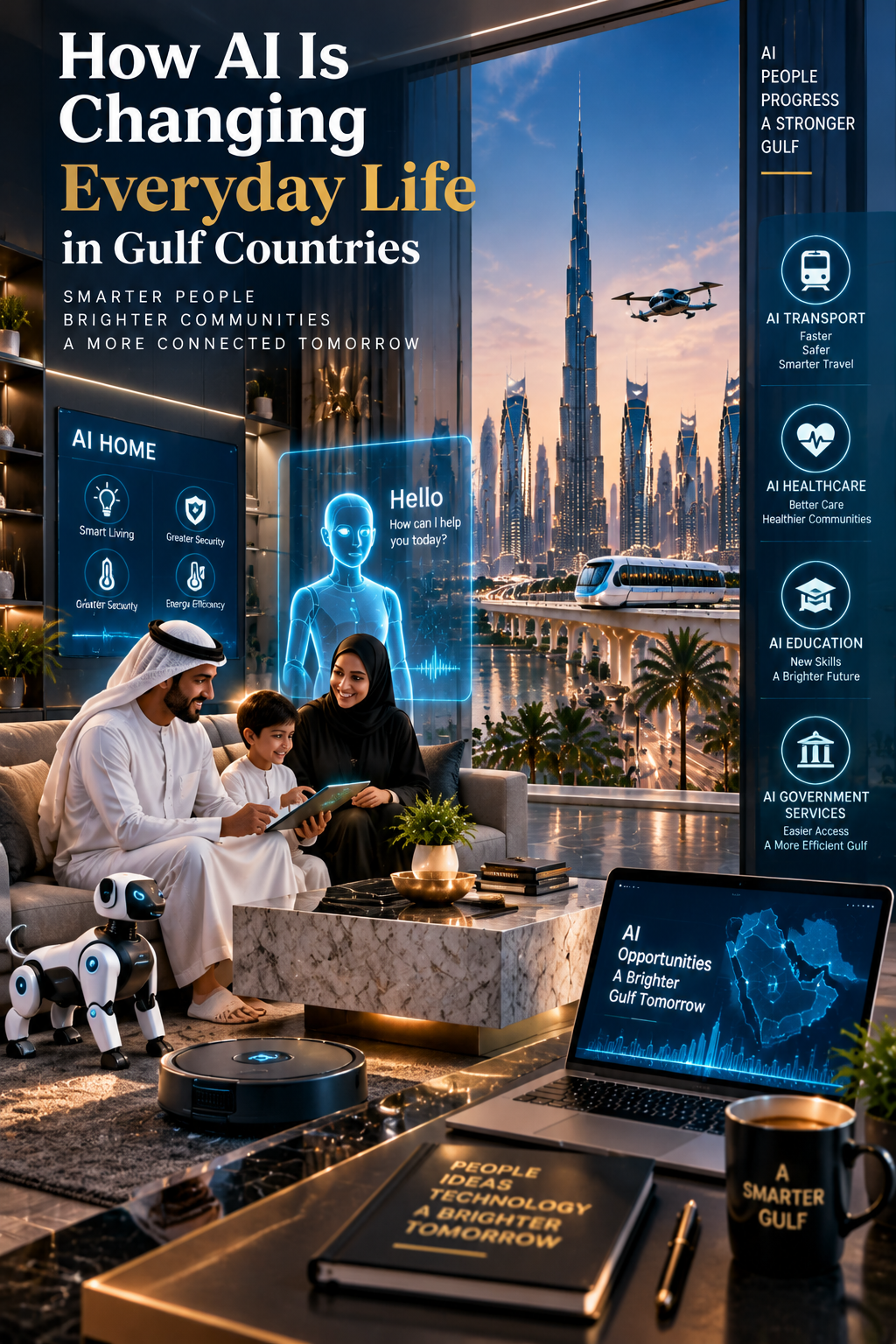
As digital systems become more advanced, cybersecurity becomes increasingly important.
AI can help security teams identify unusual activity, detect fraud and respond to threats faster.
However, criminals can also use AI to create more advanced cyberattacks.
This creates a continuous competition between security professionals and cybercriminals.
AI Cybersecurity Benefits
| Use | Advantage |
|---|---|
| Threat detection | Finds suspicious activity |
| Fraud monitoring | Protects financial systems |
| Automated response | Faster action |
| Data analysis | Identifies risks |
The future of cybersecurity will likely depend heavily on artificial intelligence.
The Role of AI in Energy and Sustainability
Energy is one of the Gulf’s most important economic sectors, and AI is helping improve efficiency.
AI can analyse large amounts of operational data to identify problems, predict maintenance needs and optimise energy use.
AI Energy Applications
- Predictive maintenance
- Smart electricity systems
- Renewable energy forecasting
- Resource optimisation
- Industrial efficiency
For countries investing in renewable energy and sustainability, AI can become an important tool for improving resource management.
AI Is Creating New Career Opportunities
The growth of artificial intelligence is creating demand for new skills.
The Gulf needs professionals who understand both technology and industry applications.
Growing AI Career Areas
| Career | Role |
|---|---|
| AI Engineer | Builds AI systems |
| Data Scientist | Analyses complex data |
| Machine Learning Specialist | Develops intelligent models |
| AI Ethics Specialist | Studies responsible AI use |
| Robotics Engineer | Creates automated systems |
| AI Consultant | Helps businesses adopt AI |
Governments and universities across the GCC are investing in AI education because future economies require technology-focused talent.
Challenges of AI Adoption in the Gulf
Despite the opportunities, AI adoption also creates challenges.
Key Challenges
| Challenge | Why It Matters |
|---|---|
| Data privacy | Protecting personal information |
| Skills shortage | Need for trained professionals |
| Cybersecurity risks | Protecting AI systems |
| Ethical concerns | Ensuring responsible use |
| High costs | Investment requirements |
| Regulation | Creating clear AI guidelines |
Successful AI adoption requires balancing innovation with safety and responsibility.
How GCC Countries Compare in AI Development
| Country | AI Focus |
|---|---|
| UAE | National AI strategy, smart cities and government applications |
| Saudi Arabia | Data-driven transformation and Vision 2030 projects |
| Qatar | Digital innovation and research |
| Bahrain | Financial technology and digital services |
| Oman | Digital transformation and emerging AI adoption |
| Kuwait | Smart government and technology development |
Each country has different priorities, but all are moving toward greater AI integration.
What the Future of AI in Gulf Countries Could Look Like
The next decade will likely bring deeper AI integration into everyday life.
Future developments may include:
- More personalised digital assistants
- Autonomous transportation
- AI-powered healthcare systems
- Smarter government services
- Advanced robotics
- Intelligent financial platforms
- Automated business operations
AI will increasingly operate in the background, improving services without always being visible to users.
The biggest change may be that technology becomes more responsive to individual needs.
Quick Takeaway: How AI Is Changing Gulf Life
AI is transforming everyday life through:
- Faster government services.
- Smarter transportation systems.
- More personalised healthcare.
- Safer financial transactions.
- Better business efficiency.
- Improved city management.
- New technology careers.
The Gulf’s AI journey is focused on using technology to create more efficient, connected and future-ready societies.
AI in Gulf Countries Is Becoming Part of Everyday Life
AI in Gulf countries is moving from a future concept into a practical technology that affects daily experiences.
The UAE is using AI to strengthen smart-city services and digital government. Saudi Arabia is integrating AI into Vision 2030 transformation plans. Qatar, Bahrain, Oman and Kuwait are also developing AI capabilities across finance, healthcare, business and public services.
The biggest impact of artificial intelligence will not come from one single invention.
It will come from thousands of small improvements happening every day: faster payments, smarter roads, better healthcare decisions, easier government services and more personalised digital experiences.
As Gulf countries continue investing in technology, AI will become one of the key forces shaping how people live, work and interact across the region.
Do follow us on Instagram
Read More – Cybersecurity in the Gulf: Why Demand Is Growing Across GCC Countries