How Flamingos Survive in Kuwait Coastal Habitats
Kuwait is known for its hot desert climate, modern buildings and beautiful coastline. However, its natural environment is also home to many interesting birds and wildlife species. Among them, flamingos are some of the most beautiful birds. Their pink feathers, long legs and curved bills make them easy to recognise along Kuwait’s coast.
- 1. Why Kuwait Coastal Habitats Are Important for Flamingos
- 2. Their Special Bills Help Them Find Food
- 3. How Flamingos Get Their Pink Colour
- 4. Long Legs Help Flamingos Walk Through Shallow Water
- 5. How Flamingos Survive in Kuwait Salty Water
- 6. How Flamingos Handle Kuwait Hot Weather
- 7. Why Live and Feed in Large Groups
- 8. Migration Helps Flamingos Find Better Living Conditions
- 9. How Flamingos Find Safe Places to Rest
- 10. How Tides Affect Flamingo Feeding Habits
- 11. The Role of Flamingos in Kuwait Coastal Ecosystem
- 12. Major Threats to Flamingos in Kuwait
- 13. Conservation Efforts to Protect Flamingos in Kuwait
- 14. Best Time and Places to See Flamingos in Kuwait
- 15. Interesting Facts About Flamingos
- Conclusion
- Frequently Asked Questions (FAQs)
Large groups of flamingos visit Kuwait’s coastal habitats, particularly during the cooler months. They can often be seen feeding in shallow water, searching for food in muddy areas or resting together in large flocks. Places such as Kuwait Bay, Sulaibikhat Bay and Jahra Nature Reserve provide important feeding and resting areas for these birds.
But how do flamingos survive in an environment where temperatures can become extremely high, water is often salty and food availability changes throughout the year?
Their survival depends on several physical features and natural behaviours. Flamingos have special adaptations that help them find food, remove excess salt, manage heat and travel long distances.
The Greater Flamingo (Phoenicopterus roseus) is the main flamingo species commonly seen in Kuwait. These birds depend on healthy coastal wetlands, shallow lagoons and tidal mudflats for food and shelter. Their presence also highlights the importance of protecting Kuwait’s coastal ecosystems.
Let’s explore how flamingos survive in Kuwait’s coastal habitats and why these birds are an important part of the country’s natural environment.
1. Why Kuwait Coastal Habitats Are Important for Flamingos
Although Kuwait has a dry desert climate, its coastline offers a very different natural environment. Shallow waters, muddy shorelines, salt marshes and coastal lagoons provide suitable conditions for many waterbirds.
These areas are especially important for flamingos because they offer food and safe places to rest. Kuwait is also located along an important bird migration route connecting parts of Europe, Asia and Africa. Many migratory birds visit the country during their seasonal journeys, using its wetlands as places to feed and rest.
Some important locations where flamingos can be observed include:
- Kuwait Bay: Its shallow waters and extensive tidal mudflats provide feeding areas for many waterbirds.
- Sulaibikhat Bay: This area is well known for its flamingo flocks and other migratory birds.
- Jahra Nature Reserve: Its wetland environment offers suitable feeding and resting areas for flamingos.
- Al-Doha coastal area: Its mudflats, sandy shorelines and reed-covered areas support different types of migratory birds.
According to KuwaitBirds.org, up to 3,000 Greater Flamingos have been recorded overwintering around Sulaibikhat Bay. This highlights the importance of Kuwait’s coastal wetlands for these birds.
2. Their Special Bills Help Them Find Food
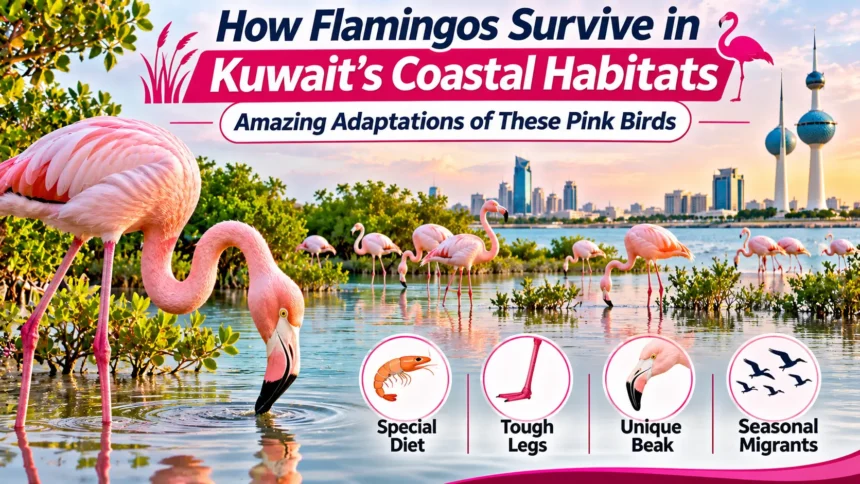
One of the most interesting features of flamingos is their curved bill. Unlike many other birds, flamingos do not simply pick up food with the tips of their beaks. Instead, they use their bills as natural filters to collect tiny food particles from water and mud.
Their bills contain small, comb-like structures called lamellae. These structures help separate food from water and muddy material.
Flamingos search for food in shallow water and muddy areas. They turn their heads upside down and use their special-shaped beaks to filter out tiny animals, algae, and insect larvae from the water and mud.
When feeding, a flamingo often places its head upside down in the water. It moves its bill through the shallow water and uses its tongue to pump water in and out. Tiny food organisms become trapped inside the filtering structures, while unwanted water and mud pass out.
This feeding method allows flamingos to collect food that many other birds cannot easily reach.
Their diet may include:
- Small crustaceans and brine shrimp.
- Microscopic algae.
- Tiny aquatic insects and larvae.
- Small organisms living in muddy coastal water.
- Other microscopic plants and animals.
The availability of these food sources makes Kuwait’s shallow coastal wetlands valuable feeding areas for flamingos.
3. How Flamingos Get Their Pink Colour
The pink colour of flamingos is one of their most recognisable features. However, these birds are not born with bright pink feathers. Their colour mainly comes from pigments called carotenoids, which are found in the algae and tiny shrimp they eat in wetlands and coastal areas.
Flamingos get their pink colour from a natural pigment called beta-carotene. This pigment is found in the algae and tiny shrimp they eat in wetlands and coastal areas.
When flamingos consume these food sources, their bodies process the pigments and use them in their feathers, skin and other tissues. This gives their feathers different shades of pink, orange and red.
The intensity of their colour can vary depending on their diet, age and overall condition. Young flamingos usually have greyish or pale feathers. As they grow and continue eating food containing carotenoids, their feathers gradually develop their familiar pink colour.
This natural process also shows how closely flamingos depend on healthy coastal ecosystems. A lack of suitable food can affect their condition and the development of their colourful feathers.
4. Long Legs Help Flamingos Walk Through Shallow Water
Flamingos have extremely long legs compared with many other waterbirds. These legs are not just part of their unusual appearance. They play an important role in helping the birds survive in coastal habitats.
Their thick, scaly skin protects their legs from salty water, sharp shells, and other harmful substances found in shallow coastal areas and muddy wetlands.
Kuwait’s tidal mudflats and shallow lagoons provide suitable places for flamingos to search for food. Their long legs allow them to walk through these areas while keeping most of their bodies above the water.
This gives them several advantages:
- Access to food: They can walk through shallow water while searching for small aquatic organisms.
- Easy movement: Their long legs help them move through muddy coastal areas.
- Keeping their bodies above water: They can feed with their heads underwater while keeping most of their bodies dry.
- Access to different feeding areas: They can move between areas with different water depths.
These features are particularly useful in Kuwait, where coastal water levels change throughout the day because of the tides.
5. How Flamingos Survive in Kuwait Salty Water
Living near the sea presents a challenge for many birds because seawater contains large amounts of salt. Taking in too much salt can disturb the body’s natural balance.
Flamingos have a special biological system that helps them deal with salty environments. Like several other waterbirds, they have salt glands located near their eyes. These glands remove excess salt from their bodies, which is then released through the nasal passages.
This adaptation is useful because flamingos often feed in saline lagoons, salt marshes and coastal wetlands. It allows them to use a wider range of habitats without depending entirely on freshwater sources.
However, flamingos do not rely only on salty water. They can also use suitable freshwater sources when available.
Their ability to remove excess salt is one of the reasons they can survive in different wetland environments, including the saline coastal habitats found around Kuwait.
6. How Flamingos Handle Kuwait Hot Weather
Kuwait experiences extremely hot summers, with daytime temperatures rising considerably during the warmer months. These conditions can be challenging for birds because they need to maintain a stable body temperature.
Flamingos use different behaviours to manage changing temperatures. During warmer periods, they may spend time in shallow water, where they can continue feeding while staying in a cooler environment than exposed dry land.
They can also adjust their activities according to the weather. For example, they may spend more time feeding during cooler parts of the day and resting when temperatures become uncomfortable.
Other behaviours that help them cope with changing conditions include:
- Standing in shallow water.
- Resting during periods of extreme heat.
- Moving between feeding and resting locations.
- Standing on one leg, a common behaviour that may help reduce heat loss and conserve energy.
Their feathers also provide insulation and help maintain a stable body temperature.
However, these adaptations cannot protect flamingos from every environmental challenge. Extremely high temperatures, reduced water levels and changes in food availability can still affect their health and survival.
This makes suitable coastal wetlands important throughout the year.
7. Why Live and Feed in Large Groups
Flamingos are highly social birds. They usually feed, rest and move in large groups rather than spending most of their time alone. A large group of flamingos is commonly called a flamboyance.
In Kuwait, large flocks can sometimes be seen gathering along coastal mudflats and shallow waters. Living in groups offers several advantages.
Protection from predators: When many birds stay together, it becomes easier to notice possible danger. If one bird spots a threat, others can quickly respond.
Better feeding opportunities: Flamingos often feed together in areas where food is available. This allows them to make good use of productive feeding grounds.
Social communication: They use different body movements, calls and displays to communicate with one another. These behaviours are also important during courtship and breeding.
Finding suitable resting places: Large groups can move together between feeding and resting areas when environmental conditions change.
This social behaviour is particularly useful in open coastal habitats, where there are few places to hide from potential threats.
8. Migration Helps Flamingos Find Better Living Conditions
Migration is another important part of flamingo survival. These birds move between different geographical areas depending on food availability, weather conditions and breeding requirements.
Kuwait is an important stopover and wintering destination for many migratory birds. Its location along the northern Arabian Gulf makes it a useful feeding and resting area for birds travelling between different parts of Asia, Europe and Africa.
Greater Flamingos can be seen in Kuwait throughout the year, although they are more commonly observed during the cooler months.
Their seasonal movements are influenced by several factors:
- Changes in temperature.
- Food availability in coastal wetlands.
- Suitable breeding locations.
- Water levels in lagoons and mudflats.
- Seasonal weather conditions.
During autumn, many migratory birds move south towards warmer regions. In spring, some return to their northern breeding areas. Along the way, flamingos can use suitable wetlands to rest and regain energy.
A particularly interesting example was recorded in September 2025, when a four-year-old female Greater Flamingo was identified at Jahra Nature Reserve in Kuwait. Its leg bands showed that it had originally been marked in Camargue, southern France, in August 2021.
This discovery demonstrated the connection between Kuwait’s wetlands and distant European habitats. It also showed how bird monitoring can help researchers understand flamingo migration patterns.
9. How Flamingos Find Safe Places to Rest
Rest is just as important as feeding for flamingos. Searching for food, flying long distances and moving between wetlands require energy. These birds therefore need suitable places where they can rest without constant disturbance.
Kuwait’s coastal mudflats and shallow lagoons provide useful resting areas.
Flamingos often stand in shallow water or on muddy ground while resting. They may tuck their heads beneath their feathers and stand on one leg for extended periods.
Scientists believe that standing on one leg may help flamingos conserve energy and reduce heat loss. This behaviour is common among resting flamingos.
Their choice of resting area also depends on environmental conditions. When water levels change or human activity increases, they may move to quieter locations.
Safe resting places are especially important during migration because birds need enough energy to continue their journeys.
10. How Tides Affect Flamingo Feeding Habits
Tides play an important role in the daily lives of flamingos along Kuwait’s coastline. The water level rises and falls throughout the day, creating different feeding opportunities for waterbirds.
During low tide, parts of the coastal mudflats become exposed. This makes small aquatic organisms and other food sources easier for birds to reach.
When the tide rises, some feeding areas become covered with water. Flamingos may then move to other shallow areas or wait until suitable feeding grounds become available again.
These natural changes help support many coastal birds and marine organisms.
Kuwait’s intertidal mudflats are particularly important because they provide feeding opportunities for large numbers of migratory and wintering birds.
According to the Kuwait Institute for Scientific Research, these mudflats support many flamingos, gulls and other shorebirds during autumn, winter and spring.
Changing tides also help maintain coastal ecosystems by moving nutrients and supporting small aquatic organisms.
11. The Role of Flamingos in Kuwait Coastal Ecosystem
Flamingos are not only beautiful birds. They also play a role in Kuwait’s coastal ecosystem.
Their feeding activities connect different parts of the wetland food chain. By eating algae, small crustaceans and other aquatic organisms, they help transfer energy through the ecosystem.
Their presence can also provide useful information about the condition of wetlands. Flamingos depend on suitable water conditions, enough food and relatively undisturbed feeding areas. When these conditions change, they may move elsewhere or spend less time in a particular location.
Flamingos share their habitats with many other bird species, including:
- Herons.
- Egrets.
- Gulls.
- Sandpipers.
- Plovers.
- Terns.
- Other migratory waterbirds.
These species use the same coastal areas for different purposes, including feeding, resting and breeding.
Protecting flamingo habitats therefore helps support many other species that depend on Kuwait’s coastal wetlands.
12. Major Threats to Flamingos in Kuwait
Although flamingos have several natural adaptations that help them survive, they still face environmental challenges. Human activities and changes to coastal ecosystems can make their habitats less suitable.
Some of the main threats include:
1. Water pollution
Pollution is a major concern for coastal wildlife. Plastic waste, chemicals, oil and untreated wastewater can affect water quality and harm the small organisms that flamingos depend on for food.
Contaminated feeding areas can also create health risks for birds.
2. Habitat destruction
Coastal development, construction and changes to natural shorelines can reduce the amount of suitable wetland habitat available to flamingos.
When important feeding and resting areas disappear, birds may struggle to find alternative locations.
3. Human disturbance
Frequent human activity near wetlands can disturb birds while they are feeding or resting. Loud noises, approaching too closely and recreational activities may cause flamingos to fly away unnecessarily.
Repeated disturbance can waste their energy, especially during migration.
4. Hunting and accidental capture
Illegal shooting and accidental capture in fishing nets are additional dangers. Flamingos need protection from these activities to survive safely in their natural habitats.
5. Climate change
Changing temperatures, rainfall patterns and sea levels can affect coastal wetlands. These changes may influence water availability, food sources and the condition of important feeding areas.
KuwaitBirds.org identifies pollution of tidal feeding flats, occasional shooting and accidental capture in fishing nets as local threats to Greater Flamingos.
13. Conservation Efforts to Protect Flamingos in Kuwait
Protecting flamingos requires maintaining the coastal habitats where they feed, rest and spend the winter. Conservation efforts also benefit many other migratory birds that depend on Kuwait’s wetlands.
Several natural areas in Kuwait are important for bird conservation, including Jahra Nature Reserve, Sulaibikhat Bay and Bubiyan Island.
Environmental organisations, researchers and birdwatching groups help protect these birds by monitoring their populations, recording migration patterns and raising awareness about wildlife conservation.
Kuwait’s winter bird-count activities are one example of how researchers and conservation groups collect information about the species visiting the country’s coastal areas.
In January 2026, a winter bird-count event at Sulaibikhat Beach recorded 200 Greater Flamingos among the birds observed. Such activities provide useful information about bird populations and highlight the importance of protecting coastal habitats.
There are several practical ways to help protect flamingos:
- Keep beaches and coastal wetlands free from plastic and other waste.
- Avoid disturbing birds while they are feeding or resting.
- Prevent illegal hunting and protect birds from fishing nets.
- Support wetland protection and habitat restoration.
- Encourage responsible birdwatching and nature photography.
- Improve water quality through better waste management.
- Support scientific research and regular bird monitoring.
Conservation is not only the responsibility of environmental organisations. Local communities, visitors, businesses and government authorities all have a role to play in protecting Kuwait’s natural environment.
14. Best Time and Places to See Flamingos in Kuwait
Flamingos are among the most attractive birds to observe in Kuwait. Their large flocks and bright pink feathers make them popular with birdwatchers and nature photographers.
Although they can be found in the country throughout the year, the cooler months generally offer better opportunities to see large groups.
Flamingos arrive in Kuwait around August or September and stay through the cooler winter months until March or April. They leave before the hot summer season begins.
The period from November to March is particularly suitable for flamingo watching. During this time, many birds gather around coastal wetlands to feed and rest.
Some well-known places to observe them include:
| Location | Why it is important |
|---|---|
| Sulaibikhat Bay | Large flocks of Greater Flamingos and extensive mudflats |
| Jahra Nature Reserve | Important wetland and migratory bird habitat |
| Kuwait Bay | Shallow waters and productive coastal feeding grounds |
| Al-Doha coastal area | Mudflats and resting areas for waterbirds |
Visitors should always follow local access rules, especially in protected areas. Keeping a safe distance and using binoculars or zoom cameras are good ways to observe flamingos without disturbing them.
Kuwait’s coastal wetlands offer a valuable opportunity to see how wildlife survives in a desert environment.
15. Interesting Facts About Flamingos
Flamingos have many interesting characteristics that make them different from other waterbirds.
Here are some fascinating facts about these beautiful birds:
- They are excellent filter feeders: Their specially shaped bills help them collect tiny food organisms from water.
- They are highly social: Flamingos usually live in large groups called flamboyances.
- Their pink colour comes from food: Carotenoid pigments in their diet give their feathers their pink colour.
- They can stand on one leg: This behaviour is common during rest and may help them manage heat loss.
- They have salt glands: These special glands help remove excess salt from their bodies.
- They are strong flyers: Flamingos can travel long distances during seasonal migration.
- They have long lifespans: Greater Flamingos can live for several decades, particularly under favourable conditions.
- They use shallow wetlands: Mudflats, lagoons and salt marshes provide important feeding and resting areas.
These characteristics explain why flamingos can survive in different environments, including the coastal wetlands of Kuwait.
Conclusion
Flamingos are a wonderful example of how wildlife adapts to challenging natural environments. Despite Kuwait’s hot climate, salty coastal waters and changing tides, these birds have developed special features that help them survive.
Their curved bills allow them to filter food from shallow water, while their long legs help them walk through muddy coastal areas. Special salt glands allow them to remove excess salt, and their social behaviour helps them feed and rest in large groups.
Kuwait’s coastal habitats, particularly Kuwait Bay, Sulaibikhat Bay and Jahra Nature Reserve, play an important role in supporting these beautiful birds.
However, their survival also depends on healthy wetlands, clean water and protection from human disturbance. Pollution, habitat destruction and illegal hunting can put pressure on flamingo populations.
Protecting these coastal environments is important not only for flamingos but also for the many other migratory birds and marine species that depend on them.
By improving conservation efforts and encouraging responsible tourism, Kuwait can continue to provide valuable natural habitats for flamingos and other wildlife for generations to come.
Frequently Asked Questions (FAQs)
1. Which flamingo species is commonly found in Kuwait?
The Greater Flamingo (Phoenicopterus roseus) is the main flamingo species commonly observed in Kuwait. It is particularly visible around Kuwait Bay, Sulaibikhat Bay and Jahra Nature Reserve.
2. Why do flamingos visit Kuwait?
Flamingos visit Kuwait because its coastal wetlands provide suitable feeding and resting areas. The shallow waters and muddy shorelines contain small aquatic organisms that make up their natural diet.
3. What do flamingos eat in Kuwait?
Flamingos mainly eat small crustaceans, brine shrimp, algae and other microscopic organisms found in shallow coastal waters and mudflats.
4. How do flamingos survive in salty water?
Flamingos have special salt glands near their eyes that help remove excess salt from their bodies. This adaptation allows them to live and feed in saline coastal environments.
5. Why are flamingos pink?
Flamingos get their pink colour from carotenoid pigments found in their food. Their bodies process these pigments and deposit them in their feathers.
6. When is the best time to see flamingos in Kuwait?
The cooler months, particularly November to March, are generally the best time to observe large groups of flamingos in Kuwait.
7. Where can visitors see flamingos in Kuwait?
Some well-known locations include Sulaibikhat Bay, Kuwait Bay, Jahra Nature Reserve and the Al-Doha coastal area.
8. What are the biggest threats to flamingos in Kuwait?
The main threats include water pollution, habitat destruction, human disturbance, illegal hunting and accidental capture in fishing nets.
9. How Flamingos Survive in Kuwait costal Habitat?
Flamingos survive in Kuwait’s coastal habitats through their long legs, specially adapted bills, salt-filtering glands and ability to adapt to changing temperatures and food availability.
Do follow us on Instagram
Read More – Why Vultures Are Important to Desert Ecosystems