




Understanding Business Bank Accounts
GCC Business Banking is an essential part of running a company in the UAE, Saudi Arabia, Qatar, Bahrain, Oman or Kuwait. Registering a company gives an entrepreneur the legal structure to operate, but a functioning business also needs a reliable way to receive customer payments, pay suppliers, manage salaries, make international transfers and maintain clear financial records.
- GCC Business Banking: 2026 Overview
- Understanding Business Bank Accounts
- 1. Opening a Business Bank Account
- 2. Preparing Company Documents
- 3. Understanding KYC and Beneficial Ownership
- 4. Choosing the Right Bank
- 5. Minimum Balances and Banking Fees
- 6. Business Payments and Transfers
- 7. Multi-Currency Business Banking
- 8. Payment Gateways and Merchant Accounts
- 9. Business Cards and Expense Management
- 10. Business Loans and Credit Facilities
- 11. Trade Finance and International Business
- 12. Keeping the Account Compliant
- Business Banking in the UAE
- Business Banking in Saudi Arabia
- Business Banking in Qatar
- Business Banking in Bahrain
- Business Banking in Oman
- Business Banking in Kuwait
- Business Banking for Startups
- Business Banking for Online Companies
- Business Banking for Free Zone Companies
- Islamic Business Banking in the GCC
- Choosing Between One Bank and Multiple Banks
- Common Business Banking Mistakes
- GCC Business Banking Checklist
- Final Thoughts on GCC Business Banking
Opening a company bank account is therefore one of the most important steps after incorporation.
It is also one of the areas where new entrepreneurs frequently become frustrated.
Having a trade licence does not automatically guarantee that a bank will approve an account. Gulf banks operate under strict Know Your Customer, anti-money laundering and financial crime rules. They need to understand who owns the company, what it does, where its money comes from and what types of transactions are expected.
The Central Bank of the UAE, for example, requires licensed financial institutions to identify and verify customers and beneficial owners, understand the purpose and nature of the banking relationship and maintain ongoing monitoring of customer activity.
Saudi Arabia follows a similar principle. SAMA requires banks to apply KYC and AML requirements and understand the nature of the customer and expected business activity before or during the banking relationship.
For entrepreneurs, the lesson is simple: business banking begins with transparency.
A company with clear ownership, proper documents, a realistic business model and understandable transactions will generally be easier for a bank to assess than a newly created company with complicated ownership and unclear expected activity.
GCC Business Banking: 2026 Overview
Business banking requirements differ between banks and countries, but the basic process across the GCC is broadly similar.
| Banking Area | What Entrepreneurs Should Expect |
|---|---|
| Company verification | Trade licence or commercial registration |
| Ownership checks | Shareholders and ultimate beneficial owners |
| Signatories | People authorised to operate the account |
| Business explanation | Activity, customers and suppliers |
| Source of funds | Where startup and operating money comes from |
| Expected transactions | Monthly volumes and countries involved |
| Tax information | FATCA, CRS and local tax details where applicable |
| Online banking | Usually available for corporate customers |
| Multi-currency accounts | Available from many banks |
| Finance | Subject to credit assessment and business history |
| Account monitoring | Continues after account opening |
A business account is therefore not simply a larger personal account.
Banks normally treat companies as separate legal and financial customers.
This is why company money should generally be kept separate from personal funds.
Clear separation makes accounting, tax reporting, investor due diligence and financial management much easier.
Understanding Business Bank Accounts
A business bank account is opened in the legal name of the company rather than in the owner’s personal name.
It may allow the company to:
- Receive customer payments
- Pay suppliers
- Make salary payments
- Issue corporate cards
- Make international transfers
- Receive foreign currencies
- Apply for business finance
- Use payment gateways
- Access trade finance
- Maintain transaction records
Different account types may be available.
Business current account
Designed for everyday company transactions.
Foreign-currency account
Used to hold currencies such as USD, EUR or GBP.
Deposit account
Used for surplus company funds.
Merchant account
Supports card-payment processing.
Financing account
Connected with business loans or Islamic finance facilities.
Most SMEs begin with a standard operating current account and add other banking services as the company grows.
1. Opening a Business Bank Account
The normal process begins after the company has been legally incorporated.
Banks commonly ask the entrepreneur to provide information on:
- Company registration
- Business licence
- Shareholders
- Directors
- Authorised signatories
- Business activity
- Expected revenue
- Customers
- Suppliers
- Source of funds
- Countries of operation
Some banks allow parts of the process to be completed digitally.
Others may require founders or authorised signatories to attend a branch or complete a video-identification process.
Approval time depends heavily on the risk profile.
In the UAE, the currently applicable SME Market Conduct Regulation says banks should have systems allowing low-risk SME bank accounts to be opened within three business days when all standard due-diligence documents are complete.
A new SME Customer Protection Regulation will replace that framework on September 13, 2026, and retains the three-business-day standard for qualifying low-risk completed applications while allowing additional time where financial-crime compliance requirements justify it.
Since this article is being prepared before September 13, the existing SME Market Conduct Regulation remains the applicable UAE framework at present.
Most other GCC countries do not provide one universal public account-opening timeframe because the individual bank’s due-diligence process can vary.
2. Preparing Company Documents
Preparing complete documentation before applying can reduce delays.
Common documents include:
- Trade licence
- Commercial registration
- Certificate of incorporation
- Memorandum of association
- Articles of association
- Shareholder register
- Passport copies
- National or residence IDs
- Board resolution
- Signatory authorisation
- Proof of business address
Additional documents may be requested.
These can include:
- Business plan
- Customer contracts
- Supplier invoices
- Website
- Bank statements
- Financial statements
- Source-of-funds evidence
Saudi Arabia provides a useful example of formal corporate banking documentation.
SAMA’s in-force rules for resident companies require banks to obtain the commercial register, memorandum or articles of association, identification of the manager, board members and owners, together with documents authorising the individuals who will operate the account.
Bahrain’s CBB due-diligence framework similarly lists company incorporation or commercial registration documents, memorandum and articles of association, board resolutions, authorised-signatory identification and, where available, financial statements among documents banks use when verifying corporate customers.
The precise list still depends on the company type and bank.
3. Understanding KYC and Beneficial Ownership
KYC means Know Your Customer.
For a company, banks usually need to know much more than the name printed on the trade licence.
They need to identify the ultimate beneficial owners, or UBOs.
A beneficial owner is generally the real individual who ultimately owns or controls the company, even when the shares are held through other companies.
Imagine this structure:
Gulf Trading LLC
owned by
International Holdings Ltd
owned by
Mr A and Ms B
The bank may need information not only on Gulf Trading LLC but also on International Holdings and the individuals who ultimately control it.
The UAE requires financial institutions to identify and verify legal entities and beneficial owners and to understand the customer’s business, source of funds and expected activity.
Qatar’s banking instructions similarly require financial institutions to identify customers, beneficial owners, the reason for opening an account, expected transaction activity and authorised signatories.
Kuwait’s AML instructions require banks to take measures to identify and verify beneficial owners, including in corporate ownership structures.
This is why complicated offshore structures can take longer to bank.
The bank needs to understand the entire ownership chain.
4. Choosing the Right Bank
Do not choose a business bank based only on whether it approves the account.
Compare how well the bank fits the business.
Important factors include:
- Monthly fees
- Minimum balance
- Online banking
- International transfers
- Branch network
- Corporate cards
- Currency accounts
- Trade finance
- Merchant services
- Customer support
A small consultant has very different needs from an importer.
A consultant may prioritise:
- Low monthly fees
- Digital banking
- International transfers
A trading company may prioritise:
- Letters of credit
- Foreign exchange
- Supplier payments
- Customs-related banking
A company with hundreds of employees may care more about:
- Payroll
- Bulk payments
- Corporate cards
- Cash management
Select the bank around expected transactions rather than its brand name alone.
5. Minimum Balances and Banking Fees
Business bank accounts can involve fees that personal accounts may not.
Possible charges include:
- Monthly account fee
- Minimum-balance fee
- International transfer fee
- Foreign exchange markup
- Cash deposit charges
- Cheque services
- Corporate card fees
- Additional user fees
Terms vary significantly by bank.
Some business accounts have no monthly minimum balance but charge a fixed monthly fee.
Others waive monthly fees when a required average balance is maintained.
Avoid choosing an account based on one fee alone.
An importer receiving USD and paying overseas suppliers might save far more through competitive foreign-exchange pricing than through a slightly lower monthly account fee.
Calculate the expected annual cost based on how the company will actually use the account.
6. Business Payments and Transfers
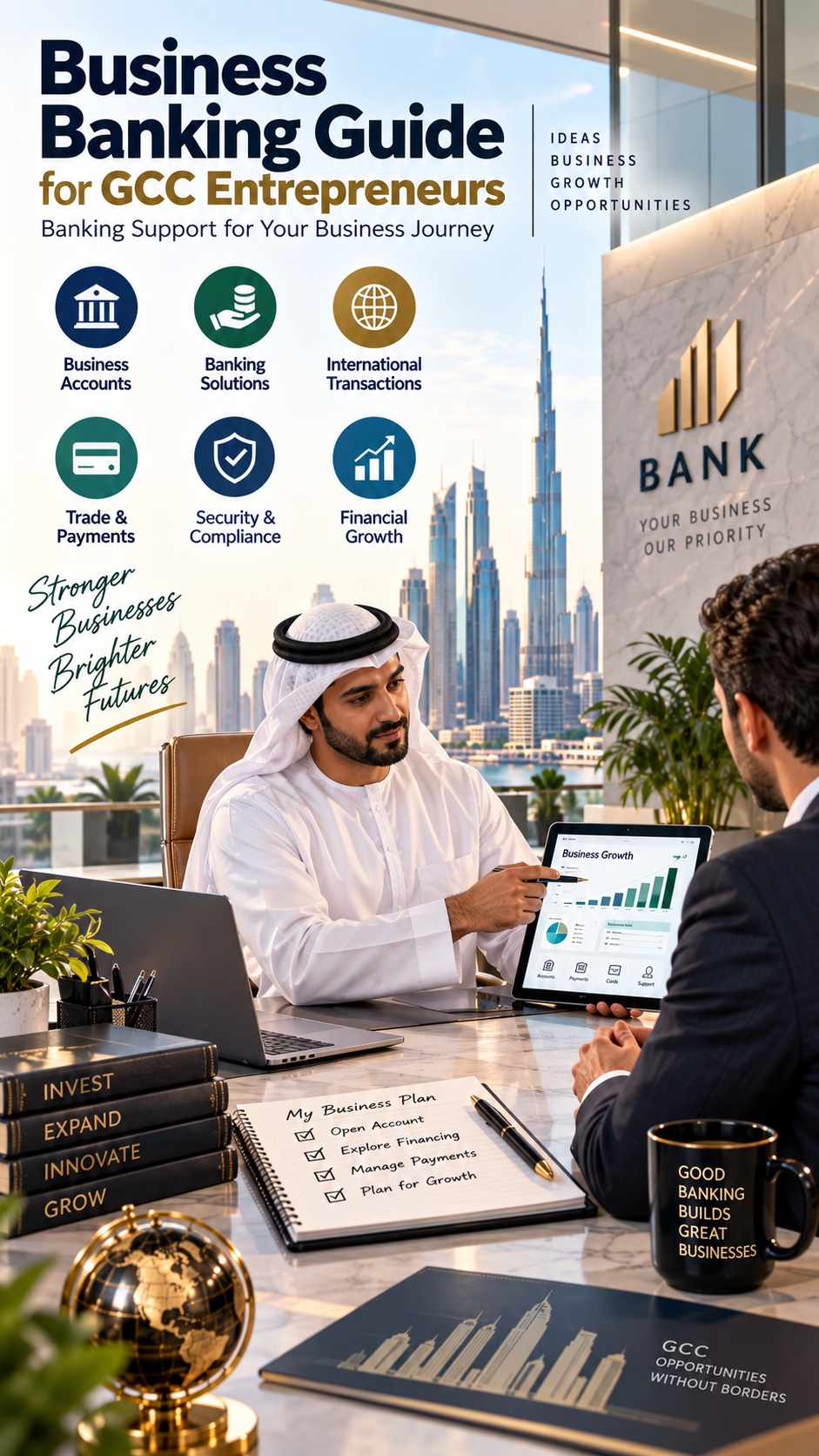
Modern Gulf business banking is increasingly digital.
Entrepreneurs can usually perform activities such as:
- Domestic bank transfers
- International payments
- Salary transfers
- Supplier payments
- Scheduled transfers
- Bulk payments
Companies should establish approval controls.
For example:
Founder prepares payment
Finance manager reviews payment
Authorised director approves payment
This is safer than allowing one employee to create and approve every transaction.
Larger businesses can establish multiple banking users with different permissions.
Common roles can include:
- View only
- Create payment
- Approve payment
- Full administrator
Strong internal controls reduce fraud risk and make financial management easier.
7. Multi-Currency Business Banking
Many Gulf businesses trade internationally.
A UAE company may invoice in USD.
A Saudi company may purchase products from Europe in EUR.
A Qatar-based consultancy may receive GBP from British customers.
A multi-currency business account can allow companies to hold several currencies rather than converting every payment immediately.
Potential benefits include:
- Lower unnecessary conversion
- Easier international invoicing
- Better control over FX timing
- Simplified supplier payments
Foreign-exchange cost matters particularly for trading businesses.
Suppose an importer processes millions of dirhams in international supplier payments every year.
Even a small difference in the bank’s exchange-rate margin can become financially significant.
Compare FX spreads as carefully as transfer fees.
8. Payment Gateways and Merchant Accounts
Online businesses need to connect banking with payment processing.
A payment gateway allows customers to pay through:
- Credit cards
- Debit cards
- Digital wallets
- Other online methods
The payment provider normally settles the money into the company’s bank account.
Entrepreneurs should compare:
- Transaction fee
- Setup charge
- Settlement period
- Refund fee
- Chargeback process
- Supported currencies
- International cards
- Fraud controls
A merchant service provider may also perform separate KYC.
That means having a business bank account does not guarantee automatic payment-gateway approval.
Online companies should prepare:
- Website
- Terms and conditions
- Refund policy
- Privacy policy
- Product information
- Company licence
before applying for payment processing.
9. Business Cards and Expense Management
Corporate debit and credit cards can make business spending easier to control.
They can be issued to:
- Founders
- Managers
- Sales teams
- Travelling employees
Companies should avoid sharing one card among many employees.
Instead, create clear card limits and expense categories.
For example:
Sales employee: AED 5,000 limit
Operations manager: AED 10,000 limit
Founder: AED 30,000 limit
Expense-management systems can then connect each payment with:
- Receipt
- Department
- Client
- Project
This creates stronger accounting records.
Corporate cards should be treated as company tools rather than personal spending accounts.
10. Business Loans and Credit Facilities
Opening a bank account does not automatically mean a new company can obtain a loan.
Banks usually evaluate:
- Revenue
- Cash flow
- Business age
- Financial statements
- Existing debt
- Owner profile
- Industry
- Credit history
New businesses often have less access to unsecured finance because they have limited operating history.
Possible forms of business finance include:
- Working capital loan
- Overdraft
- Equipment finance
- Commercial property finance
- Invoice finance
- Trade finance
Islamic banks may offer Sharia-compliant business finance using alternative contractual structures.
Entrepreneurs should avoid using expensive short-term finance to cover a business model that is permanently losing money.
Finance should support growth or temporary working-capital needs rather than hide weak economics.
11. Trade Finance and International Business
Importers and exporters often need more sophisticated banking products.
Trade finance can include:
- Letters of credit
- Bank guarantees
- Documentary collections
- Import finance
- Export finance
A letter of credit can help reduce trust risk between a buyer and overseas seller.
For example, a Saudi importer purchasing equipment from Germany may use a letter of credit issued by its bank.
The seller receives greater confidence that payment will be made if the required documents and conditions are met.
Trade-finance pricing depends on:
- Company strength
- Transaction value
- Country
- Bank risk
- Security
For businesses importing or exporting regularly, trade-finance capability should be an important factor when selecting the primary bank.
12. Keeping the Account Compliant
KYC does not end after the account opens.
Banks continue monitoring customer activity.
The UAE’s CDD framework specifically requires ongoing monitoring and periodic or event-driven updates to customer and beneficial-ownership information.
Businesses may therefore periodically receive requests to update:
- Trade licence
- Shareholder information
- Passport
- Residence ID
- Business address
- Financial statements
- Expected transactions
The bank may also ask questions about unusual transactions.
Suppose a consultancy normally receives AED 100,000 per month from UAE clients and suddenly receives AED 5 million from an unrelated company overseas.
The bank may reasonably ask:
- What is the payment for?
- Where is the contract?
- What is the commercial relationship?
Keeping invoices and contracts organised helps answer these questions quickly.
Business Banking in the UAE
The UAE has an extensive business banking market serving startups, SMEs and multinational companies.
Corporate customers can choose between local banks, Islamic banks and international banking groups.
The CBUAE’s current SME rules provide important protection for smaller businesses.
For qualifying low-risk SMEs that have submitted complete standard documentation, institutions should have systems capable of completing account opening within three business days.
However, the rule does not override AML and sanctions checks.
Banks can take longer when additional financial-crime due diligence is required.
UAE banks must identify and verify:
- Company
- Beneficial owners
- Business purpose
- Expected activity
and maintain ongoing monitoring.
A significant regulatory update arrives shortly after this article’s publication date. The new SME Customer Protection Regulation takes effect on September 13, 2026, replacing the current SME Market Conduct Regulation while maintaining the three-day low-risk account-opening standard with compliance exceptions.
For UAE entrepreneurs, having a trade licence, clear ownership structure and genuine evidence of business activity can help the application.
Business Banking in Saudi Arabia
Saudi Arabia has detailed banking rules for corporate customers.
SAMA’s in-force rules state that banks opening accounts for resident companies obtain information including:
- Commercial registration
- Memorandum or articles of association
- Manager identification
- Board member details
- Owner details
- Authorisation for account operators
Saudi banks also apply KYC and AML requirements designed to understand the customer, business activity and associated financial-crime risks.
Remote corporate account opening is permitted under SAMA rules where banks use reliable information to verify the company, ownership, directors and authorised account operators and apply suitable risk controls.
For entrepreneurs, the practical sequence is therefore usually:
Establish company
Obtain commercial registration
Prepare corporate documents
Apply to bank
Complete KYC
Activate banking
Business owners should ensure that the commercial activity in the bank application matches the company’s official registration.
Business Banking in Qatar
Business banks in Qatar operate within Qatar Central Bank’s regulatory framework.
QCB’s customer due-diligence rules require financial institutions to identify and verify the customer and beneficial owner before establishing the banking relationship.
Banks should also understand:
- Nature of the business
- Expected transaction pattern
- Purpose of the account
- Expected activity level
- Account signatories
This means a new Qatar company should be able to explain clearly what it does and where payments are expected to come from.
A consulting company expecting transfers mainly from Qatari businesses presents a different profile from an international trading company receiving payments from several countries.
Banks may therefore request different evidence depending on risk.
Entrepreneurs should prepare customer contracts, invoices or a business plan when the company is newly established and has limited transaction history.
Business Banking in Bahrain
Bahrain has a mature banking industry serving both domestic and international companies.
The Central Bank of Bahrain’s corporate customer due-diligence framework requires banks to verify the legal existence and ownership of companies.
Relevant documentation can include:
- Certificate of incorporation
- Commercial registration
- Memorandum of association
- Articles of association
- Board resolution
- Signatory identification
- Financial accounts where applicable
Banks must also identify and take reasonable measures to verify beneficial owners.
This makes ownership transparency important.
A simple Bahrain WLL with one or two clearly identified shareholders may be easier for a bank to understand than a business owned through multiple foreign holding entities.
That does not mean complex structures are prohibited.
It means they usually require more supporting documentation.
Business Banking in Oman
Oman has been investing in digital banking infrastructure.
The Central Bank of Oman operates a national electronic KYC and digital onboarding initiative through Mala’a.
CBO states that the platform enables financial institutions to verify identity and access KYC information for both individuals and corporate clients.
The Central Bank issued digital onboarding and e-KYC instructions in 2023, and its current infrastructure programme is also developing Electronic Know Your Business, or E-KYB, capabilities for company verification.
This does not mean every company can automatically open every bank account completely online.
Individual banks still apply their own onboarding, product and risk requirements.
Omani companies should therefore prepare the standard corporate documentation as well as clear beneficial-ownership and business information.
Business Banking in Kuwait
Kuwait’s banks operate under Central Bank of Kuwait AML and banking regulations.
The CBK requires banks to take appropriate measures to identify beneficial owners and verify relevant ownership information when establishing customer relationships.
As elsewhere in the GCC, corporate banking requirements can include:
- Company registration
- Ownership documents
- Authorised signatories
- Business activity
- Expected transactions
Foreign-owned companies should pay particular attention to ensuring that the banking application matches the company’s legal investment and ownership structure.
A company established under a special investment framework may also need to present the corresponding investment licences and approvals.
Bank-specific account fees and minimum balances should be compared carefully because business banking packages vary.
Business Banking for Startups
Startups can sometimes find bank onboarding more difficult because they have little financial history.
The bank may ask:
Who are your customers?
What revenue do you expect?
How is the company funded?
Why was the company created?
A new startup can strengthen its application with:
- Business plan
- Founder CV
- Website
- Signed customer contract
- Supplier agreement
- Investment agreement
The objective is to show that the business has a genuine economic purpose.
Avoid exaggerating expected transaction volume.
If the application predicts monthly revenue of $10 million but the company has no contracts, employees or funding, the forecast may create more questions than confidence.
Use realistic numbers.
Business Banking for Online Companies
Digital businesses need banking that works well with online payments and international transactions.
Important features can include:
- Payment gateway compatibility
- Fast electronic transfers
- Multi-currency accounts
- Corporate cards
- Accounting integrations
Banks may ask online companies for additional evidence such as:
- Website
- Product list
- Terms and conditions
- Customer locations
- Payment gateway details
E-commerce businesses should also explain where inventory is sourced and which markets they serve.
A dropshipping company, marketplace and digital marketing consultancy may all be “online businesses” but have completely different transaction patterns.
Business Banking for Free Zone Companies
UAE free-zone companies sometimes assume that receiving a licence automatically guarantees bank approval.
It does not.
The bank still performs independent KYC.
Free-zone businesses should be prepared to explain:
- Why the chosen free zone fits the activity
- Where customers are located
- Whether transactions involve the UAE mainland
- Where shareholders live
- Expected currencies
- Source of initial funds
A company with clear economic substance and genuine contracts can generally present a stronger banking profile.
Avoid purchasing the cheapest company licence without considering whether the resulting structure makes sense to banks, customers and suppliers.
Islamic Business Banking in the GCC
Islamic banking is a major part of financial services across the Gulf.
Businesses can use Sharia-compliant banking for:
- Current accounts
- Working capital
- Trade finance
- Asset finance
- Property finance
Instead of conventional interest-based lending, Islamic finance uses structures designed to comply with Sharia principles.
The exact structure depends on the bank and financing product.
An entrepreneur comparing conventional and Islamic business finance should look at:
- Total financing cost
- Payment schedule
- Security
- Early settlement
- Contract structure
Islamic does not automatically mean cheaper or more expensive.
Compare the full commercial terms.
Choosing Between One Bank and Multiple Banks
A small business may need only one bank.
As the business grows, using two can provide useful flexibility.
Reasons for multiple banking relationships include:
- Backup payments
- Different currencies
- Better trade finance
- Better FX pricing
- Risk diversification
However, opening unnecessary accounts creates more administration.
Every account may require:
- KYC updates
- Accounting reconciliation
- Fees
- Access controls
Start simple.
Add banking relationships when there is a clear operational reason.
Common Business Banking Mistakes
Using a personal account for company transactions
This makes accounting and compliance harder.
Applying without complete documents
Prepare registration and ownership information first.
Hiding shareholders
Banks need to understand beneficial ownership.
Giving unrealistic revenue estimates
Expected account activity should match the business.
Choosing a bank only for low monthly fees
Consider payments, FX and service quality.
Ignoring minimum balances
Low balances can create recurring fees.
Mixing personal and business expenses
Keep finances separate.
Ignoring KYC update requests
Outdated information can create account restrictions.
Sending unexplained large payments
Maintain invoices, contracts and transaction records.
Assuming a trade licence guarantees an account
Bank approval remains a separate regulated process.
GCC Business Banking Checklist
Before opening a company bank account:
- Complete company incorporation
- Obtain the trade licence or commercial registration
- Prepare incorporation documents
- Identify all shareholders
- Prepare beneficial ownership information
- Identify authorised signatories
- Prepare passport and residence ID copies
- Prepare board resolutions where required
- Define expected monthly revenue
- Identify main customer countries
- Identify supplier countries
- Explain source of startup funds
- Prepare contracts or invoices where available
- Compare minimum balance requirements
- Compare monthly fees
- Compare international transfers
- Check multi-currency options
- Compare FX pricing
- Review payment gateway compatibility
- Review corporate card options
- Check payroll services
- Review lending and trade finance
- Create internal payment approval controls
- Keep company KYC information updated
Final Thoughts on GCC Business Banking
Understanding GCC Business Banking is essential for entrepreneurs because a bank account connects almost every part of a company’s operations.
It receives revenue, pays employees, settles supplier invoices, supports payment gateways and creates the financial records needed for accounting and tax compliance.
The basic principle is similar across all six Gulf countries.
Banks need to know who owns the company, what the company does, where its money comes from and what transactions it expects to conduct.
In the UAE, CBUAE rules require customer and beneficial-owner identification, business-purpose assessment and ongoing monitoring. Low-risk SMEs with complete standard documentation are covered by a three-business-day account-opening expectation, and a new SME Customer Protection Regulation preserving this framework becomes effective on September 13, 2026.
In Saudi Arabia, SAMA rules provide a detailed corporate onboarding framework requiring commercial registration, constitutional documents, management and shareholder information and authorised-signatory details.
In Qatar, QCB’s due-diligence framework requires banks to understand beneficial ownership, business activity, expected transactions and account purpose.
In Bahrain, banks verify corporate registration, constitutional documents, authorised signatories and beneficial ownership under the CBB’s customer due-diligence framework.
In Oman, the Central Bank’s national e-KYC infrastructure already supports individual and corporate identity verification while the country continues developing its digital Know Your Business capabilities.
In Kuwait, Central Bank AML rules require banks to identify and verify beneficial owners when establishing corporate banking relationships.
For entrepreneurs, the strongest banking strategy is therefore not simply to find the bank that opens an account fastest.
Choose a bank that fits the way the company actually operates.
A consultant may need low fees and international transfers. An online retailer may prioritise payment gateways and settlement speed. An importer may need multi-currency accounts, foreign exchange and trade finance. A larger company may need payroll, cash management and multiple transaction approvals.
Keep company records organised, provide accurate information during KYC and separate business money from personal finances from the beginning.
A well-managed business account should do more than hold money.
It should provide the company with the payment infrastructure, financial control and banking relationship needed to support sustainable growth across the Gulf.
Do follow us on Instagram
Read More – Online Business in the Gulf: 12 Essential Steps for Entrepreneurs in 2026