How Traditional Storytelling Preserves Cultural Heritage
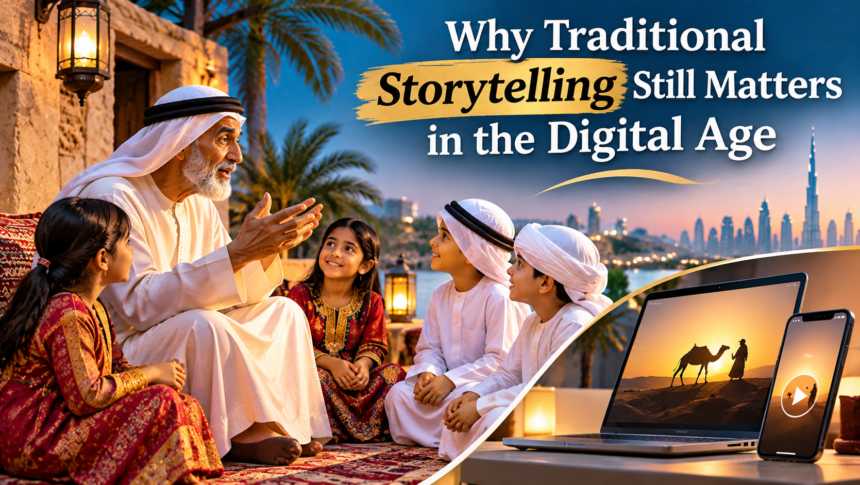
In a world dominated by smartphones, streaming platforms, artificial intelligence, and social media, traditional storytelling may appear to belong to an earlier era. Yet the simple act of sharing stories through spoken words continues to hold an important place in human culture. From grandparents narrating childhood memories to community elders sharing historical experiences, traditional storytelling in the digital age remains a powerful way to preserve knowledge, strengthen relationships, and maintain cultural identity.
- 1. How Traditional Storytelling Preserves Cultural Heritage and Identity
- 2. Why Traditional Storytelling Creates Stronger Human Connections
- 3. How Traditional Stories Support Education and Critical Thinking
- 4. The Powerful Role of Traditional Storytelling in the Digital Entertainment Era
- 5. How Technology Can Preserve and Revive Traditional Storytelling
- 6. Why Traditional Storytelling Matters for Gulf Communities and Future Generations
- 7. The Future of Traditional Storytelling in an Increasingly Digital World
Long before printed books, television, and digital entertainment existed, communities relied on storytelling to explain their surroundings, communicate values, and pass knowledge between generations. Folktales, legends, poetry, proverbs, and personal experiences formed an essential part of education and social life. These traditions helped communities understand their histories while encouraging a shared sense of belonging.
Today, digital technology has transformed how people create and consume stories. Videos, podcasts, interactive experiences, and online platforms can reach audiences across continents within seconds. However, greater access to information does not automatically replace the emotional depth of direct human interaction. Traditional storytelling continues to offer cultural context, personal connection, and opportunities for meaningful conversation that remain valuable in an increasingly connected world.
1. How Traditional Storytelling Preserves Cultural Heritage and Identity
Traditional storytelling has historically served as a living archive of community knowledge. Before historical information could be documented through modern recording systems, societies passed important experiences and cultural practices from one generation to another through oral communication.
Stories helped explain the origins of communities, the significance of local customs, and the values that shaped everyday behaviour. Although oral narratives are not always literal historical records, they preserve valuable insights into how communities understand their past.
The United Nations Educational, Scientific and Cultural Organization (UNESCO) recognises oral traditions and expressions as an important part of intangible cultural heritage. These traditions include folktales, legends, poetry, riddles, proverbs, and other forms of spoken cultural expression.
The Cultural Importance of Oral Traditions
Traditional stories preserve much more than entertainment. They frequently contain knowledge about social relationships, local environments, historical experiences, and community responsibilities.
For example, a story about a difficult journey might communicate lessons about courage, cooperation, or resourcefulness. A folktale involving animals might explore moral choices, while a family narrative could preserve memories of migration or community development.
These narratives help people understand the beliefs and experiences that influenced previous generations.
Traditional storytelling supports cultural preservation by:
- Maintaining awareness of local history and customs.
- Passing cultural knowledge to younger generations.
- Preserving regional languages, expressions, and dialects.
- Encouraging respect for community experiences.
- Strengthening connections between cultural identity and collective memory.
- Creating opportunities for people to share personal and historical perspectives.
Storytelling Traditions Across the Arabian Gulf
The Arabian Gulf offers particularly meaningful examples of oral storytelling traditions.
Historically, storytelling, poetry, and spoken cultural expression were important aspects of social gatherings. Narratives often reflected desert life, maritime trade, family relationships, hospitality, and experiences connected to the region’s environment.
Majlis gatherings have provided spaces for conversation, exchanging knowledge, and discussing community matters. Poetry and traditional narratives also hold significant cultural importance across the region.
Some stories reflect experiences associated with pearl diving, trade journeys, desert travel, and relationships between communities.
These traditions help younger audiences appreciate aspects of Gulf life that existed before rapid urban development.
Cultural Identity in a Globalised World
Globalisation has made international entertainment more accessible than ever. While this creates opportunities for cultural exchange, it can also increase competition for attention between local traditions and global media.
Traditional storytelling provides a way for communities to maintain distinctive cultural expressions without rejecting modern influences.
A young person can enjoy international films and digital entertainment while also learning stories connected to family history and regional heritage.
Cultural preservation therefore does not require society to remain unchanged. It requires meaningful opportunities for cultural knowledge to continue being shared.
2. Why Traditional Storytelling Creates Stronger Human Connections
One of the most valuable characteristics of traditional storytelling is its ability to bring people together through shared experiences.
Unlike many forms of digital entertainment, face-to-face storytelling creates a direct relationship between the storyteller and the audience.
The speaker’s voice, facial expressions, pauses, gestures, and responses can shape how listeners experience a narrative. Listeners may interrupt with questions, share their own memories, or respond emotionally to particular moments.
This interaction makes storytelling a participatory activity rather than simply a method of delivering information.
The Emotional Value of Shared Stories
Stories often communicate emotions more effectively than abstract explanations.
A personal account about overcoming hardship may encourage empathy because listeners encounter events through the perspective of someone who experienced them.
Similarly, stories about childhood, family traditions, or community celebrations can create emotional connections between people with different backgrounds.
These experiences help explain why storytelling continues to matter even when information is available through digital devices.
Information communicates what happened. A personal narrative can also communicate why an experience mattered to someone.
Strengthening Intergenerational Relationships
Traditional storytelling provides opportunities for younger and older generations to interact.
Grandparents and elders may share memories that are not recorded in books or digital archives. These stories can introduce children to historical events, changing social practices, and family experiences.
For older relatives, storytelling offers an opportunity to contribute knowledge and maintain meaningful relationships.
For younger listeners, it creates a personal connection with experiences that may otherwise feel distant.
Some practical benefits include:
- Encouraging meaningful conversations between family members.
- Providing children with opportunities to ask questions.
- Helping older generations communicate personal experiences.
- Creating shared family memories and traditions.
- Developing appreciation for different perspectives.
However, these benefits depend on the quality of interaction rather than the simple act of listening. Stories become especially meaningful when audiences can respond and participate.
Storytelling and Community Belonging
Community storytelling events can also bring together people who might not otherwise interact.
Cultural centres, schools, libraries, and neighbourhood organisations can host storytelling sessions that encourage residents to share experiences.
In multicultural Gulf societies, these activities can introduce audiences to the traditions of different nationalities while creating opportunities to explore shared human experiences.
A story about family responsibility, hospitality, or personal ambition may contain cultural details unfamiliar to some listeners while addressing emotions they recognise.
Such exchanges can encourage understanding without requiring different communities to abandon their individual identities.
3. How Traditional Stories Support Education and Critical Thinking
Storytelling has long been used as a method of education because narratives make complex subjects easier to understand and discuss.
Rather than presenting information as disconnected facts, a story places ideas within a sequence of events involving characters, decisions, challenges, and consequences.
This structure gives learners a meaningful context for exploring unfamiliar concepts.
Traditional storytelling can support learning in classrooms, homes, museums, and community programmes.
Teaching Values Through Narrative
Folktales and traditional narratives frequently explore honesty, generosity, responsibility, patience, and cooperation.
Instead of directly instructing listeners to behave in a particular way, a story can demonstrate the consequences of different decisions.
For example, a narrative about a character who ignores wise advice may encourage discussion about decision-making.
A story involving cooperation between neighbours may introduce questions about trust and community responsibility.
Importantly, educators should encourage learners to examine stories critically rather than treating every traditional message as unquestionably correct.
Some narratives reflect historical social attitudes that may require thoughtful discussion in contemporary settings.
Developing Language and Communication Skills
Oral storytelling gives children opportunities to hear different vocabulary, sentence structures, expressions, and storytelling styles.
When children retell stories, they practise organising events, describing characters, and communicating ideas clearly.
Interactive storytelling can also encourage listening and questioning skills.
Language-related activities might include:
- Listening to a short traditional story.
- Identifying the main characters and important events.
- Explaining the central conflict or challenge.
- Retelling the narrative using different words.
- Discussing alternative endings or decisions.
- Comparing the story with experiences from everyday life.
These activities can be adapted for different age groups and educational environments.
Traditional Storytelling Compared With Digital Learning
| Learning Feature | Traditional Storytelling | Digital Storytelling |
|---|---|---|
| Interaction | Direct discussion with the storyteller | Interactive or recorded experiences |
| Cultural Context | Often connected to community knowledge | Can reach wider international audiences |
| Language Development | Listening, speaking, and oral expression | Listening, reading, and multimedia literacy |
| Accessibility | Depends on people, place, and time | Potentially available across locations |
| Personalisation | Storyteller can respond immediately | Depends on platform features |
| Preservation | Relies on continuing transmission | Allows recording and archiving |
Neither method is automatically superior in every situation.
Traditional storytelling offers opportunities for direct interaction, while digital tools can make narratives available to learners who cannot attend live sessions.
Combining the two approaches may create a richer educational experience.
Encouraging Imagination and Interpretation
Spoken storytelling often leaves visual details to the listener’s imagination.
Without predetermined images, listeners can develop their own interpretations of characters, settings, and events.
This can encourage creative thinking and personal engagement.
Educators can build on this process through drawing, writing, role-playing, or discussions about possible outcomes.
A single traditional story can therefore support language learning, creative expression, and ethical reflection.
4. The Powerful Role of Traditional Storytelling in the Digital Entertainment Era
The expansion of digital entertainment has significantly changed how audiences discover and consume stories.
Streaming services, social media platforms, online games, podcasts, and short-form videos provide access to countless narratives.
These technologies offer convenience, variety, and global reach, but they also change expectations around storytelling length, presentation, and audience participation.
Traditional storytelling occupies a different position within this environment.
Attention and the Experience of Listening
Digital platforms frequently compete for attention through constant updates, notifications, and rapidly changing content.
Traditional storytelling can provide an alternative experience that encourages audiences to follow a narrative without continually switching between unrelated information.
A live storytelling session may unfold gradually, allowing listeners to consider details and anticipate what happens next.
This does not mean digital content prevents deep engagement. Long-form podcasts, documentaries, and online lectures can also support focused attention.
The important distinction is how the experience is designed and how the audience participates.
Why Human Presence Still Matters
The emotional character of a story often depends on how it is delivered.
A storyteller may adjust the pace of a narrative after noticing confusion, excitement, or curiosity among listeners.
A dramatic pause can create anticipation, while a change in tone can communicate humour or sadness.
These elements are not exclusive to traditional storytelling, but direct communication allows them to respond to the audience in real time.
Live performances also carry a sense of shared presence. Participants experience the same event together and may remember both the story and the social interaction surrounding it.
Traditional and Digital Storytelling Can Coexist
Modern technology does not necessarily threaten traditional storytelling. It can also create new opportunities for preservation and participation.
A traditional storyteller might perform at a community gathering while recording selected stories for an online archive.
A museum could combine live storytelling sessions with digital exhibitions that provide historical background.
Schools might invite local storytellers to speak with students and then use recordings for later classroom discussions.
The objective should not be to prove that traditional formats are better than modern ones.
Instead, communities can identify the strengths of each approach and use them to support cultural continuity.
What Makes Traditional Storytelling Distinctive?
Several characteristics help explain its continuing relevance:
- Stories can be adapted to the needs of a particular audience.
- Listeners can participate through questions and discussion.
- Cultural expressions can be communicated in their original languages.
- Family and community memories can be shared directly.
- Live storytelling requires relatively little equipment.
- Performances can evolve as communities reinterpret inherited traditions.
These qualities help traditional storytelling remain meaningful alongside contemporary entertainment.
5. How Technology Can Preserve and Revive Traditional Storytelling

Digital technology offers valuable opportunities to document oral traditions that might otherwise become less familiar to younger generations.
Audio recordings, video archives, online libraries, podcasts, and educational platforms can preserve storytelling performances and make them accessible beyond their original settings.
However, successful preservation requires attention to cultural context, accuracy, and community participation.
Recording the Voices of Storytellers
One of the most important opportunities involves recording elders, poets, performers, and community members who maintain oral traditions.
Audio and video can preserve details that written transcripts may overlook, including pronunciation, tone, rhythm, gestures, and audience reactions.
These characteristics are often essential to understanding how a story was traditionally performed.
A recording might capture an elder narrating a local folktale in a regional dialect, accompanied by explanations of unfamiliar expressions.
Such material can become a valuable educational resource for future generations.
Digital Archives and Cultural Accessibility
Libraries, universities, museums, and cultural organisations can create digital collections of traditional narratives.
A well-designed archive may include:
- Original audio or video recordings.
- Information about the storyteller and cultural context.
- Transcriptions in the original language.
- Translations where appropriate and authorised.
- Explanations of historical references.
- Details about the recording date and location.
- Clear permissions governing access and reuse.
These elements help ensure that a story is preserved as more than an isolated piece of content.
Context is especially important because a narrative may have specific meanings within the community from which it originates.
Podcasts and Short-Form Storytelling
Podcasts can introduce traditional narratives to audiences who prefer listening while travelling, exercising, or completing everyday activities.
Short-form videos can similarly present selected stories or introduce viewers to particular storytelling traditions.
However, adapting lengthy narratives for short formats requires careful editorial decisions.
Reducing a complex story to a brief clip may remove important cultural details.
Creators should therefore distinguish between introducing audiences to a tradition and documenting its complete form.
Artificial Intelligence and Cultural Preservation
Artificial intelligence may assist with transcription, translation, search functions, and organising large collections of recorded material.
These capabilities could make archives easier to explore, particularly when stories exist in multiple languages.
However, automated systems can misunderstand dialects, cultural expressions, names, and historical references.
AI-generated voices or reconstructed narratives also raise questions about authenticity, permission, and representation.
Technology should therefore support community knowledge rather than replace the authority of storytellers and cultural custodians.
The Importance of Ethical Preservation
Not every story is intended for unrestricted public distribution.
Some traditions may contain sensitive knowledge, sacred material, or information shared only within particular community contexts.
Cultural institutions should obtain appropriate permission and consult the communities connected to the stories before publication.
Preserving a tradition responsibly involves respecting how its knowledge is created, shared, and understood.
6. Why Traditional Storytelling Matters for Gulf Communities and Future Generations
Across the Gulf, rapid economic development and urbanisation have transformed everyday life within a relatively short historical period.
Modern infrastructure, international migration, digital communication, and new industries have created opportunities while changing the environments in which cultural traditions are experienced.
Traditional storytelling can help connect contemporary lifestyles with regional histories and family memories.
Connecting Modern Gulf Life With Historical Experiences
Stories associated with desert travel, maritime commerce, pearl diving, agriculture, and family life offer perspectives on earlier social and economic conditions.
These narratives can help younger audiences understand how communities responded to environmental challenges and changing circumstances.
They may also introduce values associated with cooperation, hospitality, resilience, and responsibility.
However, historical experiences should be presented with care. Traditional stories may express cultural memories rather than provide complete factual accounts of particular events.
Combining oral narratives with historical research can create a more balanced understanding of the past.
The Role of Cultural Institutions
Museums, libraries, heritage centres, and educational institutions can support storytelling through public programmes.
Live performances, oral-history projects, workshops, and exhibitions can introduce traditional narratives to audiences who may not encounter them regularly.
These activities are particularly valuable when storytellers and community members participate in deciding how their traditions are presented.
Cultural institutions can also connect storytelling with subjects such as architecture, traditional crafts, music, and local history.
Storytelling in Multicultural Gulf Societies
Gulf cities include residents from many cultural and linguistic backgrounds.
Community storytelling events can provide opportunities for people to share traditions while developing appreciation for different experiences.
For example, a cultural programme might feature Arabian folktales alongside narratives from South Asia, Africa, or other regions represented within the community.
Such exchanges can highlight both cultural differences and shared themes.
Stories about family, migration, courage, or belonging may resonate across nationalities even when their settings and traditions differ.
Practical Ways to Encourage Storytelling
Families, schools, and community organisations can support traditional storytelling through accessible activities.
Family checklist
- Invite older relatives to share childhood experiences.
- Record family memories with permission.
- Encourage children to ask questions about traditional stories.
- Discuss the cultural meaning behind familiar folktales.
- Create regular opportunities for storytelling without digital distractions.
Community and education checklist
- Organise live storytelling sessions.
- Invite local storytellers and cultural practitioners.
- Include regional narratives in educational activities.
- Support multilingual storytelling events.
- Preserve recordings with accurate cultural context.
- Encourage younger participants to create their own interpretations.
These activities do not require large budgets or advanced technology.
Their effectiveness depends primarily on participation, continuity, and respect for cultural knowledge.
7. The Future of Traditional Storytelling in an Increasingly Digital World
The future of traditional storytelling will not necessarily involve choosing between oral traditions and digital technology.
Instead, the most promising approaches may combine the accessibility of modern platforms with the personal and cultural qualities of traditional narrative practices.
Digital media can help stories reach wider audiences, while live storytelling can preserve the relationships and interactions through which cultural knowledge remains meaningful.
New Opportunities for Creative Collaboration
Contemporary artists, educators, filmmakers, and digital creators can explore traditional narratives through new formats.
Animated adaptations, documentary projects, interactive exhibitions, and audio productions can introduce audiences to cultural stories they might otherwise never encounter.
Such projects can also create opportunities for collaboration between experienced storytellers and younger creative professionals.
However, adaptation requires careful consideration of cultural ownership and representation.
Creators should avoid treating traditional stories as unrestricted material that can be changed without consulting relevant communities.
Balancing Innovation With Authenticity
Innovation can make cultural traditions more accessible, but excessive simplification may weaken the meaning of a narrative.
A successful adaptation should identify which elements are essential to the story’s cultural significance.
These might include language, performance style, narrative structure, historical context, or the relationship between storyteller and audience.
Some details may be adapted for accessibility, while others may need to remain unchanged.
The appropriate balance should be determined with meaningful input from those who maintain the tradition.
Challenges and Opportunities Ahead
| Future Development | Potential Opportunity | Important Consideration |
|---|---|---|
| Digital Archives | Long-term access to recorded stories | Preservation quality and cultural permissions |
| Podcasts | Wider access to oral narratives | Retaining storytelling context |
| Online Education | Introducing traditions to younger audiences | Accurate cultural interpretation |
| Artificial Intelligence | Transcription and multilingual discovery | Errors, consent, and authenticity |
| Virtual Exhibitions | Reaching international audiences | Meaningful community representation |
| Live Cultural Events | Direct intergenerational interaction | Accessibility and continued participation |
These developments demonstrate that technological progress and cultural preservation can support one another when they are approached thoughtfully.
The Continuing Importance of the Human Voice
Despite advances in recording and communication technology, direct storytelling retains characteristics that cannot be fully reproduced through archived content.
A living storyteller can respond to listeners, explain unfamiliar references, and adapt a narrative to a particular moment.
The audience can contribute questions, memories, and interpretations.
This exchange allows storytelling traditions to remain dynamic rather than becoming fixed records of the past.
For younger generations, participating in such experiences can provide a sense of cultural continuity while encouraging curiosity about the wider world.
Conclusion
Traditional storytelling in the digital age remains important because it connects cultural heritage with contemporary human experiences.
Stories preserve community memories, communicate values, strengthen relationships, and introduce younger audiences to the histories that shape their identities.
Digital technology has transformed how narratives are recorded, distributed, and experienced. Yet these developments do not eliminate the value of oral traditions. Instead, they offer opportunities to support preservation while introducing storytelling to wider audiences.
The challenge is to ensure that cultural knowledge remains connected to the people and communities who maintain it.
Across the Arabian Gulf and beyond, traditional storytelling can continue to contribute to education, cultural understanding, and intergenerational relationships.
Its future will depend not only on how effectively stories are recorded, but also on whether people continue to tell, listen to, discuss, and reinterpret them.
In an increasingly digital world, the enduring importance of traditional storytelling lies in its ability to remind people that meaningful communication is not simply about receiving information. It is also about sharing experiences, preserving identity, and creating connections that continue across generations.
Do follow us on Instagram
Read More – How Migrant Communities Are Shaping the Gulf’s Contemporary Cultural Identity