

Understanding Legal Business Structures in the GCC
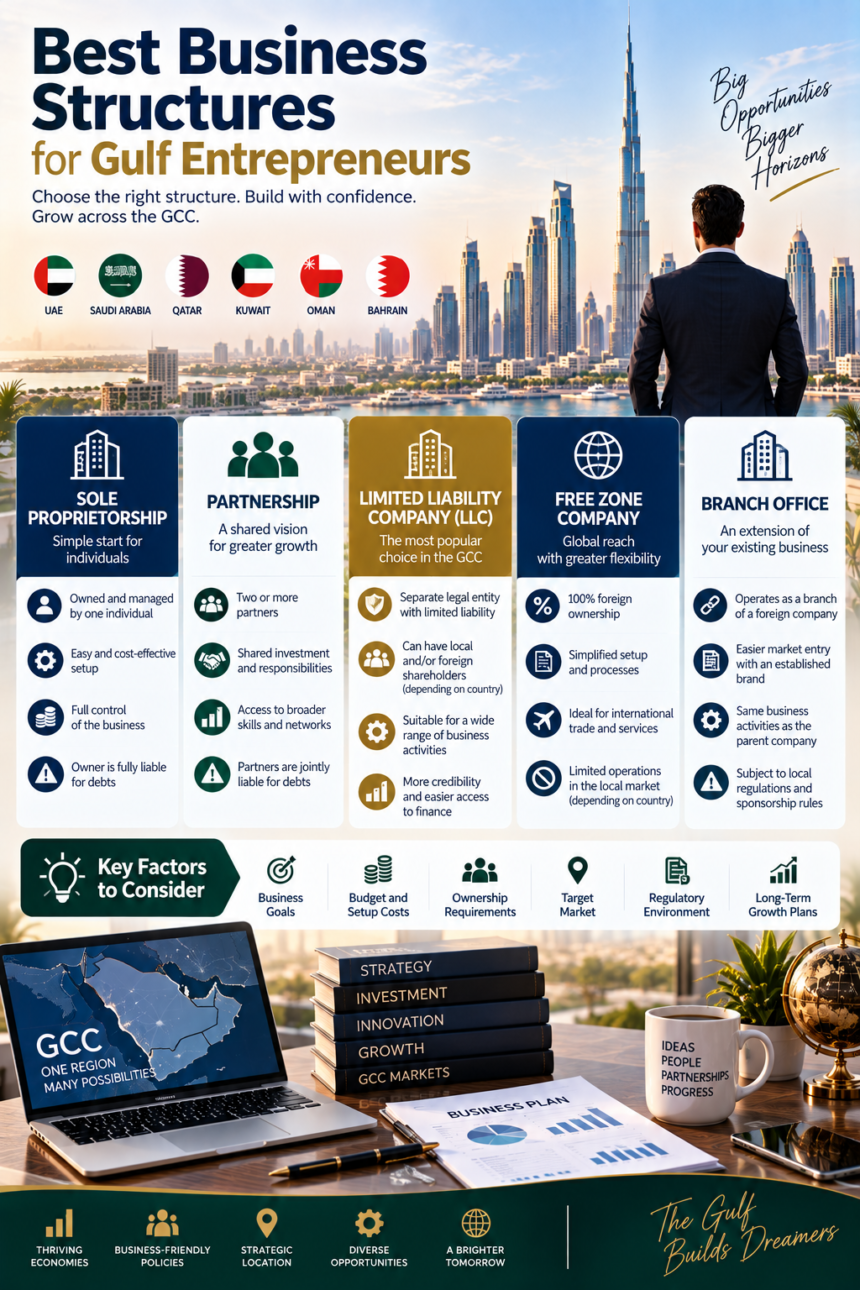
Gulf Business Structures give entrepreneurs several ways to establish, own and expand a company across the UAE, Saudi Arabia, Qatar, Bahrain, Oman and Kuwait. The most common options include limited liability companies, single-person companies, branches, partnerships, joint stock companies and companies established inside free zones or special economic zones.
- Gulf Business Structures: 2026 Overview
- Understanding Legal Business Structures in the GCC
- 1. Limited Liability Company
- 2. Single-Person Company
- 3. Sole Proprietorship
- 4. Foreign Company Branch
- 5. Representative Office
- 6. Partnership and Joint Venture
- 7. Private and Simplified Joint Stock Company
- 8. Public Joint Stock Company
- 9. Holding Company
- 10. Free Zone and Special Economic Zone Company
- Business Structures in the UAE
- Business Structures in Saudi Arabia
- Business Structures in Qatar
- Business Structures in Bahrain
- Business Structures in Oman
- Business Structures in Kuwait
- Best Structure for Small Gulf Businesses
- Best Structure for Startups
- Best Structure for Foreign Entrepreneurs
- Best Structure for Large Companies
- Choosing Between an LLC and Branch
- Liability and Business Risk
- Ownership and Investor Requirements
- Tax and Accounting Considerations
- Common Business Structure Mistakes
- Gulf Business Structure Comparison
- Business Structure Setup Checklist
- Final Thoughts on Gulf Business Structures
The best option depends on much more than registration cost.
A solo consultant may need a simple structure with limited liability and low administration. A technology startup expecting outside investors may need a structure that makes share ownership and fundraising easier. An established international company expanding into Riyadh or Dubai may prefer a branch instead of incorporating an entirely new subsidiary.
Ownership rules also differ significantly across GCC countries.
The UAE permits numerous mainland and free-zone company structures. Saudi Arabia allows foreign investors to use structures including LLCs, one-person LLCs, joint stock companies and foreign branches. Qatar provides LLCs, branches, joint ventures and shareholding companies. Bahrain offers structures including WLLs, single-person companies and branches. Oman allows structures including LLCs, foreign branches and free-zone companies, while Kuwait provides both standard commercial-company structures and a special direct-investment route through KDIPA.
Choosing the right structure at the beginning can reduce future problems involving liability, banking, investors, taxation, licences and company expansion.
Gulf Business Structures: 2026 Overview
The easiest way to compare company structures is by looking at their typical purpose.
| Business Structure | Usually Best For | Main Advantage | Main Consideration |
|---|---|---|---|
| LLC | SMEs and operating businesses | Limited liability | Ownership and licensing rules |
| Single-Person Company | Solo founders | One owner with limited liability | Availability varies |
| Sole Proprietorship | Individual professionals | Simple structure | Owner may have unlimited liability |
| Foreign Branch | Established international companies | Uses parent-company identity | Parent generally carries liability |
| Representative Office | Market research | Low operational scope | Cannot normally trade |
| Partnership | Multiple active partners | Flexible partner structure | Liability can be higher |
| Private Joint Stock | Larger growing companies | Easier capital expansion | More governance |
| Public Joint Stock | Large enterprises | Public capital raising | Heavy regulation |
| Holding Company | Business groups | Owns multiple subsidiaries | Additional administration |
| Free Zone Company | International and specialist businesses | Flexible foreign ownership | Market-access rules |
No structure is automatically the best.
The strongest choice is the one that matches the entrepreneur’s ownership, risk, customer base, investment plans and long-term growth strategy.
Understanding Legal Business Structures in the GCC
A legal structure determines how a company exists under the law.
It can influence:
- Who owns the business
- Who is liable for debts
- How investors enter
- Whether shares can be transferred
- Which activities can be licensed
- Accounting requirements
- Capital requirements
- How the business can expand
Two entrepreneurs can operate almost identical businesses while using completely different company structures.
For example, a consultancy could potentially operate as a single-person company, an LLC, a branch of an international consultancy or a free-zone company depending on the country and licence.
The structure should therefore be selected after defining the business model, not before.
1. Limited Liability Company
The Limited Liability Company, usually shortened to LLC, is one of the most important business structures across the Gulf.
Its main advantage is already contained in the name.
Shareholders are generally liable for company obligations only to the extent of their investment, subject to applicable laws and circumstances.
This helps separate the operating company from the personal assets of its shareholders.
LLCs are commonly suitable for:
Small and medium businesses, consulting companies, trading businesses, restaurants, technology companies, professional services and family-owned companies.
In Qatar, Invest Qatar describes the LLC as the country’s most common company structure and confirms that shareholder liability is limited to capital contributions. Certain sectors can also qualify for 100% foreign ownership.
Bahrain’s Ministry of Industry and Commerce similarly describes its limited liability company structure as having up to 50 partners, with each partner responsible only for their share of the company’s capital. Foreign ownership can reach 100% depending on the activity.
The LLC is often the strongest starting option for entrepreneurs because it provides a balance between flexibility and legal protection.
2. Single-Person Company
Not every entrepreneur has business partners.
A single-person company allows one individual or corporate shareholder to own the entire company while still using a limited-liability corporate structure.
This can be useful for:
Consultants, individual founders, online businesses, professional service providers and entrepreneurs who do not need outside shareholders initially.
Saudi Arabia’s foreign-investor framework includes a one-person limited liability company among the legal entities available to investors.
Kuwait’s direct-investment framework also recognises the Single Person Company. KDIPA notes that the owner’s responsibility for company debts and losses is generally limited to the company’s capital.
The important distinction is between a single-person company and a sole proprietorship.
Both can have one owner, but the legal liability treatment can be very different.
3. Sole Proprietorship
A sole proprietorship or sole establishment is generally the simplest form of individually owned business.
The business and its owner are usually more closely connected legally than in an LLC.
That simplicity can be useful for small professional businesses, but it can also mean greater personal liability.
Bahrain’s official company guide describes a sole proprietorship as a business owned by one individual who is responsible for its obligations. It also places nationality and residency conditions on who can use the structure.
The UAE also recognises sole establishments for eligible activities. Current Dubai activity guidance shows that certain professional activities permit foreign investors to use the Sole Establishment legal form if a UAE local service agent is appointed.
A sole proprietorship may be attractive because of simplicity, but entrepreneurs should understand the liability implications before choosing it merely to reduce setup costs.
4. Foreign Company Branch
A branch is particularly useful for an existing international company entering a Gulf market.
Unlike a newly incorporated subsidiary, a branch generally operates as an extension of the overseas parent company.
That can help preserve:
- Corporate identity
- Brand history
- Parent-company contracts
- International reputation
- Group control
However, a branch is generally not legally independent from its parent in the same way as a separate LLC.
Qatar’s official investment guidance states that a foreign branch operates under the parent company, which assumes liability for its operations.
Saudi Arabia includes a foreign company branch among the legal entities available to international investors.
The UAE also permits branches in both mainland and free-zone systems. UAE Government guidance lists a branch of a local or international company among available free-zone entity options.
Kuwait’s KDIPA framework provides another important route, allowing foreign companies to establish licensed branches under the direct-investment system.
A branch is often attractive when an established foreign company wants direct regional expansion without creating an entirely separate shareholder structure.
5. Representative Office
A representative office provides an even lighter international presence.
Its purpose is usually limited to activities such as:
- Market research
- Promotion
- Relationship building
- Business development
- Parent-company representation
It normally cannot conduct ordinary commercial trading.
Qatar states that representative offices can conduct non-commercial activities such as market research, promotion and providing information about the parent business.
Kuwait’s KDIPA system similarly allows a representative office whose purpose is market studies and evaluating production possibilities, without engaging in commercial transactions.
This can be useful for an international company testing a market before making a larger investment.
However, it is not suitable if the business needs to invoice customers and generate normal local revenue.
6. Partnership and Joint Venture
Partnership structures bring two or more parties together in a business.
The partners may contribute:
- Capital
- Skills
- Technology
- Customers
- Local market expertise
- Intellectual property
A joint venture can be especially useful for a particular project or market opportunity.
Qatar’s official investment platform recognises joint ventures as arrangements involving two or more local or foreign entities establishing a business for a particular activity or project.
Partnership structures can also contain different liability categories.
For example, limited partnerships may contain general partners who carry greater responsibility and limited partners whose liability is limited to their investment.
These structures can suit professional firms and carefully structured investment ventures.
However, an entrepreneur should never enter a partnership simply because a local partner appears useful for company registration.
The shareholder agreement should clearly define:
- Capital contributions
- Voting rights
- Profit distribution
- Management authority
- Exit rights
- Dispute procedures
A poorly structured partnership can create more risk than benefit.
7. Private and Simplified Joint Stock Company
Businesses expecting substantial growth may eventually need something more flexible than a basic LLC.
Private joint stock companies divide ownership into shares and typically offer a stronger structure for bringing in multiple investors.
Saudi Arabia has also developed the Simplified Joint Stock Company, giving growing enterprises another corporate form.
The Ministry of Investment’s legal-entity guidance lists both the Joint Stock Company and Simplified Joint Stock Company among structures available to investors.
This can be particularly relevant for:
- Startups raising larger investment rounds
- Family groups
- Private equity-backed companies
- Businesses planning acquisitions
- Companies with multiple investor classes
The trade-off is complexity.
Joint stock structures normally require more governance, formal shareholder procedures and financial administration than a small LLC.
Oman is also encouraging company growth through joint stock structures. In December 2025, the Ministry of Commerce, Industry and Investment Promotion announced incentives encouraging LLCs to convert into closed joint stock companies, with several businesses already making the transition.
8. Public Joint Stock Company
A Public Joint Stock Company is designed for much larger enterprises.
Shares can ultimately be offered more broadly and, where listing requirements are satisfied, may be traded on a stock market.
This structure is not normally suitable for a first-time small entrepreneur.
It requires stronger corporate governance and usually involves:
- Larger capital
- Boards of directors
- Detailed reporting
- Auditing
- Shareholder protections
- Securities regulation
The UAE recognises Public Joint Stock Companies among its principal mainland company forms.
Qatar also recognises public shareholding companies, with Invest Qatar noting requirements concerning share capital, shareholder numbers and corporate governance.
Kuwait’s Companies Law similarly recognises public and closed shareholding companies.
For most entrepreneurs, this is a future-stage structure rather than the starting point.
9. Holding Company

A holding company is generally established to own interests in other companies rather than conduct every operating activity directly itself.
For example:
Holding Company
owns:
Company A: Technology
Company B: Real Estate
Company C: Logistics
This structure can help business groups separate investments and operating risks.
It can also support:
- Group ownership
- Joint ventures
- Family businesses
- Intellectual property ownership
- Investment portfolios
- Regional subsidiaries
Bahrain’s Ministry of Industry and Commerce states that holding companies can take forms including public or closed joint stock companies, limited liability companies or single-person companies.
Qatar also recognises holding companies among available commercial structures.
Holding structures become particularly useful when an entrepreneur owns several different businesses rather than one operating company.
However, multiple companies mean multiple compliance requirements, so they should not be created simply for appearance.
10. Free Zone and Special Economic Zone Company
Free-zone companies are especially important in the UAE and Oman, although different kinds of economic zones exist across the GCC.
In the UAE, official guidance lists free-zone structures including:
- Private LLC
- Free Zone Company
- Free Zone Establishment
- Public LLC
- Branch of a local or international company
Free zones can be particularly attractive for businesses involved in international trade, technology, logistics, media or specialised industries.
They can offer flexible workspaces and industry-specific infrastructure.
However, mainland trading requirements still matter.
UAE Government guidance updated in April 2026 explains that free-zone companies can trade internationally but need appropriate arrangements, licences or a mainland presence for direct local-market activity.
Oman also operates important free and special economic zones. Current Ministry guidance highlights Sohar, Salalah, Al Mazunah and Duqm as part of its investment ecosystem and notes benefits including foreign ownership and investment incentives.
Free-zone structures are therefore best evaluated based on the business model rather than simply their advertised setup price.
Business Structures in the UAE
The UAE provides a particularly wide range of business forms.
Current UAE Government mainland guidance lists:
- General partnership
- Limited partnership
- Limited liability company
- Public joint stock company
- Private joint stock company
Dubai licensing can also accommodate structures including sole establishments, civil companies, branches, one-person LLCs and other legal forms depending on the activity.
The country’s extensive free-zone network adds additional structures such as FZEs, FZ Companies, private LLCs and branches.
For many small and medium entrepreneurs, an LLC is likely to be the most versatile structure, especially where the business serves the UAE market directly.
Free-zone entities can be more suitable for international trade, remote services or companies that benefit from specialised industry ecosystems.
Business Structures in Saudi Arabia
Saudi Arabia provides several corporate structures for foreign investors.
Ministry of Investment guidance identifies:
- Limited Liability Company
- One-Person Limited Liability Company
- Joint Stock Company
- Foreign Company Branch
- Professional Company
- Simplified Joint Stock Company
The country’s updated Investment Law applies to both local and foreign investors and introduced a broader investor framework rather than regulating foreign investors separately under the older model.
For entrepreneurs, the LLC is often the practical operating structure.
The simplified joint stock model can become more attractive for startups and businesses expecting multiple investment rounds.
A branch is usually more appropriate when an existing overseas company is entering Saudi Arabia.
GCC investors can also receive different treatment. Saudi investment guidance currently confirms that a qualifying Gulf investor is considered a local investor unless the Gulf company itself contains foreign ownership.
Business Structures in Qatar
Qatar offers a broad corporate framework under Commercial Companies Law No. 11 of 2015.
Invest Qatar identifies important structures including:
- LLC
- Joint venture
- Foreign branch
- Representative office
- Public shareholding company
- Limited partnership
Additional structures include single-person LLCs and private joint stock companies.
For many entrepreneurs, the LLC remains the natural starting point because of its flexibility and limited liability.
Foreign ownership needs to be considered separately.
Qatar’s foreign investment framework permits 100% ownership in qualifying sectors, while areas such as banking, insurance, commercial agencies and natural-resource exploitation remain subject to exclusions or specific rules.
Business Structures in Bahrain
Bahrain provides flexible options for entrepreneurs and international investors.
Common structures include:
- With Limited Liability Company
- Single Person Company
- Partnership
- Foreign branch
- Holding company
- Sole proprietorship
The WLL is particularly useful for SMEs because shareholder responsibility is generally limited to the value of their shares.
Bahrain’s Ministry of Industry and Commerce confirms that foreign and GCC investors can hold 100% of WLL shares where the selected business activity permits it.
A single-person structure can be useful for individual founders, while foreign branches can serve established international companies.
Sole proprietorship eligibility is more restricted and should therefore be checked before assuming it is available to every foreign entrepreneur.
Business Structures in Oman
Oman has modernised its investment environment significantly.
The Ministry of Commerce, Industry and Investment Promotion states that the Foreign Capital Investment Law permits 100% foreign ownership in most sectors.
The company-formation process is handled through the Oman Business platform.
Current Ministry guidance identifies commonly used structures including:
- Limited Liability Company
- Sole Proprietorship
- Foreign Company Branch
- Free Zone Company
The LLC is likely to suit many operating businesses.
Foreign branches suit established international companies.
Free-zone companies can be attractive for logistics, manufacturing and international trade.
Entrepreneurs should still confirm the selected activity because certain sectors can require specific approvals or local participation despite the general foreign-ownership framework.
Business Structures in Kuwait
Kuwait requires a more careful distinction between the general Companies Law and the foreign direct investment framework.
Under the general commercial framework, forms include:
- Limited Liability Company
- Single Person Company
- Closed Shareholding Company
- Public Shareholding Company
- Partnerships
Foreign ownership under ordinary structures can still be limited depending on the company type.
However, Kuwait’s Law No. 116 of 2013 creates a separate direct-investment pathway.
Through KDIPA, qualifying foreign investors can establish an investment entity with up to 100% foreign ownership.
Possible KDIPA structures include a Kuwaiti company, foreign company branch or representative office.
Kuwait also introduced long-term residency of up to 15 years in 2026 for qualifying investors and key executives in KDIPA-licensed companies, strengthening the practical value of the direct-investment framework.
For a small entrepreneur, however, the KDIPA route should not automatically be assumed to be the simplest choice. Eligibility and investment requirements need to be examined first.
Best Structure for Small Gulf Businesses
For many small operating businesses, the LLC is the strongest general-purpose structure.
It provides limited liability and is recognised throughout the GCC.
It can work for:
Consulting, technology, trading, restaurants, marketing, construction and many other activities.
A solo founder may instead consider a single-person LLC where available.
Sole proprietorships can sometimes be simpler, but entrepreneurs should consider whether personal liability is worth that simplicity.
Best Structure for Startups
A startup expecting external investors should think beyond today’s ownership.
An LLC may work well initially.
However, a company expecting repeated fundraising rounds, employee equity or institutional investors may eventually benefit from a share-based structure such as a simplified or private joint stock company where available.
Saudi Arabia’s Simplified Joint Stock Company is particularly notable in this context because it provides another option between traditional LLCs and more complex public-company structures.
The startup should choose a structure that can accommodate tomorrow’s shareholders rather than only today’s founders.
Best Structure for Foreign Entrepreneurs
For an individual foreign entrepreneur, the strongest options are usually:
LLC or single-person limited-liability company, where ownership and activity rules allow it.
These structures provide a separate legal entity while allowing the founder to maintain strong ownership control.
Free-zone companies can also work particularly well for foreign entrepreneurs serving international customers.
An established overseas business may instead prefer a foreign branch.
Foreign ownership should always be checked activity by activity because even countries allowing 100% foreign ownership maintain restrictions in selected industries.
Best Structure for Large Companies
Large companies may need stronger governance and easier capital movement.
Options can include:
- Private joint stock companies
- Public joint stock companies
- Holding companies
- Regional subsidiaries
- Foreign branches
A multinational entering one GCC market might use a branch initially.
A group planning multiple regional subsidiaries could create a holding structure.
A company eventually seeking a stock-market listing will require a shareholding structure that supports public ownership and securities regulation.
There is no reason for a small entrepreneur to adopt this complexity prematurely.
Choosing Between an LLC and Branch
This is one of the most common choices for international businesses.
| Factor | LLC Subsidiary | Foreign Branch |
|---|---|---|
| Separate legal entity | Generally yes | Generally no |
| Liability separation | Stronger | Parent usually responsible |
| Local shareholders | Depends on rules | Parent owns branch |
| Brand connection | Separate subsidiary | Direct parent identity |
| Future investors | Easier in subsidiary | More difficult |
| Best suited to | Long-term local operation | Existing foreign company expansion |
An LLC can provide stronger separation between the overseas parent and the local operation.
A branch provides greater direct continuity.
The choice should therefore consider liability, taxation, contracts and future ownership.
Liability and Business Risk
Liability is one of the most important reasons to care about business structure.
Limited liability normally means the shareholder’s financial exposure is limited to their contribution, subject to legal exceptions.
Unlimited-liability structures can place personal assets at greater risk.
Entrepreneurs running businesses with significant contractual exposure, employees, inventory or debt should therefore think carefully before choosing a structure simply because it is cheap to establish.
A slightly more expensive LLC can provide much stronger legal separation than a basic sole proprietorship.
Ownership and Investor Requirements
The structure should also reflect who will own the business.
Ask whether the company will have:
One founder, two co-founders, family members, venture capital investors, a corporate shareholder or a foreign parent company.
Each situation can lead to a different optimal structure.
Ownership restrictions can also depend on business activity.
This is particularly important for foreign entrepreneurs.
The fact that a country permits 100% foreign ownership in many sectors does not mean every licence or profession automatically qualifies.
Tax and Accounting Considerations
Legal structure can also affect financial reporting and tax administration.
Companies may face requirements involving:
- Corporate Tax
- Income tax
- VAT
- Audits
- Financial statements
- Transfer pricing
- Beneficial ownership reporting
Qatar’s investment guidance, for example, notes that companies operating under the state tax regime must follow applicable financial reporting and tax-registration requirements.
Larger joint stock and holding structures generally require more formal governance than small single-owner businesses.
Entrepreneurs should therefore compare the annual compliance cost, not simply incorporation fees.
Common Business Structure Mistakes
The most common mistake is choosing the cheapest structure rather than the right one.
Other problems include selecting a sole business without understanding personal liability, establishing a branch without considering parent-company liability, choosing a free zone before checking domestic-market access, creating an unnecessarily complex holding company and assuming one GCC country’s ownership rules apply throughout the region.
Another major mistake is choosing a structure that works today but cannot support future investors or business expansion.
Restructuring later can involve new registrations, contracts, bank accounts and tax implications.
Gulf Business Structure Comparison
| Entrepreneur Type | Structure Usually Worth Considering |
|---|---|
| Solo consultant | Single-person LLC or eligible sole business |
| Small operating company | LLC |
| Two or more founders | LLC |
| Growing startup | LLC or simplified/private joint stock |
| International corporation | Branch or subsidiary LLC |
| Company testing the market | Representative office |
| Project partners | Joint venture |
| Family business group | Holding company |
| Large growth company | Private joint stock |
| Public capital raising | Public joint stock |
| International trade business | Free-zone or special-zone company |
These are general starting points rather than legal recommendations.
The final structure depends on the country, licence and owners.
Business Structure Setup Checklist
Before choosing a Gulf company structure:
- Define the business activity
- Choose the target GCC country
- Identify all shareholders
- Check foreign ownership rules
- Decide whether limited liability is important
- Confirm whether a single-owner structure is available
- Compare LLC and branch options
- Check capital requirements
- Review investor entry and share-transfer rules
- Determine whether local-market access is required
- Compare mainland and free-zone structures
- Review office requirements
- Check tax and accounting obligations
- Consider future fundraising
- Consider future branches or subsidiaries
- Calculate annual compliance costs
- Confirm sector-specific approvals
- Review shareholder agreements
- Verify current requirements with the official registration authority
Final Thoughts on Gulf Business Structures
Understanding Gulf Business Structures can save entrepreneurs significant time and money because the legal entity chosen at the beginning affects almost every part of the business later.
For most small and medium enterprises, an LLC remains one of the strongest overall options because it combines operating flexibility with limited liability.
Solo entrepreneurs may prefer a single-person limited-liability structure where available.
Established international companies can consider branches when maintaining the direct identity of the parent company is important.
Startups expecting substantial external investment may eventually benefit from private or simplified joint stock structures.
Large business groups can use holding companies to organise multiple subsidiaries, while companies seeking public capital require more heavily regulated public shareholding structures.
Country differences remain important.
The UAE offers mainland LLCs, partnerships, private and public joint stock companies, branches and extensive free-zone options.
Saudi Arabia provides foreign investors with LLCs, one-person LLCs, joint stock companies, simplified joint stock companies, professional companies and foreign branches.
Qatar offers structures including LLCs, joint ventures, branches, representative offices and shareholding companies.
Bahrain provides WLLs, single-person companies, partnerships, branches, holding companies and other structures, with foreign ownership depending on the activity.
Oman combines LLCs, branches and free-zone structures with a foreign-investment environment that permits full foreign ownership in most sectors.
Kuwait operates both its ordinary Companies Law framework and the KDIPA direct-investment route, which can allow qualifying investors to establish businesses with up to 100% foreign ownership.
For entrepreneurs, the most useful question is therefore not:
“Which company structure is cheapest?”
It is:
“Which structure protects me, permits my business activity, supports my ownership needs and still works when the company becomes larger?”
Choosing the answer carefully can create a business structure capable of supporting years of growth rather than requiring an expensive restructuring shortly after launch.
Do follow us on Instagram
Read More – Mainland vs Free Zone: 12 Essential Business Setup Differences in 2026