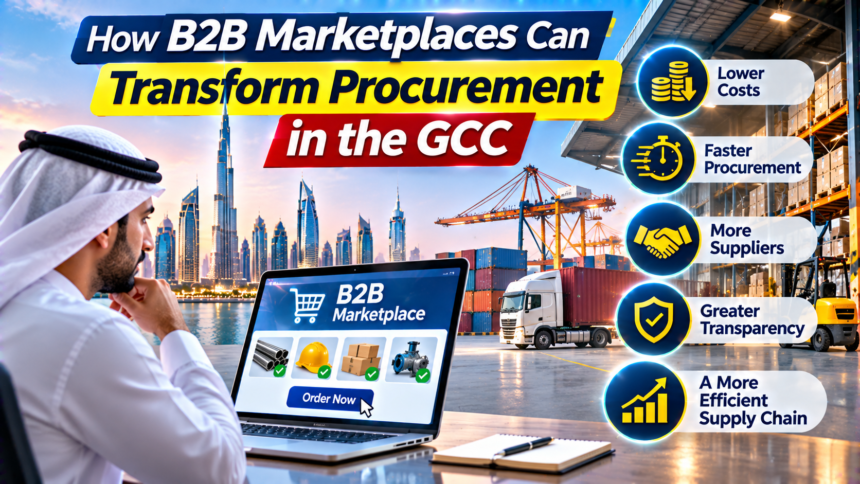
Why B2B E-Commerce Could Reshape Gulf Supply Chains
Across the Gulf Cooperation Council, businesses depend on extensive supplier networks to obtain the products, equipment, and services needed for their daily operations. From construction materials and industrial machinery to hotel supplies, office equipment, electronics, and packaging, procurement plays an important role in supporting economic activity.
- 1. Why B2B Marketplaces in the GCC Are Becoming More Relevant
- 2. How Digital Marketplaces Could Simplify Purchasing and Supplier Discovery
- 3. What UAE and Saudi Arabia Reveal About Digital Procurement Platforms
- 4. Why B2B Marketplaces Could Create Opportunities for GCC SMEs
- 5. How AI, Logistics, and Data Could Improve B2B Supply Chains
- 6. The Risks and Challenges of B2B Marketplace Adoption in the Gulf
- 7. The Future of B2B Marketplaces in GCC Procurement
- How Businesses Should Measure Success
- Opportunities for GCC Technology Businesses
- Why Government Procurement Remains Important
- Conclusion
Traditionally, many business purchases have involved contacting suppliers individually, requesting quotations, comparing offers, negotiating terms, and arranging deliveries through separate communication channels.
Although these methods remain necessary for complex purchases, digital technology is creating alternatives for more routine and standardised procurement.
B2B marketplaces in the GCC could become an increasingly important part of this transformation by connecting business buyers with suppliers through online platforms that support product discovery, quotation requests, ordering, and transaction management.
Unlike consumer shopping websites, business-to-business marketplaces are designed around commercial purchasing requirements. These may include bulk quantities, negotiated pricing, supplier verification, purchase approvals, invoicing, and business-specific payment arrangements.
Across the United Arab Emirates, Saudi Arabia, Qatar, Bahrain, Oman, and Kuwait, the broader movement toward digital business services is creating opportunities for procurement modernisation.
Dubai-based Tradeling provides an example of a commercial B2B marketplace, while the UAE’s Digital Procurement Platform and Saudi Arabia’s Etimad system demonstrate how public-sector purchasing is becoming more digital.
These systems are not identical. Private wholesale marketplaces, enterprise procurement platforms, and government tendering systems serve different users and operate under different rules.
However, they illustrate a common shift toward more accessible purchasing information and digitally managed transactions.
The potential benefits include faster supplier discovery, improved purchasing visibility, wider market access for smaller businesses, and more efficient supply-chain coordination.
Yet online procurement is not automatically cheaper, safer, or more transparent. Its success depends on reliable supplier information, appropriate competition, cybersecurity, logistics, and sound commercial judgement.
Understanding these opportunities and challenges explains why B2B marketplaces could influence the future of procurement across the GCC.
1. Why B2B Marketplaces in the GCC Are Becoming More Relevant
Procurement involves identifying needs, selecting suppliers, purchasing goods or services, and managing the resulting commercial relationships.
For many businesses, these activities represent a significant part of operating expenditure.
Digital marketplaces may simplify selected purchasing stages by providing a common environment where buyers and suppliers can exchange information.
How Traditional Business Purchasing Works
A company requiring office furniture, industrial supplies, or maintenance equipment may begin by contacting existing vendors.
Procurement staff request specifications, obtain quotations, compare prices, and verify delivery arrangements.
After selecting a supplier, they may issue a purchase order and process invoices separately.
This approach allows detailed negotiation but can require substantial administrative work.
The difficulty increases when purchases involve multiple branches, frequently changing products, or many small orders.
What Makes a B2B Marketplace Different?
A B2B marketplace enables businesses to discover products and suppliers through a digital platform.
Depending on its design, users may compare listings, request quotations, negotiate commercial terms, place orders, and track deliveries.
Some platforms also provide purchasing analytics, integration with enterprise software, or payment services.
However, these features vary between providers.
A product listing does not necessarily mean that stock, price, and delivery availability have been independently verified.
Different Types of Procurement Platforms
| Platform Type | Main Function | Typical User |
|---|---|---|
| Wholesale B2B Marketplace | Product discovery and commercial orders | Retailers and business buyers |
| Enterprise Procurement Platform | Manage purchasing under company policies | Medium and large organisations |
| Government E-Procurement System | Conduct public purchasing and tenders | Public entities and approved suppliers |
| Supplier Discovery Platform | Identify suitable vendors | Procurement departments |
| Industry-Specific Marketplace | Source specialised goods | Sector-focused businesses |
| E-Tendering Portal | Publish and receive competitive bids | Buyers and bidders |
Why Gulf Businesses May Benefit
GCC economies contain businesses ranging from small retailers to major industrial groups.
Their purchasing needs differ substantially, but many depend on reliable suppliers and efficient commercial processes.
A shared digital environment may make it easier to identify vendors, compare offers, and maintain purchasing records.
However, high-value infrastructure contracts and specialised technical services will still require detailed assessment and formal procurement procedures.
2. How Digital Marketplaces Could Simplify Purchasing and Supplier Discovery
One of the most immediate opportunities offered by B2B marketplaces is reducing the time spent identifying products and contacting potential suppliers.
Traditional purchasing may require procurement employees to search multiple websites, exchange emails, and manually compile quotations.
Digital platforms can bring some of this information into one place.
Centralising Product Information
A marketplace may display product descriptions, specifications, supplier information, minimum order quantities, and indicative prices.
This allows buyers to make preliminary comparisons without contacting every supplier separately.
However, products must be compared using equivalent specifications.
A lower listed price may reflect different quality, warranty coverage, minimum quantity, or delivery terms.
Digital Requests for Quotations
Some platforms allow companies to create a request for quotation, commonly called an RFQ.
The request describes the products, quantities, and requirements.
Relevant suppliers can then submit their offers.
This may improve the organisation of quotations, particularly for frequently purchased goods.
However, complex purchases still require technical evaluation and appropriate contractual protections.
Managing Purchase Approvals
Enterprise procurement tools may allow companies to establish spending limits and approval workflows.
For example, a branch manager might submit an equipment request that requires approval from a central purchasing department.
Recording these steps digitally can improve visibility.
However, software controls are only effective when company policies are appropriately designed and enforced.
Traditional and Digital Procurement Compared
| Stage | Traditional Approach | Possible Digital Approach |
|---|---|---|
| Supplier Discovery | Calls, directories and referrals | Searchable supplier listings |
| Product Comparison | Separate quotations and spreadsheets | Centralised product information |
| Purchase Approval | Emails and manual documents | Digital approval workflows |
| Ordering | Individually issued purchase orders | Platform-based ordering |
| Delivery Tracking | Supplier updates | Integrated tracking where available |
| Invoicing | Separate accounting processes | Electronic invoices |
| Reporting | Manual consolidation | Purchasing dashboards |
Why Administrative Savings Matter
Small improvements in ordering processes can become meaningful when an organisation makes frequent purchases.
However, reduced administrative time should not be confused with lower product prices.
Businesses need to measure both operating efficiency and total purchasing costs.
3. What UAE and Saudi Arabia Reveal About Digital Procurement Platforms
The UAE and Saudi Arabia provide useful examples of procurement digitalisation across commercial and government settings.
Their programmes show how different platform models can support supplier access and purchasing administration.
Dubai’s Tradeling Marketplace

Tradeling is a Dubai-based business-to-business marketplace serving buyers and sellers across the Middle East and North Africa.
The platform offers wholesale sourcing and enterprise procurement services.
Its enterprise offering describes capabilities for managing purchasing and connecting with existing procurement systems.
These services demonstrate how commercial marketplaces are developing beyond simple online product catalogues.
However, supplier coverage, available categories, pricing, and fulfilment conditions depend on the particular transaction.
The UAE’s Digital Procurement Platform
The UAE Ministry of Finance operates a Digital Procurement Platform connecting federal entities with registered suppliers.
The system supports procurement activities including tender announcements, bid submission, contracting, purchase orders, invoicing, and supplier evaluation.
Launched in 2021, it provides a digital channel for federal government procurement.
In February 2024, the ministry announced that its expanded purchasing catalogue included more than 120,000 products and services across 35 categories from 230 suppliers.
These figures describe the catalogue at the time of that announcement, not necessarily its present inventory.
A Specific Efficiency Example
The UAE Ministry of Finance reports that its catalogue-ordering process can be completed in approximately six minutes compared with a previous process of around 60 days.
This refers to the relevant catalogue purchasing workflow.
It should not be interpreted as a six-minute turnaround for every government tender, contract, or delivery.
Saudi Arabia’s Etimad Platform
Saudi Arabia’s Etimad platform supports government financial management and procurement activities.
It provides facilities for tender announcements, bid submissions, award procedures, contracts, and payment-related processes.
The platform was launched in 2018 as part of the country’s public-sector digital transformation.
Etimad illustrates how electronic procurement can be connected with wider government financial administration.
However, suppliers must follow applicable registration, qualification, and tender requirements.
Selected GCC Procurement Systems
| Platform | Country | Main Role |
|---|---|---|
| Tradeling | UAE | Commercial B2B marketplace and enterprise procurement |
| UAE Digital Procurement Platform | UAE | Federal government purchasing and supplier management |
| Etimad | Saudi Arabia | Government tenders and financial procurement processes |
| Monaqasat | Qatar | State procurement and tender information |
| Bahrain Tender Board E-Tendering | Bahrain | Electronic government tendering |
These examples share digital procurement features but should not be treated as interchangeable commercial marketplaces.
4. Why B2B Marketplaces Could Create Opportunities for GCC SMEs
Small and medium-sized enterprises play important roles as suppliers, distributors, service providers, and local manufacturers.
However, smaller businesses may face barriers when attempting to sell to large corporations or government buyers.
Digital procurement systems can potentially reduce some of these barriers.
The Challenge of Finding Business Customers
A small supplier may offer suitable products but lack established relationships with major corporate purchasing departments.
Traditional procurement networks can be difficult to enter without existing contacts.
Online marketplaces can provide an additional route for product visibility.
However, being listed on a platform does not guarantee sales.
Suppliers still need competitive products, appropriate documentation, reliable fulfilment, and credible business operations.
Access to Government Procurement
The UAE Ministry of Finance allows eligible businesses, including SMEs, to register in the Federal Supplier Register and participate in government procurement opportunities.
The ministry states that the supplier register has grown to more than 10,000 registered companies.
This can make information about relevant tenders more accessible.
However, eligibility conditions and procurement requirements continue to apply.
What International Research Suggests
OECD research identifies digital procurement as one method that can reduce administrative burdens and improve access to opportunities.
Its 2026 analysis of competition in public procurement emphasises the importance of accessible information, fair competition, and suitable tender design.
The research also notes that digitalisation alone does not eliminate barriers.
Small firms may continue facing financing constraints, complex qualification requirements, or large contract sizes.
How SMEs Could Benefit
| Opportunity | Potential Advantage | Remaining Challenge |
|---|---|---|
| Online Supplier Listings | Greater visibility | Competition for attention |
| Digital Tenders | Easier discovery of opportunities | Qualification requirements |
| Standardised Catalogues | Clearer product presentation | Accurate information maintenance |
| Electronic Invoicing | More organised billing | Payment timing |
| Customer Diversification | Access to additional buyers | Sales and fulfilment capacity |
| Purchasing Analytics | Better business information | Digital skills and software costs |
Supporting Local Manufacturing
B2B marketplaces may help GCC manufacturers reach additional business customers.
A company producing packaging, building components, or industrial supplies could use digital channels to present products to buyers beyond its existing network.
However, local manufacturing development also depends on product quality, standards compliance, investment, and logistics.
Digital visibility is only one part of industrial competitiveness.
5. How AI, Logistics, and Data Could Improve B2B Supply Chains
Digital marketplaces generate information about product searches, quotations, orders, prices, and purchasing patterns.
When managed responsibly, this information may help businesses understand demand and improve procurement decisions.
Artificial intelligence and system integration could expand these capabilities.
AI-Assisted Product Discovery
Some procurement systems may use automated recommendations to help buyers locate products matching technical specifications.
For example, a system might suggest alternative suppliers for a commonly purchased product.
However, recommendations should be checked against required quality, compatibility, and contractual conditions.
A suggested substitute is not necessarily suitable for a regulated or safety-critical application.
Purchasing Analytics
Digital procurement records can help companies understand where money is being spent.
A business may discover that several departments purchase the same item from different suppliers at varying prices.
Centralised information can support discussions about standardisation or negotiated agreements.
However, consolidating suppliers may also create dependency risks.
The objective should be better purchasing decisions rather than automatically selecting the cheapest or largest supplier.
Logistics Integration
Procurement is connected with inventory management, warehousing, and transportation.
Some B2B platforms provide delivery information or connect with logistics services.
This can improve visibility when accurate tracking information is available.
However, an electronic order confirmation does not guarantee that products will arrive on time.
Cross-border shipments may involve customs clearance, product certification, and other regulatory requirements.
Digital Payment and Invoice Management
Electronic invoicing and payment systems can help businesses organise financial records.
Depending on the platform, suppliers may be able to submit invoices directly through the purchasing system.
However, payment approval and settlement can remain subject to contract terms and verification procedures.
Potential Technology Applications
| Technology | Potential Use | Important Limitation |
|---|---|---|
| AI Product Matching | Identify relevant listings | Recommendation accuracy |
| Spend Analytics | Understand purchasing patterns | Data completeness |
| Inventory Integration | Support stock planning | System compatibility |
| Logistics Tracking | Monitor order movement | Carrier data quality |
| Electronic Invoicing | Organise billing records | Regulatory and technical requirements |
| Supplier Risk Tools | Identify possible supply concerns | Data accuracy and fairness |
Why Data Protection Matters
Procurement information may reveal sensitive pricing, supplier relationships, purchasing volumes, or operational plans.
Businesses must protect this information through appropriate security and access controls.
AI tools should not expose confidential commercial data without authorisation.
6. The Risks and Challenges of B2B Marketplace Adoption in the Gulf
Despite their potential, B2B marketplaces introduce challenges involving supplier reliability, competition, cybersecurity, delivery performance, and contractual responsibilities.
Companies should evaluate platforms carefully before making them a central part of procurement.
Supplier Verification
Online listings can make it easier to discover unfamiliar suppliers.
However, buyers still need to verify relevant business credentials, product authenticity, and compliance requirements.
Certain industries may require specific certifications, technical standards, or authorised distribution arrangements.
A platform’s seller-verification process should not be assumed to cover every buyer requirement.
Product Quality and Counterfeit Risks
Business purchases can involve products where quality failures create serious consequences.
Construction materials, electrical components, healthcare equipment, and industrial spare parts may require formal technical assessment.
Procurement teams should maintain appropriate inspection and acceptance procedures.
Digital convenience must not weaken these controls.
Cybersecurity and Fraud
Online procurement systems can become targets for account compromise, invoice fraud, and unauthorised changes to payment details.
Businesses should use suitable authentication, access controls, and independent verification for sensitive financial changes.
Staff training is also important.
Platform Dependence
Relying heavily on one marketplace may simplify purchasing but create concentration risks.
A system outage, change in fees, or supplier withdrawal could disrupt operations.
Businesses should maintain appropriate contingency arrangements for essential purchases.
Cross-Border Procurement
The GCC offers opportunities for regional trade, but different products and transactions may face varying rules.
Import documentation, customs procedures, product standards, taxes, and delivery requirements can influence the final cost.
Businesses should evaluate these factors before comparing local and overseas supplier prices.
Major Risks and Responses
| Risk | Possible Consequence | Practical Response |
|---|---|---|
| Unverified Suppliers | Poor-quality or fraudulent purchases | Due diligence |
| Misleading Listings | Incorrect product selection | Technical specification checks |
| Cybersecurity Threats | Financial loss or disruption | Secure access and payment controls |
| Delivery Delays | Interrupted operations | Logistics planning |
| Platform Dependence | Concentrated operational risk | Contingency suppliers |
| Hidden Costs | Higher total expenditure | Landed-cost analysis |
| Poor System Integration | Duplicate administrative work | Compatibility testing |
| Weak Competition | Limited purchasing choice | Monitor supplier concentration |
Why Marketplaces Do Not Eliminate Procurement Expertise
Experienced procurement professionals remain important for supplier evaluation, contract negotiations, risk management, and technical purchasing.
Digital tools can support their work but cannot replace the judgement required for complex commercial decisions.
7. The Future of B2B Marketplaces in GCC Procurement
As GCC economies continue digitalising business activities, B2B marketplaces could become more closely integrated with enterprise systems, logistics networks, and financial services.
However, the pace and success of adoption will depend on the needs of individual industries and the reliability of available platforms.
Moving Toward Connected Procurement
Businesses may increasingly connect online marketplaces with accounting, inventory, and enterprise resource planning systems.
This could reduce duplicate data entry and improve visibility across departments.
However, integration projects require investment and careful testing.
Poorly connected systems can introduce additional errors rather than eliminate them.
Combining Marketplaces With Supplier Relationships
Digital purchasing does not necessarily mean abandoning long-term supplier partnerships.
Businesses may use marketplaces for supplier discovery and routine purchases while maintaining direct contracts for specialised or strategically important goods.
A hybrid approach can preserve flexibility.
The appropriate model depends on purchase value, complexity, reliability requirements, and business risk.
A Practical B2B Marketplace Adoption Checklist
- Identify purchasing categories suitable for online sourcing.
- Compare platforms against business requirements.
- Verify supplier registration and credentials.
- Review product specifications and certifications.
- Calculate total purchase and delivery costs.
- Check payment and dispute-resolution arrangements.
- Test integration with existing business software.
- Establish purchasing approvals and spending controls.
- Protect confidential procurement information.
- Maintain contingency suppliers for essential products.
- Measure costs, delivery performance, and supplier quality.
- Review platform performance regularly.
How Businesses Should Measure Success
The number of orders placed online does not, by itself, demonstrate improved procurement.
Companies should assess whether digital sourcing produces meaningful improvements in purchasing efficiency, quality, reliability, and total cost.
These outcomes should be measured against a suitable baseline.
Procurement Performance Indicators
| Indicator | What It Measures |
|---|---|
| Purchase Cycle Time | Time required to complete a purchasing process |
| Total Procurement Cost | Product, administrative and delivery expenditure |
| Supplier Participation | Number and diversity of qualified bidders |
| On-Time Delivery | Delivery reliability |
| Product Acceptance | Conformity with specifications |
| Contract Compliance | Adherence to purchasing policies |
| Invoice Accuracy | Billing quality |
| Supplier Concentration | Dependence on limited vendors |
| User Satisfaction | Procurement-team experience |
Opportunities for GCC Technology Businesses
Growth in digital procurement could create opportunities for software developers, payment providers, logistics businesses, supplier-verification services, and procurement consultants.
Specialised marketplaces may also emerge around industrial equipment, hospitality supplies, healthcare purchasing, or construction materials.
However, new platforms will need to build trust, establish sustainable commercial models, and provide reliable customer support.
Why Government Procurement Remains Important
Government purchasing systems can influence how suppliers interact with large buyers.
The UAE’s Digital Procurement Platform, Saudi Arabia’s Etimad, Qatar’s Monaqasat, and Bahrain’s electronic tendering services demonstrate the expanding role of digital administration.
However, public procurement must operate under applicable rules concerning competition, eligibility, evaluation, and accountability.
Commercial marketplace practices cannot simply replace legally required tender procedures.
Conclusion
Business-to-business marketplaces could transform procurement in the GCC by making it easier for companies to discover suppliers, compare products, manage orders, and analyse purchasing activity.
Commercial platforms such as Tradeling demonstrate how digital sourcing is developing in the private sector, while government systems in the UAE and Saudi Arabia show how procurement administration can be modernised at an institutional level.
These developments may create opportunities for smaller suppliers, support business digitalisation, and improve purchasing visibility.
However, the benefits are not automatic.
Successful adoption requires reliable supplier verification, appropriate product standards, secure transactions, efficient logistics, and professional procurement management.
For businesses, the strongest approach may be to begin with purchasing categories that can be standardised and evaluated easily.
For marketplace providers, the priority should be building systems that offer trustworthy information and dependable transactions.
For governments, digital procurement can support broader objectives involving efficiency, accessibility, and competition when backed by suitable governance.
Ultimately, the future of GCC procurement will depend not only on moving transactions online but also on improving the quality of the decisions behind those transactions.
By combining digital platforms with strong commercial relationships and responsible purchasing practices, businesses could develop procurement systems that are more efficient, transparent, adaptable, and prepared for future supply-chain challenges.
Do follow us on Instagram
Read More – How Community-Based Research Could Help Gulf Governments Understand Changing Social Needs