



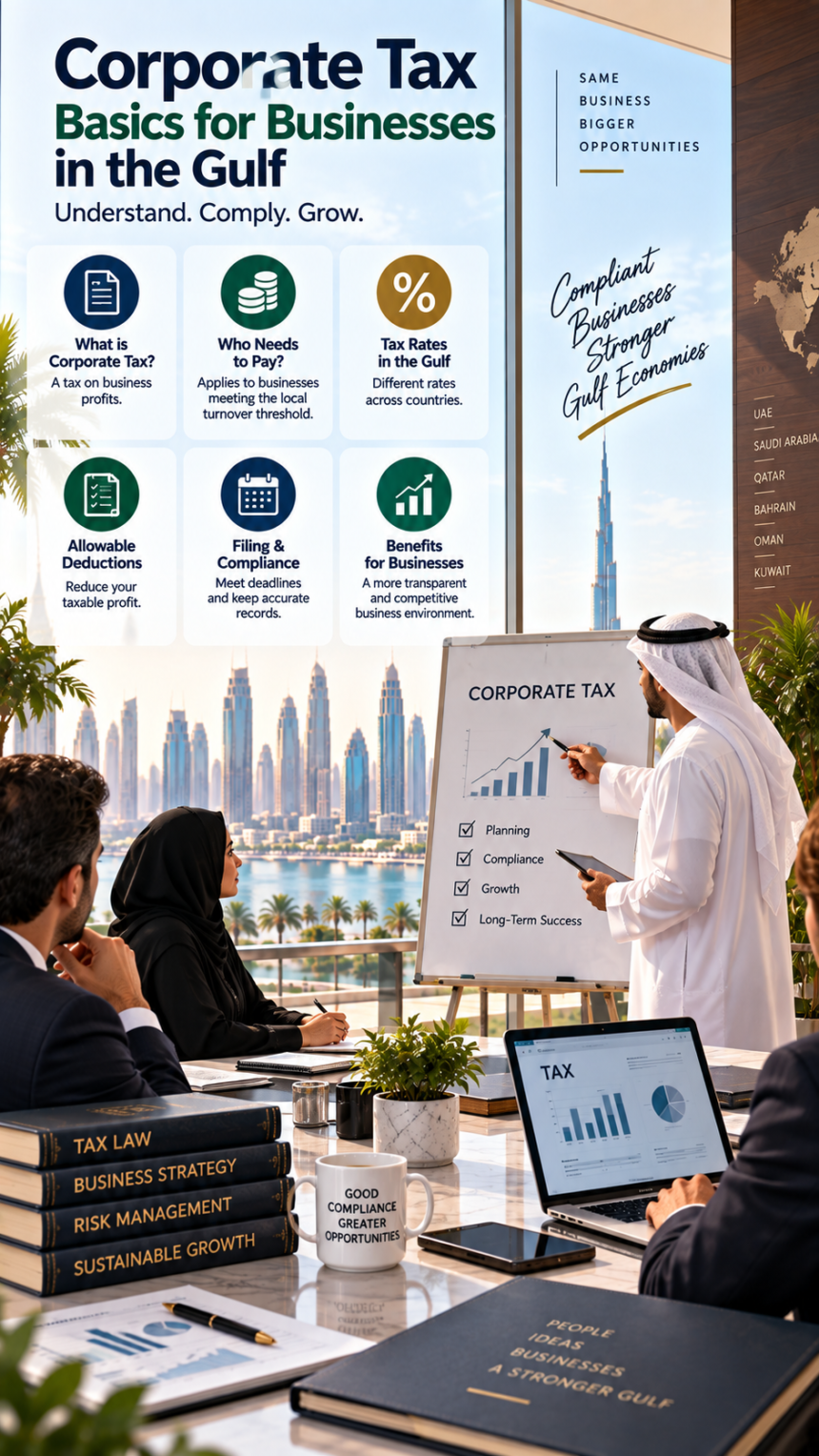
Understanding Corporate Tax in the Gulf
GCC Corporate Tax rules differ significantly across the UAE, Saudi Arabia, Qatar, Bahrain, Oman and Kuwait, which means businesses expanding around the Gulf cannot rely on one regional tax rate or one standard compliance system.
- GCC Corporate Tax: 2026 Overview
- Understanding Corporate Tax in the Gulf
- 1. Corporate Tax Rates Across the GCC
- 2. Understanding Taxable Income
- 3. Business Expenses and Tax Deductions
- 4. Corporate Tax Registration
- 5. Corporate Tax Returns and Deadlines
- 6. Free Zone and Special Economic Zone Tax Rules
- 7. Zakat and Corporate Income Tax
- 8. Withholding Tax on Cross-Border Payments
- 9. Permanent Establishment Rules
- 10. Transfer Pricing and Related Companies
- 11. Global Minimum Tax for Multinationals
- 12. Corporate Tax Records and Compliance
- Corporate Tax in the UAE
- Corporate Tax in Saudi Arabia
- Corporate Tax in Qatar
- Corporate Tax in Bahrain
- Corporate Tax in Oman
- Corporate Tax in Kuwait
- Corporate Tax for Small Gulf Businesses
- Corporate Tax for Foreign-Owned Companies
- Corporate Tax vs VAT
- Common GCC Corporate Tax Mistakes
- GCC Corporate Tax Comparison
- Corporate Tax Business Checklist
- Final Thoughts on GCC Corporate Tax
The UAE generally applies a 9% Corporate Tax rate on taxable income above AED 375,000. Saudi Arabia generally applies 20% income tax to the taxable share of non-Saudi ownership while Saudi and qualifying GCC ownership can fall within the zakat system. Qatar generally applies 10% income tax to taxable income, with exemptions linked to Qatari ownership. Oman applies a standard 15% income tax rate, while Bahrain still has no broad corporate income tax for most ordinary companies in 2026, apart from specific sectors and the global minimum tax regime for large multinational groups. Kuwait generally applies 15% corporate income tax to foreign corporate bodies doing business in the country.
These differences make tax planning an important part of choosing where and how to establish a Gulf business.
Corporate Tax is also only one part of the picture.
A company may additionally need to consider:
- VAT
- Zakat
- Withholding tax
- Customs duties
- Global minimum tax
- Transfer pricing
- Tax filing
- Accounting requirements
The correct tax position depends on the country, company ownership, activity, profit level and whether the business is part of a larger multinational group.
GCC Corporate Tax: 2026 Overview
The broad current position looks like this:
| Country | General Business Tax Position |
|---|---|
| UAE | 0% up to AED 375,000 taxable income, then 9% |
| Saudi Arabia | Generally 20% income tax on non-Saudi taxable ownership share; zakat rules apply separately |
| Qatar | Generally 10% on taxable income, subject to ownership exemptions |
| Bahrain | No general CIT for most ordinary companies; 46% oil and gas; 15% DMTT for qualifying MNEs |
| Oman | 15% standard rate; 3% for qualifying small enterprises |
| Kuwait | Generally 15% on taxable profits of foreign corporate bodies |
This table is only a starting point.
The effective tax bill may change because of:
- Tax exemptions
- Deductible expenses
- Free-zone incentives
- Ownership structure
- Tax treaties
- Losses
- Related-party transactions
- Industry-specific rules
A company should therefore calculate tax based on taxable profit, not merely revenue.
Understanding Corporate Tax in the Gulf
Corporate Tax is generally a tax on business profits.
It is different from VAT.
VAT is typically collected on taxable sales and paid through the supply chain.
Corporate Tax is calculated on taxable business income after applying the relevant deductions and adjustments.
Suppose a company has:
Revenue: 5 million
Allowable expenses: 3.5 million
Taxable profit before other adjustments: 1.5 million
Corporate Tax is generally calculated using the taxable income figure rather than the full 5 million in sales.
This is why accurate accounting is essential.
The company’s financial statements usually provide the starting point, after which tax rules can require adjustments.
Certain expenses may be deductible.
Others may be restricted or disallowed.
Some income may be exempt.
The accounting profit and taxable profit are therefore not always identical.
1. Corporate Tax Rates Across the GCC
There is no unified GCC Corporate Tax rate.
UAE
The UAE generally applies:
- 0% on taxable income up to AED 375,000
- 9% on taxable income above AED 375,000
The Federal Tax Authority’s guidance confirms these standard rates.
Saudi Arabia
Saudi income tax is generally 20% on the applicable tax base for resident capital companies with non-Saudi ownership and certain non-resident persons conducting business in the Kingdom.
Qatar
Qatar’s general income tax rate is 10% of taxable income. The tax position can depend on ownership, with profits attributable to qualifying Qatari ownership receiving exemptions under the national framework.
Bahrain
Bahrain currently has no general corporate income tax for most ordinary businesses.
Companies operating in certain oil and gas activities can be subject to a 46% rate. Large multinational groups can also fall within Bahrain’s 15% Domestic Minimum Top-Up Tax regime.
Oman
Oman applies:
- 15% standard income tax
- 3% for qualifying small enterprises meeting specific requirements
Its Tax Authority confirms the current rates.
Kuwait
Kuwait generally imposes a flat 15% Corporate Income Tax on the taxable profits of foreign corporate bodies carrying on business in Kuwait.
2. Understanding Taxable Income
Taxable income is generally the amount on which Corporate Tax is calculated.
It normally begins with company revenue and business profit, but tax adjustments can change the final taxable amount.
Revenue can include:
- Product sales
- Service income
- Rental income
- Commissions
- Consultancy fees
- Investment income
- Licensing income
Allowable expenses can reduce taxable profit where the relevant tax law permits them.
A business should therefore distinguish between:
Revenue
and
Taxable profit.
A company with AED 10 million in sales does not necessarily pay Corporate Tax on AED 10 million.
If its legitimate deductible business expenses are AED 8 million, taxable profit may be closer to AED 2 million before further tax adjustments.
Qatar’s General Tax Authority, for example, explains that taxable income is calculated using gross income after allowable deductions and applicable carried-forward losses.
Oman similarly taxes net taxable income rather than gross turnover under its general income-tax framework.
3. Business Expenses and Tax Deductions
Expenses incurred for genuine business purposes can often reduce taxable income.
Common examples may include:
- Salaries
- Office rent
- Utilities
- Marketing
- Professional fees
- Business travel
- Insurance
- Equipment
- Technology
- Supplier costs
The exact deduction rules vary by country.
Some expenses may be only partly deductible.
Others may be disallowed completely.
Companies should maintain:
- Invoices
- Contracts
- Salary records
- Bank statements
- Receipts
A business should never create expenses merely to reduce tax.
Tax deductions generally need to be connected with legitimate business activity and supported by documentation.
Personal spending should not be mixed with company expenses.
Clear separation makes both accounting and tax compliance much easier.
4. Corporate Tax Registration
Businesses may need to register with the national tax authority even before Corporate Tax becomes payable.
The exact registration process varies.
In the UAE, Taxable Persons generally register with the Federal Tax Authority.
The FTA updated Corporate Tax registration and deregistration timelines again in 2026 through Decision No. 12 of 2026.
Saudi businesses subject to income tax register through ZATCA. The authority specifically provides a Corporate Income Tax registration service for foreign establishments and taxable non-Saudi ownership.
Qatar uses the General Tax Authority and its Dhareeba tax platform.
Oman’s Tax Authority operates its online tax portal for income-tax registration and filings.
Registration should be treated separately from payment.
A business may need to register and file even where relief or exemptions mean little or no tax is ultimately due.
5. Corporate Tax Returns and Deadlines
Corporate Tax normally requires periodic returns.
A return reports information such as:
- Revenue
- Expenses
- Taxable profit
- Adjustments
- Tax deductions
- Tax payable
Deadlines vary by country.
The UAE generally requires Corporate Tax returns and payment within nine months after the end of the relevant Tax Period.
The FTA confirmed in September 2026 that businesses whose financial year ended on December 31, 2025 generally need to file and pay before the end of September 2026.
Oman’s filing period differs according to the applicable tax rate. The Tax Authority states that taxpayers subject to the 3% small-enterprise rate generally submit within three months after the end of the tax year, while those subject to 15% generally file within four months.
Businesses should create a tax calendar covering:
- Return deadlines
- Payment deadlines
- VAT deadlines
- Zakat deadlines
- Annual financial statements
Missing a filing deadline can create penalties even when the business believes little tax is due.
6. Free Zone and Special Economic Zone Tax Rules
Free zones can create attractive tax incentives, but they should never automatically be described as tax-free.
The UAE is the clearest example.
A Qualifying Free Zone Person can receive:
- 0% Corporate Tax on Qualifying Income
- 9% on taxable income that does not qualify for the preferential treatment
The company must satisfy the conditions of the free-zone Corporate Tax framework.
The FTA continued updating Qualifying Free Zone Person compliance requirements in 2026, including Decision No. 6 of 2026.
This means that simply incorporating in a UAE free zone does not automatically produce a 0% Corporate Tax bill.
Qatar also offers incentives through its free-zone framework. The General Tax Authority’s investor guidance notes that Qatar’s free zones can provide long-term Corporate Tax exemptions, subject to the applicable zone and investment conditions.
Free-zone decisions should therefore consider:
- Customer location
- Business activity
- Substance
- Tax treatment
- Market access
- Long-term expansion
rather than tax alone.
7. Zakat and Corporate Income Tax
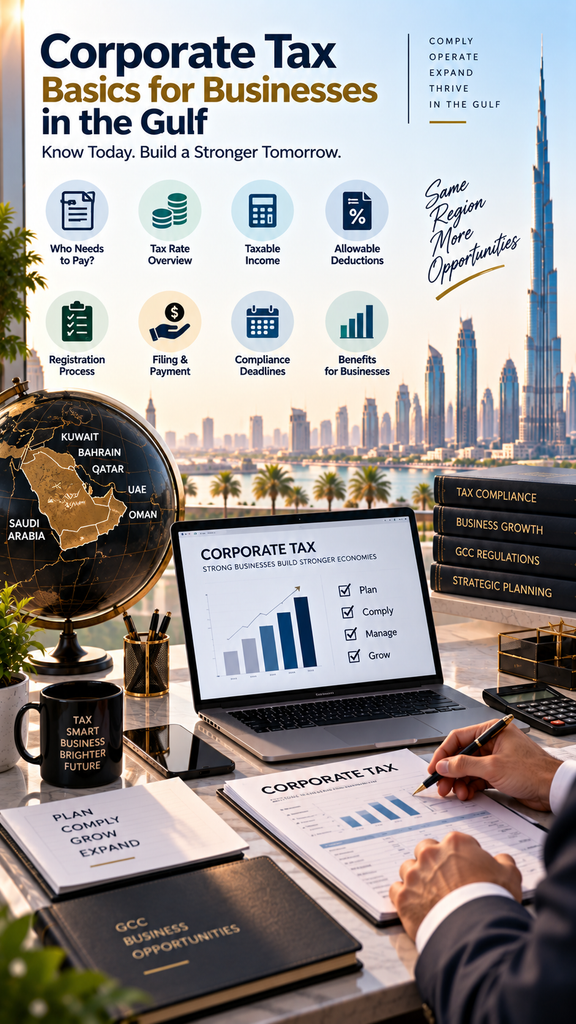
Saudi Arabia is particularly important because Corporate Income Tax and zakat can apply differently depending on ownership.
ZATCA confirms that income tax applies to resident capital companies with respect to shares owned by non-Saudi partners.
Saudi or qualifying GCC ownership can fall within the zakat framework instead.
ZATCA’s general guidance states that zakat is generally calculated at 2.5% of the zakat base for a Hijri year, although calculations can differ depending on the financial period.
This means a mixed-ownership Saudi company can have a more complicated tax position than a fully foreign-owned business.
For example:
Saudi ownership portion → zakat framework
Foreign ownership portion → Corporate Income Tax framework
The calculation is much more technical than simply multiplying profit by one percentage.
Businesses with mixed ownership should obtain professional tax advice.
8. Withholding Tax on Cross-Border Payments
Withholding tax can apply when a company makes certain payments to non-residents.
It is usually deducted by the local company making the payment and paid to the tax authority.
Common payment categories can include:
- Royalties
- Interest
- Management fees
- Services
- Technical fees
The rate can depend on:
- Payment type
- Country
- Tax treaty
- Relationship between companies
Oman currently applies a general 10% withholding tax to specified payments made to non-residents, including certain services, interest and royalties.
Saudi Arabia also applies withholding-tax rules to payments to non-residents, with the applicable percentage depending on the payment category.
The UAE currently does not generally impose withholding tax on domestic or cross-border payments under its normal Corporate Tax system.
Businesses should check withholding tax before paying an overseas supplier or parent company, rather than discovering the requirement after transferring the money.
9. Permanent Establishment Rules
A foreign company does not necessarily need to incorporate a local subsidiary before becoming taxable in another country.
A Permanent Establishment, or PE, can arise when the overseas company has a sufficiently significant business presence in that jurisdiction.
This can include situations involving:
- Fixed offices
- Branches
- Employees
- Long-term projects
- Agents
- Management activities
Saudi Arabia’s income-tax rules apply to non-residents conducting business through a permanent establishment.
Kuwait’s tax framework can also treat foreign companies as taxable where they conduct Kuwait-source business, and its interpretation of taxable presence can be broad depending on the facts.
This matters for international consulting and service companies.
An overseas company cannot assume:
No local company = no local Corporate Tax.
Employees working regularly in another GCC country can sometimes create tax exposure.
10. Transfer Pricing and Related Companies
Transfer pricing becomes important when related companies conduct transactions with one another.
Imagine a group has:
Dubai parent company
Saudi subsidiary
Qatar subsidiary
The businesses might charge one another for:
- Management services
- Software
- Loans
- Intellectual property
- Shared employees
Tax authorities generally expect these transactions to reflect arm’s-length pricing.
That means the price should broadly resemble what independent businesses would agree under similar circumstances.
Artificially shifting profit from one country to another can attract tax scrutiny.
The UAE Corporate Tax regime contains transfer-pricing rules and requires qualifying businesses to follow the arm’s-length principle.
Qatar’s General Tax Authority also highlights measures addressing profit shifting and transactions between related or affiliated entities.
Kuwait’s tax framework similarly gives the tax authority powers to review inter-company transactions and assess whether they reflect arm’s-length terms.
Small independent companies may have limited transfer-pricing exposure.
Regional business groups need to pay much more attention.
11. Global Minimum Tax for Multinationals
Corporate taxation across the Gulf is increasingly influenced by the OECD’s Pillar Two global minimum tax system.
The basic objective is to ensure that very large multinational groups pay an effective tax rate of at least 15% in jurisdictions where they operate.
These rules generally focus on multinational groups with consolidated annual revenue of at least EUR 750 million under the relevant tests.
UAE
The UAE Domestic Minimum Top-Up Tax applies for financial years beginning on or after January 1, 2025 to qualifying large MNE groups.
Bahrain
Bahrain’s Domestic Minimum Top-Up Tax has applied from financial years beginning on or after January 1, 2025 to in-scope multinational groups meeting the EUR 750 million revenue test.
Qatar
Qatar’s Pillar Two framework also applies for fiscal years commencing on or after January 1, 2025 and targets large MNE groups with a minimum 15% effective tax rate.
Kuwait
Kuwait’s DMTT similarly became effective for fiscal years beginning on or after January 1, 2025 for qualifying multinational groups.
Most small and medium Gulf businesses will never come close to these thresholds.
However, multinational companies need specialist tax systems because Pillar Two operates in addition to ordinary national tax rules.
12. Corporate Tax Records and Compliance
Good Corporate Tax compliance begins long before the return is due.
Businesses should maintain accurate records of:
- Revenue
- Expenses
- Payroll
- Assets
- Loans
- Related-party transactions
- Invoices
- Contracts
- Tax payments
- Financial statements
Accounting software can make compliance easier, but software cannot correct poor bookkeeping automatically.
Management should also review whether the company has:
- New shareholders
- New foreign customers
- New overseas subsidiaries
- New free-zone activities
- Related-party loans
- Permanent establishments
These changes can affect tax.
Corporate Tax should therefore become part of normal financial management rather than an annual emergency.
Corporate Tax in the UAE
The UAE introduced federal Corporate Tax for financial years beginning on or after June 1, 2023.
The general rate structure remains:
0% on taxable income up to AED 375,000
9% on taxable income above AED 375,000
For example, if taxable income is AED 1 million:
First AED 375,000 → 0%
Remaining AED 625,000 → 9%
Corporate Tax = AED 56,250.
Small businesses can also consider Small Business Relief.
The FTA currently states that qualifying resident persons can elect for the relief where revenue is AED 3 million or less in both the current and all previous relevant tax periods, subject to the conditions. A company that previously exceeded the AED 3 million threshold cannot later regain eligibility merely because revenue falls.
Qualifying Free Zone Persons can receive 0% on Qualifying Income, subject to strict conditions.
Large multinational groups can additionally fall within the UAE DMTT regime, effective from financial years starting on or after January 1, 2025.
Corporate Tax in Saudi Arabia
Saudi Arabia combines Corporate Income Tax and zakat.
The general income-tax rate is 20% on the applicable tax base for qualifying non-Saudi ownership and taxable foreign businesses.
ZATCA states that income-tax rules apply to the shares of resident capital companies owned by non-Saudi partners.
Saudi and qualifying GCC ownership can instead fall within the zakat framework.
This makes shareholder nationality important.
A fully foreign-owned Saudi company can face a different calculation from a company with Saudi and foreign shareholders.
Special industries can also have different rates.
Oil and hydrocarbon production can face substantially higher income-tax rates than ordinary businesses, while natural-gas investment remains subject to separate treatment.
Businesses should therefore avoid describing Saudi tax simply as “20% for everyone.”
Corporate Tax in Qatar
Qatar generally applies a 10% income-tax rate to taxable income.
The ownership structure matters.
The General Tax Authority explains that resident legal persons can receive exemptions in proportion to qualifying Qatari ownership, while foreign partners can remain taxable on their corresponding share.
Oil, gas and petroleum-related activities can face higher rates, with Qatar’s tax law providing for rates of no less than 35% in specified petroleum-related circumstances.
Qatar also introduced its Global and Domestic Minimum Tax framework for large multinational groups from fiscal years starting January 1, 2025.
Free zones can separately provide qualifying tax incentives.
This means the effective Qatar tax position depends heavily on ownership, sector and business location.
Corporate Tax in Bahrain
Bahrain remains unusual within the GCC.
As of 2026, ordinary companies generally do not face a broad-based Corporate Income Tax.
PwC’s July 2026 Bahrain tax review confirms that there is no general Corporate Income Tax on most business income, except for limited oil and gas activities, where a 46% rate can apply.
However, large multinational groups are different.
Bahrain’s Domestic Minimum Top-Up Tax has applied from January 1, 2025 and ensures qualifying multinational groups meeting the EUR 750 million threshold can face a minimum effective rate of 15%.
Businesses should also watch future changes.
Bahrain announced a proposal in December 2025 for a 10% tax on certain larger domestic company profits, with an intended 2027 implementation subject to the legislative process. The proposal targets companies exceeding specified revenue or profit thresholds.
That proposed 2027 regime is not the same as saying Bahrain currently applies a general 10% Corporate Tax in 2026.
Corporate Tax in Oman
Oman has one of the clearer traditional Corporate Income Tax systems in the GCC.
The standard income-tax rate for institutions and commercial companies is 15% of net taxable income.
A reduced 3% rate can apply to qualifying small enterprises.
Oman’s Tax Authority identifies conditions including limits on:
- Registered capital
- Annual gross income
- Employee numbers
and excludes certain professional activities from the reduced regime.
Oil and gas exploration companies can face a much higher 55% income-tax rate under applicable concession arrangements.
Oman also applies withholding tax to specified payments to non-residents.
For ordinary SMEs, the key priorities are maintaining proper financial statements, checking eligibility for the small-enterprise rate and filing returns within the correct period.
Corporate Tax in Kuwait
Kuwait generally imposes 15% Corporate Income Tax on foreign corporate bodies carrying on business or trade in Kuwait.
Companies wholly owned by Kuwaiti or qualifying GCC nationals are generally outside that foreign Corporate Income Tax framework, although other obligations such as zakat or national labour-related charges can apply depending on the company type.
Foreign ownership therefore matters.
A company with a foreign corporate shareholder can face tax on the foreign ownership portion.
Kuwait also introduced a Domestic Minimum Top-Up Tax for qualifying multinational groups from January 1, 2025.
The Ministry of Finance states that the regime targets MNE groups meeting the EUR 750 million revenue threshold and is designed to ensure at least a 15% effective rate on qualifying Kuwait profits.
The new DMTT regime can replace certain existing Kuwait business taxes for entities that fall within its scope.
Corporate Tax for Small Gulf Businesses
Small businesses should not assume that low revenue means tax administration can be ignored.
The correct approach is:
- Register where required.
- Maintain proper accounts.
- Identify the applicable tax rate.
- Claim legitimate reliefs.
- File on time.
The UAE’s Small Business Relief is particularly relevant for qualifying resident businesses with revenue not exceeding AED 3 million under the current conditions.
Oman provides a reduced 3% income-tax regime for qualifying small enterprises.
Small businesses should also remember that Corporate Tax and VAT thresholds are separate.
A business might have VAT obligations even if its Corporate Tax bill is small.
Corporate Tax for Foreign-Owned Companies
Foreign ownership can materially affect tax across several GCC countries.
Saudi Arabia applies income tax to the non-Saudi share of resident capital companies.
Qatar’s system similarly gives importance to Qatari versus foreign ownership when determining taxable profits.
Kuwait generally imposes Corporate Income Tax on foreign corporate bodies rather than wholly Kuwaiti or qualifying GCC-owned companies.
The UAE takes a different approach.
Its general Corporate Tax applies according to the taxable person’s status and income rather than simply imposing one system for Emirati ownership and another for foreign ownership.
This is why foreign investors should never assume that “100% foreign ownership” automatically tells them the tax rate.
Ownership law and tax law are different questions.
Corporate Tax vs VAT
Corporate Tax and VAT are often confused.
| Feature | Corporate Tax | VAT |
|---|---|---|
| Based on | Taxable profit | Taxable sales/supplies |
| Paid by | Business | Ultimately consumer, collected by business |
| UAE main rate | 9% above threshold | 5% |
| Saudi main rate | 20% CIT for applicable taxpayers | 15% VAT |
| Bahrain | No general CIT for ordinary firms | 10% VAT |
| Oman | 15% | 5% |
| Qatar | Generally 10% | No VAT currently |
| Kuwait | 15% for applicable foreign corporate bodies | No VAT currently |
A business can be subject to both.
Paying VAT does not replace Corporate Tax.
Likewise, being outside VAT does not necessarily mean there is no income-tax obligation.
Common GCC Corporate Tax Mistakes
Using one tax rate for every GCC country
Each state has its own rules.
Calculating tax on revenue instead of taxable profit
Corporate Tax generally applies after allowable deductions and adjustments.
Ignoring shareholder nationality
This is especially important in Saudi Arabia, Qatar and Kuwait.
Assuming free zones are automatically tax-free
Preferential treatment normally requires conditions to be satisfied.
Mixing VAT and Corporate Tax
They are separate systems.
Ignoring withholding tax
Cross-border service and royalty payments can create additional tax.
Missing registration deadlines
Registration and payment are separate obligations.
Keeping poor records
Unsupported expenses can become difficult to deduct.
Ignoring related-party transactions
Transfer pricing matters for business groups.
Assuming global minimum tax applies to SMEs
Pillar Two generally focuses on very large multinational groups.
GCC Corporate Tax Comparison
| Country | Main Corporate Tax Position | Important Extra Rule |
|---|---|---|
| UAE | 0% up to AED 375,000; 9% above | QFZP regime and 15% DMTT for qualifying MNEs |
| Saudi Arabia | 20% on applicable non-Saudi taxable base | Zakat applies separately |
| Qatar | 10% general rate | Qatari ownership exemptions and 15% Pillar Two |
| Bahrain | No general CIT for most firms | 46% oil/gas and 15% DMTT |
| Oman | 15% | 3% for qualifying small enterprises |
| Kuwait | 15% for applicable foreign corporate bodies | 15% DMTT for qualifying MNEs |
This comparison illustrates why “low-tax Gulf” is too broad a description.
The actual tax environment depends heavily on the company.
Corporate Tax Business Checklist
Before operating a company in the GCC:
- Identify the country of tax residence
- Confirm the company ownership structure
- Identify the applicable Corporate Tax rate
- Check whether zakat applies
- Register with the tax authority
- Maintain proper accounting records
- Separate personal and business expenses
- Review deductible expenses
- Check tax exemptions
- Review free-zone incentives
- Identify withholding-tax obligations
- Review foreign supplier payments
- Check permanent-establishment exposure
- Identify related companies
- Apply arm’s-length pricing
- Review transfer-pricing documentation
- Check whether Small Business Relief applies
- Review multinational-group thresholds
- Prepare annual financial statements
- Maintain supporting invoices
- File returns before deadlines
- Pay tax on time
- Reconcile tax with accounting records
- Monitor regulatory changes
Final Thoughts on GCC Corporate Tax
Understanding GCC Corporate Tax is becoming increasingly important as Gulf economies expand their tax systems and align more closely with international standards.
The UAE applies a general 9% Corporate Tax rate above AED 375,000 of taxable income, while eligible small businesses and qualifying free-zone companies can access specific reliefs or preferential treatment.
Saudi Arabia generally applies 20% Corporate Income Tax to the taxable share of non-Saudi ownership while maintaining a separate zakat framework for qualifying Saudi and GCC ownership.
Qatar generally applies a 10% tax rate, with ownership-based exemptions and a separate 15% global minimum tax system for qualifying multinational groups.
Bahrain remains without a broad Corporate Income Tax for most ordinary businesses in 2026, although oil and gas companies and large multinational groups face specific taxation. A separate domestic business tax proposal is targeted for possible implementation from 2027 rather than being part of the current 2026 general regime.
Oman applies a 15% standard Corporate Income Tax rate, with a reduced 3% regime available to qualifying smaller enterprises.
Kuwait generally applies a 15% tax to applicable foreign corporate bodies and has also introduced a 15% minimum-tax framework for large multinational groups.
For entrepreneurs, the most important lesson is that the headline tax percentage is only the beginning.
Two companies in the same GCC country can have very different tax bills because of:
- Ownership
- Profit
- Expenses
- Free-zone status
- Industry
- Foreign transactions
- Group structure
Businesses should therefore build tax into their financial planning from the day they begin operating.
Maintain clean accounts.
Keep supporting documents.
Understand which expenses are deductible.
Review foreign payments before they are made.
Check whether tax reliefs apply.
And never assume that a structure described as “tax-free” in marketing material automatically produces a zero tax bill.
Strong tax management is not simply about paying less.
It is about paying the correct amount, filing on time and avoiding compliance problems that can become far more expensive than the tax itself.
Do follow us on Instagram
Read More – Traditional Breakfasts: 15 Amazing Morning Meals Around the World